Jin Shi Shu Ju

Search documents
金十数据全球财经早餐 | 2026年1月21日
Jin Shi Shu Ju· 2026-01-20 22:58
男生普通话版 下载mp3 女声普通话版 下载mp3 粤语版 下载mp3 西南方言版 下载mp3 东北话版 下载mp3 上海话版 下载mp3 今日优选 特朗普举行重返白宫一周年记者会 欧洲议会冻结美欧贸易协议批准程序 波兰央行批准购买150吨黄金的计划 国家发改委:将研究制定出台2026年—2030年扩大内需战略实施方案 市场盘点 周二,白宫就格陵兰岛的未来向欧洲发出威胁,再度引发"抛售美国"交易,美元指数最终收跌0.49%,报98.56;基准的10年期美债收益率最终收报 4.3000%,对美联储政策利率敏感的2年期美债收益率收报3.6050%。 特朗普威胁要对欧洲盟友征收额外关税,引发对避险资产的抢购,现货黄金首次突破4760美元,最终收涨1.82%,报4763.25美元/盎司;现货白银刷新新高 至95.86美元,最终收涨0.25%,报94.60美元/盎司。 因哈萨克斯坦油田暂时停产,以及全球经济增长更加强劲的预期可能推动燃料需求,WTI原油最终收涨0.17%,报59.5美元/桶;布伦特原油低开高走,最终 收跌0.13%,报63.55美元/桶。 欧洲主要股指全线收跌,英国富时100指数收跌0.67%;德国DA ...


特朗普风险“大到无法忽视”!丹麦养老基金宣布清仓美债
Jin Shi Shu Ju· 2026-01-20 14:46
Schelde列举了特朗普接管格陵兰岛的言论,作为促使该基金远离美债的原因之一。他对财政纪律和美 元走软的担忧也证明了从美国风险敞口撤退是合理的。 这一进展发生之际,特朗普正不断升级他接管格陵兰岛的威胁,这在丹麦的欧洲盟友中引发了恐慌。作 为丹麦王国一部分的格陵兰岛一直回应特朗普购买该岛的努力,声明它是非卖品。 丹麦养老基金AkademikerPension计划在月底前退出美国国债市场,因为担心美国总统特朗普的政策制 造了大到无法忽视的信贷风险。 "美国基本上信用状况不佳,而且长期来看,美国政府的财政是不可持续的,"AkademikerPension的首席 投资官Anders Schelde周二指出。 Schelde表示,管理着约250亿美元教师和学者储蓄的AkademikerPension,在2025年底持有约1亿美元的 美国国债。留在美债市场的唯一原因是风险和流动性管理,而且"我们决定我们可以找到替代方案,"他 说。 虽然在美国国债市场的背景下这只是沧海一粟,但在当前的政治背景下,AkademikerPension的撤资计 划标志着重要的象征性一步,因为机构投资者正在重新思考什么是避险资产。 德意志银行早 ...
冯德莱恩反击:特朗普格陵兰关税是“错误”,誓言“对等”报复
Jin Shi Shu Ju· 2026-01-20 14:33
Group 1 - The European Union (EU) views President Trump's economic threats regarding the purchase of Greenland as a "mistake" that violates the trade agreement reached with transatlantic allies last year [1] - The EU and the US reached a trade agreement in July, which the EU Commission President Ursula von der Leyen emphasized must be honored politically and commercially [1] - Trump announced plans to impose a 10% tariff on goods from eight European countries starting February 1, escalating to 25% in June unless a deal for Greenland is reached [1] Group 2 - The EU's response will be "firm, united, and reciprocal," with an emergency meeting scheduled to discuss potential retaliatory measures [2] - EU leaders expressed solidarity with Denmark and Greenland, preparing to protect themselves from any form of coercion [2] - The EU is considering reinstating tariffs on $109 billion worth of US goods, including Boeing aircraft and whiskey, which were suspended under the previous trade agreement [2] Group 3 - The EU is contemplating the use of its unutilized coercive tools, which allow it to respond to third countries that exert pressure through trade measures [3] - Potential measures may include tariffs, fees, or targeted restrictions on investments in the EU, as well as limiting access to the EU market [3] - To support Greenland, the EU is developing a comprehensive support plan, including a significant increase in European investments and collaboration on Arctic security issues [3]
欧洲的“10万亿美元武器”:用美债美股反制特朗普,说起来容易做起来难
Jin Shi Shu Ju· 2026-01-20 14:01
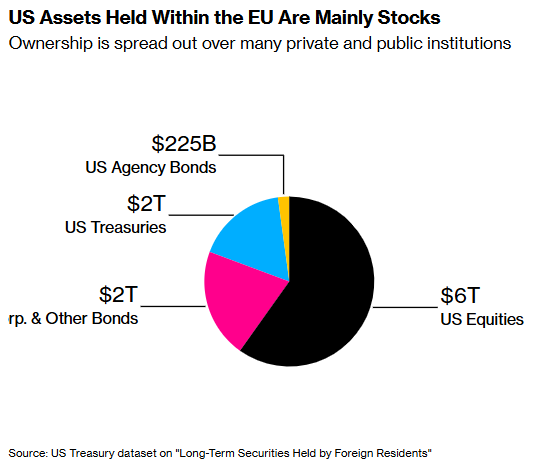
Core Viewpoint - The article discusses the potential for European countries to respond to U.S. President Trump's threats regarding Greenland by selling U.S. assets, which could impact U.S. borrowing costs and stock markets, although such actions are deemed unlikely due to the complexities involved [1][5]. Group 1: European Holdings of U.S. Assets - European countries hold trillions of dollars in U.S. debt and equities, with a significant portion owned by public sector funds [1]. - The total value of U.S. assets held within the EU exceeds $10 trillion, with additional holdings from the UK and Norway [1]. - The potential for European public sector investors to halt or reduce their U.S. asset holdings is contingent on significant escalation of tensions [2]. Group 2: Market Reactions and Economic Implications - The escalation of tensions has negatively affected U.S. stock index futures, European markets, and the dollar, while benefiting safe-haven assets like gold and the Swiss franc [5]. - The EU's most concrete response so far includes a proposal to halt the approval of a trade agreement with the U.S. and discussions on imposing tariffs on $108 billion worth of U.S. goods [5]. - Any move to weaponize European holdings of U.S. assets would signify a serious escalation, transforming a largely ignored trade war into a direct financial conflict [5]. Group 3: Investor Behavior and Market Stability - Investors concerned about overexposure to U.S. assets may have already reduced their holdings following Trump's previous tariff actions, leading to a rebalancing of dollar positions [6]. - Despite the pressure on the dollar, U.S. Treasury bonds have had their best year since 2020, and U.S. stock markets continue to reach record highs [6]. - The EU lacks the ability to force private sector investors to sell dollar assets but can encourage investment in euro-denominated assets [6].
从美国到巴西,从中东到东南亚:2026年为何被称为“超级选举年”
Jin Shi Shu Ju· 2026-01-20 14:01
二月 这是自2024年以来,孟加拉国首次举行全国投票。选民还将就"七月宪章"作出决定,该改革方案旨在限 制行政权力、强化司法独立,并使执法机构免受政治干预。 老挝——议会选举(2月22日) 三月 SHMET 网讯:2026年,全球将有40多个国家和地区举行大选、总统选举或议会选举,将决定全球近五 分之一人口的治理走向。选举结果将影响各国、各地区的内政政策、经济战略以及全球联盟关系。 以下按月份梳理2026年值得关注的关键选举及其政治影响(所有时间均为当地时间)。 一月 四月 匈牙利2026年选举将同时重塑其国内政治与国际联盟格局。与俄罗斯关系密切、并指责欧盟在俄乌冲突 中"鼓动战争"的总理维克托·欧尔班(Viktor Orban),自2010年执政以来将首次面临最严峻挑战,对手 是彼得·马扎尔(Peter Magyar)领导的蒂萨党。 选举结果将决定匈牙利的政治平衡,以及其在欧盟与俄罗斯之间的立场,并对欧洲稳定及乌克兰冲突产 生更广泛影响。 缅甸——大选(1月11日——第二阶段),(1月25日——第三阶段) 乌干达——大选(1月15日) 葡萄牙——总统选举(1月18日) 哥斯达黎加——大选(2月1日) 泰国— ...
每日投行/机构观点梳理(2026-01-20)
Jin Shi Shu Ju· 2026-01-20 13:55
Group 1 - Westpac's commodity research head Robert Rennie indicates that global financial markets are underestimating the seriousness of the situation regarding Greenland, particularly in light of the Trump administration's attempts to exert control over the territory [1] - The market is awaiting Trump's speech at the Davos Forum and the results of an emergency European summit to better understand the severity of the situation [1] Group 2 - Bank of America reports that global investor sentiment has reached its highest level since July 2021, with a significant drop in cash holdings to a historical low of 3.2% [2] - The bank's bull-bear indicator has surged to an "ultra-bull" level of 9.4, with 38% of surveyed fund managers expecting economic strength and concerns about recession at a two-year low [2] - Liquidity conditions are the best since 2021, and nearly half of respondents have no hedging measures against a significant stock market decline [2] Group 3 - BlackRock CEO Larry Fink warns that global capitalism is losing public trust as prosperity is not benefiting a wide population, suggesting that success should be measured by people's ability to perceive and feel it [3] - Fink expresses concerns that artificial intelligence could exacerbate inequality, urging Davos to listen more to the voices of ordinary people rather than just the elite [3] Group 4 - Goldman Sachs predicts that emerging market equities will be the most attractive investment destination globally over the next one and five years, with an expected base return rate of 8% [4] - The probability of emerging market returns exceeding expectations is estimated at 20%, while the chance of experiencing low single-digit negative returns is 25% [4] Group 5 - Citigroup's Japan market head, Akira Hoshino, suggests that if the yen continues to weaken, the Bank of Japan may raise interest rates three times in 2026, potentially doubling the current rate [5] - Hoshino indicates that if the USD/JPY exchange rate exceeds 160, a rate hike could occur as early as April, with further hikes possible in July and by the end of the year [5] Group 6 - Tokyo State Street Asset Management's senior fixed income strategist, Masahiko Loo, states that the "high market trade" strategy remains effective, with shorting the yen being the simplest strategy [6] - Loo notes a significant herd effect in the Japanese market, leading banks to refrain from buying until the Bank of Japan raises rates [6] Group 7 - CICC reports that recent strengthening of the RMB exchange rate is partly due to seasonal increases in settlement demand, particularly in December and January [7] - The report highlights that historically, the RMB has appreciated by 0.5% and 0.8% against the USD in December and January, respectively, with probabilities of appreciation at 75% and 67% [7] Group 8 - Guotai Junan Securities indicates that AI and anti-involution themes may become the main lines of the A-share market in 2026, with AI-driven trends extending from upstream infrastructure to downstream applications [8] - The report notes that AI's contribution to improving PPI is primarily reflected in the prices of non-ferrous metals and technology sectors [8] Group 9 - Galaxy Securities expresses optimism about the dividend value of the banking sector, citing structural monetary policy tools and improving credit demand as supportive factors [9] - The report anticipates that the first batch of listed banks will show stable recovery in performance, with ongoing policy effects expected to be released [9] Group 10 - CITIC Securities sees high certainty in the development of computing power and anticipates significant investment opportunities in domestic computing chips and system-level manufacturers by 2026 [10] - The report emphasizes the importance of AI applications in various sectors, suggesting a focus on office, coding, agent, and multi-modal AI applications [10] Group 11 - CITIC Securities notes a cooling of market speculation, with record outflows from the ETF market, while technology and cyclical sector ETFs continue to attract funds [11] - The report suggests that a multi-dimensional comparative allocation strategy is more prudent in the current environment, recommending attention to various ETFs in sectors like new energy and healthcare [11]
美国史上最强阵容力挺经济前景,贝森特喊出5%增长目标
Jin Shi Shu Ju· 2026-01-20 13:43
尽管外界对美国总统不断膨胀的野心普遍感到担忧,但美国为给达沃斯与会者留下印象而做出的史上最 大规模官方努力,还是得到了与会者对经济乐观言论的回应。 世界经济论坛的首个完整日以财政部长贝森特对今年美国繁荣改善的大胆预测拉开序幕,紧随其后的是 国际货币基金组织(IMF)对这一世界最大经济体更高的增长展望。银行家们也随声附和,对其扩张前 景表达了谨慎的热情。 道富银行首席执行官Ron O'Hanley观察到,许多因素可能会维持美国的增长势头,并自然而然地带动世 界其他地区。他似乎同意贝森特关于财政之风有助于消费者的观点,并指出了其他可能支撑扩张的因 素。 "你看美元贬值,这应该有助于出口,甚至像世界杯来到美国和北美这一广泛地区也将推动大量支 出,"他表示。"美国的顺风相当强劲。" 对美国的企业乐观情绪在2025年也有所体现,经常出席会议的荷兰国际集团(ING)首席经济学家 Marieke Blom上周观察到,虽然这种乐观在某种程度上是合理的,但也可能被夸大了。 她指出,实际上去年美国经济的表现相比预测"略显逊色",且与欧洲的差距"比达沃斯的共识所暗示的 要小得多"。 "有理由对美国经济持相对乐观的态度,"她在一份报 ...
格陵兰岛风波持续发酵,美股准备先跌为敬?
Jin Shi Shu Ju· 2026-01-20 12:58
Group 1 - The core issue revolves around the escalating tensions between the US and Europe regarding Greenland, which is impacting the market significantly, prompting Wall Street to prepare for stock sell-offs [2] - Citigroup has downgraded its rating on European stocks, citing potential damage to corporate earnings, marking the first downgrade in a year, despite European stocks previously outperforming US stocks by 2025 [2] - Morgan Stanley's chief US equity strategist, Mike Wilson, notes that the direct cost impact of President Trump's new tariff threats on major US stock indices is relatively limited, but sectors like automotive, consumer staples, materials, and healthcare face the highest risks [2] Group 2 - Concerns are rising that the EU may activate its "anti-coercion tool," which could target the service sector and pose greater challenges for large US tech stocks [2][3] - Goldman Sachs' chief European economist, Sven Jari Stehn, indicated that activating this tool signals potential EU actions without immediate sanctions, encompassing measures beyond tariffs, such as investment restrictions and taxes on US assets and services [3] - The market's apprehension is reflected in the Nasdaq 100 futures, which have declined ahead of the earnings reports from major US tech companies [3] Group 3 - TS Lombard's Christopher Granville suggests that significant market declines would only occur if US-EU tensions escalate beyond tariff increases to more severe confrontations, such as using LNG exports as leverage or restricting US tech companies' market access [3] - Wilson expresses a relatively optimistic view on small-cap stocks, noting that their fundamentals are improving, which is driving their performance to potentially outperform the broader market [3][4] - Morgan Stanley's favored small-cap sectors include consumer discretionary, regional/mid-sized banks, short-cycle industrials, and biotechnology stocks [4]

特朗普誓言强夺格陵兰“绝不回头”,美欧同盟濒临决裂,市场恐慌加剧
Jin Shi Shu Ju· 2026-01-20 12:30
Group 1 - President Trump is determined to pursue control over Greenland, refusing to rule out the possibility of using force, which threatens the long-standing Western alliance and reignites trade tensions [1] - Trump's ambitions include taking sovereignty over Greenland from NATO ally Denmark, which has led to criticism from European leaders and concerns about the stability of transatlantic relations [1][2] - The EU is considering retaliatory trade measures against the U.S., including tariffs on $109 billion worth of American imports, as well as the potential use of an "anti-coercion instrument" to limit access to public tenders and services [2] Group 2 - The geopolitical tensions surrounding Greenland have prompted discussions about the need for a new independent Europe, as stated by the President of the European Commission [2][3] - Russia has expressed skepticism regarding Denmark's sovereignty over Greenland, indicating that the situation could exacerbate divisions between Europe and the U.S. [5] - Concerns over a potential trade war have led to declines in European stock markets by over 1%, with similar impacts on U.S. stock futures and the dollar [5]
LME铜现货溢价飙升!创纪录价差暗示库存争夺战打响
Jin Shi Shu Ju· 2026-01-20 12:17
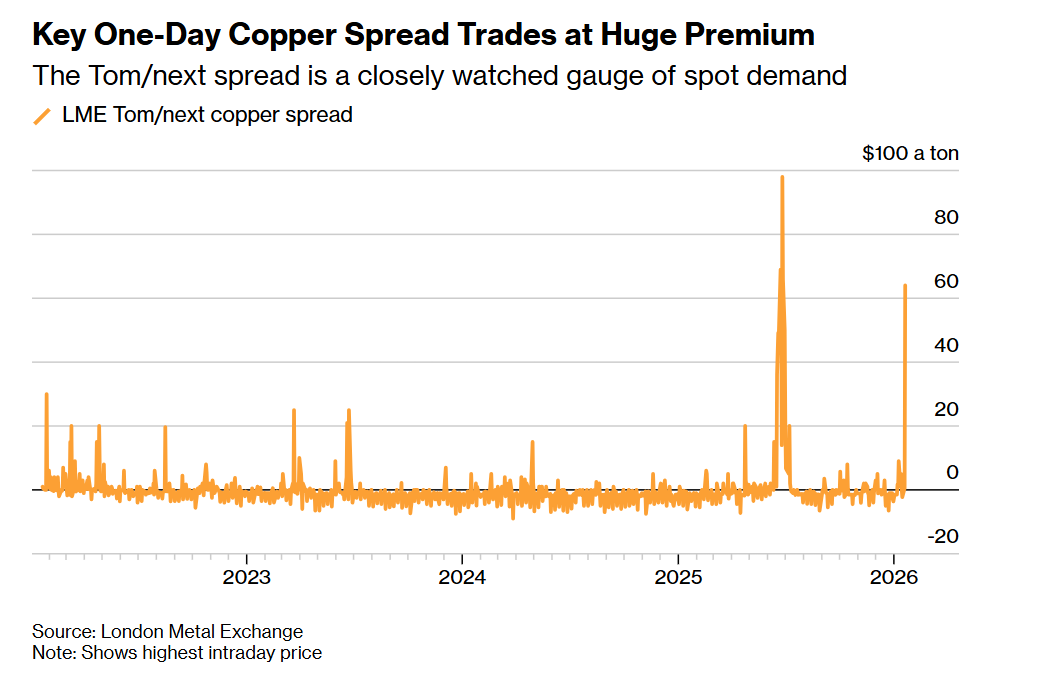
Group 1 - The LME copper spot price has significantly risen compared to future contract prices, indicating that traders may be extracting large amounts of inventory from the exchange's warehouses [1] - The premium for the copper contract expiring on Wednesday was $64 higher than the next day's contract, a market condition known as backwardation, suggesting an increase in immediate demand [1] - This price movement is among the highest levels recorded since 1998, reflecting increased volatility in the LME copper market [1] Group 2 - As of Thursday, three independent institutions held at least 30% of the open interest in the January contracts, which could allow them to withdraw over 160,000 tons of copper, exceeding the available inventory in the LME network [4] - The surge in the Tom/next spread indicates that short position holders may face significant losses if they do not roll over their contracts [4] Group 3 - The current market conditions signal a more severe structural supply constraint in the global copper industry, with many analysts predicting a deep shortage by the end of 2028 [5] - Although global copper inventories are currently sufficient, they are heavily concentrated in U.S. warehouses, leading to record shipments to the U.S. due to anticipated tariff changes [5] Group 4 - The recent increase in LME copper inventory, with an addition of 8,875 tons, brings the total to 156,300 tons, driven by inflows into New Orleans and Baltimore warehouses [8] - The fluctuations in the price spread have had minimal impact on the three-month copper contract, which experienced a maximum daily drop of 1.4% due to broader market sell-offs [8]