
Wen Hua Cai Jing

Search documents
LME铜现货价差飙升至2021年供应紧张以来最高
Wen Hua Cai Jing· 2026-01-21 01:05
Group 1 - The spot copper price on the London Metal Exchange (LME) surged to a significant premium over future contracts, reaching the highest level since the historic supply tightness in 2021, with a premium of $100 per ton for contracts expiring Wednesday compared to those expiring the next day [2][3] - The recent spike in the backwardation phenomenon indicates rising spot demand, driven by production stoppages and increased copper exports to the U.S., leading to tight supply in other regions [3] - Analysts and traders expect severe structural supply constraints in the copper market, with most monthly price differentials showing backwardation until the end of 2028, potentially depleting global inventories and driving prices higher [4] Group 2 - As of last Friday, three different institutions held at least 30% of the long positions in the January contracts, which could yield over 130,000 tons of copper if held to expiration, exceeding the current spot supply in LME warehouses [3] - The increase in LME copper inventory by 8,875 tons to 156,300 tons was attributed to inflows from Asian warehouses and a small inflow to the New Orleans warehouse, despite the price differential volatility having minimal impact on the three-month benchmark contract [4] - China's copper industry faces three major challenges: rising dependence on foreign upstream resources, overcapacity in the midstream processing sector, and suppressed downstream demand due to high copper prices [5]

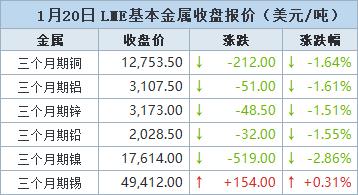
金属全线下跌 期铜下挫,工业消费者对高价望而却步【1月20日LME收盘】
Wen Hua Cai Jing· 2026-01-21 00:50
1月20日(周二),伦敦金属交易所(LME)铜价大幅下跌,在库存水平处于多年高位的情况下,价格 上涨令工业买家望而却步。 伦敦时间1月20日17:00(北京时间1月21日01:00),LME三个月期铜下跌212美元,或1.64%,收报每吨 12,753.5美元。前一交易日上涨1.3%。 | | 1月20日 LIE基本金属收盘报价(美元/吨) | | | --- | --- | --- | | 金屋 | 收盘价 | 张跃 张跃帽 | | 三个月期铜 | | 12,753.50 -212.00 -1.64% | | 三个月期铝 | 3,107.50 | -51.00 -1.61% | | 三个月期锌 | 3,173.00 ↓ | -48.50 -1.51% | | 三个月期铅 | 2,028.50 ↓ | -32.00 -1.55% | | 三个月期镇 | 17,614.00 -519.00 -2.86% | | | 三个月期锡 | 49,412.00 ↑ +154.00 ↑ +0.31% | | Hansen补充说:"考鉴于当前世界充满诸多不确定性,金属作为硬资产一直需求旺盛。但就目前而言, 黄金仍是更安全的金 ...
LME期铜区间波动,等待方向指引
Wen Hua Cai Jing· 2026-01-20 10:43
镍矿商PT Vale Indonesia周一表示,该公司获得的采矿生产配额很可能不足以满足其冶炼厂今年的需 求。 在此之前,印尼政府上周表示可能批准2026年约2.6亿吨的镍矿生产配额,比2025年的配额有所减少, 被认为无法满足需求。 上期所期镍在上涨2.36%至每吨144,180元后回调,日间收盘仅录得0.36%的涨幅。 LME指标三个月期镍目前下跌0.43%,至每吨18,055美元。 1月20日(周二),伦敦金属交易所(LME)期铜呈区间波动,投资者在等待新的催化剂推动铜价向任 一方向发展。 截至北京时间16:44,LME三个月期铜下跌0.52%,至每吨12,897.50美元,仍在13,000美元关口下方徘 徊。 上海期货交易所主力期铜日间收盘上涨0.58%,至每吨101,230元。 由于投资者对地缘政治风险保持谨慎,青睐黄金等避险资产,伦敦期铜周一的反弹失去动力。 铜是去年表现最好的基本金属,伦敦和上海铜价分别上涨41%和33%,实现创纪录涨势。 在基本金属市场的其他方面,印尼的镍政策仍是焦点。 其他金属方面,三个月期铝下跌0.47%,报每吨3,143.50美元;期镍下跌2.09%,至每吨18,180 ...
中国12月原铝进口量同比增加17.22% 分项数据一览
Wen Hua Cai Jing· 2026-01-20 10:22
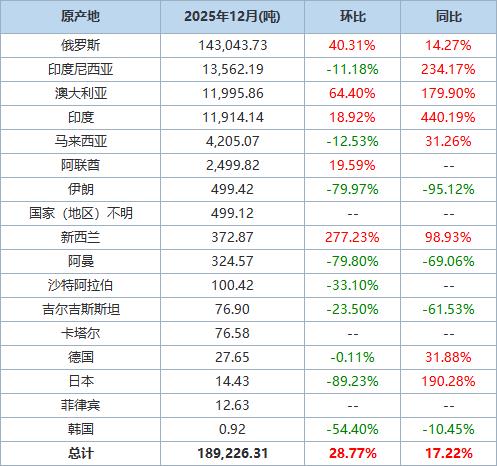
Core Insights - China's primary aluminum imports in December 2025 reached 189,226.31 tons, marking a month-on-month increase of 28.77% and a year-on-year growth of 17.22% [1] Import Sources - Russia was the largest source of imports, supplying 143,043.73 tons, which represents a month-on-month increase of 40.31% and a year-on-year increase of 14.27% [1] - Indonesia ranked second, with imports of 13,562.18 tons, showing a month-on-month decrease of 11.18% but a significant year-on-year increase of 234.17% [1] - Australia contributed 11,995.86 tons, reflecting a month-on-month increase of 64.40% and a year-on-year increase of 179.90% [1] - India imported 11,914.14 tons, with an 18.92% month-on-month increase and a remarkable year-on-year increase of 440.19% [1] - Malaysia's imports decreased by 12.53% month-on-month to 4,205.07 tons, but increased by 31.26% year-on-year [1] Additional Import Data - The UAE imported 2,499.82 tons, with a month-on-month increase of 19.59% [1] - Iran's imports plummeted by 79.97% month-on-month to 499.42 tons, with a year-on-year decrease of 95.12% [1] - Other notable imports include 372.87 tons from New Zealand, showing a month-on-month increase of 277.23% and a year-on-year increase of 98.93% [1] - Imports from Oman and Saudi Arabia saw significant month-on-month declines of 79.80% and 33.10%, respectively [1] Summary Table - The total imports for December 2025 were 189,226.31 tons, with various countries contributing different amounts and showing varying trends in month-on-month and year-on-year changes [1]
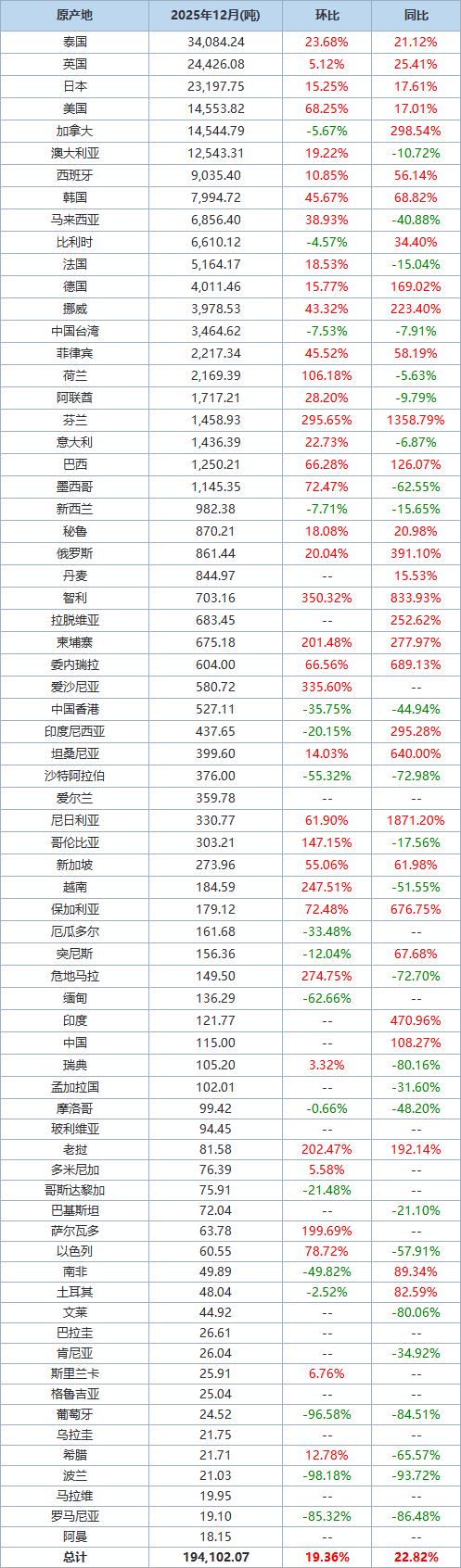
中国12月废铝进口量同比增加22.82% 分项数据一览
Wen Hua Cai Jing· 2026-01-20 10:22
海关统计数据在线查询平台公布的数据显示,中国2025年12月废铝(铝废料及碎料)进口量为 194,102.07吨,环比增长19.36%,同比增长22.82%。 泰国是第一大进口来源地,当月从泰国进口废铝(铝废料及碎料)34,084.24吨,环比上升23.68%,同 比增长21.12%。 英国是第二大进口来源地,当月从英国进口废铝(铝废料及碎料)24,426.08吨,环比增加5.12%,同比 增长25.41%。 以下为根据中国海关总署官网数据整理的2025年12月废铝进口分项数据一览表: | 原产地 | 2025年12月(吨) | 环比 | 同比 | | --- | --- | --- | --- | | 泰国 | 34.084.24 | 23.68% | 21.12% | | 英国 | 24,426.08 | 5.12% | 25.41% | | 日本 | 23,197.75 | 15.25% | 17.61% | | 美國 | 14,553.82 | 68.25% | 17.01% | | 加拿大 | 14,544.79 | -5.67% | 298.54% | | 澳大利亚 | 12,543.31 | 1 ...
中国12月铝土矿进口量同比减少1.72% 分项数据一览
Wen Hua Cai Jing· 2026-01-20 10:22
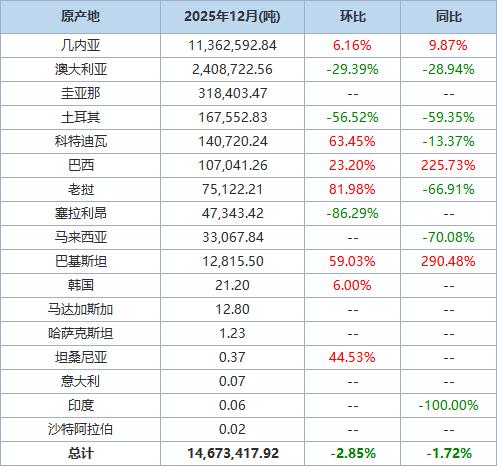
几内亚是第一大进口来源地,当月从几内亚进口铝土矿(铝矿砂及其精矿)11,362,592.84吨,环比增长 6.16%,同比上升9.87%。 澳大利亚是第二大进口来源地,当月从澳大利亚进口铝土矿(铝矿砂及其精矿)2,408,722.56吨,环比 减少29.39%,同比下降28.94%。 数据来源:海关总署 注:进口/出口总量(总计)中亦包括上表未列出的部分原产地数据 海关统计数据在线查询平台公布的数据显示,中国2025年12月铝土矿(铝矿砂及其精矿)进口量为 14,673,417.92吨,环比下降2.85%,同比减少1.72%。 以下为根据中国海关总署官网数据整理的2025年12月铝土矿进口分项数据一览表: | 原产地 | 2025年12月(吨) | 环比 | 同比 | | --- | --- | --- | --- | | 几内亚 | 11,362,592.84 | 6.16% | 9.87% | | 澳大利亚 | 2,408,722.56 | -29.39% | -28.94% | | 圭亚那 | 318,403.47 | -- | -- | | 干道真 | 167,552.83 | -56.52% | - ...
海关总署:中国12月精炼铜进口量同比减少27% 分项数据一览
Wen Hua Cai Jing· 2026-01-20 09:01
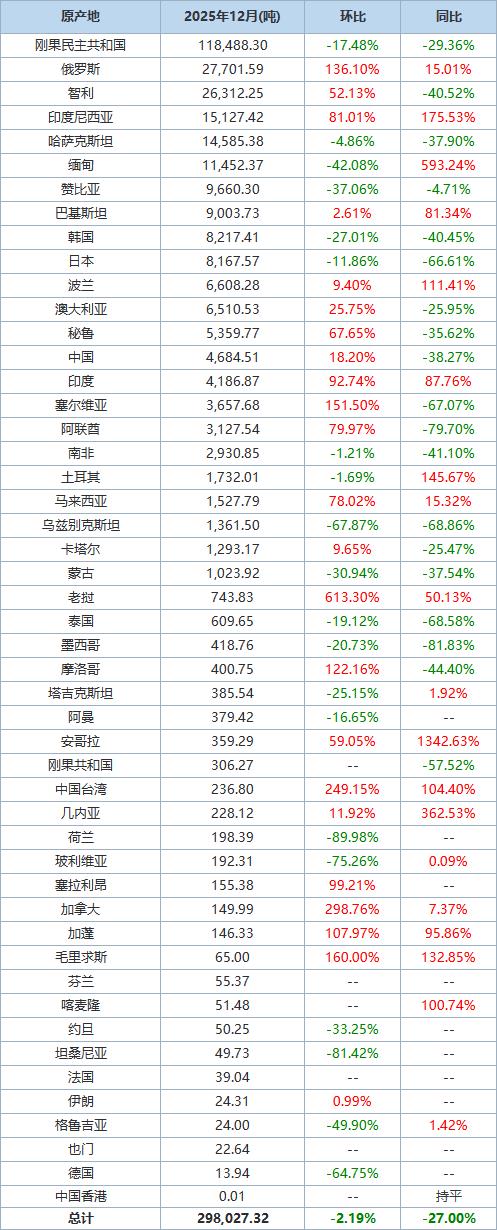
Core Insights - China's refined copper imports in December 2025 totaled 298,027.32 tons, reflecting a month-on-month decrease of 2.19% and a year-on-year decline of 27.00% [1][2] Import Sources - The Democratic Republic of the Congo was the largest source of imports, supplying 118,488.30 tons, which is a month-on-month decrease of 17.48% and a year-on-year decrease of 29.36% [1] - Russia ranked second, with imports of 27,701.59 tons, showing a significant month-on-month increase of 136.10% and a year-on-year growth of 15.01% [1] - Other notable sources included Chile (26,312.25 tons, +52.13% month-on-month, -40.52% year-on-year) and Indonesia (15,127.42 tons, +81.01% month-on-month, +175.53% year-on-year) [1] Detailed Import Data - A comprehensive breakdown of refined copper imports by origin is provided, highlighting various countries and their respective import volumes, month-on-month, and year-on-year changes [1][2] - For instance, imports from Kazakhstan decreased by 4.86% month-on-month and 37.90% year-on-year, while imports from India increased by 92.74% month-on-month and 87.76% year-on-year [1] Additional Notes - The total import volume includes refined copper products with a copper content greater than 99.9935% and other specified forms of refined copper [3] - The total also accounts for data from origins not listed in the detailed table [4]
海关总署:中国12月废铜进口量环比上升14.83% 分项数据一览
Wen Hua Cai Jing· 2026-01-20 09:01
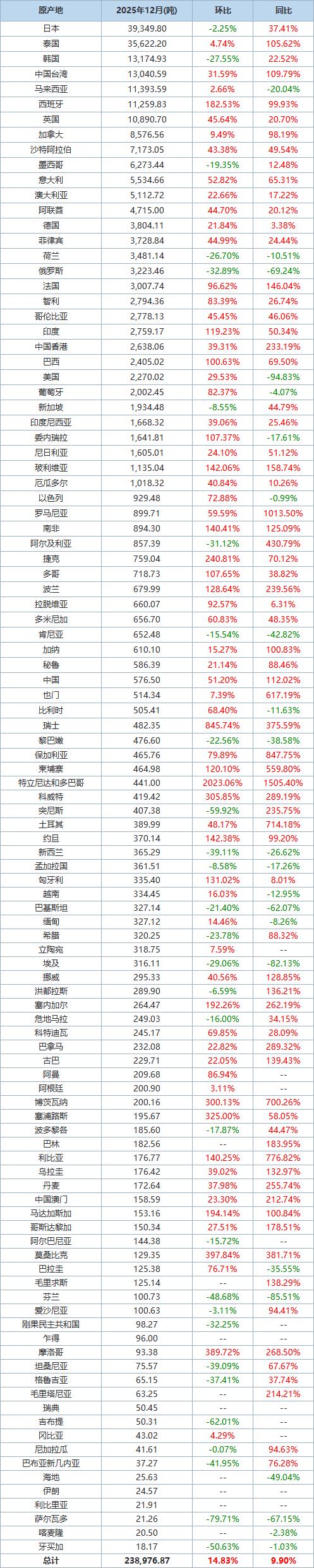
海关统计数据在线查询平台公布的数据显示,中国2025年12月废铜(铜废碎料)进口量为238,976.87 吨,环比增加14.83%,同比增长9.90%。 日本是第一大进口来源地,当月从日本进口废铜(铜废碎料)39,349.80吨,环比下降2.25%,同比增加 37.41%。 泰国是第二大进口来源地,当月从泰国进口废铜(铜废碎料)35,622.20吨,环比上升4.74%,同比增加 105.62%。 | 阿尔及利亚 | 857.39 | -31.12% | 430.79% | | --- | --- | --- | --- | | 捷克 | 759.04 | 240.81% | 70.12% | | 亲温 | 718.73 | 107.65% | 38.82% | | 波兰 | 679.99 | 128.64% | 239.56% | | 拉脱维亚 | 660.07 | 92.57% | 6.31% | | 多米尼加 | 656.70 | 60.83% | 48.35% | | 肯尼亚 | 652.48 | -15.54% | -42.82% | | 加纳 | 610.10 | 15.27% | 100.83% ...
海关总署:中国12月铜矿砂及其精矿进口量环比增加7.05% 分项数据一览
Wen Hua Cai Jing· 2026-01-20 08:55
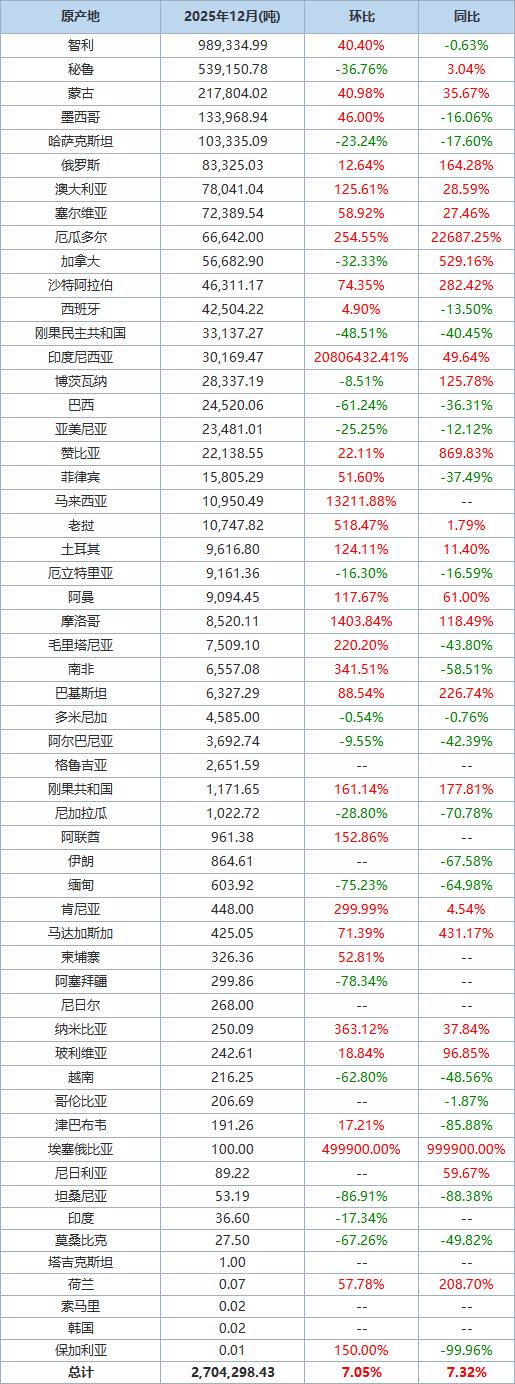
海关统计数据在线查询平台公布的数据显示,中国2025年12月铜矿砂及其精矿进口量为2,704,298.42 吨,环比上升7.05%,同比增长7.32%。 智利是第一大进口来源地,当月从智利进口铜矿砂及其精矿989,334.99吨,环比增长40.40%,同比下降 0.63%。 数据来源:海关总署 注:进口/出口总量(总计)中亦包括上表未列出的部分原产地数据 (文华综合) 以下为根据中国海关总署官网数据整理的2025年12月中国铜矿砂及其精矿进口分项数据一览表: | 原产地 | 2025年12月(吨) | 环比 | 同比 | | --- | --- | --- | --- | | 智利 | 989,334.99 | 40.40% | -0.63% | | 秘鲁 | 539,150.78 | -36.76% | 3.04% | | 蒙古 | 217,804.02 | 40.98% | 35.67% | | 墨西哥 | 133,968.94 | 46.00% | -16.06% | | 哈萨克斯坦 | 103,335.09 | -23.24% | -17.60% | | 俄罗斯 | 83,325.03 | 12.64 ...
秘鲁11月出口铜21.6万吨 锡2300吨 金56.16万盎司 铅9.34万吨
Wen Hua Cai Jing· 2026-01-20 08:00
Group 1 - Peru's central bank reported that in November, the country exported 216,000 tons of copper, 2,300 tons of tin, 561,600 ounces of gold, 300 ounces of refined silver, 93,400 tons of lead, and 121,900 tons of zinc [2] Group 2 - As the world's largest copper consumer, the Chinese industry faces three major challenges: increasing dependence on foreign upstream resources, overcapacity in the midstream processing sector, and suppressed downstream demand due to high copper prices [3] - To assist the industry in addressing these challenges, Shanghai Nonferrous Metals Network has collaborated with copper industry chain enterprises to compile the "2026 China Copper Industry Chain Distribution Map" in both Chinese and English [3]