Wen Hua Cai Jing

Search documents
Vale Indonesia:2026年采矿配额不够满足新冶炼厂需求
Wen Hua Cai Jing· 2026-01-20 02:36
Group 1 - The CEO of PT Vale Indonesia expressed concerns that the approved mining production quota for the year may be insufficient to meet the demands of the smelter set to come online later this year, as the company received only about 30% of its requested quota [1] - Vale and its partners are currently constructing three High-Pressure Acid Leach (HPAL) plants to extract nickel materials used in electric vehicle batteries, with the Pomalaa plant expected to start operations in August and the Bahodopi plant projected to be completed in Q4 [2][3] - The Pomalaa plant has an annual production capacity of 120,000 tons of Nickel Hydroxide Precipitate (MHP) and will require 21 million tons of nickel ore annually, while the Bahodopi plant will need 10.4 million tons of nickel ore to produce 66,000 tons of MHP [2][3] Group 2 - Vale and its partners plan to invest $4.5 billion in the Pomalaa project and $2 billion in the Bahodopi project [4] - Another plant located in Sorowako, Southeast Sulawesi, is expected to begin operations next year [5] - The company has set a target for high-grade nickel production of 71,234 tons by 2025, having produced 66,848 tons as of November [6][7]
伦镍库存位于逾七年高位 沪镍库存继续累积
Wen Hua Cai Jing· 2026-01-20 02:30
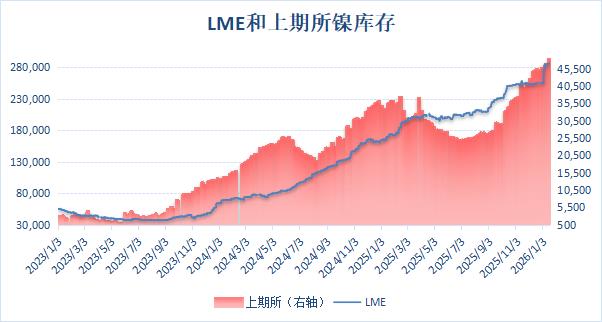
Group 1 - The London Metal Exchange (LME) reported an increase in nickel inventory, reaching a seven-year high on January 16, with the latest inventory level at 285,080 tons [1] - The Shanghai Futures Exchange (SHFE) also saw a rise in nickel inventory, increasing by 3.28% to 48,180 tons, marking an eight-year high [1] - Generally, a decline in inventories on domestic and international exchanges supports futures prices, while an increase may exert downward pressure on prices [3] Group 2 - A comparison of LME and SHFE nickel inventories since January 2023 shows significant trends in inventory levels [4] - Detailed inventory data for LME and SHFE since January 2026 is available, measured in tons [5]

期铜反弹,受助于美元走软、需求预期和智利下调产量预估【1月19日LME收盘】
Wen Hua Cai Jing· 2026-01-20 00:37
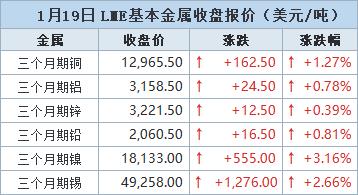
Group 1 - LME copper prices rebounded on January 19, 2025, due to a weaker dollar and stable economic data from China, alongside reduced production forecasts from Chile, the largest copper producer [1][4][7] - The three-month copper price rose by $162.5, or 1.27%, closing at $12,965.5 per ton, following two consecutive days of decline [1][2] - Over the past six months, copper prices have surged by 31%, driven by concerns over potential supply shortages due to mining disruptions [4][6] Group 2 - China's industrial output data showed a year-on-year growth of 5.2% in December 2025, contributing to positive demand sentiment [6] - The GDP for 2025 was reported at 14,018.79 billion yuan, with a year-on-year growth of 5.0%, slightly above expectations [6] - Chile has revised down its short-term copper production forecasts, delaying the timeline for reaching a production peak of over 6 million tons [7][8] Group 3 - Concerns over weak demand are reflected in rising copper inventories, with LME warehouse stocks increasing by 3,850 tons, or 2.68%, to 147,425 tons [8] - Shanghai Futures Exchange copper contracts fell by 0.7% amid profit-taking and concerns over demand [8]
统计局:1-12月十种有色金属累计产量为8175万吨 同比增长3.9%。
Wen Hua Cai Jing· 2026-01-19 11:23
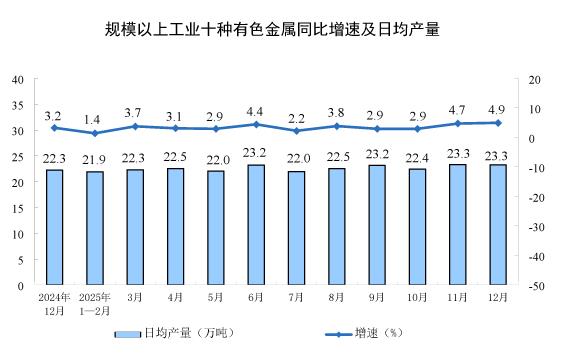
Group 1 - The core viewpoint of the articles indicates that China's aluminum and non-ferrous metal production is showing positive growth trends, with specific figures highlighting the production increases for both raw aluminum and ten types of non-ferrous metals in December 2025 compared to the previous year [1] Group 2 - In December 2025, China's raw aluminum (electrolytic aluminum) production reached 3.87 million tons, representing a year-on-year increase of 3.0% [1] - The cumulative production of raw aluminum from January to December 2025 was 45.02 million tons, reflecting a year-on-year growth of 2.4% [1] - The production of ten types of non-ferrous metals in December 2025 was 7.21 million tons, which is a year-on-year increase of 4.9% [1] - The cumulative production of these non-ferrous metals from January to December 2025 totaled 81.75 million tons, showing a year-on-year growth of 3.9% [1]
沪铜偏弱震荡 社会库存继续累积【1月19日SHFE市场收盘评论】
Wen Hua Cai Jing· 2026-01-19 11:18
Core Viewpoint - The copper market is experiencing weakness due to sluggish domestic demand and increasing social inventory, leading to a decline in copper prices [1] Group 1: Market Performance - On Friday night, copper prices showed a significant decline, closing down by 0.68% after a slight recovery in the morning [1] - The overall atmosphere in the non-ferrous sector has turned weak, with domestic copper demand remaining low [1] Group 2: Inventory and Supply - As of January 19, domestic electrolytic copper inventory reached 338,000 tons, an increase of 10,500 tons compared to January 15 [1] - The recent increase in domestic supply and high copper prices have limited purchasing demand from downstream enterprises, contributing to the rise in inventory [1] Group 3: Processing Fees and Production - Domestic copper concentrate processing fees continue to operate weakly, although trading enthusiasm has shown some recovery [1] - A survey indicated that five domestic smelting plants will undergo maintenance in January, leading to expectations of a decline in refined copper production [1] Group 4: Future Outlook - Jinrui Futures suggests that while the market has cooled due to the postponement of tariffs, the impact on copper may be minimal, and the price spread has not shown significant changes [1] - The anticipated tightness in the copper market is expected to persist, indicating that the overall strong fluctuation in copper prices may not be over yet [1]
下游需求疲软 沪锡承压下挫【1月19日SHFE市场收盘评论】
Wen Hua Cai Jing· 2026-01-19 11:18
Core Viewpoint - The recent decline in tin prices is attributed to limited changes in the fundamentals, a recovery in supply, and a significant drop in downstream demand, leading to a correction of previously rapid price increases [1][2]. Group 1: Price Movement - Tin prices fell by 5.98%, closing at 389,500 yuan/ton, following a period of price increases driven by speculative trading and surrounding commodity influences [1]. - The recent price drop is a correction after a rapid increase, with the market responding to high prices that have suppressed downstream demand [1]. Group 2: Demand Analysis - Downstream consumption remains weak, with overall consumption this year slightly lower than in previous years; short-term recovery in photovoltaic demand is expected, but production in January is anticipated to continue declining [1]. - Feedback from downstream users indicates a lack of new orders and a decrease in inventory turnover efficiency, as many end-users are hesitant to purchase due to high prices and are controlling inventory levels [1]. Group 3: Supply Dynamics - The supply side remains stable, with no significant adjustments in the production pace of smelters; the operating rate of smelters in Yunnan was reported at 87.09%, consistent with the previous week [1]. - Tin ore supply from Myanmar is gradually recovering, supporting high operating rates in Yunnan, but low processing fees are pressuring profits and limiting production increases [1]. - Some smelters in Jiangxi are facing production constraints due to a shortage of recycled materials, leading to continued low output of refined tin, with some manufacturers even reducing production slightly last week [1]. Group 4: Market Outlook - Short-term price declines are influenced by tightened risk controls by exchanges, which have suppressed speculative trading, and a significant increase in warehouse receipts ahead of contract delivery [2]. - The supply-demand balance remains tight, with expectations of a supply squeeze in the future, particularly with Indonesia's tin export quota projected at 60,000 tons for 2026 [2]. - There is a potential for improved inventory replenishment by downstream enterprises following the recent price correction, although the focus remains on essential stockpiling [2].
1月16日LME金属库存及注销仓单数据
Wen Hua Cai Jing· 2026-01-19 09:56
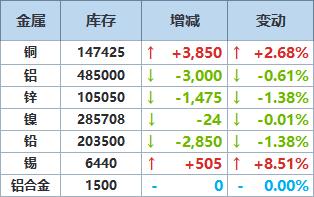
Group 1: Copper Inventory Changes - Copper inventory increased by 3,850 tons, reaching a total of 147,425 tons, reflecting a rise of 2.68% [1] - Registered warehouse receipts for copper are at 98,875 tons, with a decrease of 2.07% in canceled receipts [2] - The total copper inventory across all locations is 485,000 tons, showing a slight increase of 1.27% [2] Group 2: Zinc Inventory Changes - Zinc inventory decreased by 1,475 tons, bringing the total to 105,050 tons, a decline of 1.38% [1] - Registered warehouse receipts for zinc are at 96,525 tons, with a significant drop of 11.20% in canceled receipts [2] - The overall zinc inventory across all locations is 106,525 tons, indicating a slight decrease [9] Group 3: Aluminum Inventory Changes - Aluminum inventory decreased by 2,850 tons, resulting in a total of 203,500 tons, a decline of 1.38% [1] - Registered warehouse receipts for aluminum are at 162,675 tons, with canceled receipts at 40,825 tons, representing 20.06% of the total [5] - The total aluminum inventory across all locations is 485,000 tons, reflecting a decrease of 0.61% [1] Group 4: Tin Inventory Changes - Tin inventory increased by 505 tons, reaching a total of 6,440 tons, an increase of 8.51% [1] - Registered warehouse receipts for tin are at 6,225 tons, with canceled receipts at 215 tons, representing 3.34% of the total [11] - The overall tin inventory across all locations is 6,440 tons, showing a positive trend [11] Group 5: General Inventory Trends - The overall trend in metal inventories shows fluctuations, with copper and tin experiencing increases while zinc and aluminum face declines [1][2] - The registered and canceled receipts across various metals indicate varying levels of market activity and demand [2][5]
沪铝库存增近三成 刷新九个月最高位
Wen Hua Cai Jing· 2026-01-19 09:51
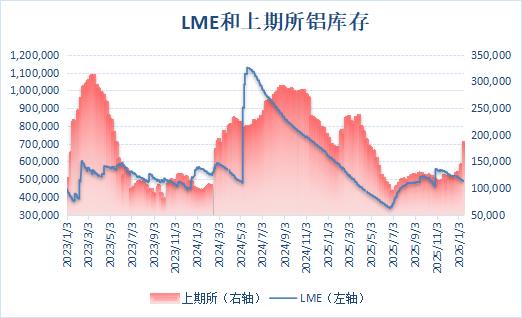
Group 1 - LME aluminum inventory decreased to 488,000 tons, reaching a two-and-a-half-month low [1] - SHFE aluminum inventory increased by 29.24% to 185,879 tons, marking a nine-month high [1] - Generally, declining inventories in domestic and international exchanges support futures prices, while increasing inventories may exert downward pressure [3] Group 2 - Comparison of LME and SHFE aluminum inventories since January 2023 [4] - Data on LME and SHFE aluminum inventories since January 2026 (in tons) [5]
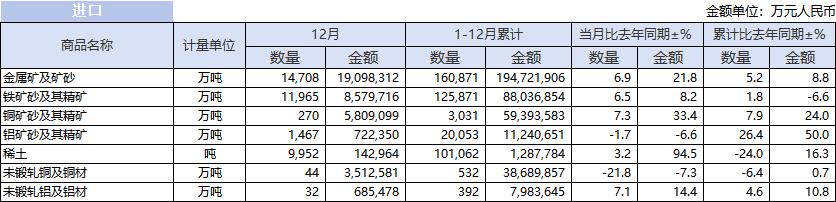
海关:中国2025年铝矿砂及其精矿进口量为20053万吨 同比增加26.4%
Wen Hua Cai Jing· 2026-01-19 09:51
Group 1 - In December, China's import of aluminum ore and its concentrates was 14.67 million tons, a year-on-year decrease of 1.7%. The cumulative import for the year reached 200.53 million tons, an increase of 26.4% compared to the previous year [1][3]. - The export volume of alumina in December was 210,000 tons, reflecting a year-on-year increase of 9.3%. The total export volume for the year was 2.55 million tons, which is a 42.7% increase year-on-year [2][3]. Group 2 - The total import of metal ores and sands in December was 14.71 million tons, with a total value of 191.98 billion RMB. The cumulative import for the year was 160.87 million tons, valued at 194.72 billion RMB, showing a year-on-year increase of 5.2% in quantity and 8.8% in value [3]. - The import of iron ore and concentrates in December was 11.97 million tons, with a total value of 85.80 billion RMB. The cumulative import for the year was 125.87 million tons, valued at 88.04 billion RMB, indicating a year-on-year increase of 1.8% in quantity but a decrease of 6.6% in value [3]. - The import of copper ore and concentrates in December was 270,000 tons, valued at 5.81 billion RMB, with a year-on-year increase of 7.3% in quantity and 33.4% in value. The cumulative import for the year was 3.03 million tons, valued at 59.39 billion RMB, showing a year-on-year increase of 7.9% in quantity and 24.0% in value [3].
欧盟或将允许电信铜缆淘汰时间推迟至2035年
Wen Hua Cai Jing· 2026-01-19 06:35
1月16日(周五),欧盟委员会计划允许成员国将同的电信网络淘汰时间推迟至2035年,从而为电信行业向速度更快的光纤网络过渡提供更多时间。 SMM V CE 穿蛋 2026 电线电缆工业展览 2026 SMM 4th WIRE & CABLE CONFERENCE & INDUSTRY E 暨 产 业 发 展 大 会 暨 电 线 电 缆 品 牌 营 销 大 会 2026.05.14-15 ♥中国·苏州 市场人士称,业界最初曾讨论并预期在2030年淘汰铜缆。 市场人士表示,欧盟委员会的目标仍然是将欧洲的固定线路基础设施升级到光纤。但更长的过渡期让各地监管机构有机会在制定各自的时间表时权衡成本和 竞争等不同因素。 任何最终规则都需要欧盟立法者和成员国的批准。 (文华综合) 此举将赋予各国政府根据当地市场状况、网络准备情况和对消费者的影响等因素,自行设定铜缆淘汰时间表的自主权。政府仍可自行决定是否提前淘汰。 对于电信运营商和各国政府而言,将光纤升级的截止日期推迟到2035年至关重要,因为他们正努力应对将传统网络迁移到光纤的成本和复杂性;对于仍然依 赖铜缆服务的家庭和企业而言,同样意义重大。 埋藏在地下的旧铜线对电信公 ...