Tai Mei Ti A P P

Search documents
《财富》中国500强中的大宗玩家
Tai Mei Ti A P P· 2025-07-25 04:02
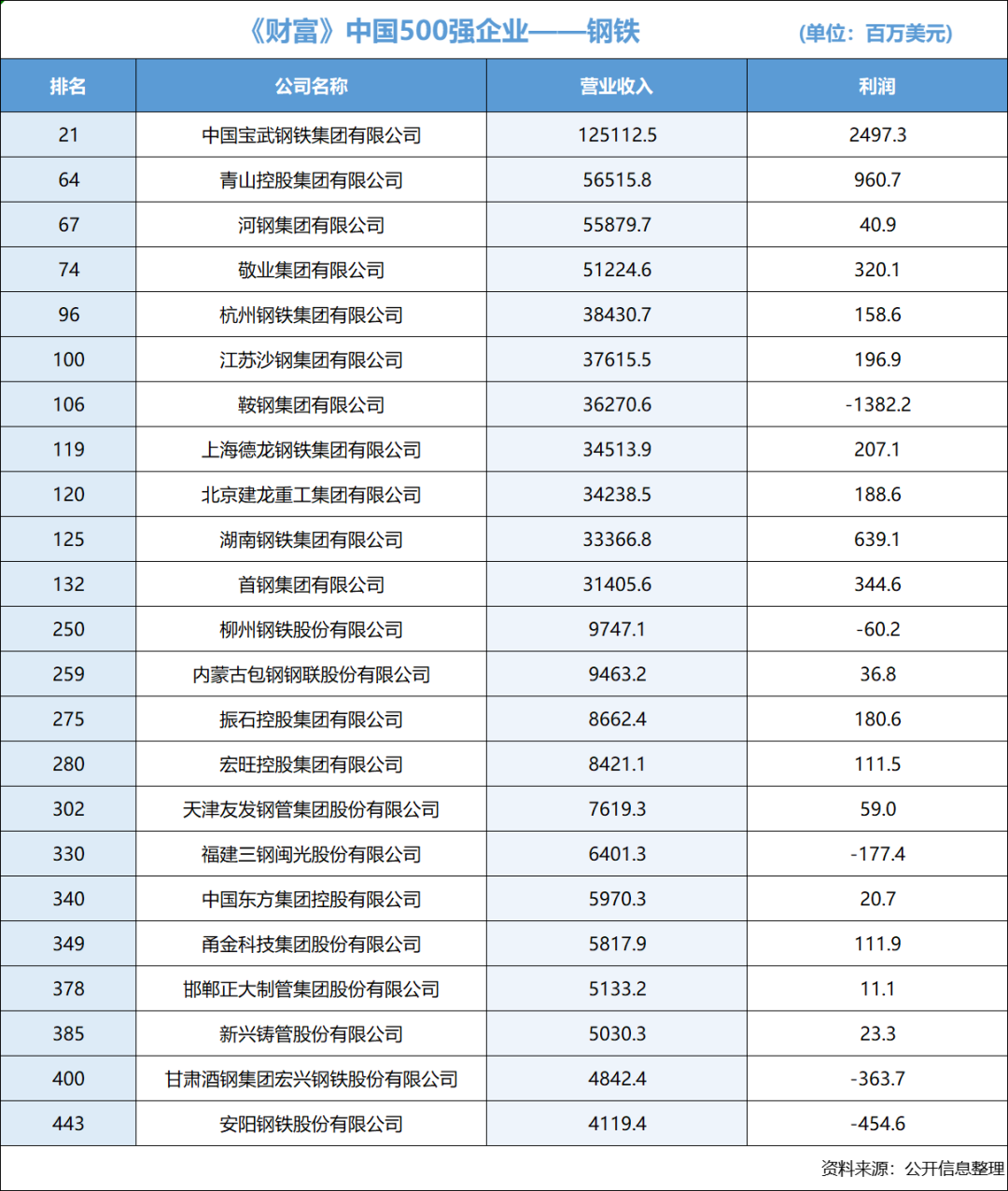
Core Viewpoint - The 2025 Fortune China 500 list highlights the performance and market dynamics of leading companies in the commodity sectors, particularly steel, non-ferrous metals, coal, and oil and gas, reflecting the ongoing trends of industry consolidation and competitive differentiation. Steel Sector - The steel sector remains a pillar of the national economy, with 23 companies making the Fortune China 500 list, indicating a significant increase in market concentration after years of mergers and restructuring [2] - China Baowu Steel Group continues to lead the industry with a revenue of $125.1 billion and a profit of $2.5 billion, despite a drop in ranking from 12th to 21st [3][4] - The profitability of Baowu accounts for nearly 50% of the total profit of all steel companies on the list, highlighting the increasing "Matthew effect" in the industry [3] - Several large state-owned steel companies, such as Ansteel and Liuzhou Steel, reported significant losses due to high raw material prices and low market demand [4][5] - Private steel companies like Qingshan Holding and Jingye Group have shown competitive advantages by focusing on niche markets, achieving better profitability compared to state-owned enterprises [4][5] Non-Ferrous Metals Sector - The non-ferrous metals sector shows strong growth, with 29 companies on the Fortune China 500 list, reflecting ongoing expansion and superior profitability compared to steel and coal industries [7] - China Minmetals leads the sector with a revenue of $115.8 billion, followed by Jiangxi Copper and Shandong Weiqiao with revenues of $77.7 billion and $77.6 billion, respectively [6][7] - The aluminum industry, particularly companies like China Hongqiao and Shandong Nanshan Aluminum, demonstrates high profit margins, benefiting from the demand in lightweight materials for new energy vehicles [8] - The sector is characterized by significant internationalization, with leading companies like Zijin Mining and Luoyang Molybdenum achieving over 30% of their revenue from overseas operations [8][9] Coal Sector - The coal sector shows a general recovery in profitability, with 13 out of 14 listed companies reporting profits, reflecting improved operational conditions supported by energy supply policies [10][11] - China National Energy Investment Group leads the sector with a revenue of $107.7 billion and a profit of $6.9 billion, benefiting from an integrated operational model [11] - The sector faces challenges, with medium-sized coal companies struggling to maintain profitability due to rising environmental costs and market pressures [12][13] - Companies are increasingly diversifying into renewable energy and clean energy sectors, indicating a shift towards sustainable practices [13] Oil and Gas Sector - The oil and gas sector is characterized by a high concentration of revenue among a few major players, with China National Petroleum and China Petroleum & Chemical Corporation together accounting for over 90% of the sector's total revenue [14] - China National Petroleum leads with a revenue of $412.6 billion and a profit of $22.4 billion, showcasing its strength in upstream exploration and development [14] - The sector is under pressure to transition towards cleaner energy sources, with traditional companies needing to adapt to changing market dynamics and regulatory environments [15] Conclusion - The 2025 Fortune China 500 list illustrates the importance of resources and technology, the impact of industry chain integration on profitability, and the necessity for innovation and transformation in traditional commodity sectors [15]




自营会是京东外卖的“良药”吗?
Tai Mei Ti A P P· 2025-07-24 11:15
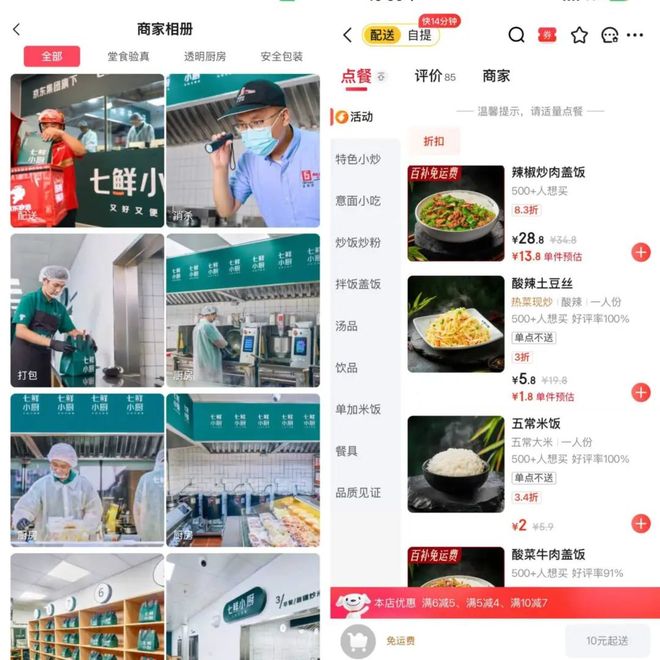
Core Viewpoint - JD.com is shifting its strategy in the food delivery market by launching its self-operated service "Qixian Kitchen," investing 1 billion yuan to recruit "dish partners" and aiming to open 10,000 self-operated stores in three years, indicating a significant pivot in its approach to compete in the highly competitive food delivery sector [1][2][3]. Group 1: JD.com's Strategy - JD.com has officially opened its first self-operated delivery store, "Qixian Kitchen," which allows users to order online with options for delivery and self-pickup, but no dine-in service [2][3]. - The company plans to invest over 10 billion yuan in the next three years to establish more than 10,000 "Qixian Kitchen" locations across the country, with partners only needing to provide recipes and participate in development [3][4]. - The initiative aims to provide consumers with quality and affordable food while helping quality restaurants increase sales, thereby eliminating low-quality "ghost kitchens" from the market [3][4]. Group 2: Market Context and Competition - The food delivery market has seen intense competition, with JD.com previously adopting a low-profile approach during the subsidy wars against competitors like Meituan and Ele.me [2][9]. - Despite JD.com's efforts, it has faced significant pressure from established players, with Meituan reporting over 1.2 billion orders in a single day during a recent promotional event, highlighting the scale of competition [10]. - Analysts suggest that JD.com's move to self-operation is a response to the high costs associated with ongoing subsidy wars, as self-operated models may prove to be more cost-effective in the long run [10][11]. Group 3: Consumer Reception and Challenges - Initial consumer feedback for "Qixian Kitchen" has been mixed, with reports of issues such as slow service and order delays, raising concerns about the operational efficiency of the self-operated model [15][16]. - The self-operated approach may face challenges in gaining trust from restaurant partners, as it could be perceived as competing directly with them, potentially limiting their willingness to collaborate [12][13]. - The long-term viability of JD.com's self-operated model remains uncertain, as the food delivery industry is characterized by low margins and high competition, making it difficult to balance the interests of consumers, merchants, and the platform itself [13][14].

从东吴证券再融60亿到天风定增落地,证券业“补血”逻辑迎来巨变
Tai Mei Ti A P P· 2025-07-24 10:29
Group 1 - The core viewpoint of the articles is that the recent announcements from Dongwu Securities and Tianfeng Securities indicate a recovery in the financing environment for the securities industry, driven by increased capital demand and market activity [1][2][3] - Dongwu Securities plans to raise up to 6 billion yuan through a private placement to enhance its subsidiaries, technology finance, wealth management, and market-making businesses, reflecting a broader trend of securities firms seeking to bolster their capital through both equity and debt financing [1][2] - The securities industry has seen a significant decline in equity financing in recent years due to market downturns, with a shift back to equity financing expected as market conditions improve [2][3] Group 2 - The financing strategies of securities firms differ from those of banks and insurance companies, with securities firms relying more on capital markets for direct financing, while banks and insurers depend on deposits and premiums [4][5] - The current trend suggests that securities firms are increasingly using equity financing to support innovative business expansions in areas like technology finance and wealth management, as opposed to traditional banking activities [4][5] - The anticipated mergers and acquisitions in the securities industry are expected to be supported by equity refinancing, which provides necessary capital for strategic investments and resource optimization [6][7]


首个“主任级AI医生”来了,AI正成为患者问诊第一站
Tai Mei Ti A P P· 2025-07-24 10:11
Group 1 - AI is increasingly being used by patients to seek medical advice before consulting with doctors, indicating a shift in the traditional doctor-patient dynamic [2] - The HealthBench model released by OpenAI demonstrates significant potential in the medical field, with GPT-4.1 outperforming average doctor scores in five out of seven evaluation themes [2] - Microsoft's MAI-DxO system achieved an AI diagnostic accuracy of 85.5%, surpassing the approximate 65% accuracy of human doctors [3] Group 2 - Quark's health model has successfully passed assessments by chief physicians in 12 core medical disciplines, integrating "slow thinking" capabilities for complex medical problem-solving [3][4] - The health model's diagnostic accuracy for common outpatient diseases reached 90.78%, comparable to human doctors' case writing accuracy [4] - The reliability of AI in healthcare is critical, as a single incorrect answer can negate the advantages of multiple correct ones [4] Group 3 - AI is also being utilized to assist in the treatment of mental health issues, with capabilities to analyze subtle biological markers for diagnosing conditions like depression [7] - The use of AI in mental health can help address the shortage of human resources in psychological clinical treatment [8] - Ethical considerations regarding the early use of AI tools in therapy are being discussed, emphasizing the need for more data to understand the long-term impacts [9]


首程控股领投、“热钱”不断,加速进化两月完成两轮新融资
Tai Mei Ti A P P· 2025-07-24 09:35
Group 1 - The investment in the embodied intelligence industry is experiencing a significant surge, with the company "Accelerated Evolution" completing over 100 million RMB in A+ round financing led by Shoucheng Holdings [2] - Since its establishment in 2023, Accelerated Evolution has completed six rounds of financing, attracting investments from notable firms such as Shoucheng Holdings and Inno Angel Fund [2] - The company focuses on high-frequency usage and user feedback to continuously improve its hardware and software capabilities, achieving leading performance and reliability in the industry [2] Group 2 - The main product of Accelerated Evolution is the "Booster T1," a bipedal humanoid robot that stands 1.1 meters tall and weighs 29 kg, with mass production set to begin in October 2024 [3] - The Booster T1 robot won first place in a speed competition at the IEEE-RAS Humanoids 2024 conference, showcasing its competitive edge in the market [3] - Accelerated Evolution plans to enter the consumer market with the upcoming release of the Booster K1 robot [3] Group 3 - Accelerated Evolution is one of the early companies to develop a robot operating system and development platform, which enhances research efficiency and lowers development barriers [4] - The company is part of a broader investment strategy by Shoucheng Holdings, which has invested in numerous core enterprises across the humanoid robot and AI systems sectors [4] - Shoucheng Holdings has initiated a global brand recruitment plan for "robot comprehensive experience stores," indicating a strategic expansion in the robotics market [4]

对话XREAL徐驰:当雷军投入七八成精力做AI眼镜,百镜大战才真正到来
Tai Mei Ti A P P· 2025-07-24 09:27
Core Viewpoint - The emergence of major players like Xiaomi in the AI glasses market indicates that the industry is maturing, but the current products still lack the sophistication needed for mass adoption [1][3]. Group 1: Industry Insights - The AI consumer electronics era is marked by a rush to integrate AI, yet many sectors are still unclear on practical applications [3]. - The current market for AI glasses is characterized by high return rates, suggesting that consumer experience is not yet satisfactory [1]. - The industry should focus on long-term development rather than short-term gains, with a vision for AI glasses to potentially replace smartphones in the future [3][6]. Group 2: Company Strategies - XREAL aims to sell its AR products in the millions, recently launching the One Pro model priced at 4,299 yuan, featuring advanced optical technology [4][6]. - The company is focused on creating lightweight glasses that provide 80% of the experience of traditional headsets at only 20% of the cost [6]. - XREAL recognizes the importance of ecosystem development but does not intend to create its own; instead, it plans to collaborate within existing ecosystems to enhance scalability [6]. Group 3: Market Dynamics - The XR industry is currently experiencing significant growth, led by major companies like Apple, Meta, Google, and Xiaomi, which is a departure from the previous hype surrounding the metaverse [6]. - The industry is not conducive to quick profits, with Qualcomm being the only company to have made substantial earnings in the past decade [7].


退款、补发、政务......多个客服场景智能体应用走向成熟丨ToB产业观察
Tai Mei Ti A P P· 2025-07-24 07:50
Core Viewpoint - The article emphasizes that companies should focus on integrating AI Agents with business scenarios to create value rather than blindly pursuing technological iterations [2] Group 1: AI Agent Development Stages - The development of intelligent customer service can be divided into three stages: 1. **Traffic Interception**: The primary goal is to answer user questions without focusing on service quality [3] 2. **Service Level Improvement**: Enhancing the service level to that of a business expert through AI technology [3] 3. **User Experience Companion**: Evolving into a comprehensive shopping assistant that provides personalized support [3] Group 2: Deployment Efficiency - The introduction of generative AI has significantly lowered the deployment threshold for intelligent customer service, reducing setup time from about one week to just a few hours [4] - Currently, 90% of JD.com's self-operated customer service has adopted AI models, retaining only 10% of human agents [4] Group 3: Value Creation in Customer Service - The application of large models in intelligent customer service is not revolutionary but effectively reduces costs and increases efficiency [5] - Key factors for rapid application include: 1. **User and Scenario**: The vast number of user applications in intelligent customer service creates significant value [5] 2. **Data Availability**: The large volume of structured interaction data supports high-quality model training [5] 3. **Revenue Model**: The clear evaluation of ROI from replacing human labor with AI [5] Group 4: Specific Use Cases - Intelligent customer service has shown effectiveness in various scenarios, such as refunds and reshipments, with significant reductions in processing time and labor costs [6][7] - For example, the implementation of intelligent agents in refund processes has reduced processing time by 60% and decreased the workload of human agents by 60% [7] Group 5: Broader Applications - Beyond e-commerce, intelligent agents are also being utilized in government services, such as the 12345 hotline, improving response times and operational efficiency [8][9] Group 6: Current Limitations and Future Potential - Despite the advancements, intelligent customer service is still in the "L2+" stage, requiring human intervention for complex issues [10] - The future of intelligent customer service lies in creating a symbiotic relationship between digital employees and human experts, with a focus on integrating SaaS and Agent models [11]

监管再“泼凉水”,稳定币急需降温
Tai Mei Ti A P P· 2025-07-24 04:51
"更值得我们关注的是泡沫化趋势。近期随著稳定币概念的热炒,市场出现了过度亢奋的情绪。一些上 市公司,只要宣称有意开拓稳定币业务即'点石成金',股价即应声上涨。" "至今已经有数十家机构主动接触金管局团队,有的明确表示有意申请稳定币牌照,有的属于初步探路 性质。" 随着香港《稳定币条例》即将于2025年8月1日生效,香港金融管理局总裁余伟文再次撰文对稳定币市场 的"过度炒作"发出警示,强调需要为这股热潮"降温"。余伟文在不到一个月内第二次发文为稳定币"降 温",足以显示出监管层对当前市场情绪的警惕。 数十家机构蜂拥而至,多数"只停留在概念阶段" 尽管香港金管局此前已明确表示,在初阶段只会批出"数个"稳定币牌照,但余伟文透露,至今已有数十 家机构主动接触金管局团队。余伟文表示,这些机构中,有的明确表示有意申请稳定币牌照,有的则属 于初步探路性质。 余伟文直言,在这些接触的机构中,许多机构的计划"只停留在概念阶段"。他们提出的愿景宏大,例 如"提升跨境支付效率"、"支持Web3.0发展"、"提升外汇市场效率"等,但却普遍缺乏实际的应用场景、 切实可行的具体方案和落实计划,更遑论具备管控风险的意识和能力。 对于那些声 ...

中国机床业如何突破“代差封锁”?|产业链观察
Tai Mei Ti A P P· 2025-07-24 02:58
Core Viewpoint - The Beijing International Machine Tool Exhibition has reached unprecedented heights, showcasing the evolution and growth of China's machine tool industry, which is now recognized as a global leader in manufacturing technology [2][3][4]. Industry Development - The machine tool industry is crucial for modern manufacturing, serving as the backbone of industrial production, with China emerging as a key player in this sector [2][5]. - The China International Machine Tool Exhibition (CIMT) has become one of the top four international machine tool exhibitions, reflecting the industry's growth and the increasing participation of international brands [2][3]. Technological Advancements - Chinese machine tool manufacturers are no longer just selling equipment; they are providing comprehensive solutions, including digitalization, customization, and technical training [4][5]. - The industry has seen a shift from traditional product procurement to deep technical exchanges, with an increasing number of international buyers seeking partnerships with domestic manufacturers [4][5]. Market Dynamics - The unique industrial ecosystem in China, characterized by diversity and collaboration, supports the growth of the machine tool sector, driven by strong domestic demand in areas like 3C electronics and new energy vehicles [5][12]. - The rise of private enterprises in the machine tool sector has led to significant innovation and market disruption, challenging state-owned enterprises to adapt and reform [11][12]. Global Positioning - China's machine tool exports have surpassed imports for the first time, indicating a shift from trade deficits to surpluses, with projections showing continued growth in export value [16][17]. - The global competitiveness of Chinese machine tools is bolstered by the establishment of overseas service networks, enhancing customer trust and satisfaction [18][19]. Future Challenges - Despite significant advancements, challenges remain in high-end machine tool production, particularly in precision and core technology development, where gaps still exist compared to international leaders [20][21]. - The industry must focus on strengthening foundational technology research and fostering a more open global cooperation ecosystem to continue its growth trajectory [21][22].

史上最严“新国标”将落地,小电驴告别“蒙眼狂奔”
Tai Mei Ti A P P· 2025-07-24 02:58
Core Viewpoint - The new national standard for electric bicycles (GB 17761-2024) imposes strict speed limits and design requirements, fundamentally changing the landscape of the electric bicycle industry in China, particularly affecting the production and sales of two-wheeled electric vehicles [2][8][14]. Group 1: Regulatory Changes - The new standard limits the maximum speed of electric bicycles to 25 km/h and introduces an "over-speed power cut" mechanism to prevent exceeding this limit [2][8]. - Manufacturers are prohibited from including modification interfaces for speed control, effectively eliminating the possibility of illegal speed enhancements [2][8]. - The transition period for manufacturers to comply with the new standard extends until September 1, 2025, after which only vehicles meeting the new requirements can be sold [11]. Group 2: Historical Context - The development of electric bicycles in China began in 1995, with significant growth following the implementation of "motorcycle bans" in various regions starting in 2001 [3][4]. - By 2013, the production of electric bicycles had surged to 36.1 million units, reflecting a compound annual growth rate (CAGR) of over 20% [4]. Group 3: Market Impact - The new regulations are expected to lead to a price increase for electric bicycles, with entry-level models projected to rise by 20%-25% due to higher production costs associated with new safety and design requirements [14][16]. - The demand for electric bicycles among delivery personnel is significant, with over 10 million delivery riders in China relying on these vehicles for their work [12]. Group 4: Safety and Compliance - The new standard mandates that electric bicycles must meet enhanced fire safety standards, including restrictions on the use of non-metal materials and the installation of anti-tampering devices [11][14]. - The World Health Organization has indicated a direct correlation between speed and the severity of traffic accidents, emphasizing the need for these regulatory changes to improve safety [7][8]. Group 5: Transition Strategies - Local governments are implementing financial incentives and support measures to facilitate the replacement of old electric bicycles with new models that comply with the new standards [10][17]. - The industry is witnessing a rapid increase in the replacement of old models, with significant monthly growth in the number of exchanges reported [17].