半导体芯闻

Search documents
RISC-V,就现在
半导体芯闻· 2025-12-04 10:09
Core Viewpoint - RISC-V architecture has shown significant potential since its inception in 2010, despite facing skepticism regarding its ecosystem and competition from established architectures like X86 and Arm. Recent developments indicate that RISC-V is now tangible and applicable in various scenarios, particularly in AI applications [2][3]. Group 1: RISC-V Development and Product Offerings - The RISC-V processor development by Alibaba's Damo Academy began in 2018, with the team being one of the earliest in China to engage in this field. They have launched nearly 20 processor IPs across three series: E series for embedded systems, R series for real-time applications, and C series for high performance and energy efficiency [5][8]. - The E901 processor competes with the 8051 in cost and power consumption, while the E907, 906, and 902 models are optimized for voice and control applications. The R908, R910, and R908A are designed for high-reliability applications such as automotive, and the C906, 907, 908, and high-performance C910, 920 processors are positioned as competitive offerings [8][12]. Group 2: Software and Ecosystem Development - The team has invested heavily in software and ecosystem development, collaborating with various operating systems and communities to enhance the RISC-V software ecosystem. This includes partnerships with Linux distributions and efforts to adapt RISC-V for Android applications, achieving real-world implementations in products like facial recognition payment devices [9][10]. - The team is also involved in the standardization of RISC-V, holding significant positions within the RISC-V International Foundation and contributing to the development of various technical proposals and standards [10]. Group 3: AI and High-Performance Computing - RISC-V's modular architecture allows for extensive customization, making it well-suited for AI applications. The architecture supports scalable vector and matrix computations, enabling performance enhancements from 1T to 8T in AI workloads [11][12]. - The C930 processor integrates over 80 standard extension instructions, achieving a performance increase of 30 times for vector instructions and over 10 times for matrix instructions, making it effective for large model computations [13]. Group 4: Market Impact and Future Prospects - The Damo Academy has established a strong market presence with over 400 clients and more than 1,000 IP licenses, resulting in a chip shipment volume of 4.5 billion units across various sectors, including AI, automotive, industrial control, and communication [15]. - The company aims to collaborate with domestic and international IP and EDA vendors to create solutions that leverage RISC-V technology, emphasizing the importance of standardization in achieving high-performance and secure applications [15].


存储芯片,乱成一锅粥
半导体芯闻· 2025-12-04 10:09
Core Insights - The current storage shortage is a structural issue rather than a temporary phenomenon, posing macroeconomic risks and challenges to AI infrastructure and the consumer electronics industry [1][4][9] Group 1: Market Dynamics - Transcend has reported a drastic reduction in NAND Flash allocations from major suppliers like SanDisk and Samsung, with storage costs surging by 50% to 100% within a week [1] - Micron's strategic shift away from consumer products to focus on enterprise and AI storage indicates a long-term structural change in the market, exacerbating supply shortages [2] - The price of storage chips has doubled in some markets since February, with average inventory levels for DRAM dropping significantly from 3-8 weeks to just 2-4 weeks [3] Group 2: Competitive Landscape - Major tech companies, including Google, Microsoft, and Alibaba, are engaged in an unprecedented supply competition, placing unlimited orders with suppliers regardless of price [5] - Chinese competitors like Changxin Storage are pushing major players like Samsung and SK Hynix to pivot towards higher-margin products, intensifying the competition in the DRAM market [3] Group 3: Supply Chain Challenges - The ongoing chip shortage is expected to delay billions in digital infrastructure projects and could exacerbate inflationary pressures in various economies [4] - Storage manufacturers are under immense pressure to meet the soaring demand from AI projects, with OpenAI's Stargate project requiring chip supplies that exceed current global production capacity [6] Group 4: Price Trends and Consumer Impact - The rising costs of storage are being passed on to consumers, with smartphone manufacturers like Realme warning of potential price increases of 20% to 30% due to skyrocketing storage costs [7] - Retailers in Japan are limiting the purchase of storage products to combat hoarding, reflecting the extreme volatility in pricing and supply [8] Group 5: Future Outlook - The structural dominance of high-end products is being established, with traditional consumer markets facing significant supply-demand imbalances [9] - The ongoing supply war is expected to last for several years until new large-scale production capacities come online, potentially not until 2027 or 2028 [9]

吴华强、叶甜春等学者当选IEEE Fellow
半导体芯闻· 2025-12-04 10:09
Core Insights - The 2026 IEEE Fellow selection list has been announced, recognizing 347 scholars for their outstanding contributions in engineering and technology fields, with over 70 from mainland China and Hong Kong, marking a new high for Chinese representation [1] Group 1: IEEE Fellow Recognition - IEEE Fellow is the highest membership honor awarded by the IEEE, recognizing significant breakthroughs in research, technology leadership, or exceptional engineering contributions [1] - The selection process is rigorous, with an acceptance rate of less than 0.1% of the total membership [1] Group 2: Areas of Contribution - The newly elected fellows' research spans critical fields such as artificial intelligence, integrated circuits, wireless communication, quantum computing, biomedical engineering, renewable energy, and cybersecurity [1] - Their work has not only achieved theoretical breakthroughs but also has had a profound practical impact on industry upgrades and solving major engineering challenges [1] Group 3: Key Technologies - Several elected fellows played core roles in tackling "bottleneck" technologies, including high-performance computing architectures, next-generation mobile communication standards, high-end chip design, and intelligent sensing systems [1]
HBM 4,三星拿下大单
半导体芯闻· 2025-12-04 10:09
如果您希望可以时常见面,欢迎标星收藏哦~ 三星电子已完成第六代高带宽存储器(HBM4)的研发,并已内部完成生产准备批准(PRA) 阶段,这是量产前的最后一步。 据半导体行业消息人士12月3日透露,三星电子半导体事业部(DS)近期完成了HBM4芯片的 PRA阶段,这是其内部质量验证的最终阶段。PRA是一项内部指标,用于证明产品的良率和性 能已达到量产标准。三星电子通过将10纳米第六代(1c)DRAM芯片与采用其4纳米逻辑工艺制 造的基础芯片相结合,克服了发热和速度方面的技术挑战。此次PRA的通过表明,三星电子已 进入一个阶段,其制造竞争力不再仅仅局限于研发完成,而是能够直接转化为盈利能力。 三星的业绩预计将大幅增长。金融投资行业预测,该公司2026年的年度营业利润将接近或超过 100万亿韩元,创历史新高。具体来看,今年的年度营业利润预计在40万亿至42万亿韩元之间。 证券公司预计,三星明年的营业利润至少为84万亿韩元,最高可达105万亿韩元,比今年增长2 至2.5倍。尤其值得一提的是,据分析,仅DS部门明年的营业利润就将达到77万亿至93万亿韩 元左右。 营业利润大幅增长的背景在于HBM市场格局的转变。从明年下 ...

刚刚,安森美携手英诺赛科
半导体芯闻· 2025-12-03 10:28
Core Viewpoint - Onsemi and Innoscience have signed a Memorandum of Understanding (MoU) to explore opportunities for accelerating the deployment of Gallium Nitride (GaN) power devices, starting with 40-200V power devices, to significantly expand their customer base [1][2]. Group 1: Collaboration Benefits - The collaboration aims to overcome existing barriers to GaN deployment, focusing on mainstream market applications such as industrial, automotive, telecommunications, consumer electronics, and AI data centers [2][3]. - Benefits for Onsemi's customers include faster time-to-market through rapid prototyping and design integration, scalable manufacturing capabilities to meet high demand, and reduced system costs due to optimized packaging and simplified thermal management [2][3]. Group 2: Market Potential and Growth - GaN technology is expected to play a crucial role in improving electronic products by enabling smaller, more efficient power systems, thereby saving energy and reducing CO2 emissions [3]. - The GaN market is projected to reach $2.9 billion by 2030, with Onsemi expected to capture 11% of the global power semiconductor market, growing at a compound annual growth rate (CAGR) of 42% from 2024 to 2030 [3][4]. Group 3: Product Portfolio Expansion - The partnership will enhance Onsemi's comprehensive smart power product portfolio, which currently includes silicon, silicon carbide (SiC), and GaN technologies, allowing for optimal power systems across various applications [4]. - This integrated product offering positions Onsemi as a leading supplier of fully integrated power systems, maximizing performance and energy efficiency amid rising global electrification and AI energy demands [4].

又一颗2nm芯片,发布
半导体芯闻· 2025-12-03 10:28
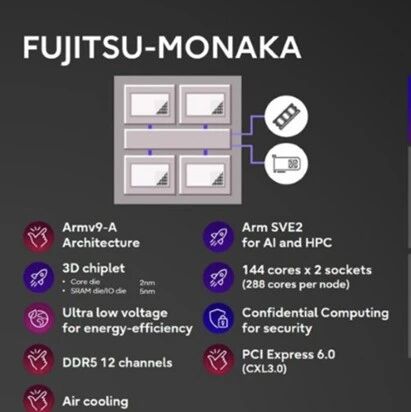
Group 1 - Fujitsu introduced the future development of the MONAKA series processors, which will include more core Arm server processors and built-in AI core functionality [1][3] - The MONAKA processor features Armv9-A architecture cores, supports SVE2 instruction set, and has a small chip design utilizing CoWoS system-level packaging and the industry's first 3.5D F2F packaging technology, totaling 144 enhanced Armv9 cores [1][3] - The MONAKA processor is built on a 2nm process technology and employs hybrid copper bonding (HCB) in a Face 2 Face (F2F) stacking method with 5nm SRAM modules, integrating compute, SRAM, and I/O modules [3] Group 2 - Future plans include the MONAKA-X processor, which will have pure CPU and CPU+NPU versions, with the pure CPU version expected by the end of 2029 using 3D multi-chip module layout and 1.4nm process technology [5] - The MONAKA-X CPU+NPU version is planned for the second half of 2030, featuring an NPU module for medium-sized LLMs, with a further MONAKA-XX processor expected by 2031 [5] - A collaboration between RIKEN, Fujitsu, and NVIDIA aims to develop the FugakuNEXT supercomputer, which will utilize the MONAKA-X and aims to enhance performance by 100 times while maintaining the same power consumption of 40MW, scheduled for operation in 2030 [8]
三星入局MRAM代工
半导体芯闻· 2025-12-03 10:28
Core Insights - Samsung Electronics' wafer foundry business is recovering due to strong growth in the automotive semiconductor market, having secured orders from Tesla and Hyundai [1][2] - The company is supplying eMRAM, a non-volatile memory technology, to Hyundai, which is produced using a 14nm FinFET process [1] - eMRAM offers significant advantages over NAND flash memory, including a speed approximately 1000 times faster and low power consumption, driving demand in the automotive sector [1] Group 1 - Samsung has completed the development of its 14nm eMRAM process and plans to expand its product lineup to 8nm by 2026 and 5nm by 2027, with expected density and speed improvements of 30% and 33% respectively [2] - The company is rapidly expanding its automotive foundry business, having been selected by Tesla for the production of its next-generation AI semiconductor, AI6, which will utilize a 2nm process [2][3] - Samsung is also preparing to mass-produce 8nm MCUs for Hyundai, with plans to complete development by 2028 and start production by 2030 [2] Group 2 - There is a high likelihood that Samsung will win the contract for Hyundai's high-end 5nm autonomous driving chips, as the selection process is set to take place next year [3] - The project, "K-on-Device AI Semiconductor," has been delayed but is expected to favor Samsung due to its established capabilities in advanced process technologies [3] - Samsung's foundry has gained reference standards for various automotive chip processes, including advanced nodes (2nm, 5nm, and 8nm) and mature processes (14nm) [3]
三菱光芯片,扩产三倍
半导体芯闻· 2025-12-03 10:28
Core Viewpoint - Mitsubishi Electric plans to triple its production capacity for optical semiconductor devices used in data centers and communication base stations by fiscal year 2028, shifting investment from power devices for electric vehicles due to sluggish market growth [1][2]. Group 1: Company Strategy and Market Position - The company aims to enhance the production of optical devices that convert light signals to electrical signals, particularly at its Hyogo plant, with a revised plan to increase capacity by 150% by fiscal year 2026 [1]. - Mitsubishi Electric holds approximately 50% of the global market share in optical devices for data centers, which are increasingly in demand due to the growth of artificial intelligence applications [2]. - The semiconductor and device business segment reported a revenue decline of about 4% year-on-year to 140.6 billion yen (approximately $9.02 billion) for the period from April to September, while operating profit increased by 6% to 24.7 billion yen [2]. Group 2: Market Growth and Competitors - The global AI data center market is projected to grow from approximately $15 billion in 2024 to about $94 billion by 2032, indicating a significant demand for optical devices [1]. - Competitors like Sumitomo Electric Industries plan to double their optical device production capacity by fiscal year 2026 to meet the rising demand [2]. - Lumentum Japan aims to increase its optical device output to six times the 2024 level by 2027, utilizing larger diameter semiconductor wafers for improved production efficiency [3]. Group 3: Industry Trends and Future Outlook - The optical device market is expected to grow significantly, with estimates suggesting that the equipment market, including optical devices, will reach 10.73 trillion yen by 2030, approximately 3.5 times the size in 2024 [2]. - Japanese manufacturers dominate the optical device market, with the top three companies holding about 70% of the global market share, and they are at the forefront of high-performance device development [3]. - The commercialization of optical devices with data transmission speeds reaching 400Gbps to 800Gbps is anticipated as chip performance improves and data volumes increase [3].
黑芝麻收购亿智,最高5.5亿
半导体芯闻· 2025-12-03 10:28
Group 1: Black Sesame Intelligence Acquisition - Black Sesame Intelligence announced plans to acquire Zhuhai Yizhi Electronic Technology Co., Ltd. through equity purchase and capital injection, with an expected total cost of approximately RMB 400 million to 550 million [1] - Upon completion of the acquisition, Black Sesame is expected to obtain a majority stake in Yizhi, which will be considered a non-wholly-owned subsidiary, and its financial performance will be consolidated into the group [1] - Yizhi is a system solution provider focused on AI machine vision algorithms and SoC chip design, specializing in the development of edge/terminal general-purpose AI SoC chips, with product lines covering smart automotive, smart hardware, and smart security applications [1] Group 2: Marvell Acquisition of Celestial AI - Marvell announced the acquisition of Celestial AI for at least $3.25 billion in cash and stock, with the potential to increase to $5.5 billion if Celestial meets revenue milestones [4][7] - Following the acquisition, Marvell aims to enhance its semiconductor networking business by integrating Celestial's technology, which is crucial for connecting high-performance computing systems [5][6] - Marvell's stock rose 13% after reporting third-quarter earnings that exceeded expectations, with projected data center revenue growth of 25% next year [5] Group 3: SiTime Negotiations with Renesas - SiTime is in discussions to acquire the timing division of Renesas Electronics, with a potential valuation of up to $2 billion, including debt [8] - The timing division produces clocks used for synchronizing signals in wireless infrastructure, networks, and data centers [8] - SiTime's stock has increased by 34% this year, with a market capitalization of approximately $7.8 billion, while Renesas's stock has decreased by 11%, with a market cap of about ¥3.4 trillion ($2.19 billion) [9]

TEL发道歉声明
半导体芯闻· 2025-12-03 10:28
Group 1 - The core issue involves a former employee of Tokyo Electron's Taiwan subsidiary being prosecuted for leaking critical 2nm technology information, which has raised concerns about corporate governance and information security [1][2] - Taiwan's prosecutors have determined that Tokyo Electron's Taiwan subsidiary had a legal obligation to supervise the former employee, but the company lacked specific preventive management measures, leading to its potential criminal liability [2] - Tokyo Electron has stated that there was no evidence of organizational involvement in the information leak and that the incident has not impacted the company's operations [2] Group 2 - The company emphasizes the importance of information security, particularly in protecting sensitive information of customers and stakeholders, and has established a robust information security system monitored by internal and external experts 24/7 [3] - To prevent similar incidents in the future, Tokyo Electron plans to strengthen its compliance system and auditing mechanisms across its Taiwan subsidiary and the entire group [3] - The company is committed to enhancing corporate value and meeting the expectations of all stakeholders [3]