华尔街见闻

Search documents
3年7倍!博通的崛起与铁腕CEO陈福阳
华尔街见闻· 2025-12-07 12:44
Core Viewpoint - The article discusses Broadcom's CEO, Hock Tan, highlighting his pragmatic management style, cost-cutting measures, and focus on profitability, which have positioned Broadcom as a significant challenger to Nvidia in the AI chip market [1][3]. Group 1: Management Philosophy and Cost-Cutting - Hock Tan is known for his ruthless efficiency, exemplified by significant layoffs and the removal of office perks after acquiring VMware for $84 billion [2][3]. - Following the acquisition, approximately half of VMware's 38,000 employees were laid off, and the number of office buildings was reduced from 18 to 5, contributing to substantial revenue growth for Broadcom [3]. - Broadcom's sales exceeded $50 billion last year, growing over 50% in two years, with expectations to surpass $60 billion this year [3]. Group 2: Acquisition Strategy - Tan has acquired at least 11 companies in the past 15 years, applying a strict methodology to identify "diamonds" and "garbage" in potential acquisitions [4]. - After acquiring VMware, he reduced the product lineup from 8,000 to just 4, focusing on the most valuable offerings for data center clients [4][5]. Group 3: Custom Chip Business - Broadcom has revitalized its chip business by focusing on custom chips, specifically application-specific integrated circuits (ASICs), which are more efficient and cost-effective than Nvidia's general-purpose chips [6][7]. - Major clients include Google, OpenAI, and Meta, with significant contracts signed in recent years, indicating a strong market position [7][8]. - Tan predicts that AI could generate $60 billion to $90 billion in new revenue for Broadcom by 2027, with potential earnings from the partnership with OpenAI reaching up to $300 billion [8]. Group 4: Leadership and Succession - At 74, Tan plans to remain CEO at least until 2030, but there are indications that Broadcom is considering succession planning [12][14]. - Charlie Kawwas, the president of Broadcom's semiconductor solutions group, is increasingly visible in investor communications, suggesting he may be a potential successor [12][13].



一周重磅日程:全球屏息!年末最关键一周来了
华尔街见闻· 2025-12-07 12:44
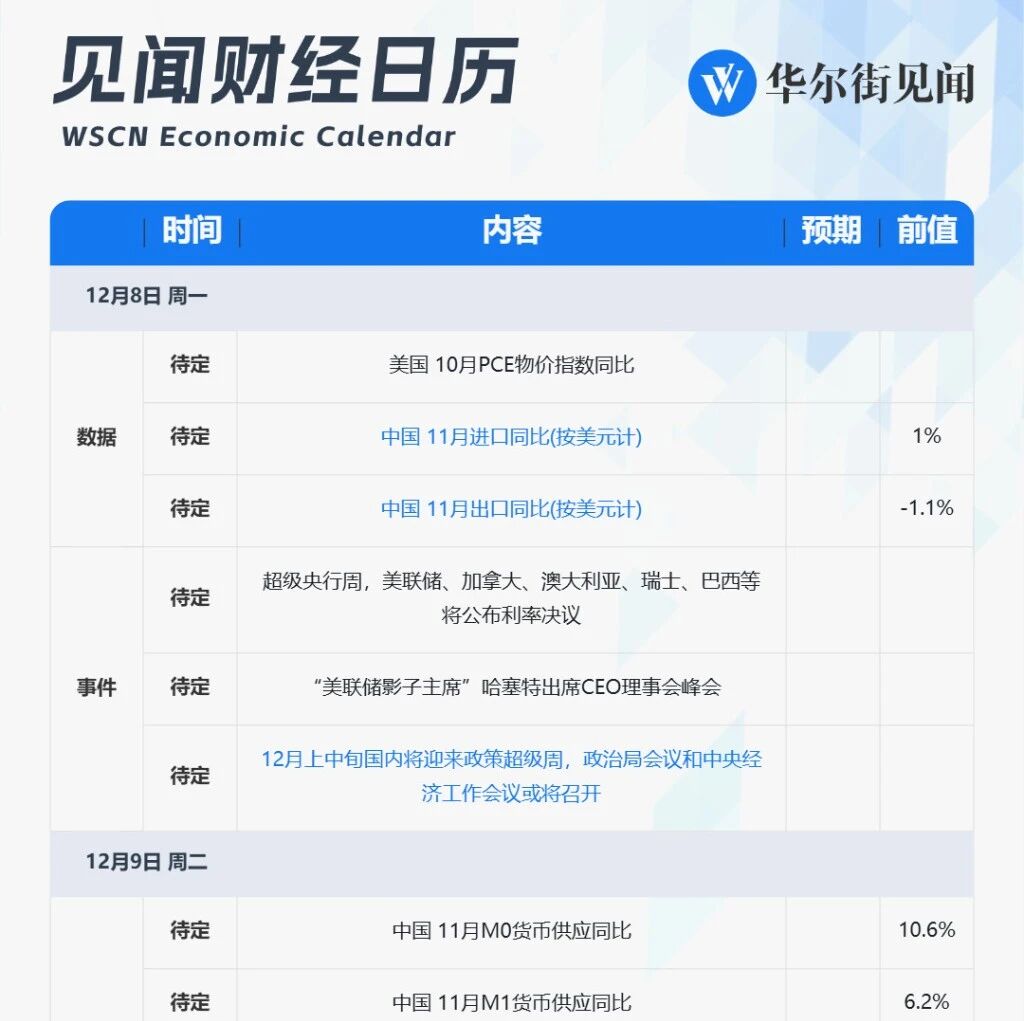
Core Viewpoint - The article highlights significant upcoming economic events and data releases, particularly focusing on the Federal Reserve's interest rate decision and the implications for global markets [6][9]. Economic Data and Events - On December 8, China will release November import and export data, with expectations of a 1% increase in imports and a 1.1% decrease in exports [3]. - The Federal Reserve is expected to announce a 25 basis point rate cut during its meeting on December 11, following recent trends in consumer spending and inflation [7][8]. - Key economic indicators such as China's CPI and PPI will be released on December 10, with CPI expected to rise to 1% from 0.2% [10][12]. Central Bank Meetings - The week of December 8-14 is termed a "super central bank week," with multiple central banks, including the Federal Reserve, Canada, Australia, and Switzerland, set to announce their monetary policy decisions [14][15]. - The Federal Reserve's decision will be closely monitored for its impact on global risk assets and future monetary policy directions [9]. Corporate Earnings Reports - Major companies like Oracle and Broadcom are scheduled to release their quarterly earnings, which are critical for assessing the AI infrastructure investment landscape [25][26]. - Broadcom is expected to report strong growth driven by demand for AI chips, while Oracle's performance will be scrutinized for its cloud infrastructure growth and capital expenditure management [25][26]. Upcoming Events - Microsoft CEO Satya Nadella will visit India from December 10 to 12, engaging with government officials and participating in AI-related discussions [17]. - OpenAI plans to release GPT-5.2 earlier than expected to compete with rivals, indicating a competitive landscape in AI development [16].
大疆旁边咖啡馆挤满了投资人
华尔街见闻· 2025-12-07 12:44
Core Insights - The article highlights the emergence of a vibrant hardware innovation ecosystem in Shenzhen, particularly influenced by former DJI employees who have founded successful startups in various hardware sectors [4][9][18]. Group 1: Investment Trends - Investors are increasingly focusing on AI hardware, with many venture capitalists (VCs) establishing a presence in Shenzhen to tap into this growing market [5][13]. - The "FOMO" (Fear of Missing Out) phenomenon is prevalent among investors regarding startups founded by former DJI employees, as these ventures often see significant valuation increases [11][12]. Group 2: Notable Startups - Several notable startups have emerged from the "DJI alumni," including LiberLive, Zhenghao Innovation, and Songling Robotics, all of which are located within close proximity to DJI's headquarters [4][9]. - The article lists a variety of startups founded by former DJI employees, such as拓竹科技 (Tuo Zhu Technology), 正浩创新 (Zhenghao Innovation), and 妙动科技 (Miao Dong Technology), showcasing their rapid growth and funding success [10][19]. Group 3: Shenzhen's Hardware Ecosystem - Shenzhen is described as a "hardware Silicon Valley," with a robust supply chain and a collaborative ecosystem that fosters innovation and competition among hardware startups [18][20]. - The city has become a hub for various hardware sectors, including 3D printing and robotics, with a high localization rate in supply chains and production capabilities [19][20]. Group 4: Global Recognition - Shenzhen's products have gained international acclaim, with over 70% of the Chinese products listed in TIME magazine's 2025 Best Inventions coming from the city, highlighting its role as a leader in hardware innovation [20].
不只是降息?前纽约联储专家:鲍威尔下周三或宣布450亿美元购债计划
华尔街见闻· 2025-12-07 12:44
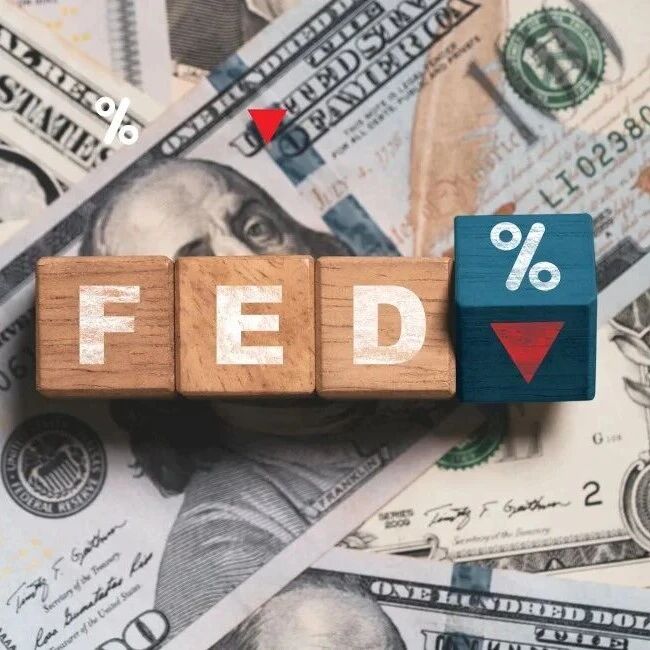
Core Viewpoint - The article discusses the upcoming Federal Reserve meeting on December 10, where a significant expansion of the balance sheet is anticipated alongside a widely expected 25 basis point interest rate cut [1][3]. Group 1: Federal Reserve's Actions - Mark Cabana, a strategist from Bank of America, predicts that the Federal Reserve will announce a plan to purchase $45 billion in Treasury bills monthly starting January 2026, aimed at injecting liquidity into the system to prevent a spike in repo market rates [1][5]. - Cabana highlights that the current level of money market rates indicates that bank reserves are no longer "ample," necessitating the Fed to restart Treasury purchases to fill the liquidity gap [1][5]. - UBS also forecasts that the Fed will begin purchasing approximately $40 billion in Treasury bills monthly in early 2026 to stabilize short-term interest rates [1][5]. Group 2: Market Conditions and Signals - The article notes that the repo market has shown signs of tightening, with overnight reference rates frequently breaching the upper limit of the Fed's policy rate corridor, indicating a shift from "ample" to "adequate" reserves in the banking system [6][7]. - Recent statements from Federal Reserve officials suggest a sense of urgency regarding the need for action, with expectations of reaching adequate reserve levels soon [7]. Group 3: Upcoming Changes and Implications - The potential policy adjustments coincide with a critical leadership transition at the Federal Reserve, as Jerome Powell's term nears its end and Kevin Hassett is viewed as a strong candidate for the next chair [3][8]. - In addition to long-term bond purchasing plans, Bank of America anticipates the Fed will announce term repo operations lasting 1-2 weeks to manage year-end funding volatility [8][10]. - UBS supports the view of a return to balance sheet expansion, emphasizing that purchasing Treasury bills can help match the average duration of the Treasury market [10].
历史惊人重演?大空头Burry预警:美股将陷入“2000年式熊市”,AI泡沫两年内破灭
华尔街见闻· 2025-12-06 11:10
Core Viewpoint - Michael Burry expresses a highly pessimistic outlook on the U.S. stock market, predicting a prolonged bear market similar to that of 2000, driven by the dominance of passive investment strategies [2][5][21]. Group 1: Market Outlook - Burry believes that the current market structure, dominated by passive funds (over 50%), will lead to a scenario where the entire market declines simultaneously, making it difficult to protect oneself with long positions [6][24]. - He compares the current AI investment frenzy to the "data transmission bubble" of 2000, noting a lag between capital expenditure and market peaks [3][8]. - Burry anticipates that Palantir's stock, currently at $200, is overvalued and should be worth $30 or less, leading him to buy out-of-the-money put options with a strike price of $50 [6][11]. Group 2: Palantir's Financial Health - Burry criticizes Palantir's financial structure, highlighting that the company has created multiple billionaires without generating significant profits, as its stock-based compensation is nearly equal to its profits [7][32]. - He points out that Palantir's revenue from government contracts has significantly decreased, and the company is now focusing on enterprise clients, which may not yield the expected profitability [31][32]. - Burry emphasizes that the current valuation of Palantir is unsustainable, as the company has not produced specialized AI products despite being perceived as a leader in the field [33][36]. Group 3: AI and Google - Burry warns that AI poses a serious threat to Google's core cash flow from its search business, as AI search is significantly more expensive compared to traditional search methods [3][42]. - He argues that most users will access AI services for free, and the willingness to pay for large models will be minimal, with real profits likely confined to the developer ecosystem [9][43]. Group 4: Critique of the Federal Reserve - Burry holds a sharp critique of the Federal Reserve, claiming it has not contributed positively over its century-long existence and advocates for its abolition, suggesting that its functions should be transferred to the Treasury [4][48][49].

华为云又有大动作
华尔街见闻· 2025-12-06 11:10
Core Viewpoint - The article discusses Huawei Cloud's significant organizational changes aimed at enhancing its competitiveness in the AI and cloud computing sectors, emphasizing a strategic shift towards becoming a "computing black land" to support various industries [4][7][14]. Organizational Changes - Huawei Cloud has undergone a major organizational adjustment, moving its R&D organization under the ICT (Information and Communication Technology) division and establishing five cloud service product lines: Infrastructure Cloud Services, Data & AI Cloud Services, Database Cloud Services, Security Cloud Services, and HCS [5][6]. - The leadership has also changed, with Zhang Pingan appointed as the chairman and Zhou Yuefeng as the CEO of Huawei Cloud, indicating a focus on commercializing cloud services [5][6]. Strategic Focus - The strategic focus of Huawei Cloud is now on AI and computing, aiming to leverage its accumulated ICT and IT technology advantages to enhance cloud platform competitiveness through system-level innovation and soft-hard collaboration [6][7][14]. - The company aims to transform the AI wave into stable, scalable commercial revenue through products like Tokens services and AI PaaS [8][9]. Market Position and Performance - Huawei Cloud's revenue from cloud computing was approximately 38.52 billion yuan in the previous year, showing a modest year-on-year growth of 8.5%, which accounted for only 4.5% of total revenue [9]. - In comparison, Alibaba Cloud reported a 34% year-on-year revenue growth to 39.82 billion yuan in the third quarter, highlighting the competitive landscape [10]. Future Directions - Huawei Cloud's future development will focus on "3+2+1" business segments, which include general computing, intelligent computing, storage, AI PaaS, databases, and security [11][14]. - The organization is consolidating resources to support the development of the Ascend cloud, Pangu large model, and intelligent computing integration, indicating a commitment to enhancing its AI capabilities [13][14].
预计下周二!OpenAI“紧急提前”发布GPT 5.2,应对Gemini 3的火爆
华尔街见闻· 2025-12-06 11:10
Core Viewpoint - OpenAI's upcoming GPT-5.2 model is expected to outperform competitors like Google's Gemini 3 and Anthropic's Claude 4.5, with a release date potentially set for December 9, ahead of the previously planned late December timeline [1][3]. Performance Comparison - GPT-5.2 shows superior performance across various benchmarks compared to Gemini 3, Gemini 2.5 Pro, and Claude Sonnet 4.5, with notable scores such as: - Academic reasoning: 67.4% for GPT-5.2 vs. 37.5% for Gemini 3 [2] - Visual reasoning puzzles: 62.2% for GPT-5.2 vs. 31.1% for Gemini 3 [2] - Scientific knowledge: 95.8% for GPT-5.2 vs. 91.9% for Gemini 3 [2] - Mathematics (No tools): 100% for GPT-5.2 vs. 95.0% for Gemini 3 [2] - Multimodal understanding: 89.1% for GPT-5.2 vs. 81.0% for Gemini 3 [2] Competitive Strategy - OpenAI has initiated a "red alert" to focus all resources on optimizing ChatGPT in response to fierce competition from Google [5][8]. - The company has identified five core priorities to enhance user experience and maintain its user base of 800 million weekly active users, including personalization, image generation, model behavior, speed and reliability, and reducing over-refusals [8][11][12]. Financial Outlook - OpenAI faces significant financial pressure, needing to raise approximately $100 billion to support ongoing research and computational needs over the next few years [3][13]. - Projected subscription revenue for ChatGPT is expected to reach $100 billion this year, with plans to double to $200 billion next year and reach $350 billion by 2027, contingent on maintaining a competitive edge [13][14]. - The performance of GPT-5.2 and the overall optimization of ChatGPT will be critical in determining the company's future financing prospects [15][16].
SpaceX估值超越OpenAI,或翻倍至8000亿美元,计划明年下半年上市
华尔街见闻· 2025-12-06 11:10
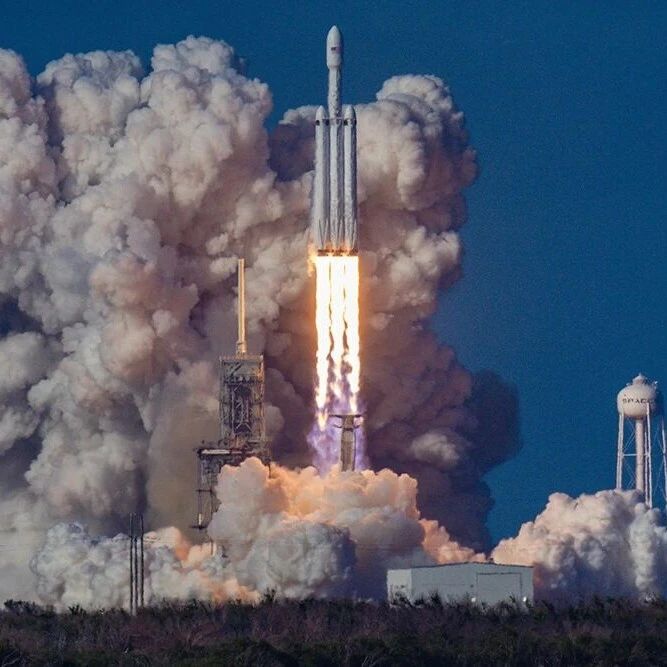
Core Viewpoint - SpaceX is negotiating a new round of internal share sales that could elevate its valuation to $800 billion, doubling its previous valuation of $400 billion from this summer and surpassing OpenAI's record of $500 billion, reclaiming the title of the world's most valuable private startup [1][2][6]. Valuation Surge - The latest valuation target of $800 billion indicates a remarkable growth rate, with the CFO recently informing investors about the sale plan. The valuation represents a significant increase from the $400 billion valuation achieved during the July financing round [5][6]. - There are indications that the share price for the transaction could be around $300, leading to an estimated valuation of approximately $560 billion, although this figure remains unconfirmed [5][6]. Business Growth Drivers - SpaceX's valuation surge is primarily driven by its dominance in the aerospace and communications sectors. As the highest-volume rocket launch provider globally, SpaceX leads the commercial satellite and crewed space launch markets with its Falcon 9 rocket and is developing the more powerful Starship for lunar and Martian missions [9]. - The satellite business is viewed as a key engine for driving valuation. SpaceX's Starlink division currently operates around 9,000 satellites in low Earth orbit and has over 8 million active customers, significantly outpacing competitors like Amazon. The company is also working on a satellite connectivity service for consumer mobile phones, having recently agreed to acquire spectrum blocks from satellite operator EchoStar, investing over $20 billion in cash, stock, and debt commitments [10]. IPO Plans - Alongside the internal share sale, SpaceX has clarified its IPO timeline and structure, aiming for an IPO in the second half of next year [3][12]. - Notably, there has been a significant change in the IPO structure. Previously, there were plans to spin off the Starlink satellite internet service for independent listing, but executives have now decided to pursue a unified public listing that includes both rocket launch and satellite services [13][14][15].
黄仁勋万字访谈:33年来每天都觉得公司要倒闭,AI竞赛无“终点线”,技术迭代才是关键
华尔街见闻· 2025-12-05 09:39
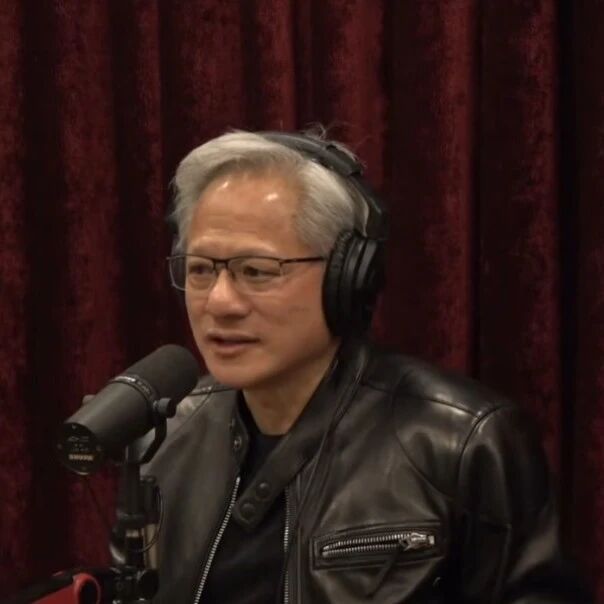
Core Viewpoint - The CEO of Nvidia, despite leading a company at the forefront of the AI revolution, expresses a persistent fear of failure, stating he feels the company is "30 days away from bankruptcy" every day [1][5]. Group 1: AI Competition and Development - Huang Renxun argues that the AI race does not have a clear endpoint and that technological progress will be gradual, with all participants evolving together rather than one achieving overwhelming dominance [2]. - He emphasizes that true competitiveness lies in the ability to iterate continuously rather than achieving one-time breakthroughs, highlighting that AI computing power has increased by 100,000 times over the past decade, focusing on cautious reasoning rather than risky actions [2]. - The past experiences of Nvidia, including near-bankruptcy moments, have shaped a unique understanding of risk and strategy, fostering a startup-like urgency within the company [3]. Group 2: AI's Impact on Jobs - Huang Renxun presents a critical insight regarding AI's potential to replace jobs, stressing the importance of distinguishing between "tasks" and "purposes." For instance, the number of radiologists has increased despite AI's advancements in radiology, as the role of a radiologist is to diagnose diseases, not merely to analyze images [4]. - He asserts that jobs focused solely on tasks may be at risk of replacement, while those that serve a higher purpose will evolve [5]. Group 3: Continuous Crisis and Energy Growth - Huang Renxun maintains a sense of urgency, stating that his fear of failure drives him more than the desire for success, which he believes fuels continuous improvement and hard work [5]. - He emphasizes the importance of energy policies in fostering economic growth, asserting that without such policies, advancements in AI and chip manufacturing would not be possible [5][21]. Group 4: AI Safety and Future Outlook - Huang Renxun believes that while AI can mimic human intelligence, it will not develop consciousness, arguing that the notion of AI suddenly achieving overwhelming capabilities is far-fetched [26][79]. - He expresses optimism about the future of AI, suggesting that advancements will lead to safer and more reliable systems, with AI becoming an integral part of everyday tasks [30][31].

豆包AI手机劲敌是小米?高盛:AI“系统级集成”面临挑战,这更验证了小米的长期竞争力
华尔街见闻· 2025-12-05 09:39
Core Viewpoint - The launch of ByteDance's "Doubao AI Assistant" signifies a shift in AI competition towards the operating system level, highlighting the enduring competitive strength of existing smartphone giants like Xiaomi [3][4]. Group 1: Doubao AI Assistant Overview - ByteDance's "Doubao AI Assistant" is a system-level graphical user interface (GUI) agent integrated with a large language model (LLM), aimed at enhancing mobile interaction through visual interpretation and complex task operations across applications [4]. - The Doubao model has become popular among several smartphone original equipment manufacturers (OEMs), with daily token generation reaching 1.3 trillion in May, accounting for 8% of total token consumption [4]. Group 2: Challenges for Third-Party AI Agents - High barriers exist for third-party AI agents to gain system-level operational permissions, as major smartphone OEMs retain strategic advantages and may not easily grant access to their system cores and permission frameworks [5]. - The ability of AI agents to operate across applications is contingent on the openness of third-party internet application interfaces, with some companies potentially restricting external agent usage to maintain closed ecosystems [6]. Group 3: Market Structure and Competition - The Chinese smartphone market is highly consolidated, with the top six manufacturers (vivo, OPPO, Honor, Apple, Xiaomi, Huawei) accounting for over 90% of shipment volume, creating significant barriers for new entrants [7][8]. - In contrast, the new energy vehicle (NEV) market is more fragmented, allowing for greater opportunities for differentiation through software [7]. Group 4: Xiaomi's Competitive Advantages - Xiaomi's long-term advantages are underscored by the challenges faced by Doubao AI, as the company actively pursues a comprehensive "people x car x home" ecosystem strategy, with AI as a core component [9]. - Xiaomi's investment in AI is substantial, with projected R&D spending exceeding 7 billion RMB by 2025, representing 22% of its total R&D expenses [10]. - The "Super XiaoAI" assistant has achieved significant penetration, with a 71% user adoption rate among Xiaomi smartphone users as of September 2025 [11]. Group 5: Integration and Functionality of Super XiaoAI - "Super XiaoAI" has integrated deep functionalities across various core scenarios, including social media interactions, e-commerce assistance, productivity services, and memory capabilities for user habits and sensitive data [12][13][14][15]. - This comprehensive integration positions Xiaomi favorably against third-party AI agents, reinforcing its competitive moat and validating the long-term value of its ecosystem strategy [16].