
GEELY AUTO(00175)

Search documents
吉利汽车12月16日斥资5054.44万港元回购29.99万股
Zhi Tong Cai Jing· 2025-12-16 11:56
Group 1 - The company, Geely Automobile, announced a share buyback plan, spending HKD 50.5444 million to repurchase 299,900 shares at a price range of HKD 16.72 to 17.20 per share [1] - On the same day, the company issued 33,000 shares due to employees exercising stock options under a plan adopted on April 28, 2023 [1]
吉利汽车(00175)12月16日斥资5054.44万港元回购29.99万股
智通财经网· 2025-12-16 11:56
于同日,因集团雇员根据认股权计划(于2023年4月28日获采纳)行使认股权而发行3.3万股股份。 智通财经APP讯,吉利汽车(00175)发布公告,于2025年12月16日,该公司斥资5054.44万港元回购29.99 万股股份,每股回购价16.72-17.2港元。 ...
吉利汽车(00175) - 翌日披露报表
2025-12-16 11:45
FF305 翌日披露報表 (股份發行人 ── 已發行股份或庫存股份變動、股份購回及/或在場内出售庫存股份) 表格類別: 股票 狀態: 新提交 第 2 頁 共 7 頁 v 1.3.0 公司名稱: 吉利汽車控股有限公司 呈交日期: 2025年12月16日 如上市發行人的已發行股份或庫存股份出現變動而須根據《香港聯合交易所有限公司(「香港聯交所」)證券上市規則》(「《主板上市規則》」)第13.25A條 / 《香港聯合交易所有限公司GEM證券 上市規則》(「《GEM上市規則》」)第17.27A條作出披露,必須填妥第一章節 。 | 第一章節 | | | | | | | | | --- | --- | --- | --- | --- | --- | --- | --- | | 1. 股份分類 | 普通股 | 股份類別 | 不適用 | | 於香港聯交所上市 | 是 | | | 證券代號 (如上市) | 00175 | 說明 | | | | | | | 多櫃檯證券代號 | 80175 | RMB 說明 | | | | | | | A. 已發行股份或庫存股份變動 | | | | | | | | | | | | 已發行股份(不包 ...
用冗余对冲风险,吉利全域安全进入2.0阶段 | 电厂
Xin Lang Cai Jing· 2025-12-16 11:25
Core Viewpoint - The automotive safety landscape is evolving with the advent of electric vehicles, leading to more complex safety challenges that go beyond traditional metrics like crash test ratings and airbag counts [2][5] Group 1: Changes in Automotive Safety - Safety issues are now more systemic, including battery thermal runaway, sensor anomalies, and software logic defects, rather than just focusing on collision impacts [2] - The rapid integration of advanced driver-assistance systems (ADAS) complicates responsibility and expectations, making it harder for consumers to assess safety claims [2] Group 2: Geely's Safety Initiatives - Geely announced the launch of its Global All-Domain Safety Center, which holds five Guinness World Records for being the largest in various automotive safety testing categories [2][5] - The company introduced the "All-Domain Safety 2.0" technology system, integrating AI to enhance safety measures for smart vehicles [5] Group 3: Volvo's Safety Legacy - Volvo's safety reputation, established through rigorous testing and high standards, serves as a benchmark for Geely, which acquired Volvo in 2010 [6][8] - Volvo's approach emphasizes real-world accident data and comprehensive testing, which Geely is now adopting in its safety protocols [8][11] Group 4: Advanced Testing Capabilities - Geely's new safety center features advanced testing capabilities, including a 0-180° collision testing range, which simulates real-world accident scenarios more accurately than traditional fixed-angle tests [11] - The testing environment incorporates various extreme conditions to assess the stability of braking systems and sensors, which are critical for safety [9] Group 5: Satellite Communication as a Competitive Edge - Geely is the first Chinese automaker to launch its own satellites, enhancing its safety framework by providing real-time communication capabilities even outside ground network coverage [12][14] - The company's satellite communication technology has been integrated into its vehicles, allowing for two-way messaging and safety checks in remote areas [14][15] Group 6: Market Trends and Consumer Preferences - There is a growing willingness among consumers to pay more for vehicles equipped with satellite communication and "no-blind-zone safety" features, indicating a shift in purchasing decisions [15]

10月北美需求下滑,欧洲增幅收窄:汽车行业海外销量点评
Huachuang Securities· 2025-12-16 09:50
Investment Rating - The report maintains a "Buy" recommendation for the automotive industry [2]. Core Insights - Global light vehicle sales in October reached approximately 7.9 million units, a year-on-year increase of 2.6% and a month-on-month increase of 0.5%. However, overseas sales totaled about 4.77 million units, showing a year-on-year decline of 0.4% and a month-on-month decline of 1.5% [2]. - North American sales were 1.56 million units, down 5.0% year-on-year but up 1.1% month-on-month. European sales were approximately 1.48 million units, up 2.9% year-on-year but down 7.5% month-on-month. In contrast, Chinese sales reached 3.13 million units, up 7.6% year-on-year and 3.7% month-on-month [2]. - The report anticipates that overseas light vehicle sales will reach 55.88 million units in 2025, a year-on-year increase of 1.3%, and 56.14 million units in 2026, a year-on-year increase of 0.5% [2]. Summary by Sections 1. Industry: Sales, Exchange Rates, Freight - Global light vehicle sales data indicates a mixed performance across regions, with North America and Europe facing declines while China shows growth [2][5]. - The report highlights the impact of exchange rates and freight costs on the automotive industry, noting a downward trend in the CCFI (China Container Freight Index) [24]. 2. Market Competition - The competitive landscape is analyzed, showing the market shares of major automotive groups, including Toyota, Volkswagen, and BYD, with a focus on their performance in the global market [28][29]. - The report also discusses the dynamics of the global new energy vehicle market, emphasizing the growth of companies like BYD and Tesla [33][34]. 3. Export Situation of Automotive and Parts Companies - The report provides insights into the export performance of domestic automotive manufacturers, highlighting the monthly growth rates of narrow passenger vehicle exports [39][40]. - It lists companies with significant overseas revenue, indicating their reliance on international markets [42].


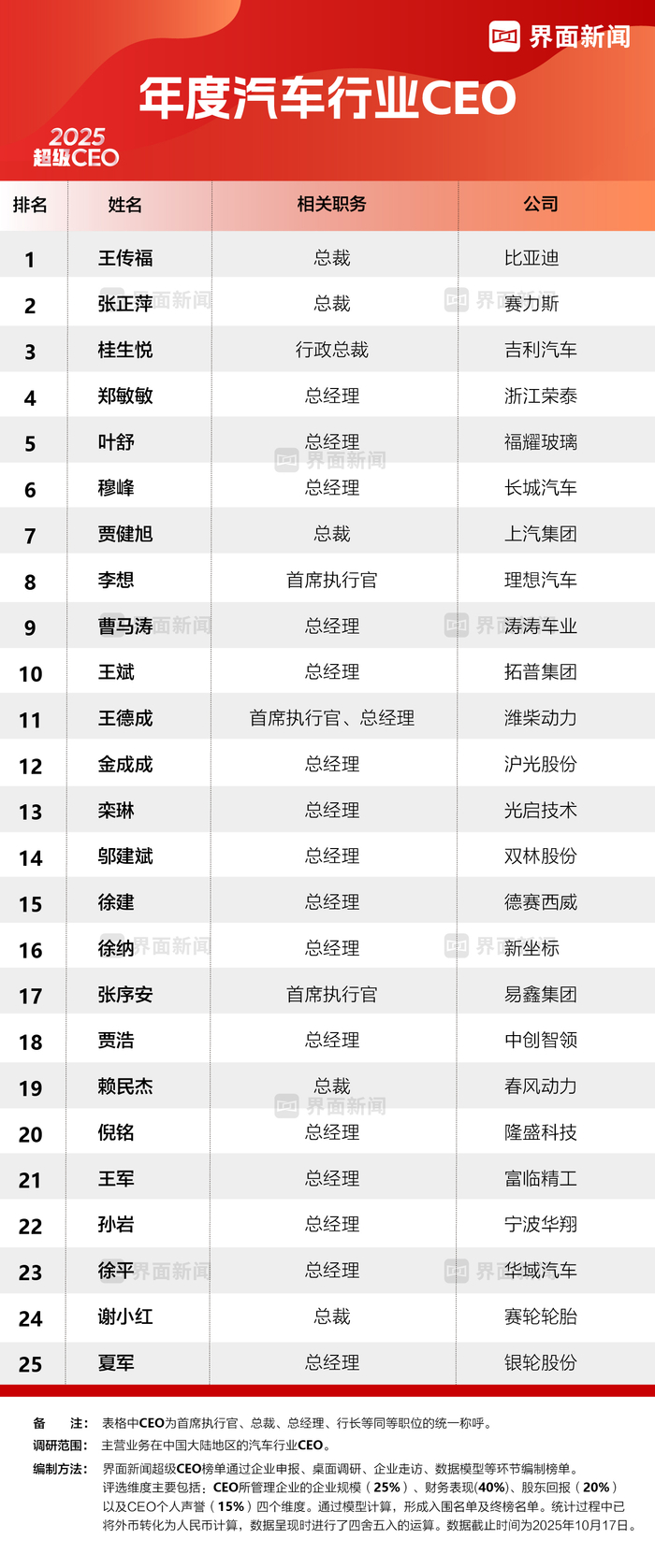
界面新闻发布2025年度汽车行业CEO榜单:比亚迪王传福、赛力斯张正萍、吉利汽车桂生悦位列前三
Xin Lang Cai Jing· 2025-12-16 08:10
Core Insights - The "Super CEO" list by Zhito Finance highlights outstanding leaders in the automotive industry, focusing on their financial growth and reputation, with BYD's Wang Chuanfu ranked first [1][12]. Industry Overview - The automotive industry in China, encompassing vehicles, parts, and services, is projected to produce and sell 31.28 million and 31.44 million units in 2024, reflecting year-on-year growth of 3.7% and 4.5% respectively, maintaining its position as the world's largest market for 16 consecutive years [2]. - In 2024, China's automotive exports are expected to reach 5.859 million units, marking a 19.3% increase, showcasing the industry's resilience amid global trade uncertainties [2]. New Energy Vehicles (NEVs) - NEVs are leading the transformation of the automotive industry, with production and sales expected to exceed 10 million units in 2024, achieving year-on-year growth of 34.4% and 35.5% respectively [3]. - NEV exports are projected to reach 1.284 million units, a 6.7% increase, as China strengthens its competitive edge in key overseas markets [3]. Automotive Parts Industry - The automotive parts sector is experiencing significant growth, with the demand for core components like batteries, motors, and electronic controls surging as NEV penetration exceeds 40% [4]. - In 2024, the installed capacity of power batteries is expected to grow by 47.6% to 531 GWh, with lithium iron phosphate batteries accounting for 69.2% of the total [4]. - The export value of automotive parts is anticipated to reach $105.61 billion, reflecting a 6.8% increase [4]. Intelligent Driving - The intelligent driving sector is witnessing rapid advancements, with consumer demand for safety and efficiency driving the adoption of L2 and higher autonomous driving features in mid-to-high-end vehicles [5]. - Technological breakthroughs in AI algorithms, automotive-grade chips, and high-precision mapping are laying a solid foundation for the industrialization of intelligent driving [5]. CEO Performance - The 25 CEOs on the list have demonstrated impressive performance, with median revenue growth of 23.3%, net profit growth of 31.42%, and return on equity of 15.35% [8]. - The average market capitalization of these companies is approximately 113.6 billion yuan, with 24 CEOs disclosing their 2024 salaries, the highest being 639.134 million yuan [8]. - The representation of post-80s CEOs has increased significantly, indicating a trend towards younger leadership in the automotive sector [8]. Notable CEOs - Wang Chuanfu of BYD leads the list, achieving sales of 4.2721 million units in 2024, with a revenue of 777.102 billion yuan, a 29.02% increase year-on-year [12]. - Zhang Zhengping of Seres has seen a remarkable revenue increase of over 305.04% to 145.176 billion yuan, with NEV sales rising by 182.84% [13]. - Li Xiang of Ideal Auto reported a revenue of 144.460 billion yuan, a 16.64% increase, and is focusing on expanding into the Middle East and Central Asia [14]. - Wang Bin of Top Group achieved a revenue of 26.6 billion yuan, growing by 35.02%, by implementing a Tier 0.5 platform strategy [15].



中国车企,“巴”握未来
Zhong Guo Qi Che Bao Wang· 2025-12-16 07:01
Core Insights - Chinese automotive companies are making significant strides in the Brazilian market, showcasing a strong commitment to local production and market penetration [1][5][10] Group 1: Company Developments - GAC International made its debut at the São Paulo International Motor Show, presenting its full range of models, while BYD's Tengshi brand launched its flagship models Z9GT and D9 in Brazil [1][3] - Geely and Renault announced plans to double their local production in Brazil through a joint venture, investing 38 billion Brazilian Reais (approximately 10.5 billion RMB) to enhance their electric vehicle offerings [3][9] - Avita officially entered the Latin American market with the launch of Avita 11, partnering with CAOA Group for comprehensive market support [4] Group 2: Market Potential - Brazil, as the sixth-largest automotive market globally, is experiencing growth driven by a population of over 200 million and an expanding middle class, making it a key target for global automotive companies [5][10] - The Brazilian automotive market is projected to see a 5% increase in sales by 2025, reaching 2.765 million vehicles, with a 7.8% rise in production [5][6] Group 3: Electric Vehicle Growth - The electric vehicle segment in Brazil is rapidly expanding, with a projected 90% increase in sales for electric vehicles in 2024, reaching 177,000 units [6][7] - Chinese companies dominate the electric vehicle market in Brazil, holding a 76% market share as of October 2025, with BYD leading in monthly sales [6][7] Group 4: Policy and Regulatory Environment - Brazilian government policies are catalyzing the shift towards electric vehicles, with incentives and tax benefits aimed at increasing the share of electric vehicles to 30% of total sales by 2030 [7][8] - The government is also implementing import tariffs on electric vehicles to encourage local production, effective from January 2024 [7] Group 5: Strategic Approaches - Chinese automotive companies are adopting differentiated strategies in Brazil, with some focusing on full localization of production, while others, like Geely and Renault, are leveraging partnerships for quicker market entry [8][9] - The establishment of local production facilities is expected to enhance the supply chain for electric vehicle components, further solidifying Brazil's role as a hub for Chinese automotive companies in Latin America [10]


从“零和博弈”到“生态共建”,吉利开放共享全球最大安全中心
Hua Xia Shi Bao· 2025-12-16 05:12
Core Viewpoint - The automotive industry is undergoing a transformation as the focus shifts from parameters like range and intelligence to safety, driven by tightening global safety regulations and the complexities introduced by smart technologies [2][3] Group 1: Industry Transformation - Global safety regulations are tightening rapidly, with new standards like the EU's general safety regulations and China's upcoming "zero tolerance" battery standards [2] - The traditional concept of "collision safety" is evolving into a more comprehensive notion of "full-domain safety," addressing data security, algorithm ethics, and expected functionality [2][3] Group 2: Geely's Global Full-Domain Safety Center - Geely has launched a Global Full-Domain Safety Center with an investment exceeding 2 billion yuan, covering approximately 45,000 square meters, and setting five Guinness World Records, including the largest automotive safety testing laboratory [2][3] - The center will be open to the entire industry, sharing key safety patents for free, indicating a shift from competitive advantage to a public asset for industry advancement [2][6] Group 3: Addressing Safety Challenges - The center serves as a systematic verification platform to tackle current and future global automotive safety challenges, addressing multi-dimensional risks associated with electric vehicles and smart technologies [3][4] - It features the world's largest collision testing area and an indoor simulation lab capable of replicating 264 scenarios, enhancing the ability to test under extreme conditions [3] Group 4: Compliance and Cost Efficiency - The center provides essential infrastructure to help automotive companies navigate compliance challenges in global markets, covering 27 categories of tests aligned with major safety regulations [4] - This capability significantly reduces the costs and time associated with compliance, supporting the globalization strategy of Geely and the broader Chinese automotive industry [4] Group 5: Evolution of Safety Concepts - Geely's "Full-Domain Safety 2.0" framework categorizes safety into life safety, health safety, property safety, and privacy safety, introducing the concept of "public safety" [5] - The center includes specialized labs for digital safety and health analysis, reflecting the industry's shift towards a broader understanding of safety [5] Group 6: Strategic Shift in Competition - Geely's decision to open the safety center represents a significant shift in competitive logic from zero-sum games to ecosystem co-construction, positioning itself as an organizer of industry standards [6][7] - By collaborating with various institutions to publish a white paper on smart vehicle safety, Geely aims to create a unified framework for safety technology development [7] Group 7: Long-term Vision and Industry Impact - The initiative addresses internal safety concerns among consumers and aims to elevate the overall safety standards of the industry, fostering a positive cycle of competition [8] - Externally, it positions Chinese automakers as leaders in global automotive safety technology, moving beyond mere compliance to actively shaping safety standards [8][9]
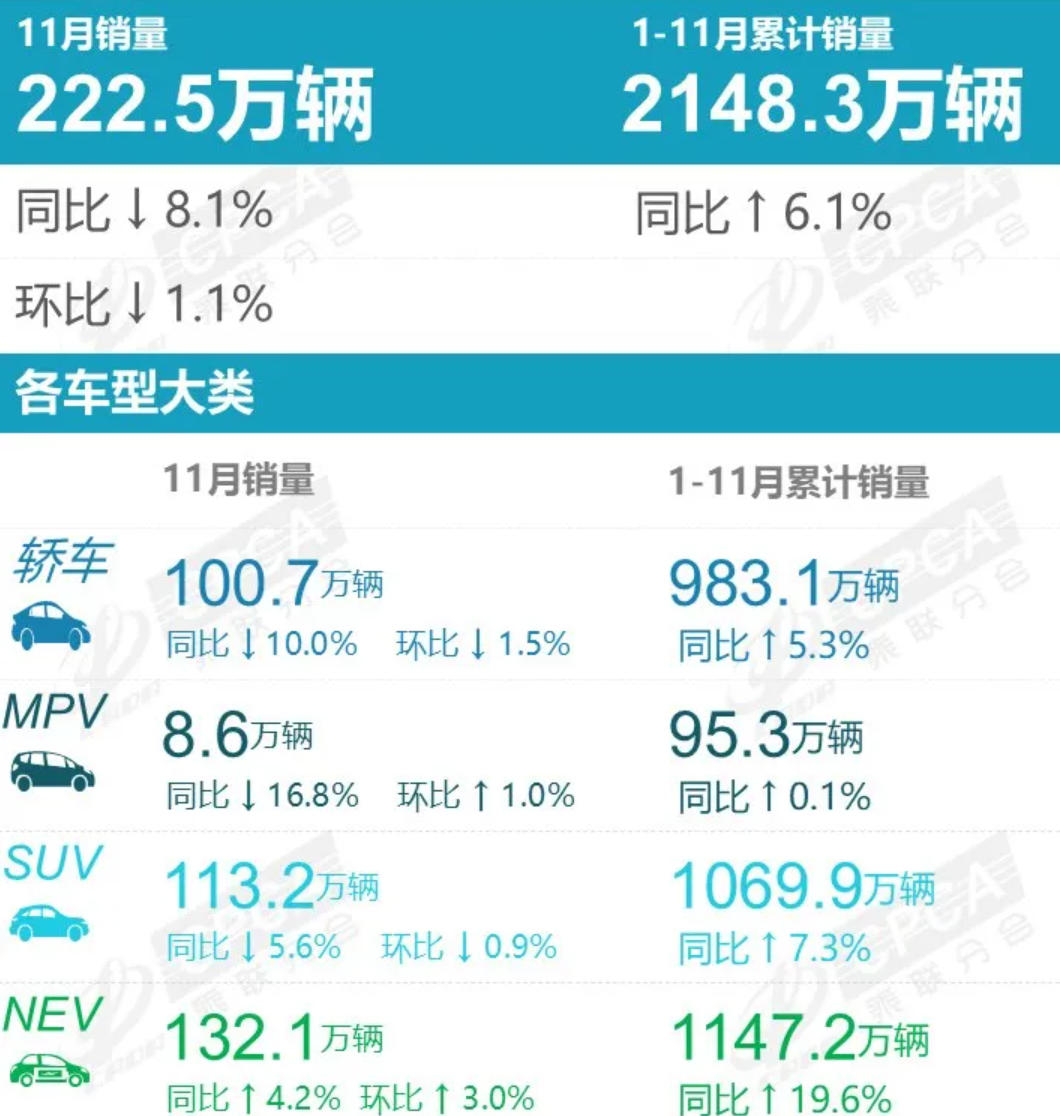
11月乘用车市场销量分析:新能源逆势增长 头部品牌领跑赛道
Zhong Guo Zhi Liang Xin Wen Wang· 2025-12-16 05:09
Group 1: Overall Market Performance - In November, the domestic passenger car market faced pressure, with retail sales reaching 2.225 million units, a year-on-year decline of 8.1% and a month-on-month decline of 1.1% [1] - The new energy vehicle (NEV) market, however, showed resilience with sales of 1.321 million units, a year-on-year increase of 4.2% and a month-on-month increase of 3.0%, achieving a penetration rate of over 59% [1] Group 2: Segment Performance - The sedan market saw retail sales of 1.007 million units, down 10.0% year-on-year and slightly down 1.5% month-on-month, with NEV sedans becoming a key growth point [4] - The MPV market was the weakest segment, with retail sales of 86,000 units, a year-on-year decline of 16.8% and a slight month-on-month increase of 1.0% [4] - The SUV market, while also facing year-on-year declines, performed better than sedans and MPVs, with retail sales of 1.132 million units, down 5.6% year-on-year and down 0.9% month-on-month; NEV SUVs sold 683,000 units, up 12.5% year-on-year [4] Group 3: Brand Performance - Among the top ten manufacturers, five were domestic brands, capturing 61% of the total market sales; domestic brands sold 1.49 million units, down 4% year-on-year, while joint venture brands sold 490,000 units, down 19% [4] - BYD led the sales with 306,561 units, although it experienced a year-on-year decline of 26.5% [7] - Geely ranked second with sales of 268,337 units, showing a year-on-year increase of 23.5%, becoming the fastest-growing company among the top brands [9] Group 4: Competitive Landscape - The German brands, particularly FAW-Volkswagen, maintained a stable performance in the shrinking joint venture market, with retail sales of 137,500 units [5] - SAIC Volkswagen's sales were 86,857 units, down 29.3% year-on-year, but it still retained a solid base in the fuel vehicle market [6] - New entrants like Hongmeng Zhixing and Xiaomi Auto showed significant growth, with Hongmeng Zhixing achieving a year-on-year increase of 95.2% [11][18] Group 5: Future Outlook - The market is expected to enter a phase of aggressive sales push in December, with domestic brands likely to maintain their lead in the NEV sector [18] - The competition is shifting from traditional product competition to a focus on technological strength and product quality, indicating a trend towards high-quality development in the automotive industry [18]
47家港股公司回购 斥资11.90亿港元
Zheng Quan Shi Bao Wang· 2025-12-16 01:59
12月15日港股公司回购一览 | 代码 | 简称 | 回购股数 | 回购金额 | 回购最高价 | 回购最低价 | 年内累计回购金额 | | --- | --- | --- | --- | --- | --- | --- | | | | (万股) | (万港元) | (港元) | (港元) | (万港元) | | 00700 | 腾讯控股 | 105.10 | 63579.09 | 608.000 | 602.500 | 7367968.54 | | 01810 | 小米集团-W | 720.00 | 30166.04 | 42.000 | 41.780 | 494401.44 | | 01919 | 中远海控 | 295.00 | 4001.61 | 13.730 | 13.450 | 638240.23 | | 00175 | 吉利汽车 | 199.10 | 3474.85 | 17.750 | 17.160 | 17347.72 | | 01024 | 快手-W | 46.20 | 2993.04 | 65.350 | 64.300 | 248504.77 | | 03888 | 金山软件 | 70.28 ...


