CHINA RES BEER(00291)

Search documents
智通港股沽空统计|9月4日
智通财经网· 2025-09-04 00:22
Group 1 - The top three stocks with the highest short-selling ratios are China Resources Beer (100.00%), Lenovo Group (100.00%), and Anta Sports (100.00%) [1][2] - The top three stocks with the highest short-selling amounts are Alibaba (2.283 billion), Tencent Holdings (1.289 billion), and Xiaomi Group (1.113 billion) [1][2] - The top three stocks with the highest deviation values are China Resources Beer (50.97%), Lenovo Group (46.84%), and Tencent Holdings (44.51%) [1][2] Group 2 - The top ten short-selling ratio rankings include China Resources Beer, Lenovo Group, and Anta Sports, all at 100.00% [2] - The top ten short-selling amounts show Alibaba leading with 22.83 billion, followed by Tencent Holdings and Xiaomi Group [2] - The top ten deviation values highlight China Resources Beer and Lenovo Group with significant deviations from their average short-selling ratios [2]






股价一度翻倍 特朗普家族又一新公司上市;市值大增1.6万亿元 谷歌创新高;品牌金饰涨破1050元/克丨每经早参
Mei Ri Jing Ji Xin Wen· 2025-09-03 22:13
Group 1 - Huawei will hold a product launch event for the Mate series and all-scenario new products on September 4 [3] - The 2025 (15th) Aviation Industry Conference and the Aviation Industry Quality Infrastructure Construction Conference will be held in September [3] - The Eurozone's retail sales data for July will be released, along with the US trade balance data for July [3] Group 2 - US stock markets closed mixed, with the Dow Jones down 0.05%, S&P 500 up 0.51%, and Nasdaq up 1.02% [5] - Google shares surged over 9%, marking its best single-day performance since April 9, with a market cap increase of $230 billion (approximately 1.6 trillion RMB) [5] - The Federal Reserve's Beige Book indicated that economic activity across most regions of the US has remained stable, with consumer spending flat or declining due to wages not keeping pace with inflation [5] Group 3 - International precious metals futures generally rose, with COMEX gold futures up 0.77% at $3,619.70 per ounce [6] - International oil prices fell sharply, with WTI crude oil down 2.77% at $63.77 per barrel [7] Group 4 - European stock indices closed higher, with Germany's DAX up 0.46%, France's CAC40 up 0.86%, and the UK's FTSE 100 up 0.67% [8] Group 5 - The Ministry of Finance and the People's Bank of China held a joint working group meeting, emphasizing the coordination of fiscal and monetary policies to support economic recovery [9] Group 6 - The first batch of standard verification pilot units for data infrastructure was announced, covering key areas such as interoperability and data security [10] Group 7 - The price of gold jewelry in China has risen above 1,050 RMB per gram, with the international gold price reaching a new high of over $3,560 per ounce [11] Group 8 - Beijing plans to list eight plots of land for residential and mixed-use development, including rare plots within the second ring road [12] Group 9 - The Hong Kong Stock Exchange announced that the exchange rate deduction rate for RMB against HKD and USD will remain at 2.6% after September 5 [13] Group 10 - The Anhui province will waive fees for highway rescue services starting September 20 [14] Group 11 - The China Passenger Car Association reported that retail sales of passenger cars in August reached 1.952 million units, a year-on-year increase of 3% [15] Group 12 - FTSE Russell announced changes to the FTSE China A50 Index, including the addition of four stocks and the removal of four others [16] Group 13 - Huawei Beer announced the appointment of Zhao Chunwu as the new chairman of the board, which is expected to bring new leadership and strategic direction [19] Group 14 - Zhongtai Asset Management's veteran Xu Zhimin will leave the company, which may lead to strategic shifts [20] Group 15 - Leap Motor completed a private placement raising 2.6 billion RMB, indicating strong domestic investor confidence in the electric vehicle sector [23] Group 16 - NIO responded to questions about not offering valet or autonomous parking, highlighting its existing parking technology capabilities [25] Group 17 - UBTECH announced a procurement contract worth 250 million RMB for humanoid robots, marking a significant achievement in the field [27] Group 18 - XGIMI is in discussions for an H-share listing, aiming to enhance its international market presence [28] Group 19 - Anpurs was fined 3.74 million RMB for selling unapproved battery cells, impacting its reputation and operations [29] Group 20 - American Bitcoin, supported by Trump's sons, saw its stock price surge over 100% after its merger, reflecting high investor interest [30] Group 21 - Anthropic completed a $13 billion financing round, achieving a valuation of $183 billion, highlighting strong market confidence in its potential [31]






股价一度翻倍,特朗普家族又一新公司上市;市值大增1.6万亿元,谷歌创新高;品牌金饰涨破1050元/克;安普瑞斯被罚没374万元丨每经早参
Mei Ri Jing Ji Xin Wen· 2025-09-03 22:09
Market Overview - US stock indices closed mixed, with the Dow Jones down 0.05%, S&P 500 up 0.51%, and Nasdaq up 1.02% [4] - Google shares surged over 9%, marking its best single-day performance since April 9, adding approximately $230 billion (about 1.6 trillion RMB) to its market cap, reaching $2.79 trillion [4] - The Federal Reserve's latest Beige Book indicated little change in economic activity across most regions, with consumer spending remaining flat or declining due to wages not keeping pace with inflation [4] Commodity Prices - International precious metals futures generally rose, with COMEX gold futures up 0.77% at $3,619.70 per ounce, and COMEX silver futures up 0.52% at $41.81 per ounce [5] - International oil prices fell significantly, with WTI crude oil down 2.77% at $63.77 per barrel, and Brent crude down 2.53% at $67.39 per barrel [6] European Market - European stock indices closed higher, with Germany's DAX up 0.46% at 23,594.8 points, France's CAC40 up 0.86% at 7,719.71 points, and the UK's FTSE 100 up 0.67% at 9,177.99 points [7] Automotive Industry - The China Passenger Car Association reported that retail sales in August reached 1.952 million units, a 3% year-on-year increase, and wholesale sales totaled 2.409 million units, a 12% year-on-year increase [15] Corporate Developments - China’s Ministry of Finance and the People's Bank of China held a joint meeting, emphasizing the importance of coordinated fiscal and monetary policies to support economic recovery [8] - Huazhu Hotels Group announced a partnership with a leading technology firm to enhance its digital services [19] - Zero Run Auto completed a domestic stock issuance, raising a total of 2.6 billion RMB, indicating strong investor confidence in the electric vehicle sector [25] Financial Market Changes - The FTSE Russell announced changes to the FTSE China A50 Index, including the addition of four stocks and the removal of four others, effective September 22, 2025 [16] - The Hong Kong Stock Exchange announced that the exchange rate deduction rate for RMB against HKD and USD will remain at 2.6% after September 5, 2025 [13] Technology Sector - Anthropic announced the completion of a $13 billion (approximately 92.8 billion RMB) Series F funding round, raising its valuation to $183 billion (approximately 1.3 trillion RMB) [31] - IMAX's first Chief Quality Officer, David Keighley, passed away, having overseen the post-production of over 500 IMAX films [17]

华润啤酒新任掌门人落定
Zheng Quan Ri Bao Zhi Sheng· 2025-09-03 16:45
Core Viewpoint - The appointment of Zhao Chunwu as the chairman of China Resources Beer Holdings Co., Ltd. marks a significant leadership transition following the resignation of former chairman Hou Xiaohai, with a focus on sustaining the company's strategic direction and growth in the beer and liquor market [1][2]. Company Leadership Changes - Zhao Chunwu has been appointed as chairman and chairman of the finance committee effective September 3, 2025, after serving as president since August 2023 [1]. - Zhao has a long history with the company, having joined in 2003 and held various key positions across different regional subsidiaries [1]. Financial Performance - In the first half of 2023, China Resources Beer reported revenue of 23.94 billion yuan, a year-on-year increase of 0.8%, and a net profit attributable to shareholders of 5.789 billion yuan, up 23% [2]. - The company's earnings before interest and taxes (EBIT) reached 7.691 billion yuan, reflecting a 20.8% increase year-on-year, with a gross margin of 48.9%, up 2 percentage points [2]. - The company declared an interim dividend of 0.464 yuan per share, a 24.4% increase compared to the same period last year [2]. Strategic Direction - The company aims to continue its "14th Five-Year" strategy focused on high-end product development, leveraging its domestic and international brand advantages [2]. - Despite a slight decline in the overall beer industry, the company has maintained balanced growth across its product lines, with high-end products experiencing double-digit growth [2]. - Zhao emphasized the importance of strategic consistency while adapting to industry changes, indicating a strong consensus within the management team regarding future growth strategies [2].
赵春武接棒执掌华润啤酒,啤酒高端化与白酒整合双线挑战如何破局?
Mei Ri Jing Ji Xin Wen· 2025-09-03 14:50
Core Viewpoint - China Resources Beer has appointed Zhao Chunwu as the new chairman of the board, effective September 3, 2025, amidst challenges in the beer and liquor markets, raising questions about the company's dual strategy of "beer + liquor" [1][6]. Group 1: Leadership Transition - Zhao Chunwu has been promoted from president to chairman and will also serve as the chairman of the finance committee, with Guo Wei appointed as a member of the finance committee [1]. - Zhao Chunwu has a long history with China Resources, starting in 2003 and holding various key positions, including vice president and general manager of China Resources Snow Beer [2][3]. - The board has expressed confidence in Zhao's management and leadership abilities, considering him the best candidate to lead the company into a new phase of development [3]. Group 2: Financial Performance - In the first half of the year, China Resources Beer reported revenues of 23.942 billion yuan, a year-on-year increase of 0.8%, while net profit attributable to shareholders rose by 23% to approximately 5.789 billion yuan [5]. - The beer segment generated revenues of 23.161 billion yuan, up 2.6% year-on-year, driven by high-end products, while the liquor segment saw revenues drop to approximately 781 million yuan, a decline of over 30% [5]. Group 3: Strategic Direction - Following the resignation of former chairman Hou Xiaohai, there is significant interest in whether the "beer + liquor" dual strategy will be adjusted; Zhao has indicated that the current management team supports continuing and enhancing the existing strategy [6]. - Zhao faces the challenge of enhancing the market share of high-end beer products while addressing the difficulties in the liquor business, including the integration of various liquor brands to reverse declining sales [7].
赵春武接棒执掌华润啤酒 啤酒高端化与白酒整合双线挑战如何破局?
Mei Ri Jing Ji Xin Wen· 2025-09-03 14:42
Core Viewpoint - China Resources Beer has appointed Zhao Chunwu as the new chairman of the board, effective September 3, 2025, amidst challenges in the beer and liquor markets, raising questions about the company's strategy moving forward [2][6]. Group 1: Leadership Transition - Zhao Chunwu has been promoted from president to chairman and will also serve as the chairman of the finance committee [2]. - Zhao has a long history with China Resources, starting in 2003 and holding various key positions, including general manager of China Resources Snow Beer [3][4]. - The board has expressed confidence in Zhao's management and leadership abilities, considering him the best candidate for the chairman role [4]. Group 2: Business Performance - In the first half of the year, China Resources Beer reported revenue of 23.942 billion yuan, a year-on-year increase of 0.8%, while net profit attributable to shareholders rose by 23% to approximately 5.789 billion yuan [6]. - The beer segment generated revenue of 23.161 billion yuan, up 2.6%, while the liquor segment saw a decline of nearly 40% to about 781 million yuan [6][7]. Group 3: Strategic Direction - Zhao Chunwu aims to continue the "beer + liquor" dual strategy established by his predecessor, with a focus on enhancing high-end beer market share and addressing challenges in the liquor business [6][7]. - The company faces pressure from international brands in the high-end beer market and must quickly integrate its liquor acquisitions to reverse declining sales [7].
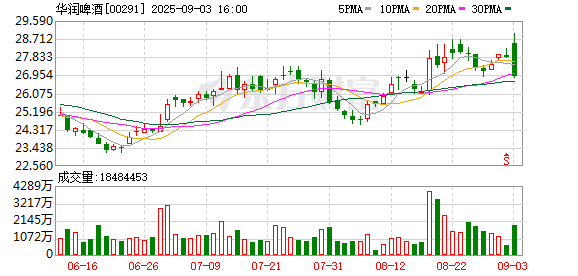
华润啤酒总裁赵春武调任董事会主席
Xin Jing Bao· 2025-09-03 14:21
截至2024年12月31日年度,赵春武执行董事之董事袍金获定为每年18万元。除董事袍金外,赵春武的酬 金包括薪金及津贴约158.52万元、年度住房公积金及社保约108817元以及酌情花红约178.78万元。 赵春武调任后,华润啤酒总裁职位暂时悬空。直至委任新总裁前,执行董事及主席赵春武将暂时承担过 渡期间总裁的工作及责任。由于总裁一职所需的深入知识及经验,华润啤酒无法确定能够委任本公司新 任总裁之时间,董事会及本公司提名委员会将继续检讨该事项。 6月27日,华润啤酒发布公告称,侯孝海辞任后,董事会主席职位将暂时悬空,直至公司委任合适继任 人。公司执行董事及总裁赵春武暂时承担过渡期间董事会主席的工作及责任。赵春武最新的一次亮相, 是华润啤酒业绩发布会。提到侯孝海离职一事,他表示"舍不得"。他称,现任管理层对于下一步发展有 着高度共识,对于此前侯孝海带领下的华润啤酒战略,以延续和发扬为主,不会有太大改动。 (文章来源:新京报) 新京报讯(记者王子扬)9月3日,啤酒企业华润啤酒(控股)有限公司(以下简称"华润啤酒")发布公 告称,公司执行董事赵春武由公司总裁调任为董事会主席。此前,对华润啤酒影响深远的原华润啤酒董 ...
华润啤酒宣布新任“一把手” 总裁赵春武调任董事局主席
Nan Fang Du Shi Bao· 2025-09-03 11:53
Group 1 - Zhao Chunwu has been officially appointed as the Chairman of China Resources Beer, transitioning from acting to formal leadership after the resignation of Hou Xiaohai [2][4] - Zhao Chunwu, a veteran with extensive experience in the company, has held various key positions since joining in 2003, including Vice President and General Manager of several core regional companies [4][6] - Under Zhao's leadership, the company aims to focus on practical management and continue its high-quality and premium development strategy, particularly in the beer sector [4][7] Group 2 - In the first half of 2023, China Resources Beer reported a total revenue of 23.942 billion yuan, a year-on-year increase of 0.8%, and a record net profit attributable to shareholders of 5.789 billion yuan, up 23% [7] - The growth in revenue was primarily driven by the surge in high-end beer sales, while the white liquor segment experienced a significant decline, with revenue dropping over 33% to 781 million yuan [7] - Zhao Chunwu indicated that the company will continue to enhance its "beer + liquor" dual empowerment business model despite challenges in the white liquor segment [7]
华润啤酒宣布新任“一把手”,总裁赵春武调任董事局主席
Nan Fang Du Shi Bao· 2025-09-03 11:49
Core Viewpoint - The appointment of Zhao Chunwu as the new chairman of China Resources Beer marks a significant leadership transition following the resignation of Hou Xiaohai, with expectations for a pragmatic management style and a focus on high-quality and premium product strategies [1][3][6]. Group 1: Leadership Transition - Zhao Chunwu has been promoted from president to chairman and chairman of the finance committee, officially taking over the leadership role after serving in an interim capacity [1][3]. - Zhao Chunwu, a veteran with extensive experience in the company, has held various key positions since joining in 2003, indicating a deep understanding of the company's operations and market dynamics [3][6]. Group 2: Company Performance - In the first half of the year, China Resources Beer reported a total revenue of 23.942 billion yuan, a year-on-year increase of 0.8%, while net profit attributable to shareholders reached 5.789 billion yuan, up 23%, marking a historical high [7]. - The growth in revenue is primarily attributed to the surge in high-end beer sales, although the white liquor segment experienced a significant decline, with revenue dropping over 33% to 781 million yuan [7]. Group 3: Market Strategy - Zhao Chunwu emphasized the ongoing potential for premiumization in the beer industry and the need to cater to diverse consumer preferences by introducing more personalized and niche products [6][7]. - The company aims to maintain a dual empowerment business model of "beer + white liquor," focusing on high-quality and premium development strategies despite challenges in the white liquor segment [7].
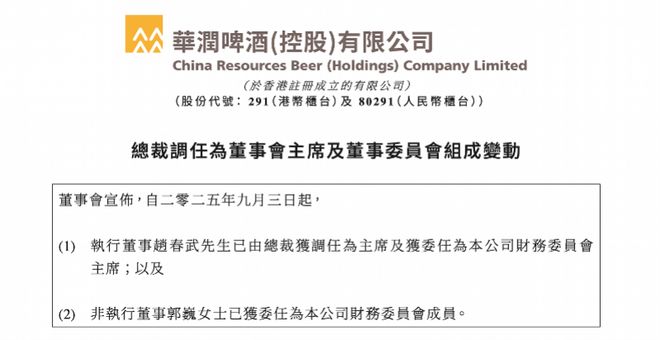
侯孝海离任两个多月后,赵春武出任华润啤酒董事会主席
Xin Lang Cai Jing· 2025-09-03 11:37
Group 1 - The new chairman of China Resources Beer, Zhao Chunwu, will officially take over on September 3, 2025, after being appointed as the chairman and chairman of the finance committee [1] - Zhao Chunwu has extensive experience in the company, having joined China Resources Snow Beer in 2003 and held various key positions, including general manager of several regional companies [1] - The previous chairman, Hou Xiaohai, resigned on June 27, 2023, to focus on personal matters, leading to Zhao Chunwu temporarily assuming the chairman's responsibilities [2] Group 2 - Under Hou Xiaohai's leadership, China Resources Beer saw significant growth, with the company achieving a revenue of 23.942 billion yuan in the first half of 2025, a year-on-year increase of 0.8%, and a net profit of 5.789 billion yuan, up 23% [4] - The beer business generated revenue of 23.161 billion yuan, reflecting a 2.6% year-on-year growth, while the liquor business contributed 0.781 billion yuan, accounting for nearly 80% of the liquor business revenue [4] - The company is committed to a long-term and high-end development strategy, focusing on a dual empowerment business model of "beer + liquor" to navigate the complex consumer environment [4]