
DONGFENG GROUP(00489)

Search documents
汽车行业年度策略报告:汽车行业2026年十大趋势及投资策略-20260105
Guoyuan Securities· 2026-01-05 13:43
Core Insights - The report highlights that the Chinese automotive industry is entering the mid-to-late stage of the electric and intelligent transformation, characterized by the coexistence of traditional fuel vehicles, electric intelligent vehicles, and future industries represented by autonomous driving. This necessitates a layered and structured investment approach based on the different stages of these industry curves [2][3]. Trend Summaries Trend 1: Scrap Gap Provides Long-term Space, Trade-in Policies Expected to Normalize - The Chinese automotive market has stabilized at an annual sales level of 31 million units, with a substantial vehicle ownership base of 350 million units, laying the groundwork for future updates. The annual scrappage volume is still significantly lower than new car sales, leading to an expanding replacement gap. The "trade-in" policy is expected to evolve from a temporary stimulus to a normalized tool, enhancing the precision of policies to support domestic demand and industrial production [2][13][27]. Trend 2: New Forces Drive China's Automotive Exports to a New Structural Upgrade Stage - China's automotive exports have entered a high-growth phase, achieving several-fold growth over four years. The export structure has undergone profound changes, with a significant increase in the penetration of new energy vehicles. New force car manufacturers are enhancing China's brand premium and technological image in the global market through high-value product exports [2][30][34]. Trend 3: "Mass Market Pure Electric + High-end Range Extender" Trend Continues to Deepen - With the penetration rate of new energy vehicles surpassing 50%, market demand is showing structural differentiation. In the mass market under 200,000 yuan, the 800V high-voltage platform significantly improves charging efficiency, driving pure electric growth to outpace plug-in hybrids and range extenders. In the high-end market above 300,000 yuan, the "large battery long-range range extender" remains the mainstream solution for full-size SUVs/MPVs [2][3]. Trend 4: The "Late Mass Market" Phase Will Continue to Strengthen the Matthew Effect - The industry is transitioning from the "early mass market" to the "late mass market" phase, where consumers prioritize brand endorsement, after-sales support, and residual value certainty. This pragmatic user base favors mature brands and ecosystem capabilities, leading to a concentration of market resources towards leading technology firms [2][3]. Trend 5: Focus on State-owned Enterprises for Opportunities Around "Certainty + Cost-effectiveness" - Regulatory bodies are intensifying the separate assessment and market value management of state-owned enterprises' new energy businesses, driving resources towards electric intelligence. Major automotive groups are restructuring to shorten development cycles, accelerating the integration of intelligent configurations into mainstream price segments [2][3]. Trend 6: Growth of New Energy Heavy and Light Trucks Enters Acceleration Phase - The electrification of commercial vehicles has crossed a critical point, entering a self-driven growth phase. The total cost of ownership (TCO) for heavy trucks has dropped to a recovery period of 1.5-2 years, accelerating the replacement of fuel vehicles. The light truck sector is also maturing, with urban delivery electrification fully established [3][6]. Trend 7: High-perception Intelligent Cockpit Configurations Will Reshape Purchase Decisions - Intelligent cockpits have become a default configuration in new energy vehicles, with the importance of intelligent features in purchase decisions rising to the forefront. Consumers are focusing on visual and perceptible components, making HUDs, large LCD screens, and intelligent seating core differentiation battlegrounds [3][6]. Trend 8: Intelligent Driving Accelerates Along "End-to-End" and "Equal Rights" Paths - The intelligent driving architecture is transitioning to an "end-to-end" model, enhancing efficiency across the perception and decision-making chain. The continued acceleration of L3 policies provides opportunities for leading manufacturers to compete and iterate rapidly in high-level intelligent driving [3][6]. Trend 9: Three Major Autonomous Driving Commercialization Scenarios Approaching Explosive Growth - Robotaxi, mining autonomous driving, and unmanned logistics vehicles are moving from pilot projects to mass production. The cost advantages of unmanned logistics vehicles are becoming increasingly evident, with sales curves showing signs of exponential growth [3][6]. Trend 10: Embodied Intelligence Enters Pre-production Phase, Releasing a Second Growth Curve for the Automotive Manufacturing Industry - Humanoid robots are transitioning from hardware-driven to intelligent dual-core driven, with the automotive supply chain naturally adapting to this field. The synergy between embodied intelligence and the automotive industry is expected to create dual dividends in performance and valuation [3][6].



宇树科技回应“上市绿色通道被叫停”;苹果回应国行版AI上线;段永平再晒部分苹果持仓,累计收益率超16倍;巴菲特退休后最新发声丨邦早报
Sou Hu Cai Jing· 2026-01-05 00:33
Group 1 - Yushu Technology clarifies that it has not applied for the "green channel" for IPO and that its listing work is progressing normally [1] - Apple has initiated a gray test for its "Apple Smart and Siri" feature for certain domestic devices, but it has not officially launched yet [1] - Warren Buffett, after retiring, expressed confidence in the new CEO Greg Abel, stating he has full decision-making authority [1] - Investor Duan Yongping shared that his investment in Apple stock has yielded a return of over 1623.48%, amounting to approximately $34.26 million [1] Group 2 - Meituan has had 3.25 million RMB worth of equity frozen by a court, with the freeze lasting for three years [2] - The control struggle at Double Star Celebrity Group has intensified, with founder Wang Hai announcing a severance of ties with his son and daughter-in-law [2][3] Group 3 - Xiaopeng Motors' Vice President Chen Yonghai has left the company, with President Wang Fengying temporarily taking over his responsibilities [4] - Romaishi has initiated a restructuring plan called "Rebirth Plan," aiming to complete funding and restructuring by Q1 2026 [4] - GAC Honda has completed the acquisition of Dongfeng Honda Engine Company, changing its name to GAC Honda Engine Company [4] Group 4 - The French skincare brand Filorga announced the closure of its official flagship store due to strategic adjustments, with the store set to cease operations on January 31, 2026 [4] - Tesla's restaurant has seen a significant drop in customer traffic and the departure of its celebrity chef within six months of opening [4] Group 5 - The "Wawa Xiaozong" trademarks have been successfully registered, with rights valid until December 13, 2035 [7] - The facial cleansing brand "Washing Bear" has faced complaints of store closures, with the founder promising to address consumer rights [9] Group 6 - Burger King's online ordering system experienced significant failures, leading to multiple public apologies from the company [11] - Former Meta AI chief Yang Likun left the company, criticizing the focus on large language models as a dead end for achieving superintelligence [12] Group 7 - Cloud Leopard Intelligent has initiated its IPO process, aiming to become the first domestic DPU company listed [12] - Bole Technology has completed over 1 billion RMB in financing, marking the largest funding round in the unmanned mining vehicle sector [12] - Shurui Robotics has raised $100 million in its D round of financing [12] Group 8 - Geely has launched new PHEV models, with prices starting at 139,800 RMB, featuring advanced hybrid technology [13] - Grok has released a new version, optimizing video generation capabilities [15] Group 9 - During the 2026 New Year's holiday, 142 million domestic trips were made in China, with total spending reaching 84.79 billion RMB [18] - China's automobile exports to Venezuela increased by 130% in 2025, with significant growth in both passenger and commercial vehicle segments [18][19] - In November 2025, China's automobile exports reached 818,000 units, a year-on-year increase of 49.2% [19]






广汽本田完成收购东风本田发动机公司
Qi Cha Cha· 2026-01-04 03:09
Group 1 - The core point of the news is the change in ownership of Dongfeng Honda Engine Co., Ltd., which has now become a wholly-owned subsidiary of GAC Honda after the exit of Dongfeng Group as a shareholder [1] - GAC Honda has acquired the 50% stake previously held by Dongfeng Group, leading to a complete ownership transition [1] - The company has been renamed to GAC Honda Engine Co., Ltd., reflecting the new ownership structure [1] Group 2 - GAC Honda Engine Co., Ltd. was established in 1998 and is involved in the research and development of automotive parts, as well as wholesale and retail of automotive components [2] - The registered capital of GAC Honda Engine Co., Ltd. is approximately 969.69 million yuan [2] - The company is located in Huangpu District, Guangzhou, Guangdong Province, and has a workforce of between 1,000 to 1,999 employees [2]

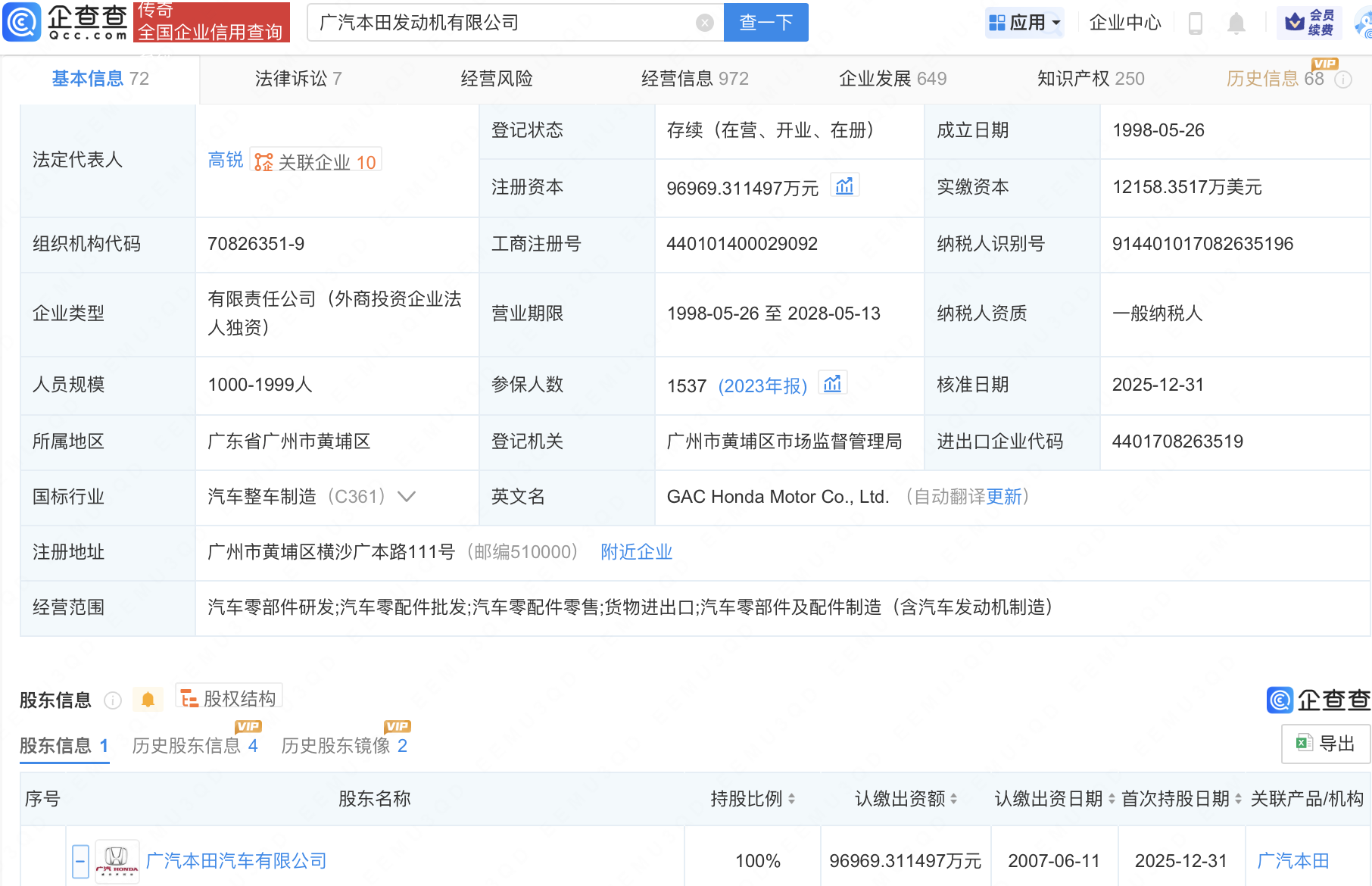
广汽本田已完成收购东风本田发动机公司
Zheng Quan Shi Bao Wang· 2026-01-04 02:29
人民财讯1月4日电,企查查APP显示,近日,原东风本田发动机有限公司发生工商变更,东风集团股份 等退出股东行列,新增广汽本田汽车有限公司为全资股东,同时企业名称变更为广汽本田发动机有限公 司。 ...
东风汽车申请汽车DTS虚拟匹配分析方法专利,避免了实车验证的高成本与长周期
Jin Rong Jie· 2026-01-02 08:48
Group 1 - Dongfeng Motor Group Co., Ltd. has applied for a patent titled "Automobile DTS Virtual Matching Analysis Method, Device, Equipment, and Readable Storage Medium," with publication number CN121257063A and application date of September 2025 [1] - The patent describes a method that constructs a multi-dimensional tolerance dimension chain model based on vehicle assembly strategies and collects actual positioning deviation data, transforming complex tolerance influencing factors into structured data [1] - This method offers a more comprehensive and precise representation of tolerance transfer paths compared to traditional empirical defect chain decomposition, providing a reliable data foundation for subsequent analysis [1] Group 2 - Dongfeng Motor Group Co., Ltd. was established in 2001 and is located in Wuhan, primarily engaged in the automotive manufacturing industry [2] - The company has a registered capital of 858,937,000 RMB and has made investments in 45 enterprises, participated in 5,000 bidding projects, and holds 5,000 patent records [2] - Additionally, the company possesses 156 administrative licenses [2]
东风汽车2025年新能源汽车销量104万辆 奕派科技占比近三成
Zhong Guo Jing Ying Bao· 2026-01-01 13:45
Core Insights - Dongfeng Motor Group achieved a significant milestone in 2025, with total new energy vehicle sales reaching 1.04 million units, a year-on-year increase of 21% [2][3] - The company aims for a total sales target of 3.25 million vehicles in 2026, including 1.7 million new energy vehicles and 600,000 exports [2] - The transformation strategy during the 14th Five-Year Plan has positioned Dongfeng's self-owned brands as the main growth driver, with a notable increase in market share [3] Sales Performance - In 2025, Dongfeng's self-owned brand vehicle sales exceeded 1.5 million units, marking a growth of over 9% [3] - The penetration rate of new energy vehicles increased by 7 percentage points year-on-year, with self-owned and joint venture sales accounting for over 60% of total sales, up 5 percentage points [3] - Lantu Motors, one of Dongfeng's brands, achieved sales of 150,169 units in 2025, representing an 87% increase [3] Brand Development - Dongfeng has established several new energy brands, including Lantu Motors, Mengshi Technology, and Yipai Technology, covering various market segments [2] - Mengshi Technology's sales reached 10,228 units in 2025, nearly tripling year-on-year [4] - Yipai Technology sold 275,752 units in 2025, a growth of 28.3%, contributing significantly to Dongfeng's overall new energy vehicle sales [6] Strategic Restructuring - The year 2025 marked the conclusion of Dongfeng's "three-year action plan for transformation and upgrading," achieving a balanced contribution from self-owned and joint venture businesses ahead of schedule [7] - The company has streamlined its operations from multiple brands to a more focused "4+2" structure, enhancing strategic implementation [7] - Yipai Technology has launched the "Future Wings" strategy, focusing on technology, brand, product, and international expansion to drive growth [9] Future Outlook - Yipai Technology aims to become a leading user-oriented and technology-driven enterprise, with a five-year plan targeting a production scale of one million vehicles [11] - The company has established a rapid response mechanism for customer issues, aiming to enhance user satisfaction and brand loyalty [13] - Plans for 2026 include launching six new models and improving existing ones to strengthen market competitiveness [14]
产业临界点已至:从“超车”到“领跑”,车企体系力迎来大考
Jing Ji Guan Cha Wang· 2026-01-01 08:21
Core Insights - The Chinese electric vehicle (EV) market has crossed a significant milestone, with the monthly retail penetration rate of new energy passenger vehicles surpassing 50% at the beginning of the year and reaching a historical high of 62.3% by year-end, indicating a fundamental shift in market dominance [1] - The annual production and sales of new energy vehicles in China are expected to grow by over 30% year-on-year, solidifying their role as the core growth engine in a market experiencing only modest overall growth [1] - The industry is transitioning from a "policy market" reliant on subsidies to a "value market" driven by consumer demand and technological value, marking a new phase of competition focused on comprehensive system capabilities [3] Industry Dynamics - The competition landscape has evolved into a zero-sum game within a fixed market size, emphasizing structural replacement rather than mere sales growth [3] - Key dimensions of competition have shifted to include technology iteration speed, lifecycle costs, ecological service capabilities, and user operation efficiency [3] - The window for technological competition has drastically shortened, with smart technology becoming a basic requirement rather than a differentiating feature [3] Export and Ecosystem - China's automotive exports are projected to exceed 7 million units this year, with successful international expansion requiring a complete system that includes localized R&D, production, brand building, and sales service networks [4] - The relationship between automotive companies and tech giants is evolving into deep co-creation alliances, shifting competition from individual companies to ecological alliances [4] Policy and Market Trends - The external policy environment is increasingly demanding systemic capabilities, with the gradual phasing out of tax exemptions for new energy vehicle purchases [4] - Industry consensus is shifting towards pursuing high-quality development, moving away from the "scale at the cost of losses" model [4] Dongfeng Motor Group's Strategy - Dongfeng Motor Group aims to achieve over 1 million new energy vehicle sales by 2025, with a significant increase in the share of its own brands to 63%, marking a milestone in its strategic restructuring [5] - The establishment of Dongfeng Yipai Automotive Technology Company represents a critical strategic move to integrate resources and enhance competitiveness in the mainstream market [6][7] Yipai Technology's Transformation - Yipai Technology has undergone a comprehensive restructuring to align with market demands, focusing on integrated operations across the entire value chain [7] - The new company structure aims to create a collaborative combat system, with distinct roles for different brands to cover various market segments [7] Technological Advancements - Yipai Technology is developing advanced manufacturing capabilities, including the world's first 16,000-ton integrated die-casting equipment and plans for self-developed solid-state batteries [8] - The company is also establishing a "Yipai+" ecosystem through partnerships with leading firms, enhancing its technological capabilities and accelerating commercialization [8][9] Future Outlook - Yipai Technology's sales reached 275,700 units in 2025, a 28% year-on-year increase, positioning it as a key player in achieving Dongfeng's sales target [9] - The company plans to launch six new models and enhance existing products to improve user experience and competitiveness in the market [9] Conclusion - The case of Yipai Technology illustrates the necessity for traditional automotive giants to undergo organizational and mindset transformations to thrive in the evolving landscape of the electric vehicle industry [11]
东风汽车申请基于车辆地理位置的二维码停车缴费方法专利,提高了缴费效率
Jin Rong Jie· 2026-01-01 04:17
国家知识产权局信息显示,东风汽车集团股份有限公司申请一项名为"一种基于车辆地理位置的二维码 停车缴费方法和系统"的专利,公开号CN121236832A,申请日期为2025年9月。 声明:市场有风险,投资需谨慎。本文为AI基于第三方数据生成,仅供参考,不构成个人投资建议。 财经频道更多独家策划、专家专栏,免费查阅>> 专利摘要显示,本发明提供了一种基于车辆地理位置的二维码停车缴费方法,通过获取停车场地理位置 信息与对应停车场二维码信息,对所述停车场地理位置信息与对应二维码信息进行审核,得到停车场地 理位置信息与对应二维码信息匹配的数据库;当车辆停车场缴费时,获取车辆实时地理位置信息,根据 所述停车场地理位置信息与对应二维码信息匹配的数据库,得到停车场对应二维码信息;根据所述停车 场对应二维码信息进行停车缴费。本发明的避免了用户在驾驶过程中寻找二维码带来的不便,本发明极 大地简化了用户的操作流程,提高了驾驶安全性,减少了停车缴费的等待时间,提高了缴费效率。 天眼查资料显示,东风汽车集团股份有限公司,成立于2001年,位于武汉市,是一家以从事汽车制造业 为主的企业。企业注册资本858937万人民币。通过天眼查大数据 ...
东风集团股份(00489) - 公告 - 持续关连交易
2025-12-31 00:17
香港交易及結算所有限公司及香港聯合交易所有限公司對本公告的內 容 概 不 負 責,對 其 準 確 性 或 完 整 性 亦 不 發 表 任 何 聲 明,並 明 確 表 示,概 不對因本公告全部或任何部分內容而產生或因倚賴該等內容而引致的 任 何 損 失 承 擔 任 何 責 任。 DONGFENG MOTOR GROUP COMPANY LIMITED* 東風汽車集團股份有限公司 (於中華人民共和國註冊成立的股份有限公司) (股份代號:489) 公 告 持續關連交易 東風汽車公司協議 本 公 司 欣 然 宣 佈,於 二 零 二 五 年 十 二 月 三 十 日,本 公 司 與 東 風 汽 車 公 司 分 別 訂 立 以 下 協 議: 截 至 本 公 告 日 期,東 風 汽 車 公 司 持 有 本 公 司 已 發 行 股 本 總 數 約73.83% 的 股 權。因 此,根 據 上 市 規 則 屬 本 公 司 關 連 人 士。 – 1 – (i) 經 續 簽 物 流 服 務 總 協 議,據 此,東 風 汽 車 公 司 同 意 提 供 並 促 使 其 附 屬 公 司 提 供 物 流 服 務 予 本 集 團; (ii) 經 ...
重卡行业月度跟踪系列:十一月总量延续高涨,年末抢装下新能源激增-20251231
Changjiang Securities· 2025-12-31 00:13
Investment Rating - The report maintains a "Positive" investment rating for the heavy truck industry [3] Core Insights - The heavy truck industry continues to show high prosperity, driven by policies encouraging vehicle replacement and increasing demand for new energy vehicles [10][51] - The report highlights three main drivers of growth: low oil and gas price differentials, a surge in new energy vehicle sales due to year-end purchasing incentives, and strong export demand, particularly from Africa [30][48][71] Summary by Sections Overall Performance - In November 2025, wholesale heavy truck sales reached 113,000 units, a year-on-year increase of 65.3% and a month-on-month increase of 6.6% [10] - Heavy truck registration sales were 77,000 units, up 34.4% year-on-year and 9.4% month-on-month [10] - Heavy truck exports totaled 34,000 units, reflecting a year-on-year increase of 38.2% but a month-on-month decrease of 8.3% [10] Key Drivers - **Oil and Gas Price Differential**: The oil and gas price differential remains low, with liquefied natural gas priced at 4,213.7 RMB/ton and diesel at 6,883.8 RMB/ton, resulting in a differential of 2,670 RMB/ton [33] - **New Energy Vehicle Surge**: The new energy heavy truck registration reached 28,000 units in November 2025, marking a 192.6% increase year-on-year and a 40.8% increase month-on-month [51] - **Export Demand**: Heavy truck exports to Africa reached 14,111 units, a significant year-on-year increase of 99.7% [76] Market Segmentation - **By Purpose**: In November 2025, logistics vehicle registration was 60,000 units, up 39.7% year-on-year, while engineering vehicle registration was 17,000 units, up 18.6% year-on-year [13][23] - **By Energy Type**: Natural gas heavy truck registrations were 19,000 units, up 70.7% year-on-year, while new energy heavy trucks accounted for 28,000 units, with a penetration rate of 36.4% [51][38] Company Performance - The top three heavy truck manufacturers in November 2025 were China National Heavy Duty Truck Group, FAW Group, and Dongfeng Motor, with sales of 29,000, 24,000, and 17,000 units respectively [13][27] - The market shares for these companies were 25.5%, 21.0%, and 15.2%, showing varying changes compared to the previous year [27] Inventory Trends - Both enterprises and channels are increasing inventory levels, with a slight rise in inventory by 0.1 thousand units for enterprises and 0.3 thousand units for channels in November 2025 [14]
