TENCENT(00700)

Search documents
2月3日华宝港股通恒生中国(香港上市)30ETF(520560)遭净赎回369.86万元
Xin Lang Cai Jing· 2026-02-04 02:22
Group 1 - The core point of the article highlights the net redemptions of the Hua Bao Hong Kong Stock Connect Hang Seng China (Hong Kong Listed) 30 ETF (520560), which faced a net outflow of 3.6986 million yuan on February 3, ranking 40th out of 212 in cross-border ETF net outflows [1] - As of February 3, the latest scale of the Hua Bao Hong Kong Stock Connect Hang Seng China (Hong Kong Listed) 30 ETF is 755 million yuan, down from 766 million yuan the previous day, indicating a net outflow of 0.48% relative to the previous day's scale [1] - Over the past 5 days, the fund experienced net redemptions totaling 35.4312 million yuan, ranking 25th out of 212 in cross-border ETF net outflows [1] - The fund's scale has decreased by 7.60% and its assets by 7.01% since the beginning of the year, with the latest share count at 814 million [2] Group 2 - The fund's management fee is 0.50% annually, and the custody fee is 0.10% annually [2] - The fund is managed by Zhang Fang and Jiang Junyang, both of whom have recorded a return of -7.27% since the fund's inception on September 24, 2025 [3] - The top holdings of the fund include Tencent Holdings (14.92%), Alibaba-W (13.98%), and China Construction Bank (7.23%), among others, with significant investments in major Chinese companies [3]





腾讯取得姿态估计方法相关专利
Jin Rong Jie· 2026-02-04 02:22
Group 1 - Tencent Technology (Shenzhen) Co., Ltd. has obtained a patent for a "Pose Estimation Method, Device, Related Equipment, and Computer Products," with authorization announcement number CN115115699B, and the application date is April 2022 [1] - Tencent Technology (Shenzhen) Co., Ltd. was established in 2000 and is located in Shenzhen, primarily engaged in software and information technology services [1] - The company has a registered capital of 2 million USD and has invested in 15 enterprises, participated in 280 bidding projects, and has 5000 trademark and patent information records, along with 574 administrative licenses [1]
未知机构:东方财富港股点评202602032月3日恒生科技指数早盘-20260204
未知机构· 2026-02-04 02:15
Summary of Key Points from Conference Call Records Industry Overview - The conference call discusses the Hong Kong stock market, particularly focusing on the technology sector, as indicated by the significant drop in the Hang Seng Technology Index, which fell over 4% on February 3, 2026 [1][1]. Core Insights and Arguments - **Market Reaction to Federal Reserve Policies**: The tightening expectations of the Federal Reserve and the strengthening of the US dollar have led to rising US Treasury yields, putting pressure on the valuations of Hong Kong technology stocks, which are primarily influenced by foreign capital [1][1]. - **Concerns Over Internet Profitability**: Market rumors have raised concerns about the sustainability of profitability in the internet sector, triggering panic selling among investors [1][1]. - **Correlation with US Market Trends**: The decline in popular US-listed Chinese stocks has created a sentiment linkage with the Hong Kong technology sector, contributing to the overall market downturn [1][1]. - **Short-term vs Long-term Trends**: The current decline is characterized as a short-term disturbance rather than a reversal of the overall trend [1][1]. Additional Important Content - **Liquidity and External Influences**: The liquidity in the Hong Kong market is significantly affected by global capital flows, with pricing power largely held by foreign investors. Rapid declines in global risk appetite can lead to quicker downturns in the Hong Kong technology sector, as seen in previous instances in April and October 2025 [2][2]. - **Valuation and Growth Potential**: The Hang Seng Technology Index is currently at historical low valuation levels, enhancing its attractiveness for investment. The ongoing commercialization of AI and recovery in domestic consumption are expected to support long-term growth in the sector [2][2]. - **Future Outlook**: Short-term strategies may focus on bottoming out supported by historical recovery patterns, while medium-term attention should be on the Federal Reserve's policy decisions, the upcoming Two Sessions policy guidance, and Q1 earnings reports from internet giants. Long-term investment value is expected to be driven by the AI industry cycle and valuation advantages [3][3]. - **Risk Factors**: Potential risks include tighter-than-expected Federal Reserve policies, slower-than-expected AI commercialization, changes in regulatory policies, and volatility in overseas markets [3][3].

互联网增值服务未加税,误传致股价波动,实际仅基础电信服务税率上调
Sou Hu Cai Jing· 2026-02-04 02:11
Core Viewpoint - The recent rumors regarding the increase of value-added tax (VAT) on internet value-added services stem from a misunderstanding of new tax regulations, which only affect basic telecommunications services and do not extend to other internet companies like Tencent [2][3] Group 1: Tax Regulation Changes - Starting from 2026, the VAT rate for basic telecommunications services, such as internet broadband access provided by companies like China Mobile, China Unicom, and China Telecom, will increase from 6% to 9% [2] - The adjustment is a targeted policy and does not apply to other types of enterprises, clarifying the boundaries of the new tax regulations [2] Group 2: Misinterpretation of Tax Applicability - The erroneous extrapolation of the tax adjustment to internet platform companies like Tencent has led to the misconception of an "internet value-added service tax increase" [2] - Tencent's primary business activities, including online gaming, social platform operations, cloud services, and digital content distribution, fall under the categories of value-added telecommunications services or sales of intangible assets, which remain subject to the 6% VAT rate without any increase [2][3] Group 3: VAT Structure Stability - The statutory VAT rates in China remain at three levels: 13%, 9%, and 6%, with the applicable objects and policy framework remaining stable and unchanged [4]




未知机构:今日快评腾讯放量回调短期情绪踩踏基本面逻辑未变市场波动核心多重利-20260204
未知机构· 2026-02-04 02:10
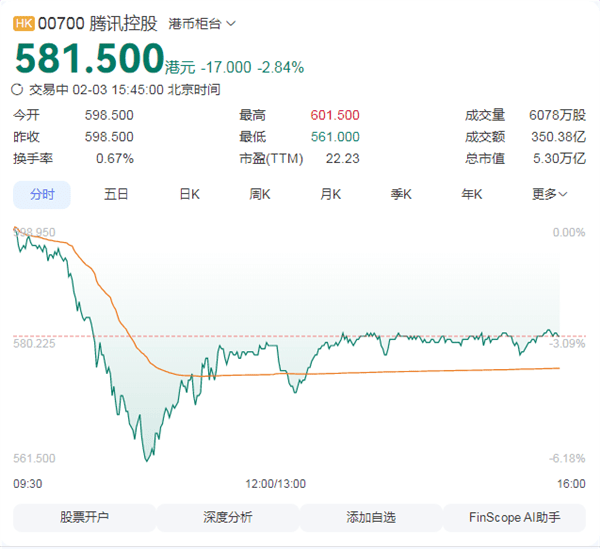
Summary of Conference Call Records Company: Tencent Key Points 1. **Market Volatility and Emotional Response** Tencent's stock price experienced significant fluctuations, primarily driven by short-term funding and psychological factors rather than a shift in business fundamentals. The core reasons include: - Rumors regarding a substantial increase in the gaming value-added tax led to irrational market reactions, causing a flight of risk-averse capital [1] - The company entered a silent period before its annual report on January 18, resulting in the absence of regular buyback support of approximately HKD 1 billion per day, which left the stock vulnerable to negative pressures [1] - Technical sell-offs occurred as the stock price breached critical technical levels, triggering passive liquidations from quantitative hedging and margin financing, amplifying intraday declines [1] 2. **Tax Risk Overreaction** The current market panic is viewed as a classic case of "wrongful killing," with the core investment logic remaining intact. Key insights include: - The tax increase in the telecommunications sector is a "category realignment" rather than a broad increase, with no legal basis for tax hikes on internet applications at present. The implementation of the VAT law on January 1, 2026, specifies three tax rates, and any significant tax adjustments require rigorous legislative processes, making sudden tax increases unlikely in the short term [2] - Even under the most pessimistic scenario where Tencent's core "value-added services" and "marketing services" are reclassified into a 9% tax bracket (currently at 6%), the potential impact on Tencent's net profit would only be between 5% to 8%, which is manageable within the company's substantial cash reserves [2] 3. **Strong Profitability and Valuation** Tencent's profitability remains robust, with a gross margin reaching a historical high of 56% in Q3 2025. The growth rate of Non-IFRS net profit (18%) significantly outpaces revenue growth, and the monetization benefits from the WeChat ecosystem (including video accounts and mini-programs) continue to be realized [2] - The current TTM price-to-earnings ratio of around 22 times has already factored in most macroeconomic pessimism. Following the end of the silent period in March, the company's unprecedented buyback plan (totaling over HKD 100 billion in 2024) is expected to act as a stabilizing force for valuation recovery [2] 4. **AI and Strategic Positioning** The panic selling is attributed to an over-projection of "debt logic." Tencent plays a crucial role in the ongoing AI competition between China and the U.S., particularly in AI accessibility and the international expansion of internet gaming, while maintaining stable relations with authorities. The company's fundamental position remains solid, suggesting that investors should maintain composure and look for rebound opportunities after the recent declines [3]
外围不确定性未除,恒指料续波动
Guodu Securities Hongkong· 2026-02-04 02:00
Group 1: Market Overview - The Hang Seng Index experienced volatility, initially rising over 300 points before dropping due to concerns over potential increases in value-added tax for technology stocks, ultimately closing up 59 points or 0.22% at 26,834 points [3][4] - The total market turnover for the day was 335.15 billion [3] Group 2: Technology Sector Concerns - Concerns arose regarding the increase in value-added tax for telecommunications services, leading to significant declines in major tech stocks such as Tencent, which fell 2.9% to 581 HKD, and Kuaishou, which dropped 4.6% to 73.45 HKD [4][9] - The adjustment of the value-added tax rate from 6% to 9% for telecommunications services has raised fears that similar increases may affect other sectors, particularly internet value-added services [9] Group 3: Gold Market Analysis - Citi's report indicates that gold prices are expected to decline, with a potential drop to 3,000 USD per ounce in a bear market scenario, while the baseline scenario predicts a decrease to 4,000 USD by 2027 [7][8] - Current gold prices have reached extreme levels, with the annual expenditure on gold as a percentage of GDP rising to 0.7%, the highest in 55 years, indicating a disconnection from the mining industry's marginal production costs [7] Group 4: Company News - Gilead Sciences announced a placement of 69.256 million new shares at a price of 12.18 HKD per share, raising approximately 844 million HKD, with 90% of the proceeds allocated for clinical trials of a new obesity treatment [11] - Cloud Wisdom plans to issue 1.008 million new H shares at a price of 310 HKD per share, raising approximately 312 million HKD, with proceeds aimed at enhancing its core technology capabilities [12] - Huatai Securities intends to issue 10 billion HKD in zero-coupon convertible bonds to support overseas business development and operational funding [14]
A股、港股AI应用股集体下挫 引力传媒触及跌停
Jing Ji Guan Cha Wang· 2026-02-04 01:57
Group 1 - A-shares and Hong Kong stocks related to AI applications experienced a collective decline [1] - In the A-share market, companies such as Gravity Media (603598) hit the daily limit down, while Tian Di Online (002995), Zhi De Mai (300785), InSai Group (300781), Yi Dian Tian Xia (301171), and Sheng Guang Group (002400) saw significant declines [1] - In the Hong Kong market, Meitu Company dropped over 10%, while Zhi Pu and MINIMAX-WP fell more than 5%, with Kingsoft, Tencent Holdings, and Alibaba-W also declining [1]





发红包能否换来AI刚需
Bei Jing Ri Bao Ke Hu Duan· 2026-02-04 01:50
本报记者 袁璐 春节临近,互联网巨头间的"红包大战"再度打响。腾讯元宝抢先出手,撒出10亿元现金红包;百度紧随 其后,投入5亿元加入战局;阿里千问则启动规模达30亿元的"春节请客计划"。 这场亿元级别的"红包雨",背后是大厂对AI(人工智能)流量入口的激烈争夺,各家都想复刻当年微信 通过红包引爆市场的成功。但行业专家指出,若后续产品力不足,热闹可能只是"昙花一现"。唯有把短 期流量转化为真实的用户习惯,才是实现长效增长的关键。 春节红包大战再起 2月2日,阿里巴巴旗下AI助手"千问"宣布将于6日正式上线总额30亿元的"春节请客计划"。该计划联合 淘宝闪购、飞猪、大麦、盒马等阿里系业务,以"免单"形式为用户提供消费福利。 1月25日,腾讯元宝宣布将分10亿元现金红包,活动自2月1日持续至17日,单个红包最高可达万元。同 日,百度也宣布,1月26日至3月12日期间,在百度App使用文心助手可参与瓜分5亿元现金红包,最高 奖励同样为1万元。 记者注意到,与以往"直接撒钱"不同,此次三家公布的红包活动均与AI产品功能进行了深度绑定。 腾讯元宝的红包玩法植根于其社交生态。用户可通过每日登录、完成任务抽奖、分享至微信或Q ...

港股明星科网股连日走低,BOSS直聘(02076.HK)跌超3%,携程集团-S(09961.HK)跌超2%,哔哩哔哩(09626.HK)、腾讯控股(00...
Jin Rong Jie· 2026-02-04 01:49
港股明星科网股连日走低,BOSS直聘(02076.HK)跌超3%,携程集团-S(09961.HK)跌超2%,哔哩哔哩 (09626.HK)、腾讯控股(00700.HK)、快手(01024.HK)、美团(03690.HK)、百度(09888.HK)、阿里巴巴 (09988.HK)等个股跟跌。 本文源自:金融界AI电报 ...


A股低开,贵金属板块走强
第一财经· 2026-02-04 01:48
Market Overview - The A-share market opened lower with the Shanghai Composite Index down 0.08%, the Shenzhen Component down 0.39%, and the ChiNext Index down 0.80% [3][4] - The Hong Kong market also opened lower, with the Hang Seng Index down 0.14% and the Hang Seng Tech Index down 0.87% [5][6] Sector Performance - The storage chip sector experienced significant declines, with companies like Deep Kangjia A hitting the daily limit down, and others such as Puran, Lanke Technology, Baiwei Storage, and Shannon Chip also opening lower [2] - The AI computing power industry chain saw a downturn, particularly in the storage and CPO sectors, while semiconductor and consumer electronics themes were among the hardest hit [4] - Conversely, gold, basic metals, and oil and gas sectors showed signs of rebound [4]