
TENCENT(00700)

Search documents
恒指升668點,標普500跌71點
宝通证券· 2026-02-24 03:19
Market Performance - The Hang Seng Index (HSI) rose by 668 points or 2.5%, closing at 27,081 points[1] - The Hang Seng China Enterprises Index increased by 237 points or 2.7%, closing at 9,197 points[1] - The Hang Seng Tech Index gained 173 points or 3.3%, closing at 5,385 points[1] - Total market turnover for the day was HKD 172.963 billion[1] U.S. Market Reaction - The Dow Jones Industrial Average fell by 821 points or 1.7%, closing at 48,804 points[1] - The S&P 500 Index decreased by 71 points or 1%, closing at 6,837 points[1] - The Nasdaq Composite Index dropped by 258 points or 1.1%, closing at 22,627 points[1] Economic Developments - The U.S. Supreme Court rejected Trump's tariffs, leading to a significant rise in Hong Kong stocks[1] - The U.S. Customs and Border Protection announced the cessation of tariffs related to the International Emergency Economic Powers Act, effective February 24[2]


春节前后多款游戏运营数据创新高,聚焦游戏ETF(159869)低位布局窗口
Mei Ri Jing Ji Xin Wen· 2026-02-24 03:18
Core Viewpoint - The gaming sector is demonstrating resilience in the current macroeconomic environment, with significant performance from both listed and non-listed companies ahead of the 2026 Spring Festival, confirming the anticipated strong product cycle for the year [1] Group 1: Company Performance - Tencent Holdings, Huya, and Kingsoft, along with A-share companies like Century Huatong and Giant Network, have shown strong operational data for their games [1] - Century Huatong's casual game "Yihuan" has surpassed 25 million pre-registrations [1] - Giant Network's "Supernatural Action Group" announced a daily active user (DAU) count exceeding 10 million as of February 2 [1] Group 2: Market Trends - The gaming sector is experiencing multiple catalysts, including AI, content innovation, and changes in commercialization models [1] - The gaming ETF (159869) tracks the China Securities Animation and Gaming Index, which leads the market in AI application content, accurately reflecting the overall performance of the A-share animation and gaming industry [1] - The current environment is characterized by favorable policies, product cycles, and AI empowerment, creating a potential investment window in the gaming sector [1]




大厂开工红包揭秘:百度最高金额2026元,腾讯人均400元,雷军亲自发钱
Xin Lang Cai Jing· 2026-02-24 03:11
新浪科技讯 2月24日上午消息,农历新年开工第一天,百度、腾讯、快手、小米等企业给员工发放开工 红包。 新浪科技了解到,百度创始人李彦宏的数字人通过工作软件"如流"的服务号向员工发放开工红包,红包 金额为365元、588元、666元、888元、2026元不等,实习生则可获得188元。值得注意的是,此前百度 并没有在春节假期结束后发放开工红包的习惯。 腾讯面向正式员工、毕业生、实习生、长期顾问发放开工红包,金额为400元。此外,腾讯还准备了随 机"加油包",不同的"开心词"对应不同金额,金额为19.98元、20.26元、66.66元和52.22元不等,领取红 包后约2小时内到账微信零钱。 and stoken 2026年开工啦,祝各位同事新年快 乐,开工大吉。今年除了"开工利是" 外,仍为大家准备了随机"加油包",快 来参与领取吧 领取范围 合同地为中国内地的腾讯集团本部正式 员工、毕业生、实习生、长期顾问 领取时间 2026年2月24日10:00-3月3日23:59 领取方式及金额 开工利是:400元/人 获取开工词,即可随机获得"加油包" 不忘初心 19.98元 概率为 47.30% 新年进步 20.26元 ...




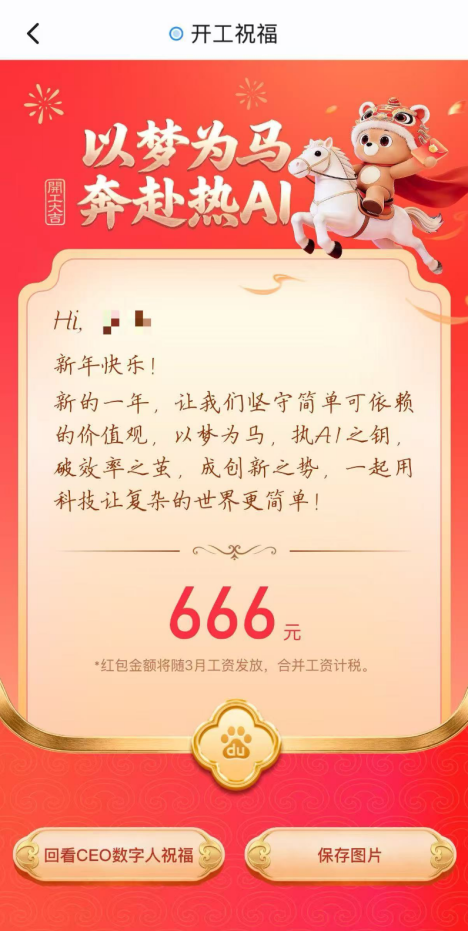
大厂开工红包揭秘:百度首派红包,腾讯设随机“加油包”,雷军亲临现场
Xin Lang Cai Jing· 2026-02-24 03:05
新浪科技讯 2月24日上午消息,农历新年开工第一天,百度、腾讯、快手、小米等企业给员工发放开工 红包。 新浪科技了解到,百度创始人李彦宏的数字人通过工作软件"如流"的服务号向员工发放开工红包,红包 金额为365元、588元、666元、888元、2026元不等,实习生则可获得188元。值得注意的是,此前百度 并没有在春节假期结束后发放开工红包的习惯。 领取时间 腾讯面向正式员工、毕业生、实习生、长期顾问发放开工红包,金额为400元。此外,腾讯还准备了随 机"加油包",不同的"开心词"对应不同金额,金额为19.98元、20.26元、66.66元和52.22元不等,领取红 包后约2小时内到账微信零钱。 and stoken 2026年开工啦,祝各位同事新年快 乐,开工大吉。今年除了"开工利是" 外,仍为大家准备了随机"加油包",快 来参与领取吧 领取范围 合同地为中国内地的腾讯集团本部正式 员工、毕业生、实习生、长期顾问 2026年2月24日10:00-3月3日23:59 领取方式及金额 开工利是:400元/人 获取开工词,即可随机获得"加油包" 不忘初心 19.98元 概率为 47.30% 新年进步 20.26元 ...
未知机构:游戏观点及春节观察260223核心观点锐度看好PC渠道重估IAA出海-20260224
未知机构· 2026-02-24 02:45
Summary of Key Points from the Conference Call Industry Overview - The focus is on the gaming industry, particularly during the Chinese New Year period, highlighting a K-shaped differentiation in game performance [1][2]. Core Insights - **K-shaped Differentiation**: Low ARPU "value games" and high ARPU "luxury games" performed well, while traditional mid-ARPU "light luxury games" underperformed [1]. - **Low ARPU "Value Games"**: Primarily consist of Tencent's high DAU games and several youth-targeted games, along with casual games [2]. - **High ARPU "Luxury Games"**: Examples include certain high-profile games that benefit from celebrity endorsements, indicating strong revenue potential [2]. - **Mid ARPU "Light Luxury Games"**: Includes genres like anime games and traditional MMOs, which are currently facing challenges [2]. Market Trends - **Commercialization Strategies**: Observations indicate a shift in game monetization strategies, such as increasing top-tier item prices through skin pools while offering lower-priced bundles to enhance user experience [2]. - **Macro Consumption Environment**: The changes in game performance and monetization are attributed to the broader macroeconomic conditions affecting consumer behavior in China [2]. Future Opportunities - **Football Games**: Anticipation for a strong performance in football games due to the upcoming 2026 World Cup in North America, suggesting a cyclical peak in this segment [3]. - **PC Channel Revaluation**: There is optimism regarding the revaluation of PC channels, with specific companies like Shunwang and ShengTian being highlighted [3]. - **IAA Overseas Expansion**: While no suitable targets have been identified yet, there is ongoing exploration in the IAA overseas direction [3]. Investment Recommendations - **A-Share Recommendations**: Companies such as Kaiying (for its integration in the legendary industry chain), Huatuo (for continuous revenue growth), Shunwang (for PC channel and computing power leasing), and Perfect World (for exceeding expectations with a new game) are recommended [3]. - **H-Share Recommendations**: Tencent is highlighted for its strong performance during the holiday season, along with other companies like Xindong and Baiao, which show promising overseas and channel performance [3].



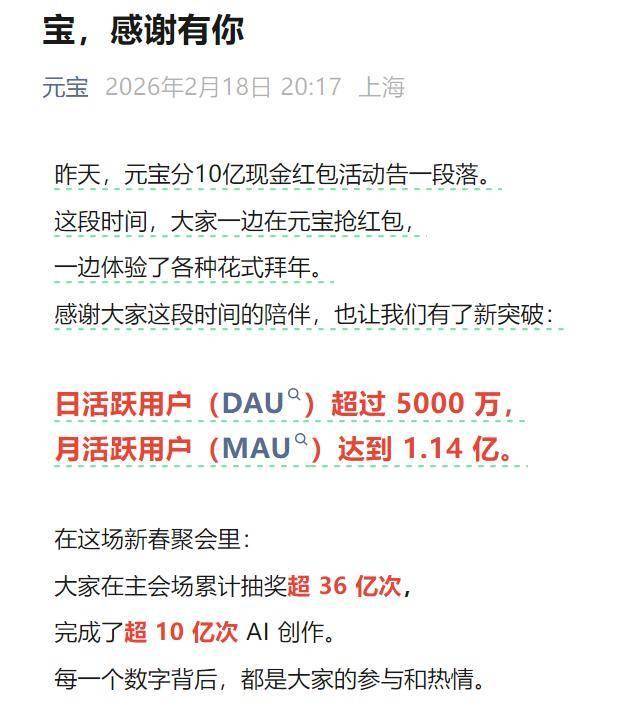
元宝分10亿现金红包活动收官,月活跃用户达1.14亿
Sou Hu Cai Jing· 2026-02-24 02:12
Core Insights - Yuanbao has concluded its 1 billion cash red envelope campaign, expressing gratitude for user support and highlighting new breakthroughs [3] - The platform has achieved over 50 million daily active users (DAU) and 114 million monthly active users (MAU), with 159 new features updated within 21 days [3] - The campaign, launched on February 1, aimed to reward users with cash red envelopes, with individual amounts reaching up to 10,000 yuan, generating significant attention [3] - Tencent's chairman, Ma Huateng, emphasized the goal of this campaign is to replicate the success of WeChat red envelopes from 11 years ago [3] - The core mechanism of the Yuanbao red envelope activity focuses on social sharing, allowing users to forward red envelopes via WeChat and QQ, increasing their chances of winning with each new participant [3]
80亿元红包之后,AI应用迎“留量”大考
Zheng Quan Ri Bao· 2026-02-24 01:53
Core Insights - The competition among AI companies for user acquisition during the Spring Festival has intensified, with significant investments aimed at establishing future traffic entry points [1][2][12] - Major players like ByteDance, Tencent, Alibaba, and Baidu have adopted distinct strategies to attract users through various promotional activities [3][10] Investment and Strategy - AI companies collectively invested over 8 billion yuan during the Spring Festival, with specific allocations such as 3 billion yuan by Qianwen, 1 billion yuan by Yuanbao, and ByteDance securing exclusive rights for the Spring Festival Gala [2][3] - The strategies vary: Baidu focuses on integrating search with AI, Tencent leverages social features for user growth, Alibaba emphasizes consumer habits through incentives, and ByteDance aims for broad exposure through entertainment [3][10] User Engagement and Interaction - On New Year's Eve, AI applications saw massive user interaction, with Qianwen's activities resulting in over 1.3 billion interactions and significant user engagement through various tasks [4][8] - Users reported varying levels of success in redeeming rewards, with some achieving substantial cash bonuses while others experienced limited engagement [5][9] Post-Festival User Retention - The challenge of retaining users post-festival is evident, with reports indicating a significant drop in app usage after the initial excitement of the promotions [8][10] - Experts suggest that the reliance on cash incentives may lead to low retention rates, emphasizing the need for companies to cultivate user habits beyond the promotional period [10][11] Future Outlook - Companies are preparing for post-festival user retention by embedding AI capabilities into existing platforms and exploring new social features to enhance user engagement [10][12] - The long-term goal is to transition from merely attracting users to fostering a sustainable ecosystem that encourages regular use of AI applications [12]

华源证券:传媒行业AI应用加速迭代 内容消费格局凸显
智通财经网· 2026-02-24 01:52
Group 1: AI Applications - The competition for super entry points in the AI era is intensifying, with domestic large models accelerating iteration [1] - Major companies like ByteDance, Alibaba, Tencent, and Baidu are deeply integrating AI technology into program production and real-time interaction during the 2026 Spring Festival Gala [1] - The focus of domestic AI large model technology competition is shifting from general capabilities to native agent capabilities, emphasizing task planning, tool invocation, and long-term execution [1] Group 2: Gaming Industry - During the Spring Festival period from February 1 to 21, 2026, player preferences leaned towards high DAU games, particularly in the MOBA and FPS segments [2] - Tencent Games dominated the market with titles like "Honor of Kings" and "Peacekeeper Elite" consistently ranking in the top two [2] - The mid-tier ranking is highly competitive, with games like "Endless Winter" and "Naruto" fluctuating in their positions due to limited-time events and version updates [2] Group 3: Film Industry - The 2026 Spring Festival box office reached over 4.8 billion yuan, a decrease of approximately 50% compared to the same period in 2025 [3] - "Fast and Furious 3" became the box office champion with over 2.4 billion yuan, accounting for 50.9% of the total box office [3] - There is a noticeable trend of audience migration to lower-tier cities, with these cities contributing about 60% of the total box office [3]
春节旅行、生活娱乐交易热 假期前六天微信支付相关交易笔数同比涨超20%
Xin Hua She· 2026-02-24 01:13
Core Insights - The WeChat platform reported a significant increase in payment consumption during the Spring Festival holiday period from February 15 to 20, with transaction volumes for travel and entertainment rising over 20% year-on-year [1] Domestic Travel - Scenic spots in cities like Nanchong and Kaifeng saw transaction volumes increase by over 50% year-on-year, while Suzhou, Huangshan, Xi'an, and Putian experienced over 30% growth in transaction volumes [1] - The transaction amount for duty-free programs in Hainan increased by 81% year-on-year [1] Cross-Border Travel - Offline transaction consumption in Malaysia and the Maldives grew by 131% and 186% year-on-year, respectively [1] - There was a notable increase in transaction volumes from overseas tourists using WeChat to bind international bank cards for offline transactions, with a year-on-year growth of over 28% [1] - WeChat Pay now supports 12 countries and regions with 29 overseas wallets for "foreign use domestically" [1]
财联社“马年春节长假”新闻精选
Xin Lang Cai Jing· 2026-02-24 01:12
Domestic Highlights - Xi Jinping's article in the latest issue of "Qiushi" emphasizes the importance of domestic demand and building a strong domestic market, with a focus on promoting consumption and expanding investment [1] - ByteDance's chip R&D team is set to begin large-scale recruitment, with multiple cloud chips already in mass production [1] - AI high-speed optical module orders are fully booked until Q4, with production bases in Wuhan and Thailand operating continuously during the Spring Festival [1] - Honor plans to launch its first humanoid robot during the 2026 Mobile World Congress, aiming to enter the consumer market as the first smartphone company to do so [1] - The Ministry of Industry and Information Technology has issued guidelines for the wine and tea industries, aiming to cultivate multiple billion-dollar production areas and industry clusters by 2028 [1][1] - The central government aims to modernize agriculture as a major industry, focusing on integrating agriculture with tourism and other sectors [1] Financial and Market Developments - The People's Bank of China reported a 9% year-on-year increase in M2 money supply as of the end of January, exceeding market expectations [1] - Meituan expects a preliminary net loss of RMB 233 billion to 243 billion for 2025, primarily due to a shift from profit to loss in its core local business segment [2] - The Hang Seng Index rose by 2.53% on February 23, with technology stocks, including semiconductor and internet sectors, performing well [2] - The China Securities Regulatory Commission is investigating Tianfeng Securities for information disclosure violations related to shareholding changes [2] International Highlights - Global capital markets saw most indices rise during the Spring Festival, with significant increases in international gold and silver prices [2] - SK Hynix indicated that the storage chip market is entering a "seller's market" due to a surge in AI demand and supply constraints [2] - Nvidia and Meta Platforms announced a strategic partnership to deploy millions of Nvidia chips across various infrastructures [2] - The European Parliament has decided to suspend the approval process for the EU-US trade agreement, delaying a scheduled vote [2]

