
KUAISHOU(01024)

Search documents
传媒互联网数据月报:港美股披露3Q业绩,年末娱乐景气度提升-20251214
CICC· 2025-12-14 08:37
Investment Rating - The report maintains an "Outperform" rating for the media and internet industry, with specific stock recommendations across various segments [5][8]. Core Insights - The media sector experienced a slight rebound in November, with the advertising segment gaining traction due to AI applications, while other segments showed minor fluctuations. The demand for entertainment is expected to rise towards the end of the year, suggesting potential opportunities in niche segments [3][4]. - Key trends for 2026 include a supportive policy environment fostering resilient growth, with a focus on AI applications, overseas expansion of Chinese content, and the revaluation of IP value driven by upgraded demand [3][4]. - The report highlights strong Q3 performance in Hong Kong and US stocks, particularly in gaming and social media sectors, with notable revenue growth from Tencent and Kuaishou [3][4][18]. Summary by Sections Industry Dynamics - The media index rose by 1.69% in November, contrasting with a decline in the Shanghai Composite Index by 1.67%. Sub-sectors showed varied performance, with digital media up by 1.76% and advertising marketing up by 9.68% [2][11]. - The gaming sector saw a record high in the issuance of domestic game licenses in November, with 178 games approved, indicating a robust supply side [20]. Company Performance - Tencent Music reported a revenue of 8,463 million, exceeding expectations, while iQIYI's performance was in line with forecasts at 6,682 million [18]. - Kuaishou's revenue reached 35,554 million, meeting expectations, driven by advancements in AI technology [18]. Valuation and Recommendations - The report maintains target prices and ratings for covered companies, recommending stocks such as Century Huatong, Mango Excellent Media, and Kuaishou for A-shares, and Tencent Music and iQIYI for Hong Kong and US stocks [5][8]. - Specific stock recommendations include Century Huatong (target price 26.50), Kuaishou (target price 89.00), and iQIYI (target price 2.50), all rated as "Outperform" [5][8].


统一视觉多模态与多任务!快手可灵与港科大团队发布视频生成模型,加速真实世界理解
量子位· 2025-12-14 07:12
Core Insights - The article introduces UnityVideo, a new visual framework developed by research teams from Hong Kong University of Science and Technology, Chinese University of Hong Kong, Tsinghua University, and Kuaishou, which enhances video generation by integrating multiple visual modalities [1][3][4]. Group 1: Model Capabilities - UnityVideo utilizes unified training across various visual modalities such as depth maps, optical flow, skeletons, and segmentation masks, allowing the model to better understand the physical world and generate more realistic and controllable videos [3][12]. - The model demonstrates zero-shot generalization, enabling it to generate reasonable results for previously unseen objects or scenes [4][16]. - The unified training approach significantly accelerates convergence speed and improves performance in RGB video generation tasks compared to single modality training [15][16]. Group 2: Technical Innovations - UnityVideo features dynamic task routing, allowing seamless integration of three training paradigms within a single architecture [19]. - A key breakthrough is the dynamic noise scheduling strategy, which randomly selects training modes during iterations, preventing catastrophic forgetting and enabling harmonious coexistence of multiple training objectives [21][22]. - The model incorporates a context learner and a modality-adaptive switcher to effectively distinguish between different modality signals, enhancing its ability to generalize across tasks [27][30]. Group 3: Training Strategy - UnityVideo employs a two-phase curriculum learning strategy, first training on carefully selected single-person scene data to establish spatial correspondence, followed by introducing all modalities and diverse scene data [33][35]. - The OpenUni dataset, containing 1.3 million multimodal video samples, supports this unified training paradigm, ensuring balanced sampling across modalities [35][36]. Group 4: Performance Results - UnityVideo outperforms existing models in various tasks, achieving high scores in physical reasoning, controllable generation, and modality estimation [39][41]. - The model's qualitative results demonstrate superior understanding of physical phenomena, such as light refraction in water, and maintains high video quality without common issues like background flickering [41][42]. - In quantitative comparisons, UnityVideo achieves a background consistency score of 97.44% and an aesthetic quality score of 64.12% in text-to-video generation tasks [44]. Group 5: Generalization and Understanding - The model exhibits strong generalization capabilities, accurately estimating unseen data and overcoming overfitting issues common in specialized models [43][56]. - UnityVideo's design emphasizes the importance of integrating multiple dimensions of perception, akin to human understanding, which enhances its ability to model physical laws and improve overall video generation quality [60][65].


智通港股通活跃成交|12月12日





智通财经网· 2025-12-12 11:02
Core Insights - On December 12, 2025, Alibaba-W (09988), SMIC (00981), and Xiaomi Group-W (01810) were the top three companies by trading volume in the Southbound Stock Connect, with trading amounts of 3.598 billion, 2.071 billion, and 2.057 billion respectively [1] - In the Shenzhen-Hong Kong Stock Connect, Alibaba-W (09988), Xiaomi Group-W (01810), and Meituan-W (03690) led the trading volume, with amounts of 5.836 billion, 4.252 billion, and 3.826 billion respectively [1] Southbound Stock Connect Trading Activity - **Top Active Companies in Southbound Stock Connect**: - Alibaba-W (09988): Trading amount of 3.598 billion, net buy of -0.626 billion [2] - SMIC (00981): Trading amount of 2.071 billion, net buy of -0.292 billion [2] - Xiaomi Group-W (01810): Trading amount of 2.057 billion, net buy of -0.597 billion [2] - Tencent Holdings (00700): Trading amount of 1.882 billion, net buy of -0.193 billion [2] - Changfei Optical Fiber (06869): Trading amount of 1.409 billion, net buy of +0.64978 million [2] Shenzhen-Hong Kong Stock Connect Trading Activity - **Top Active Companies in Shenzhen-Hong Kong Stock Connect**: - Alibaba-W (09988): Trading amount of 5.836 billion, net buy of -2.742 billion [2] - Xiaomi Group-W (01810): Trading amount of 4.252 billion, net buy of +2.959 billion [2] - Meituan-W (03690): Trading amount of 3.826 billion, net buy of +2.850 billion [2] - Tencent Holdings (00700): Trading amount of 3.495 billion, net buy of -0.803 billion [2] - SMIC (00981): Trading amount of 1.447 billion, net buy of -0.287 billion [2]
抖音电商开展应季瓜果品类专项治理 共处置违规商品超1.4万个
Zheng Quan Ri Bao Wang· 2025-12-12 10:42
Core Insights - Douyin E-commerce has launched a seasonal governance announcement targeting issues in the fruit category, particularly during the winter sales peak, addressing problems such as false specifications, discrepancies in size or weight, and substandard products [1] - Over the past three months, Douyin E-commerce has dealt with more than 14,000 violations, taking action against 3,226 non-compliant merchants and over 600 influencers [1] - The platform has intensified inspections and risk control measures for high-demand products like cherries, implementing strict penalties for severe violations, including delisting, business suspension, and fund freezing [1] Summary by Sections Governance Actions - Douyin E-commerce has conducted a special governance initiative to combat seasonal issues in fruit sales, focusing on consumer rights protection [1] - The platform has disposed of over 14,000 non-compliant products and taken measures against 3,226 merchants, including business suspensions and expulsions [1] Violations Identified - Common violations include exaggerating product weight, false advertising of specifications, and malicious dumping of low-quality goods [1] - Specific examples include discrepancies in weight claims, delivery of spoiled or defective products, and misleading promotional practices [1] Platform Response - The platform has implemented penalties such as freezing commissions, permanently closing e-commerce privileges, and deducting fines for violating accounts [2] - Douyin E-commerce encourages merchants to adhere to platform rules and improve after-sales service to ensure a safe and quality shopping experience for consumers [2]
阻止互联网广告下滑,全靠AI?
3 6 Ke· 2025-12-12 10:38
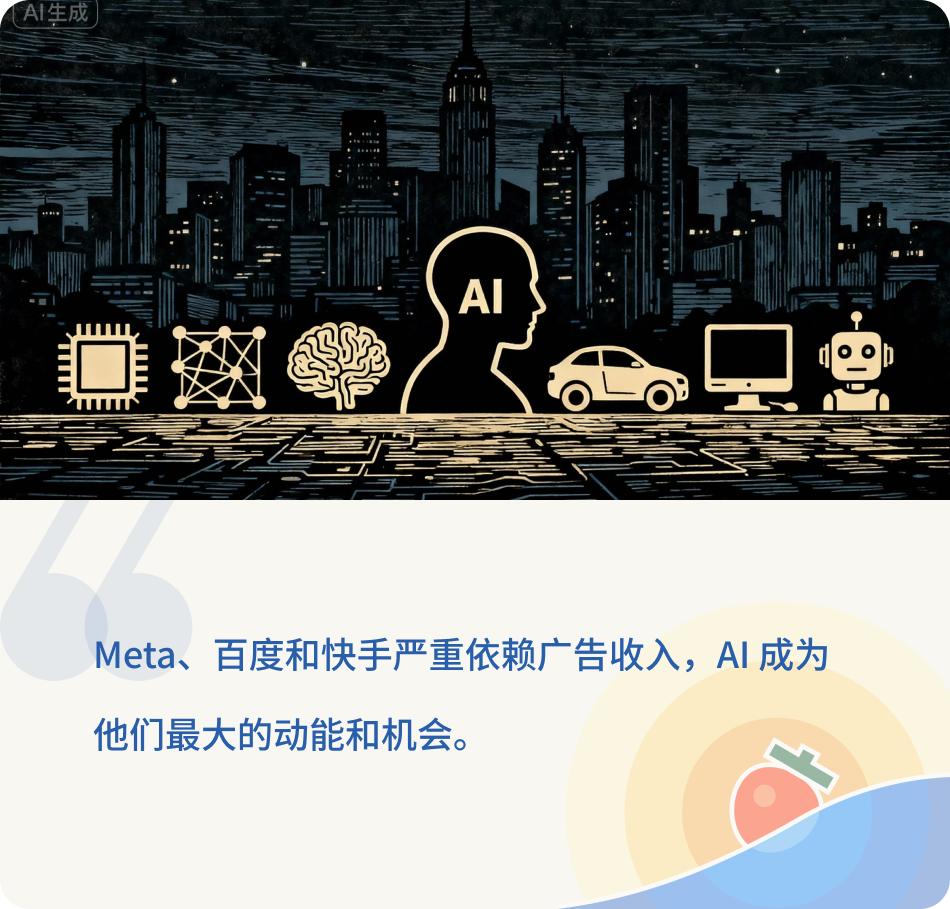
Core Insights - The article discusses how AI is becoming a crucial driver for advertising revenue in major internet companies, particularly Baidu and Kuaishou, as they seek to counteract declines in traditional advertising revenue [2][3][4][5]. Group 1: AI's Impact on Advertising Revenue - Baidu's AI native marketing service revenue reached 2.8 billion yuan, a year-on-year increase of 262%, contributing significantly to its core online marketing revenue [5]. - Kuaishou reported online marketing service revenue of 20.1 billion yuan, a 14% year-on-year growth, with AI-driven initiatives like OneRec contributing approximately 4%-5% to Q3 revenue [5][7]. - Meta also benefits from AI, with a 26% year-on-year increase in advertising revenue, highlighting the trend of AI enhancing advertising efficiency across platforms [8]. Group 2: AI as a Growth Engine - Baidu's core online marketing services account for 53% of total revenue, making AI a vital narrative for growth as traditional search advertising declines [3][4]. - Kuaishou's AI initiatives are seen as a means to generate new revenue streams, with a significant portion of its revenue coming from online marketing services [7]. - The integration of AI in advertising is viewed as a transformative force, allowing for dynamic content generation and improved targeting [10][12]. Group 3: Broader Industry Trends - AI is reshaping the marketing landscape, with companies like Meta and Kuaishou leveraging AI to enhance user engagement and advertising effectiveness [10][15]. - The global advertising market is experiencing a shift towards AI-driven solutions, with projections indicating substantial growth in AI advertising spending [18]. - Despite the promising outlook, challenges remain, including consumer skepticism towards AI-generated content and the need for a balance between investment and return [20][21].


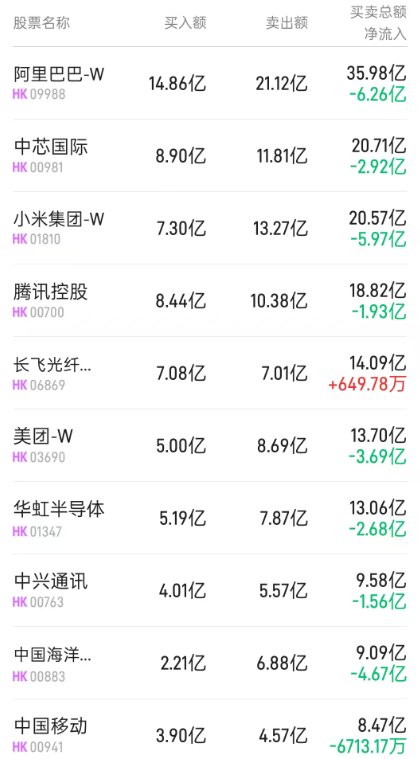
北水动向|北水成交净卖出52.87亿 北水明显调仓科网股 继续抛售芯片股
Zhi Tong Cai Jing· 2025-12-12 10:04
Core Insights - The Hong Kong stock market experienced a net sell-off of 52.87 billion HKD from northbound trading, with a net sell of 65.95 billion HKD from the Shanghai-Hong Kong Stock Connect and a net buy of 13.09 billion HKD from the Shenzhen-Hong Kong Stock Connect [1] Northbound Trading Summary - The most net bought stocks included Meituan-W (03690), Xiaomi Group-W (01810), and Beike-W (02423) [1] - The most net sold stocks included Alibaba-W (09988), Tencent (00700), and Hua Hong Semiconductor (01347) [1] Stock Performance Details - Alibaba-W (09988) had a net buy of 14.86 billion HKD and a sell of 21.12 billion HKD, resulting in a net outflow of 6.26 billion HKD [2] - Xiaomi Group-W (01810) saw a net buy of 7.30 billion HKD against a sell of 13.27 billion HKD, leading to a net outflow of 5.97 billion HKD [2] - Meituan-W (03690) recorded a net buy of 5.00 billion HKD and a sell of 8.69 billion HKD, resulting in a net outflow of 3.69 billion HKD [2] Sector-Specific Insights - Meituan-W (03690) received a net buy of 24.81 billion HKD, while Alibaba (09988) faced a net sell of 33.68 billion HKD, with expectations of increased competition in the food delivery sector [4] - Xiaomi Group-W (01810) attracted a net buy of 23.61 billion HKD, supported by positive growth in its smartphone and IoT businesses, with projected adjusted net profits of 446, 515, and 622 billion CNY for 2025-2027 [4] - Beike-W (02423) had a net buy of 9.96 billion HKD, with analysts optimistic about its AI capabilities and cost control despite challenges in the real estate market [5] Additional Company Updates - Kuaishou-W (01024) received a net buy of 5.98 billion HKD, with expectations of strong revenue contributions from its AI initiatives [5] - ZTE Corporation (00763) faced a net sell of 1.56 billion HKD, with plans to repurchase shares amid compliance investigations [5] - Semiconductor companies like SMIC (00981) and Hua Hong Semiconductor (01347) experienced net sells of 5.78 billion HKD and 7.35 billion HKD, respectively, following news of potential sales of AI chips to China [6]


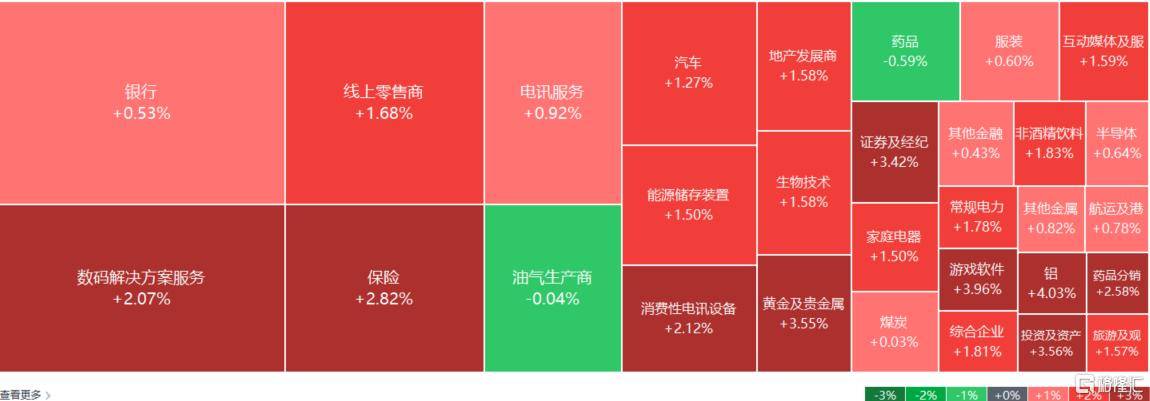
港股收评:指数集体上扬!大金融股、黄金股走强,药品股低迷


Sou Hu Cai Jing· 2025-12-12 09:01
Market Overview - The market sentiment improved significantly due to favorable news from the Central Economic Work Conference, with the Hang Seng Index rising by 1.75% and returning to 26,000 points [1] - Major technology stocks collectively increased, with NetEase rising over 4%, Tencent and Alibaba up over 2%, and other tech companies like Xiaomi, Baidu, JD.com, and Kuaishou also seeing gains [1][3] Sector Performance - **Electric Power Equipment**: Strong performance with Dongfang Electric up over 13% and other companies like Harbin Electric and Shanghai Electric also showing significant gains [1][5] - **Financial Sector**: All major financial stocks, including China Pacific Insurance and CITIC Securities, saw increases, with HSBC reaching a market value of over HKD 2 trillion [1][8] - **Precious Metals**: Gold and silver prices surged, leading to active trading in gold stocks, with China Silver Group rising nearly 6% [1][6] - **Consumer Sector**: Restaurant stocks were active, with companies like Da Shi and Haidilao seeing notable increases, driven by policies aimed at boosting consumption [10] - **Real Estate**: Property stocks rose, with Longguang Group increasing over 4%, supported by policies to stabilize the real estate market [12] Individual Stock Highlights - **NetEase**: Stock price increased by 4.20% to HKD 218.40 [4] - **Dongfang Electric**: Stock price surged by 13.59% to HKD 24.90 [5] - **China Pacific Insurance**: Stock price rose by 5.68% to HKD 34.60 [9] - **China Silver Group**: Stock price increased by 5.80% to HKD 0.730 [7] - **Xuan Bamboo Bio**: Stock price increased by 25.19% to HKD 96.90, reaching a new high [16][19] Economic Policy Impact - The Central Economic Work Conference emphasized the importance of domestic demand and consumer spending, with plans to implement measures to boost consumption and stabilize the real estate market [10][12]
红果大手笔买入AI漫剧,一分钟出价三万元
36氪未来消费· 2025-12-12 09:01
Core Viewpoint - The article discusses the emergence of "manhua drama" (漫剧) as a new trend in the entertainment industry, leveraging AI technology to reduce production costs and increase efficiency, marking 2025 as the "Year of Manhua Drama" [3][4][5]. Industry Overview - Manhua drama encompasses various forms, including meme-based comics, dynamic animations, and AI-generated 3D comics, with the definition still evolving [3]. - The industry is experiencing rapid growth, with a projected market size exceeding 20 billion yuan by 2025, driven by an 83% compound growth rate in supply during the first half of 2025 [7][9]. Financial Performance - Leading manhua drama brand Jiangyou Culture reports monthly revenues of 50 million yuan, while the company Lingju Animation has achieved a return on investment (ROI) of 1.15-1.2 [6]. - The average production cost for manhua dramas ranges from 50,000 to 150,000 yuan per episode, significantly lower than traditional short dramas, leading to higher profit margins [13][14]. Business Model - The business model for manhua dramas includes in-app advertising (IAA), in-app purchases (IAP), and hybrid monetization, with 80-90% of revenue still reliant on advertising spending [11][12]. - Companies are exploring new monetization strategies, such as brand collaborations and product placements, with successful examples already emerging [17]. Competitive Landscape - The competition in the manhua drama sector is primarily based on production volume, as the market is currently underserved [16][19]. - Major platforms like ByteDance, Tencent, and iQIYI are aggressively entering the manhua drama space, offering favorable revenue-sharing models to attract content creators [24]. Audience and Content Strategy - The primary audience for manhua dramas consists of males aged 20-30, contrasting with the female-dominated audience of traditional short dramas [23]. - The industry is awaiting a breakout hit to validate the manhua drama trend, similar to past successes in the short drama sector [25].


智通港股回购统计|12月12日


智通财经网· 2025-12-12 02:20
Core Viewpoint - Multiple companies conducted share buybacks on December 11, 2025, with Tencent Holdings leading in both the number of shares repurchased and the total amount spent [1][2]. Group 1: Buyback Details - Tencent Holdings (00700) repurchased 1.054 million shares for a total of 636 million [2]. - Xiaomi Group (01810) repurchased 2.3 million shares for a total of 97.2035 million [2]. - COSCO Shipping Holdings (01919) repurchased 3 million shares for a total of 41.3004 million [2]. - Geely Automobile (00175) repurchased 1.824 million shares for a total of 31.849 million [2]. - Kuaishou Technology (01024) repurchased 448,000 shares for a total of 29.9407 million [2]. Group 2: Cumulative Buyback Data - Tencent Holdings has a cumulative buyback of 89.367 million shares, representing 0.973% of its total share capital [2]. - Xiaomi Group has a cumulative buyback of 105 million shares, representing 0.400% of its total share capital [2]. - COSCO Shipping Holdings has a cumulative buyback of 81.543 million shares, representing 2.832% of its total share capital [2]. - Geely Automobile has a cumulative buyback of 6.529 million shares, representing 0.065% of its total share capital [2]. - Kuaishou Technology has a cumulative buyback of 7.7106 million shares, representing 0.180% of its total share capital [2]. Group 3: Notable Buybacks - Other notable companies that conducted buybacks include: - China Petroleum & Chemical Corporation (00386) with 2.546 million shares repurchased for 10.9615 million [2]. - Vitasoy International Holdings (00345) with 304,000 shares repurchased for 198.12 million [3]. - Coolpad Group (02369) with 3.42 million shares repurchased for 4.479 million [2]. - Weigao Group (01066) with 607,600 shares repurchased for 3.1692 million [2].
57家港股公司回购 斥资10.07亿港元
Zheng Quan Shi Bao Wang· 2025-12-12 02:13
Summary of Key Points Core Viewpoint - On December 11, 57 Hong Kong-listed companies conducted share buybacks, totaling 43.85 million shares and an aggregate amount of HKD 1.007 billion [1][2]. Group 1: Major Companies Involved in Buybacks - Tencent Holdings repurchased 1.054 million shares for HKD 636.36 million, with a year-to-date total buyback amount of HKD 72.408 billion [1][2]. - Xiaomi Group-W bought back 2.3 million shares for HKD 97.2035 million, with a year-to-date total of HKD 4.642 billion [1][2]. - China COSCO Shipping Holdings repurchased 3 million shares for HKD 41.3004 million, with a year-to-date total of HKD 6.278 billion [1][2]. Group 2: Buyback Amounts and Quantities - The highest buyback amount on December 11 was from Tencent Holdings at HKD 636.36 million, followed by Xiaomi Group-W at HKD 97.2035 million [1][2]. - The largest number of shares repurchased on December 11 was by Jinxin Fertility, with 3.846 million shares, followed by Coolpad Group and Tsingtao Textile with 3.42 million and 3.255 million shares, respectively [1][2]. Group 3: Additional Notable Companies - Geely Automobile repurchased 1.824 million shares for HKD 31.849 million, with a year-to-date total of HKD 1.148 billion [2]. - Kuaishou Technology bought back 448,000 shares for HKD 29.9407 million, with a year-to-date total of HKD 245.511 million [2]. - Country Garden Services repurchased 3 million shares for HKD 18.7084 million, with a year-to-date total of HKD 268.332 million [2].