
BYD(01211)

Search documents
比亚迪(002594):2026年1月销量点评:销量同环比降低,持续推进高端化和出口
Soochow Securities· 2026-02-02 23:30
Investment Rating - The investment rating for BYD is "Buy" (maintained) [1] Core Views - In January 2026, BYD's sales decreased both year-on-year and month-on-month, continuing its push towards high-end products and exports [8] - The company sold 210,000 vehicles in January, representing a year-on-year decline of 30% and a month-on-month decline of 50% [8] - The forecast for 2026 sales is 5.12 million vehicles, an 11% increase year-on-year, with exports expected to reach 1.5 to 1.6 million vehicles, a growth of 44% to 53% [8] - The share of pure electric vehicles is increasing, with January sales of plug-in hybrid vehicles at 122,000 units, accounting for 59% of total sales [8] - BYD's battery installations in January increased by 30% year-on-year, with significant growth in external battery supply and energy storage business [8] - The company anticipates a total ASP (average selling price) increase due to higher prices in high-end and overseas markets [8] Financial Projections - Total revenue is projected to reach RMB 887.06 billion in 2026, with a year-on-year growth of 5.68% [1] - Net profit attributable to shareholders is expected to be RMB 45.04 billion in 2026, reflecting a year-on-year increase of 28.65% [1] - The earnings per share (EPS) for 2026 is estimated at RMB 4.94, with a price-to-earnings (P/E) ratio of 17.82 [1] - The company’s net profit for 2025 is revised to RMB 35.01 billion, a decrease of 13.03% year-on-year [8]

丰富的产品组合加高性价比 中国车在欧洲受青睐
Zhong Guo Chan Ye Jing Ji Xin Xi Wang· 2026-02-02 23:22
Core Insights - BYD's new car registrations in the European market reached 187,657 units in 2025, representing a year-on-year growth of 268.6% [1] - Chinese automakers are gaining popularity among European consumers due to a diverse product lineup and high cost-performance ratio [1] Group 1: Market Performance - In the EU, BYD's new car registrations grew by 227.8% in 2025, increasing its market share from 0.4% in 2024 to 1.2% [1] - The market share of pure electric vehicles in the EU reached 17.4% in 2025, up from 13.6% the previous year [1] - The market share of hybrid vehicles stood at 34.5%, remaining the preferred choice for EU consumers [1] Group 2: Market Trends - The combined market share of gasoline and diesel vehicles decreased from 45.2% in 2024 to 35.5% in 2025 [1] - In December, the market share of new pure electric vehicle registrations in the EU reached 22.6%, surpassing gasoline vehicles at 22.5% for the first time [1]
吉利超比亚迪,中国汽车销量排行变天
汽车商业评论· 2026-02-02 23:10
Core Viewpoint - The Chinese automotive market is experiencing a downturn in early 2026, with significant declines in sales and a shift in market dynamics, particularly affecting new energy vehicle (NEV) companies and traditional automakers [4][5][8]. Group 1: Market Performance - In January 2026, the automotive sector saw a decline in stock prices across both Hong Kong and A-shares, with NEV companies experiencing larger drops of 4%-7%, while traditional automakers faced smaller declines of 1%-4% [4]. - The primary reason for the market downturn is attributed to disappointing sales figures in January, which fell short of expectations, alongside a significant drop in international gold prices impacting resource stocks [5][8]. - The overall sales of domestic passenger vehicles decreased by 18.1% year-on-year, while exports surged by 50.5%, providing some support to the market [7]. Group 2: Sales Rankings and Trends - The sales rankings among new energy vehicle manufacturers have shifted, with Xiaomi leading in January 2026, followed by Li Auto and NIO, while traditional automakers like Geely and BYD also showed significant sales figures [10][13][15]. - Geely's sales reached 270,200 units in January, marking a strong performance with both year-on-year and month-on-month growth, while BYD's sales dropped by 30% year-on-year and 50% month-on-month, indicating a significant slowdown [15][17]. - Traditional automakers are showing resilience, with GAC's sales growing by 18.47% year-on-year, highlighting the continued market presence of fuel vehicles amidst the NEV price wars [20]. Group 3: Future Outlook - The automotive industry is predicted to enter a "zero growth" phase in 2026, with expectations of a 20.4% month-on-month decline in January sales and only a slight year-on-year increase of 0.3% [30][31]. - Experts suggest that the market will shift from stimulus-driven growth to a more structured approach, with reduced incentives for low-priced NEVs, leading to a more competitive landscape [32]. - The focus on international expansion is expected to become a critical strategy for automakers, as the market adapts to changing consumer demands and competitive pressures [34].



中国汽车强省格局生变
2 1 Shi Ji Jing Ji Bao Dao· 2026-02-02 23:10
Core Insights - In 2025, China's automotive industry is undergoing significant transformation driven by technology and policy, with production reaching 34.78 million vehicles, a year-on-year increase of 10.2% [1] - The shift in statistical methodology by the National Bureau of Statistics from "enterprise legal person location" to "production location" has altered the automotive production landscape, impacting regional rankings [1][3] - The rise of new energy vehicles (NEVs) is a crucial factor in the changing industry dynamics, with traditional automotive hubs like Jilin falling out of the top ten rankings [1][5] Production and Regional Dynamics - In 2025, the top ten provinces for automotive production are Anhui, Guangdong, Chongqing, Shandong, Jiangsu, Zhejiang, Shanghai, Shaanxi, Hunan, and Hubei, with Anhui surpassing Guangdong due to statistical adjustments and rapid development [2][3] - Anhui's automotive production reached 3.69 million units, while Guangdong produced 3.04 million units, reflecting a shift in focus from traditional fuel vehicles to NEVs and high-end manufacturing [2][3] - The production of NEVs in Anhui has exceeded 1.6 million units, showcasing a significant leap in the province's automotive capabilities [3][6] Competitive Landscape - The competition between provinces like Anhui and Guangdong is characterized by complementary strengths rather than direct rivalry, with Anhui focusing on manufacturing scale and Guangdong on R&D and global supply chain integration [4][5] - Guangdong's NEV exports grew by 210% in 2025, with companies like BYD and XPeng leveraging the Greater Bay Area's logistics and marketing networks to expand internationally [4][5] - The automotive industry is transitioning from price and configuration competition to a comprehensive capability competition, emphasizing cost control, technology integration, and global operational capacity [6] Technological Advancements - The intelligentization wave is becoming a critical battleground, with the Ministry of Industry and Information Technology promoting advancements in automotive chips, operating systems, and AI technologies [7] - Sales of passenger vehicles equipped with Level 2 driving assistance features increased by 21.2% in 2025, indicating a growing market for smart vehicles [7] - The focus on upgrading infrastructure and enhancing industrial collaboration is essential for the healthy development of the automotive sector, with an emphasis on avoiding redundant construction and fostering innovation [8]
中国汽车强省格局生变 安徽广东双子星,吉林反而掉队
Xin Lang Cai Jing· 2026-02-02 23:09
Core Insights - In 2025, China's automotive industry is undergoing significant transformation driven by technology and policy, with production reaching 34.78 million vehicles, a year-on-year increase of 10.2% [1] - The shift in statistical methodology by the National Bureau of Statistics from "enterprise legal person location" to "production location" has altered the automotive production landscape, impacting regional rankings [1][3] - The rise of new energy vehicles (NEVs) is a crucial factor in the changing industry dynamics, with traditional automotive hubs like Jilin falling out of the top ten rankings [1][5] Production and Regional Dynamics - In 2025, ten provinces led in automotive production, with Anhui surpassing Guangdong due to statistical adjustments and rapid development in the automotive sector [2][3] - Anhui's automotive production reached 3.69 million units, while Guangdong produced 3.04 million units, reflecting a shift in focus from traditional fuel vehicles to NEVs [2][3] - The production of NEVs in Anhui has consistently exceeded 1.6 million units, showcasing its growth trajectory compared to Guangdong's declining traditional vehicle output [3][5] Competitive Landscape - The competition between provinces like Anhui and Guangdong is characterized by complementary strengths rather than direct rivalry, with Anhui focusing on manufacturing scale and Guangdong on R&D and global supply chain integration [4][5] - Guangdong's NEV exports surged by 210% in 2025, highlighting its advantages in international markets and high-value sectors such as smart driving and battery materials [4][5] Market Trends and Shifts - The market for NEVs in China is expanding rapidly, with sales reaching 16.62 million units and accounting for 47.9% of total vehicle sales, marking a 7 percentage point increase from the previous year [5][6] - Traditional automotive strongholds are experiencing declines, with Jilin's production dropping to 1.46 million units, while provinces like Shandong, Jiangsu, and Zhejiang are surpassing 2 million units [5][6] Future Directions and Innovations - The automotive industry is transitioning towards a focus on comprehensive capabilities, requiring improved cost control, technology integration, and global operational capacity [6][7] - The Ministry of Industry and Information Technology's initiatives aim to enhance key technologies such as automotive chips and AI, with a notable increase in sales of vehicles equipped with advanced driving assistance systems [7][8] - Infrastructure upgrades and collaborative innovation across provinces are essential for fostering a healthy automotive ecosystem and supporting the growth of NEVs [8]
智通ADR统计 | 2月3日
智通财经网· 2026-02-02 22:23
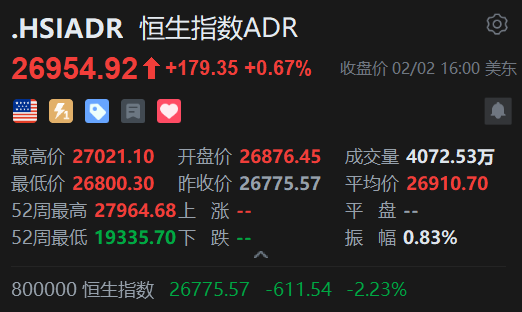
Market Overview - The Hang Seng Index (HSI) closed at 26,954.92, up by 179.35 points or 0.67% as of February 2, 16:00 Eastern Time [1] - The index reached a high of 27,021.10 and a low of 26,800.30 during the trading session, with a trading volume of 40.725 million shares [1] Major Blue-Chip Stocks Performance - HSBC Holdings closed at HKD 139.961, increasing by 3.91% compared to the Hong Kong close [2] - Tencent Holdings closed at HKD 595.694, down by 0.47% compared to the Hong Kong close [2] Stock Price Movements - Tencent Holdings: Latest price HKD 598.500, down by HKD 7.500 or 1.24% [3] - Alibaba Group: Latest price HKD 163.300, down by HKD 5.900 or 3.49% [3] - HSBC Holdings: Latest price HKD 134.700, down by HKD 1.900 or 1.39% [3] - AIA Group: Latest price HKD 89.050, down by HKD 1.300 or 1.44% [3] - Meituan: Latest price HKD 94.850, down by HKD 2.350 or 2.42% [3] - BYD Company: Latest price HKD 91.000, down by HKD 6.750 or 6.91% [3] - Kuaishou Technology: Latest price HKD 77.000, down by HKD 3.150 or 3.93% [3]





汽车及新能源汽车2025年产量升至全国首位 安徽全省一盘棋发力汽车产业(经济聚焦·关注汽车产业)
Ren Min Ri Bao· 2026-02-02 22:04
Core Viewpoint - Anhui Province is rapidly developing its automotive industry, particularly in the electric vehicle sector, aiming for a production target of 3.6865 million vehicles by 2025, with 1.7941 million being electric vehicles, both leading the nation [2][3]. Group 1: Industry Growth and Development - The automotive industry in Anhui has grown significantly, with production increasing from 1.161 million vehicles in 2020 to a projected 3.6865 million in 2025, moving from eighth to first in national rankings [3][4]. - The province has attracted seven major vehicle manufacturers and over 3,000 automotive parts companies, with total revenue from the automotive industry expected to exceed 1.5 trillion yuan in 2024, marking a growth of over 20% for two consecutive years [5][6]. Group 2: Government Support and Investment - The local government has played a crucial role in supporting the automotive industry, exemplified by a 7 billion yuan investment in NIO to stabilize its funding and attract other manufacturers like BYD and Volkswagen [5][6]. - The establishment of the "Automobile Office" by the Anhui Provincial Development and Reform Commission aims to provide comprehensive support for the automotive industry, enhancing market efficiency [6]. Group 3: Collaborative Innovation - A framework agreement was signed among major local car manufacturers, including Chery and NIO, to promote collaborative innovation in vehicle and key component development, resource sharing, and localized chip development [9]. - Chery has established a global network of R&D centers and invests approximately 20 billion yuan annually in research, focusing on engine efficiency and innovation [10].

1月车企销量公布!宝马更换全新车标!特斯拉净利润首次大幅下滑!我国新能源车保有量4397万辆,其中纯电动车3022万辆!丨一周大事件
电动车公社· 2026-02-02 16:53
New Car Launches - The new BJ40 range-extended version has been launched at a price of 279,800 yuan [2] - The new BJ40 features a rugged design with custom paint and off-road enhancements, including a total length of 4861mm, width of 2065mm, height of 2110mm, and a wheelbase of 2760mm [4] - The vehicle is equipped with a 138kW 1.5T range extender and dual motors with a total power of 403kW, paired with a 40.3kWh lithium battery, offering a pure electric range of 150km [8][10] - BYD's new flagship models, the Seal 08 sedan and the Sea Lion 08 SUV, have been recently revealed [11] Company Dynamics - General Motors projects a revenue of $185 billion for 2025, a year-on-year decline of 1.3%, with a net profit of $2.7 billion, significantly down from $6 billion in 2024 [14][15] - Tesla anticipates delivering 1.6363 million vehicles in 2025, a 9% decrease year-on-year, with total revenues declining for the first time [23][25] - Toyota expects global sales of 11.3 million vehicles in 2025, marking a 4.6% increase year-on-year, maintaining its position as the world's largest automaker [26][27] - Zotye Auto forecasts a net loss of 281 to 417 million yuan for 2025, a significant reduction from a previous loss of 1 billion yuan [30][31] Domestic News - A mandatory national standard for automotive steering systems has been released, effective July 1, which clarifies technical requirements and testing methods for new technologies [34][35] - The number of new energy vehicles in China has reached 43.97 million, with pure electric vehicles accounting for 30.22 million [38] - China is projected to export 8.32 million vehicles in 2025, a 30% increase year-on-year, with 3.43 million of those being new energy vehicles, reflecting strong competitiveness [39][41] - The country plans to add over 10,000 charging guns in service areas to enhance the convenience of charging for new energy vehicles [44][46] Vehicle Sales - BYD sold 205,518 passenger vehicles in January, maintaining its lead in the new energy vehicle market [47][51] - Geely's total sales reached 270,167 units in January, with 124,252 units being new energy vehicles [52][55] - NIO delivered 27,182 vehicles in January, with the ES8 model achieving significant sales [69][72]

卖车赚不过卖电池?多家动力电池厂业绩预喜
第一财经· 2026-02-02 15:59
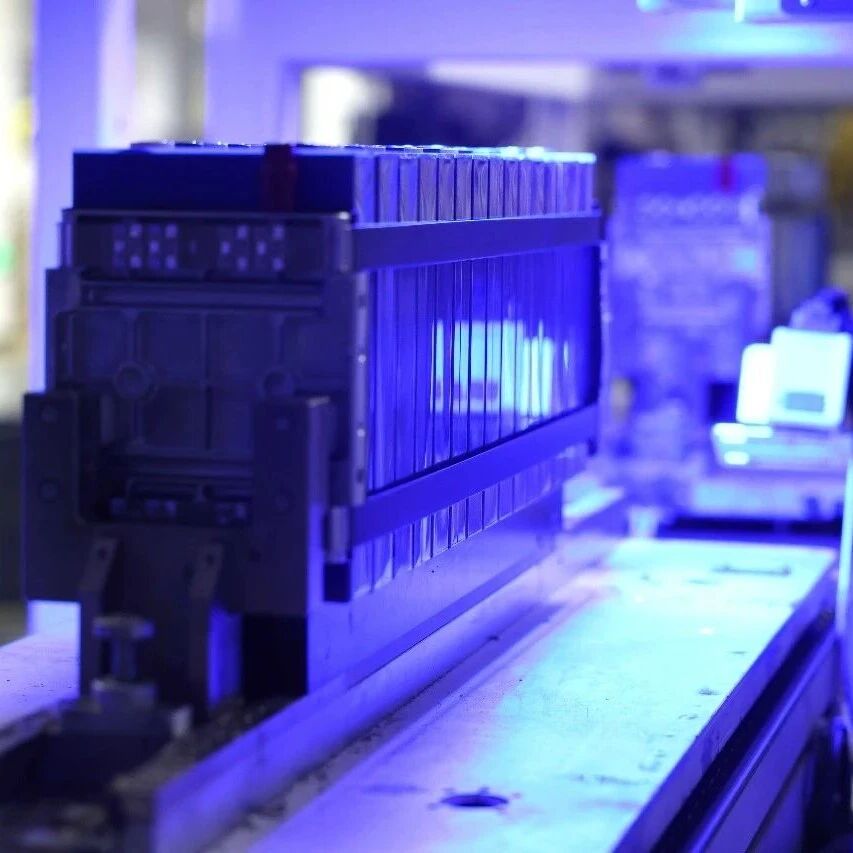
Group 1 - The core viewpoint of the article highlights that compared to automakers, power battery suppliers are potentially more profitable, as evidenced by the financial forecasts of companies like Ruipu Lanjun and Guoxuan High-Tech [2][3]. - Ruipu Lanjun expects a net profit of approximately 630 million to 730 million yuan in 2025, a significant turnaround from a net loss of 1.353 billion yuan in 2024, driven by increased product shipments and improved capacity utilization [2]. - Guoxuan High-Tech anticipates a net profit of 2.5 billion to 3 billion yuan in 2025, representing a year-on-year growth of 107.16% to 148.59% [3]. Group 2 - The profitability of leading power battery companies like CATL is highlighted, with projected net profits of 44.121 billion yuan, 50.745 billion yuan, and 49 billion yuan for 2023, 2024, and the first three quarters of 2025, respectively [3]. - In contrast, leading electric vehicle manufacturer BYD's net profits for the same periods are significantly lower, at 30.041 billion yuan, 40.254 billion yuan, and 23.333 billion yuan [3]. - The automotive industry's sales profit margin is projected to be only 4.1% in 2025, down from 4.3% at the end of 2024, indicating ongoing profitability challenges due to factors like price wars and rising raw material costs [4].


正听丨阻挠福特与中企电池合作只会损害美产业发展
Ke Ji Ri Bao· 2026-02-02 14:50
Group 1 - The U.S. House of Representatives' Special Committee on China, led by John Moolenaar, has expressed concerns over Ford's collaboration with Chinese battery companies like CATL, citing risks to U.S. supply chain independence and economic security [1] - Ford's partnership with CATL involves utilizing their technology to produce lithium iron phosphate (LFP) batteries for energy storage systems, with further discussions ongoing with BYD for hybrid vehicle battery transactions [1] - The U.S. battery industry lags significantly behind China, with Bernstein predicting that by 2026, the U.S. will account for only 10% of global battery capacity compared to China's 80% [1] Group 2 - Ford's collaboration with CATL and BYD is seen as a strategic move, especially as LFP batteries dominate the energy storage market with over 90% market share and are becoming mainstream in electric vehicles [2] - CATL leads the global market for LFP battery technology with a 48% share, while BYD holds nearly 30% of the hybrid vehicle battery market as of Q3 2025 [2] - The partnership is crucial for Ford's transition to new energy vehicles, as highlighted by Ford's VP of Electric Vehicle Systems, emphasizing the importance of introducing advanced technologies for innovation [2] Group 3 - The actions of certain U.S. politicians reflect a misguided perception of national security, viewing the use of Chinese technology and products as inherently risky, which could hinder U.S. industrial development [3] - There is a call for U.S. politicians to recognize the necessity of U.S.-China technological and industrial cooperation, urging them to stop interfering with normal business collaborations that could benefit the U.S. manufacturing sector [3]
