BYD(01211)

Search documents
比亚迪元“硬扛导弹”刷屏后,我们问了问军事专家:这是奇迹吗?
凤凰网财经· 2026-03-03 05:51
Core Viewpoint - The incident involving a BYD vehicle being damaged by an Iranian missile explosion has sparked discussions about the vehicle's safety and resilience, highlighting advancements in Chinese automotive engineering [1][8][12]. Group 1: Incident Overview - On March 1, an Iranian missile exploded near Jerusalem, causing significant damage to surrounding vehicles, including a BYD Yuan PLUS [1][2]. - The BYD vehicle sustained external damage but maintained structural integrity, with doors functioning normally and airbags deploying successfully, indicating a lack of fire or thermal runaway [8][9]. Group 2: Expert Analysis - Military expert Bai Mengchen commented on the incident, suggesting that the vehicle's damage was due to the impact of missile debris rather than a direct explosion, emphasizing the randomness of such events [11][12]. - The analysis indicated that the vehicle's position relative to the explosion site and the nature of the damage suggest it was not directly in the blast zone, which would have resulted in more severe destruction [12]. Group 3: Automotive Safety and Industry Implications - The incident reflects the advancements in materials science and vehicle design within the Chinese automotive industry, particularly in safety features that enhance resilience in extreme situations [12]. - Chinese electric vehicle brands, including BYD, have gained significant market share in Israel, with nearly half of the market in the pure electric segment, showcasing the growing influence of these brands in international markets [13][14].



年度榜单丨2025中国3C锂电池营收TOP10排行榜
起点锂电· 2026-03-03 03:24
Core Viewpoint - The article highlights the upcoming 2026 (Second) Cylindrical Battery Technology Forum and the release of the Top 20 Cylindrical Battery Rankings, emphasizing advancements in all-tab technology and the leadership of the large cylindrical battery market [1]. Group 1: Industry Overview - The 2025 revenue rankings for China's top 10 3C lithium battery companies include ATL, Zhuhai Guanyu, Yiwei Lithium Energy, Xinwangda, BYD, Weilan Lithium, Haopeng Technology, Xinneng An, Penghui Energy, and Weike Technology [2]. - ATL is recognized as the absolute leader in high-end 3C lithium batteries, focusing on high energy density and fast charging, with a customer base covering over 90% of top global 3C brands [4]. - Zhuhai Guanyu is a leading player in polymer soft-pack lithium batteries, dominating the laptop battery market and rapidly growing in the smartphone sector, with a strong presence in various 3C applications [5]. Group 2: Company Profiles - Yiwei Lithium Energy is a leading platform enterprise in the global lithium battery market, focusing on consumer, power, and energy storage batteries, with a strong position in small cylindrical batteries [6]. - Xinwangda is a comprehensive lithium-ion battery solution provider, excelling in 3C consumer batteries and establishing a strong presence in the domestic market [7]. - BYD is a global leader in electric vehicles and power batteries, with a strong vertical integration strategy across multiple sectors, including 3C lithium batteries [8]. - Weilan Lithium specializes in high-rate small cylindrical batteries, focusing on high-value applications such as drones and smart home devices [9][10]. - Haopeng Technology is a leader in small consumer lithium batteries, with a focus on AI-related energy solutions and a strong presence in the 3C battery market [11]. - Xinneng An, a joint venture between CATL and ATL, is rapidly emerging as a key supplier in high-power 3C lithium batteries, focusing on applications like drones and electric tools [12]. - Penghui Energy offers a comprehensive range of lithium battery products, focusing on high-power applications and maintaining a strong customer base in the 3C sector [13]. - Weike Technology is a pioneer in sodium-ion batteries and has a solid foundation in 3C lithium batteries, focusing on high energy density and lightweight designs [14].





中国EV在泰国涨价,比亚迪最高涨3成
日经中文网· 2026-03-03 03:06
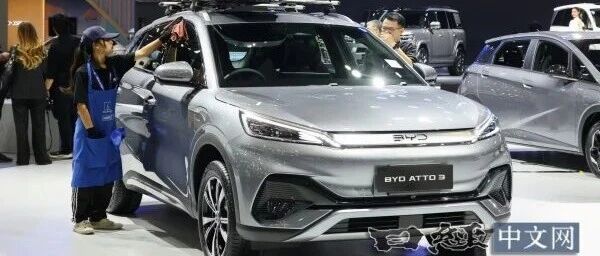
Core Viewpoint - Chinese electric vehicle (EV) manufacturers, including BYD, have raised prices in Thailand following the expiration of government subsidies, marking a shift away from aggressive price competition [2][5][7]. Group 1: Price Increases - BYD has increased the price of its popular electric SUV "ATTO3" by 21%, reaching 849,900 Thai Baht, and the standard version of the "Dolphin" hatchback by 33%, now priced at 599,900 Thai Baht [4][5]. - Other Chinese EV brands, such as MG, have also raised prices, with MG4 Electric increasing by 30,000 Thai Baht and Maxus 9 Plus by 50,000 Thai Baht [4]. Group 2: Market Context - The Thai government ended EV purchase subsidies, which previously provided up to 150,000 Thai Baht per vehicle, prompting manufacturers to adjust their pricing strategies [5][7]. - In 2025, EV sales in Thailand surged by 74% year-on-year, reaching a record high of 121,128 units, with EVs accounting for 24% of new car sales [5]. Group 3: Competitive Landscape - The price increases are seen as a way for Chinese manufacturers to move towards sustainable pricing after facing criticism for excessive discounting, which has distorted market prices [7]. - The market share of Chinese car manufacturers in Thailand has grown significantly, reaching 22% in 2025, up from just 4% in 2022, while Japanese manufacturers' share has decreased to 68% [7][8]. Group 4: Future Outlook - The demand for EVs may slow down, leading to intensified competition between Chinese and Japanese automakers, particularly as the market adjusts to the end of subsidies [8]. - 2026 is anticipated to be a pivotal year for EV demand in Thailand, with potential impacts on pricing and inventory affecting neighboring countries [8].
比亚迪:潜在比亚迪技术日展望;买入评级
2026-03-03 02:51
Summary of BYD Co. (002594.SZ/1121.HK) Conference Call Company Overview - **Company**: BYD Co. (002594.SZ/1121.HK) - **Industry**: New Energy Vehicles (NEV) Key Updates and Core Points 1. **Technology Day Event**: BYD is expected to hold a "Technology Day" on March 5, 2026, focusing on advancements in battery and charging technology, hybrid platforms, smart driving systems, intelligent chassis, and potential new model launches [1][2][4] 2. **Battery & Charging Technology**: - **Next-Generation Blade Battery**: Expected improvements in energy density from 200Wh/kg to potentially 360Wh/kg with a new 1000V charging platform for faster charging [4][5] - **Battery Size**: New models like Z9 and Z9GT are equipped with a 122.5kWh battery, enabling a driving range of over 1,000 km [4] - **Competitive Landscape**: Peers like Geely and XPeng are also advancing in battery technology, with energy densities ranging from 205Wh/kg to 255Wh/kg [5] 3. **DM-i 6.0 Super Hybrid Platform**: This platform may feature a 900V architecture and a new PHEV engine with thermal efficiency improvements of around 48%, enhancing fuel efficiency to 1.8-2.79L/100km [10] 4. **Gods' Eye 5.0 Advanced Smart Driving**: The new version aims to enhance autonomous driving capabilities, including improved AEB performance and broader feature accessibility across vehicle segments [11] 5. **DiSus Intelligent Chassis**: The upcoming version is expected to improve off-road capabilities and terrain adaptability, targeting the Rmb100k-150k price segment [12] 6. **New Model Launches**: Six new car models are in BYD's pipeline, including Da Tang, Z9GT, Seal 06 EV, and Qin Max EV, as per MIIT registration [12][14] 7. **Order Momentum Tracking**: Post-launch, it will be crucial to monitor BYD's weekly order trends to gauge consumer response to new technologies and models [4][15] Financial Projections - **Revenue Growth**: Projected revenue growth from Rmb777.1 billion in 2025 to Rmb1,024 billion by 2027, with a market cap of HK$865.7 billion [17][18] - **Sales Volume**: Expected increase in total vehicle sales from 4.3 million in 2024 to 7.1 million by 2030 [18] Investment Thesis - **Market Position**: BYD is positioned as a leading NEV maker in China and globally, with a strong product portfolio and innovative capabilities [18] - **Overseas Expansion**: Anticipated contribution of 92% to incremental vehicle sales volume from overseas markets between 2024-2028, with profit contributions expected to rise from 21% in 2024 to 76% by 2028 [18] - **Valuation**: A/H shares are trading below historical averages, presenting an attractive investment opportunity with a Buy rating [18][19] Risks - **Competition**: Intensifying competition in the electric vehicle market could pose risks to growth [19] - **Expansion Challenges**: Slower-than-expected progress in overseas markets and lower external battery sales could impact performance [19] Conclusion - BYD is set to enhance its competitive edge through technological advancements and new model launches, with a strong focus on expanding its market presence both domestically and internationally. The company is well-positioned for growth, although it faces risks from competition and market dynamics.
汽车和汽车零部件行业周报 20260301:静待板块需求好转,北美缺电链迎来高增
Guolian Minsheng Securities· 2026-03-03 02:25
Investment Rating - The report maintains a "Hold" rating for the automotive sector [3] Core Insights - The automotive sector is expected to stabilize as local governments roll out vehicle replacement subsidies and new models are launched post-Spring Festival, suggesting a potential recovery in sales [2][11] - The report highlights the increasing demand for AI computing power and the corresponding growth in the North American electricity supply gap, which presents opportunities for related supply chains [9][33] - The report emphasizes the importance of the intelligent electric vehicle segment and the anticipated growth in the robotics sector, particularly with the upcoming mass production of humanoid robots by Xiaopeng Motors [10][19] Summary by Sections 1. Weekly Insights - The automotive sector is waiting for demand recovery, with a focus on the North American electricity supply chain [9] - Recommendations include key companies such as Geely, Xiaopeng, BYD, and others across various segments [2][9] 1.1 Passenger Vehicles - Local replacement subsidy policies are being implemented, which are expected to stimulate demand positively [12][15] - January saw a decline in passenger vehicle sales, but improvements in subsidy policies and new model launches are anticipated to stabilize demand [11][15] 1.2 Intelligent Electric Vehicles - The report forecasts accelerated long-term growth in the intelligent electric vehicle segment, with a focus on the new energy vehicle supply chain [16][18] 1.3 Robotics - The humanoid robotics sector is entering a critical phase, with significant advancements expected in 2026 [19][21] - The report highlights the importance of key players like Tesla and domestic manufacturers in driving innovation and production [19][21] 1.4 Liquid Cooling - The demand for AI is driving the growth of the liquid cooling market, which is expected to grow significantly in the coming years [23][25] 1.5 Motorcycles - The report notes a positive trend in the sales of mid-to-large displacement motorcycles, with key players like Chunfeng and Longxin leading the market [26][29] 1.6 Heavy Trucks - The continuation of government policies is expected to boost domestic demand for heavy trucks, particularly in the context of the North American electricity supply chain [30][31] 1.7 Tires - The tire industry is experiencing a shift towards globalization and smart manufacturing, with recommendations for leading companies in the sector [34][36] Market Performance - The automotive sector underperformed the market in the recent week, with specific segments showing varied performance [37]



小蜂充电完成数千万元首轮融资,董事长杨涛是电力电子博士、曾任职比亚迪
Sou Hu Cai Jing· 2026-03-03 01:36
Group 1 - The core viewpoint of the article is that EVbee, a provider of overseas charging solutions, has successfully completed its first round of financing amounting to several tens of millions, exclusively funded by Chaoxi Capital [1] Group 2 - EVbee was established in 2020 and is chaired by Yang Tao, who holds a PhD in power electronics from University College Dublin and has extensive experience in leading companies in the new energy sector, including BYD and Zhejiang Energy Group [3] - The company focuses on a global development strategy, leveraging the rich industrial chain and R&D manufacturing capabilities of the Yangtze River Delta, with its management headquarters based overseas [3] - EVbee's main products include DC chargers, AC chargers, integrated storage and charging systems, and commercial energy storage systems, all of which strictly comply with European standards [3] - The company has established deep cooperation and long-term strategic partnerships with several well-known overseas charging companies and leading charging operators [3]
启动报名|3/12-13 上海「聚链成势·智启未来」智能终端产业链创新峰会正式官宣
CINNO Research· 2026-03-02 23:03
Core Viewpoint - The article emphasizes the profound adjustments in the global industrial landscape, driven by de-globalization and complex geopolitical relationships, presenting both challenges and strategic transformation opportunities for Chinese companies in the smart terminal industry [2]. Group 1: Event Overview - AWE2026, one of the most influential exhibitions in the global home appliance and consumer electronics sector, will be held in Shanghai, adopting a "one exhibition, two zones" model [3][16]. - The total exhibition area for AWE2026 will reach 170,000 square meters, attracting over 1,200 top domestic and international companies to showcase innovations in technology and smart products [16]. Group 2: Summit Focus - The summit will cover the entire smart terminal industry chain, focusing on macro guidance, technology-driven discussions, market foresight, and core supply chain localization processes [4][5][6]. Group 3: Exhibition Zones - The New International Exhibition Zone will focus on smart home, AI appliances, and various innovative fields, showcasing over 1,000 domestic and international brands [19]. - The Eastern Hub International Business Cooperation Zone will highlight advanced technologies in consumer electronics, including AI smartphones, humanoid robots, and low-altitude economy products [21]. Group 4: Consumer Engagement - AWE2026 will launch a series of consumer promotion activities, including the "AWE Renewal Consumption Festival," which successfully drove appliance sales exceeding 2 billion yuan in the previous year [24]. - The event will also feature "AWE Live Streaming Nights," aiming to surpass the previous year's sales of over 1 billion yuan through live commerce [24]. Group 5: Forums and Discussions - AWE2026 will host a record number of high-level forums and activities, focusing on industry upgrades, new consumption trends, and technological advancements [28][29]. - The event aims to solidify its position as a global benchmark for smart living and foster international technological cooperation and economic development [29].







BYD Sales Collapse. What About Tesla?
Yahoo Finance· 2026-03-02 15:31
Core Insights - BYD, the world's largest electric vehicle maker, experienced a significant sales drop of 41% year-on-year in February, with total sales falling to 190,190 units, primarily due to a 65% decline in domestic sales, despite a 50% increase in export sales [2] - The competitive landscape in China's EV market is intense, with 129 brands reported, leading to price cuts that may increase market share but also result in losses for companies like BYD [4] - Tesla's market share in China has decreased to 8%, with its Model Y ranking 20th among all brands, while BYD's sales in the EU have increased by double digits, contrasting with Tesla's declining sales in that region [5] Group 1 - BYD's February sales dropped significantly, attributed partly to the Lunar New Year, but this alone does not explain the decline [2] - The need for BYD to accelerate new model releases is highlighted, as increased consumer choice could potentially drive sales, although new models are costly [4] - Tesla's global unit sales are declining, with a need for strong performance in China, the US, and EU to reverse this trend, indicating potential challenges ahead if BYD's sales are indicative [6] Group 2 - Tesla's market share in the US has fallen to about 50%, with the situation potentially worse without tariffs on Chinese EVs [6] - The competitive pressure from numerous EV brands in China suggests that not all can survive, raising concerns for companies like BYD and Tesla [4] - The contrasting sales trends between BYD and Tesla in both China and the EU suggest a challenging environment for Tesla moving forward [5]

比亚迪(002594):公司信息更新报告:2月海外销量首超国内,出海、新技术搭载回暖可期
KAIYUAN SECURITIES· 2026-03-02 13:41
Investment Rating - The investment rating for BYD is maintained as "Buy" [1] Core Views - The report highlights that BYD's overseas sales have surpassed domestic sales for the first time, indicating strong performance in international markets [4] - The company is expected to launch new technologies and models in 2026, enhancing its competitive edge in a challenging domestic market [5] - The financial forecasts for 2025-2027 have been revised upwards, with expected net profits of 25.3, 18.6, and 14.7 times respectively, driven by overseas business growth [4] Financial Summary - Total revenue is projected to grow from 602.3 billion yuan in 2023 to 1,126.6 billion yuan in 2027, reflecting a compound annual growth rate (CAGR) of approximately 18.9% [6] - Net profit is expected to increase from 30.04 billion yuan in 2023 to 60.14 billion yuan in 2027, with a notable growth rate of 36.3% in 2026 [6] - The gross margin is forecasted to stabilize around 20% by 2027, while the net margin is expected to improve from 5.0% in 2023 to 5.3% in 2027 [6] Sales Performance - In February 2026, BYD's sales reached 190,200 units, a decrease of 41.1% year-on-year, primarily due to the impact of the Spring Festival [4] - The overseas sales in February were 100,600 units, marking a 50.1% increase year-on-year, and accounted for 52.9% of total sales [4] - For the first two months of 2026, cumulative sales were 400,200 units, down 35.8% year-on-year, largely due to the reduction in subsidies for vehicle replacements [4] Overseas Expansion - BYD aims to achieve over 1.3 million overseas sales in 2026, a 24.3% increase from the previous year, supported by a multi-faceted approach in product, channel, logistics, and production capacity [4] - The company has established over 2,000 overseas dealerships and plans to expand further into Europe and other regions [4] - The logistics capacity is set to exceed one million vehicles annually, with production facilities in Thailand and Brazil already operational, and Hungary expected to start production in 2026 [4]
汽车图谱|2月出海销量高增:比亚迪、奇瑞超10万辆
Xin Jing Bao· 2026-03-02 12:48
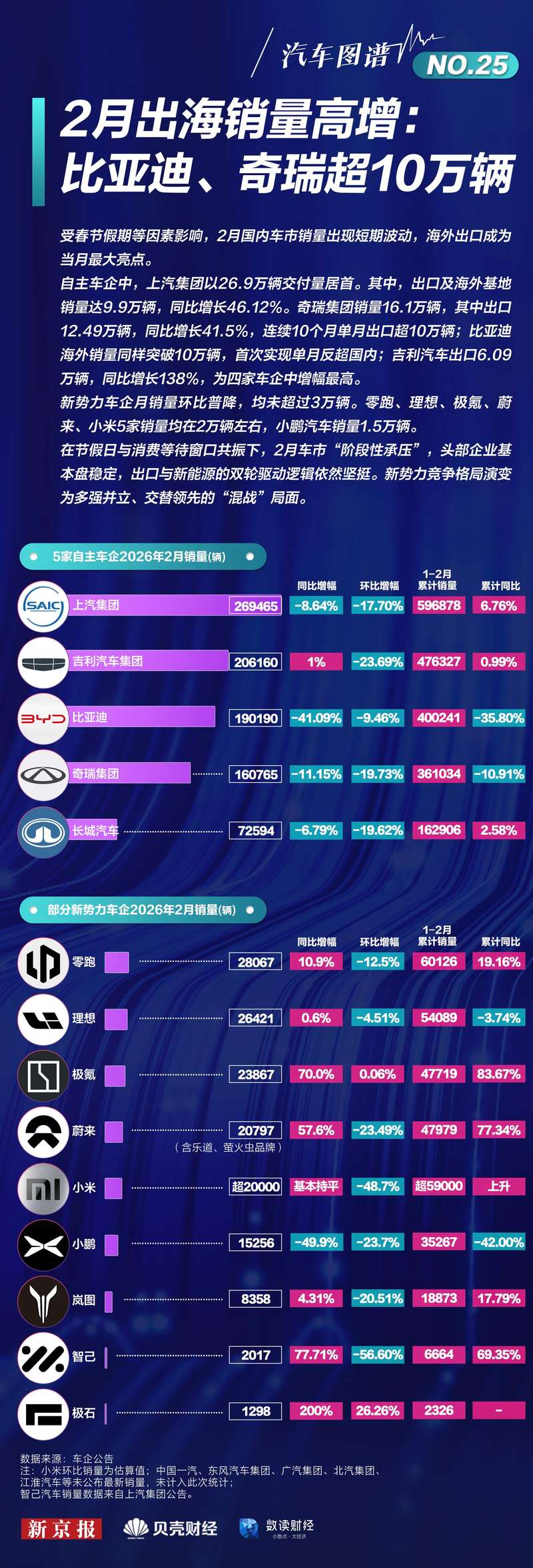
Group 1 - The domestic car market in February experienced short-term fluctuations, but the positive trends of export growth and increasing penetration of new energy vehicles remain unchanged [1] - SAIC Motor led the industry with a delivery volume of 269,465 units, with exports and overseas sales reaching 99,000 units, a year-on-year increase of 46.12%, providing crucial support against domestic market volatility [1] - Chery Group's February sales reached 161,000 units, with exports accounting for 124,900 units, a year-on-year increase of 41.5%, marking ten consecutive months of single-month exports exceeding 100,000 units [1] Group 2 - New energy vehicle companies showed a mixed performance, with sales for Leap Motor, Li Auto, Zeekr, NIO, and Xiaomi around 20,000 units, while XPeng Motors sold 15,000 units [1] - The overall market pressure in February is viewed as a short-term fluctuation rather than a trend decline, with leading companies maintaining their fundamentals and the dual drivers of exports and new energy remaining strong [1] - The competitive landscape among new energy vehicle companies has evolved into a multi-stronghold scenario, characterized by alternating leadership [1] Group 3 - The release of subsequent policy benefits and the arrival of a new round of model cycles are expected to accelerate the recovery of the car market [2] - February sales data for major domestic car companies showed varying performance, with SAIC Motor's sales down 8.64% year-on-year, while BYD's sales dropped significantly by 41.09% [4] - New energy vehicle companies like Ideal and NIO reported year-on-year increases of 0.6% and 57.6%, respectively, while others like Xiaopeng and Lantu faced declines [4]