LI AUTO-W(02015)

Search documents
ReflectDrive将有助于理想辅助驾驶安心感提升
理想TOP2· 2025-10-06 13:10
Core Viewpoint - The article presents a framework for generating safe trajectories based on discrete diffusion without the need for gradient calculations, aiming to enhance the efficiency and safety of autonomous driving systems [1][2]. Group 1: Framework Overview - The core value lies in introducing discrete ideas into trajectory generation for assisted driving, moving beyond traditional reinforcement learning and continuous diffusion models [2]. - The framework consists of two main phases: goal-oriented trajectory generation and safety-guided regeneration, both of which do not require gradient calculations [5][10]. Group 2: Phase One - Goal-Conditioned Generation - The objective is to generate a diverse set of complete trajectory plans reflecting different high-level driving intentions, crucial for scenarios requiring extensive decision-making [3]. - The workflow includes generating candidate target points, ensuring diversity through non-maximum suppression (NMS), generating complete trajectories for each candidate, and selecting the best trajectory based on a global scoring system [4]. Group 3: Phase Two - Safety-Guided Regeneration - This phase focuses on iteratively correcting trajectories identified as potentially unsafe through a dialogue between the generated model and an external safety oracle [5][10]. - The process involves trajectory evaluation, safety anchor search, and trajectory inpainting to ensure the final trajectory is safe and coherent [7][8][9]. Group 4: Challenges and Innovations - The article highlights challenges in relying solely on reinforcement learning due to issues like reward hacking and the difficulty of ensuring safety in imitation learning [11]. - It emphasizes the need for a unified architecture that efficiently integrates multimodal inputs while maintaining safety and performance, leading to the development of the ReflectDrive framework [13].


理想汽车,股价跳水!
Shen Zhen Shang Bao· 2025-10-06 11:58
Group 1 - The Hang Seng Index closed at 26,957.77 points, down 0.67%, while the Hang Seng Tech Index closed at 6,550.3 points, down 1.1% on October 6, during the Mid-Autumn Festival [1] - The gold sector led the market, with notable gains: Zhenfeng Gold up over 11%, Zijin Mining International up over 8%, Shandong Gold up over 5%, and Chifeng Jilong Gold up over 4% [1] Group 2 - Li Auto's stock fell by 3.31%, closing at HKD 96.30 per share [2] - In September 2025, Li Auto delivered 33,951 new vehicles, a 36.8% decrease compared to 53,709 vehicles delivered in September 2024. The total deliveries for Q3 2025 were 93,211, which is lower than the 105,108 vehicles delivered in the same period of 2023 [4] - As of September 30, 2025, Li Auto's cumulative delivery volume reached 1,431,021 vehicles. The company has not updated its sales bar chart on its public account for four consecutive months [4] Group 3 - The new energy vehicle market has undergone significant changes over the past year, with the previous leaders (Li Auto, Aito, and Leap Motor) being challenged by new entrants like Leap Motor, Xpeng, and Xiaomi, which have now become market benchmarks [7] - NIO and Hongmeng Zhixing are adopting multi-brand strategies to cover a broader market [7]
10月6日 港股汽车股走弱
Cai Jing Wang· 2025-10-06 07:37
Group 1 - The core viewpoint of the article indicates a decline in Hong Kong automotive stocks, with specific mention of significant drops in share prices for major electric vehicle manufacturers [1] Group 2 - Xpeng Motors (09868.HK) experienced a drop of 4% in its stock price [1] - Li Auto (02015.HK) saw a decline of nearly 3% [1] - NIO Inc. (09866.HK) reported a slight decrease of 0.1% [1]

理想、小鹏等7家车企官宣国庆促销,便宜2000-3000元
Qi Lu Wan Bao· 2025-10-06 04:58
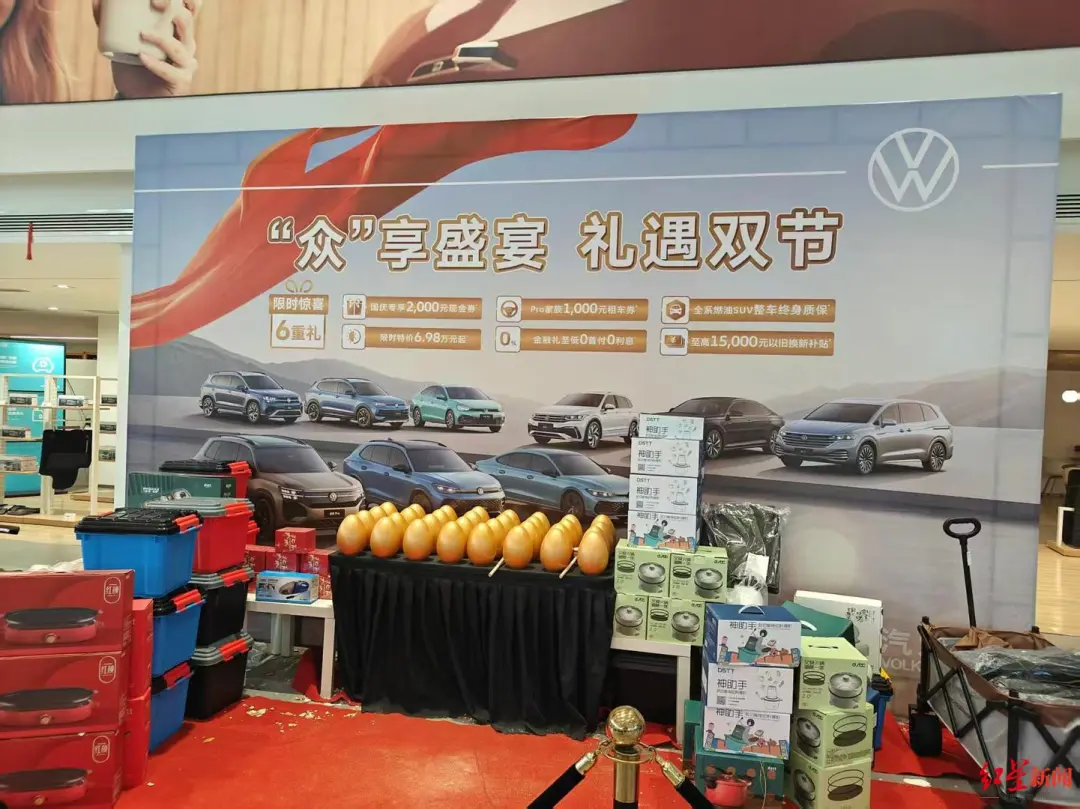
Core Viewpoint - The traditional peak sales season for the automotive industry, known as "Golden September and Silver October," has seen a significant reduction in promotional efforts this year, with discounts primarily ranging from 2,000 to 3,000 yuan, compared to previous years where discounts were more substantial [1][3][9]. Group 1: Promotional Activities - Seven automotive brands have announced National Day promotional policies, including Li Auto, Xpeng Motors, GAC Honda, GAC Toyota, FAW Toyota, FAW Audi, and SAIC Volkswagen, with promotions mainly consisting of cash subsidies and trade-in incentives [3][5]. - The maximum discount offered by GAC Toyota is 51,000 yuan, but the actual additional discount for consumers is only about 3,000 yuan due to existing promotions [6]. - Li Auto is providing a significant promotion with a trade-in subsidy of 15,000 yuan and a limited-time financial rate of 1.99% [8]. Group 2: Market Conditions - The automotive industry is experiencing a price war, leading to car prices being at a low point, which limits the potential for further discounts during the National Day period [9][10]. - Data from the China Passenger Car Association indicates that the profit margin for the automotive industry has been declining, with an average profit margin of 4.5% for the first eight months of the year [9][11]. - A report from the China Automobile Dealers Association reveals that only 30.3% of dealers met their sales targets in the first half of the year, with 52.6% reporting losses [11][13]. Group 3: Dealer Perspectives - Dealers are reluctant to offer significant discounts during the National Day promotions, as many are already selling at a loss and rely on manufacturer rebates [10][11]. - Dealers are expected to allocate more promotional funds towards year-end sales rather than during the National Day period, anticipating greater promotional efforts later in the year [10][11].
汽车行业周报:车市供需回暖趋势叠加 人形机器人催化持续
Xin Lang Cai Jing· 2025-10-06 04:34
Industry Overview - The automotive sector showed resilience in September, with retail sales of passenger vehicles expected to reach 2.15 million units, a year-on-year increase of 2.0% and a month-on-month increase of 6.5% [3] - The automotive sector's Beta trend continues to strengthen, with expectations for a valuation uplift in the fourth quarter due to seasonal demand and year-end purchasing [3] - The trend of AI applications is accelerating, driving capital expenditure and boosting the demand for cross-industry components, particularly in areas like chip manufacturing and autonomous driving [3] Company Performance - Geely Automobile reported total sales of 273,125 units in September 2025, a year-on-year increase of approximately 35%. Cumulative sales from January to September reached 2,170,189 units, up about 46% year-on-year [2] - XPeng Motors delivered 41,581 smart electric vehicles in September 2025, representing a year-on-year growth of 95% and a month-on-month increase of 10%. Cumulative deliveries for the third quarter reached 116,007 units, a year-on-year increase of 149% [2] - NIO delivered 34,749 vehicles in September 2025, a year-on-year increase of 64.1%. Cumulative deliveries for the third quarter reached 87,071 units, up 40.8% year-on-year [2] Notable Transactions and Developments - Seres completed the payment for the acquisition of a 10% stake in Shenzhen Yingwang Intelligent Technology Co., Ltd. from Huawei, with a transaction amount of 11.5 billion yuan [1] - Li Auto launched a tax subsidy plan for its i6 model, allowing users who complete their orders by October 31, 2025, to benefit from the subsidy if delivery is delayed until 2026 due to reasons related to Li Auto [1] - Rockstone Robotics submitted its application for a mainboard listing on the Hong Kong Stock Exchange [1]



港股低开,恒生科技跌超1%,小鹏汽车跌超4%,紫金矿业涨超3%
Hua Er Jie Jian Wen· 2025-10-06 02:01
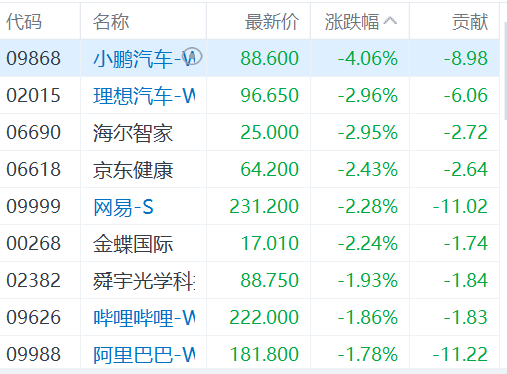
Market Overview - The Hong Kong stock market opened lower on October 6, with the Hang Seng Index down 0.5% and the Hang Seng Tech Index down 1.12% [1] - The technology sector experienced a general decline, with Alibaba down 1.8%, Baidu down 1.4%, and Xiaomi down 0.9% [2] Company Performance - Notable declines in specific companies include: - Xpeng Motors down 4.06% to HKD 88.600 - Li Auto down 2.96% to HKD 96.650 - Haier Smart Home down 2.95% to HKD 25.000 - JD Health down 2.43% to HKD 64.200 - NetEase down 2.28% to HKD 231.200 - Kingdee International down 2.24% to HKD 17.010 - Sunny Optical down 1.93% to HKD 88.750 - Alibaba down 1.78% to HKD 181.800 [3] Semiconductor Sector - The semiconductor sector saw initial gains followed by declines, with Hua Hong Semiconductor rising over 2% before turning negative, and SMIC dropping over 3% [3] - Goldman Sachs raised the target prices for SMIC and Hua Hong Semiconductor to HKD 117, citing opportunities from China's expanding AI ecosystem [4] New Energy Vehicles - The new energy vehicle sector remained sluggish, with Li Auto down over 3% and Xpeng Motors down over 4% [6] Precious Metals - The precious metals sector saw collective gains, with China Silver Group rising over 11%, and other companies like Datang Gold and Shandong Gold also experiencing increases. Zijin Mining opened high and rose over 3% [8] - Concerns over the U.S. fiscal outlook and dollar value have led to a popular "devaluation trade," boosting gold and Bitcoin prices to historical highs [8]


趋势研判!2025年中国新能源汽车电动压缩机控制器行业全景分析:随着下游市场需求总量的快速增长,市场规模及产能不断攀升 [图]
Chan Ye Xin Xi Wang· 2025-10-06 01:18
Core Insights - The global market for electric compressor controllers in the new energy vehicle (NEV) sector is experiencing rapid growth, with China being the largest market, accounting for over 50% of global demand [1][3][4] - The market size for global NEV electric compressor controllers is projected to reach 6.656 billion yuan in 2024, with China's market size expected to be 4.069 billion yuan, representing approximately 61.13% of the global market [1][3] - By 2025, the global market size is anticipated to grow to about 8.48 billion yuan, while China's market size is expected to reach 4.683 billion yuan, accounting for around 55.22% of the global market [1][3] Industry Definition and Classification - NEV electric compressor controllers are critical components in the thermal management systems of electric vehicles, controlling the operation of electric compressors to regulate cabin temperature and battery thermal management [2][3] Industry Development Status - The demand for NEV electric compressor controllers in China is projected to be 12.888 million units in 2024, with 95.45% for passenger vehicles and 4.55% for commercial vehicles [4] - The production capacity of NEV electric compressor controllers in China is expected to increase significantly from 1.271 million units in 2018 to 12.542 million units in 2024 [6] Industry Chain - The upstream of the NEV electric compressor controller industry includes raw materials such as aluminum alloys, steel, copper, and power devices, with increasing domestic production quality and rates [6][7] Industry Development Environment - Related Policies - The Chinese government has implemented various policies to support the development of the NEV industry, including initiatives to promote the replacement of old vehicles and enhance product technology standards [7] Market Competition Landscape - The market for NEV electric compressor controllers is characterized by an oligopolistic structure, with leading companies like Fudi Power, Aotegia, and others holding significant market shares [8] - Fudi Power leads the market with a 27.02% share, followed by Aotegia (14.67%), Aiwei Electric (13.35%), and Rujing Technology (12.74%), collectively accounting for nearly 68% of the market [8] Industry Development Trends - The adoption of high-voltage silicon carbide (SiC) devices is increasing, enhancing efficiency and reducing energy loss in NEV electric compressor controllers [11] - The integration of smart and connected features is expected to improve data interaction and remote diagnostics capabilities [12] - Future developments will focus on higher integration and multifunctionality, reducing component count and improving reliability [13] - Electric compressor controllers will increasingly integrate with overall vehicle energy management strategies for optimized performance [14]




9月新能源销量公布!德国总理呼吁欧盟取消燃油车禁令!极氪9X、新款特斯拉Model 3、别克至境L7等新车上市!丨一周大事件
电动车公社· 2025-10-05 16:01
Core Viewpoint - The article highlights the recent developments in the electric vehicle (EV) market, including new model launches, company dynamics, and sales performance of various manufacturers, indicating a competitive landscape and the ongoing transition towards electrification in the automotive industry [2][3][95]. New Car Launches - Volvo XC70 launched with a limited price range of 269,900 to 349,900 CNY, featuring a hybrid system and competitive specifications [2][9]. - Buick's new model, the L7, priced between 173,900 and 219,900 CNY, aims to capture the high-end market with advanced features [10][18]. - The Hummer M817 Max+ was introduced at a price of 369,900 CNY, maintaining a robust design and advanced technology [21][31]. - Zeekr 9X launched with a price range of 455,900 to 589,900 CNY, showcasing high performance and luxury features [4][46]. - The new Tesla Model 3 is priced between 235,500 and 339,500 CNY, with minor updates compared to previous models [52][59]. - Changan's A06 pure electric version is available for pre-sale at 119,900 to 159,900 CNY, featuring a new design language [60][68]. - The Tengshi N8L is set for pre-sale at 319,800 to 349,800 CNY, offering a blend of luxury and performance [70][78]. - Geely's Galaxy Star 6 is available for pre-sale at 85,800 to 118,800 CNY, targeting the compact hybrid market [80][86]. - Smart's new model, the 5 EHD, is available for pre-sale starting at 189,900 CNY, emphasizing affordability and technology [87][94]. Company Dynamics - Beijing Hyundai announced an 8 billion CNY investment to enhance local R&D and accelerate its transition to electric vehicles [95][97]. - A recall of 98,408 units of the CLEVER model was initiated by SAIC due to braking issues related to energy recovery [98][100]. - Lantu has applied for a listing on the Hong Kong Stock Exchange, indicating growth and expansion plans [101][103]. - Hesai Technology became the first company to produce over one million laser radars annually, showcasing its manufacturing capabilities [106][109]. - Jaguar Land Rover resumed production after a month-long halt, securing a 3.5 billion GBP loan to recover from cyberattack-related losses [110][111]. International News - German Chancellor Friedrich Merz called for the EU to reconsider the ban on fuel vehicles, suggesting a more gradual approach to carbon neutrality [114][118]. Sales Performance - BYD reported September sales of 393,060 passenger vehicles, maintaining a strong market presence [119][124]. - Geely's total sales reached 273,125 units in September, with 165,201 units being electric, marking a significant year-on-year increase [125][130]. - Changan's electric vehicle sales exceeded 103,000 units in September, reflecting a growing demand for its offerings [135][141]. - SAIC-GM-Wuling achieved 100,593 units in electric vehicle sales, marking a milestone for the brand [142][146]. - Chery sold 91,590 electric vehicles in September, contributing to its record-breaking sales year [147][152]. - Li Auto delivered 33,951 units in September, indicating a strong recovery and growth trajectory [188]. - NIO delivered 34,749 units, achieving a historical high and reflecting strong demand for its models [177][183].


扎堆北京商圈,新能源汽车“同台竞技”
Xin Jing Bao· 2025-10-05 09:17
Core Insights - The automotive market in Beijing is experiencing a vibrant atmosphere during the Golden Week, with a significant focus on electric vehicles (EVs) [1][2] - The trend of viewing and purchasing cars has become a leisure activity for families, with multiple EV brands showcasing their models in shopping malls [2][3] Group 1: Market Dynamics - The Beijing commercial district is becoming a competitive space for automotive brands, with a concentration of 15 EV brands in the Heshenghui shopping mall, including well-known names like Tesla and Li Auto [2][5] - The "cluster effect" of multiple brands in one location enhances consumer attraction, allowing for efficient comparison and increased foot traffic for all participating brands [5][6] Group 2: Consumer Behavior - Families are increasingly visiting EV showrooms, with a notable preference for SUVs among family customers, reflecting a growing acceptance of domestic brands in the passenger vehicle market [4][5] - The design features of vehicles, such as the rotating seats in the Zeekr 9X, are appealing to families, as they enhance comfort and interaction among family members during the car-buying experience [4][6] Group 3: Retail Strategy - The establishment of smart automotive experience centers, like the one opened by Gome Car Market, indicates a shift towards integrating automotive sales with retail environments to attract younger consumers [5][6] - Brands are evaluating the cost-effectiveness of maintaining showrooms in high-rent commercial areas, balancing brand visibility against sales conversion rates [5][6]
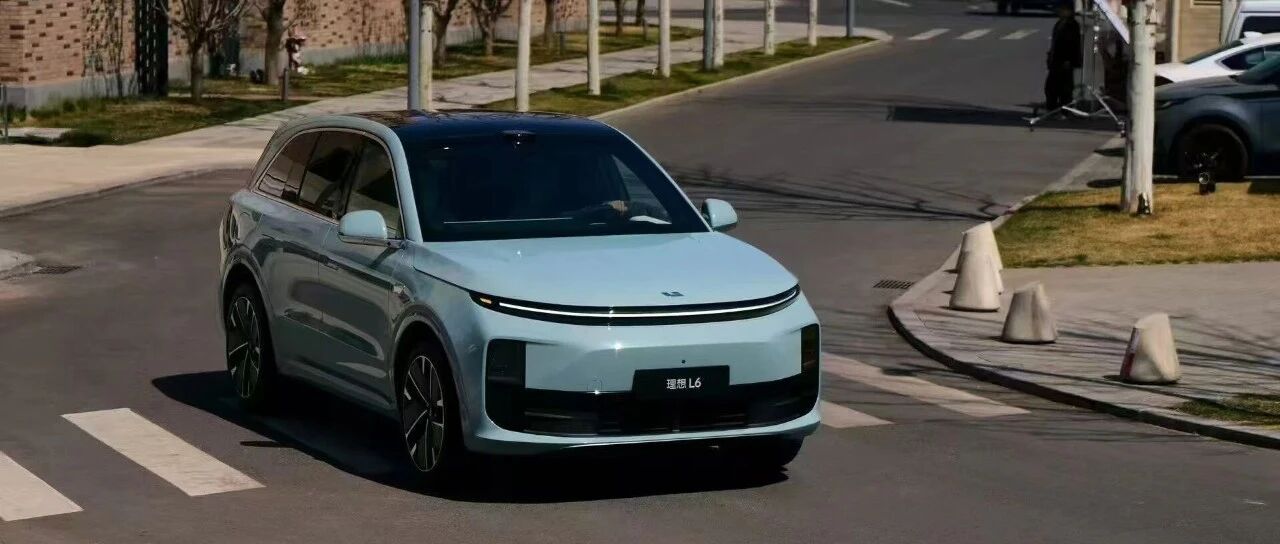
肉呆关于理想L6的观点值得参考
理想TOP2· 2025-10-05 05:53
Core Insights - The article discusses the evolving consumer preferences for the L6 vehicle, highlighting a shift from traditional family narratives to self-expression and individuality among buyers [1][9] Group 1: Consumer Behavior - L6's consumption spillover is only 36%, lower than L9's 48%, MEGA's 55%, and significantly below Model Y's 66%, with only 18% of users purchasing more than two original accessories [1] - Among L6 owners, 22% would consider the brand for their next vehicle if budget is a factor, while 15% would consider it without budget constraints, and 8% would choose based on family suggestions [1] - The proportion of female users is 27%, with 28% of them being single; 68% of purchase decisions are influenced by partners [1][2] Group 2: Gender Dynamics - 40% of male L6 owners are single, with over half focusing on personal needs rather than family needs [2] - 66% of male users express doubts about their purchase when teased by friends about entering middle age, contrasting with only 17% for Model Y and 31% for M5 [2] Group 3: Marketing Strategy - The marketing approach for the L6 emphasizes emotional connections and self-identity, moving away from traditional family-oriented messaging [4][5] - The promotional content targets young adults aged 25-35, focusing on themes of self-expression and breaking free from societal expectations [4][5] - The campaign aims to resonate with consumers' desires to maintain individuality while navigating external pressures [5][6] Group 4: Future Market Considerations - The article suggests that the traditional family narrative may be overestimated in the market, indicating a potential shift in how family vehicles are defined [9] - It raises questions about the future of family structures in China and how this may impact vehicle purchasing decisions over the next few decades [9]