LI AUTO-W(02015)

Search documents
理想汽车(02015) - 截至二零二六年一月三十一日止月份之股份发行人的证券变动月报表
2026-02-05 10:10
股份發行人及根據《上市規則》第十九B章上市的香港預託證券發行人的證券變動月報表 截至月份: 2026年1月31日 狀態: 新提交 致:香港交易及結算所有限公司 公司名稱: 理想汽車 呈交日期: 2026年2月5日 I. 法定/註冊股本變動 | 1. 股份分類 | 不同投票權架構公司普通股 | 股份類別 | A | | | 於香港聯交所上市 (註1) | | 是 | | | --- | --- | --- | --- | --- | --- | --- | --- | --- | --- | | 證券代號 (如上市) | 02015 | 說明 | | | | | | | | | | | 法定/註冊股份數目 | | | 面值 | | | 法定/註冊股本 | | | 上月底結存 | | | 4,500,000,000 | USD | | 0.0001 | USD | | 450,000 | | 增加 / 減少 (-) | | | | | | | USD | | | | 本月底結存 | | | 4,500,000,000 | USD | | 0.0001 | USD | | 450,000 | | 2. 股份分類 | ...
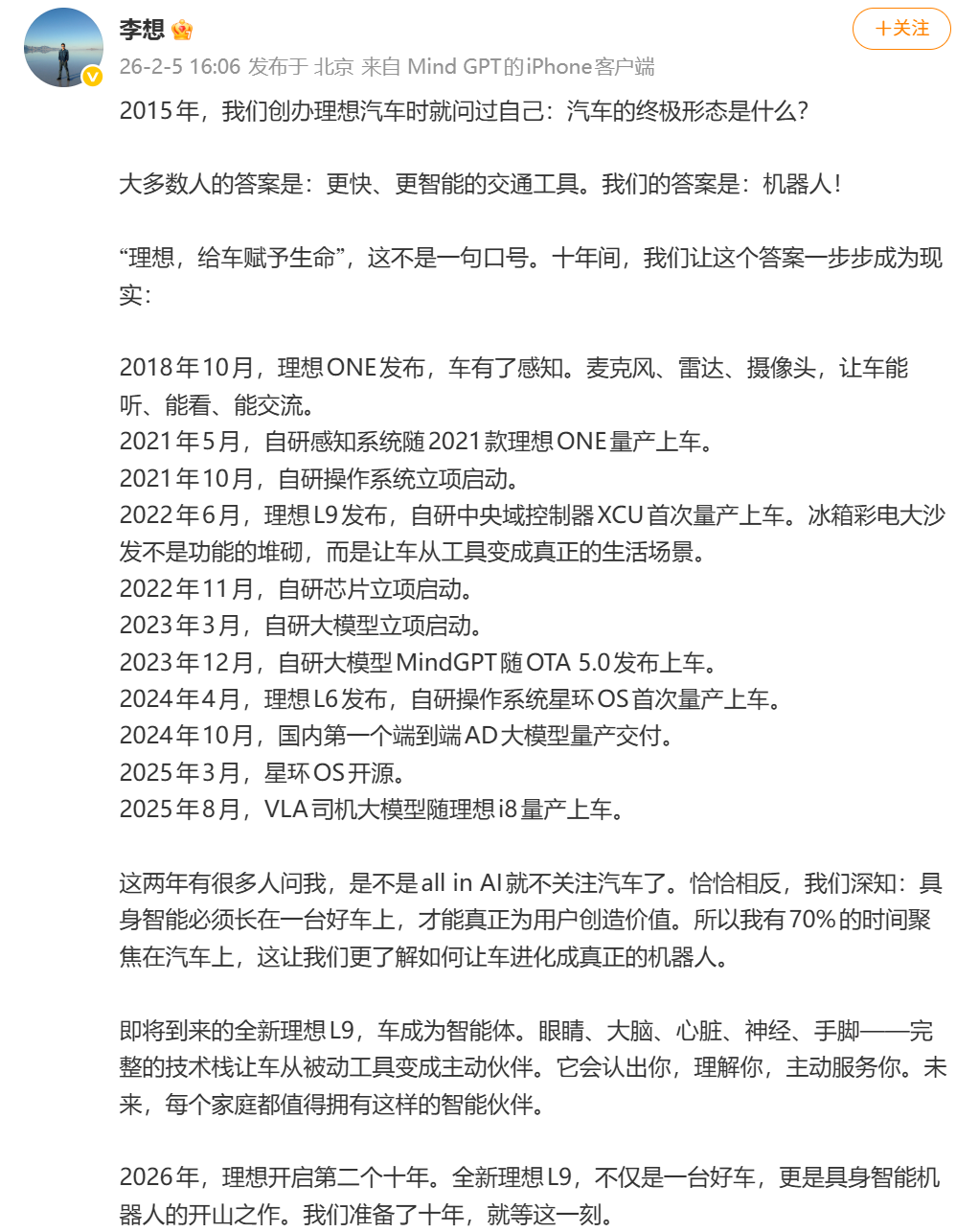
理想汽车李想:全新理想L9将是具身智能机器人开山之作
Mei Ri Jing Ji Xin Wen· 2026-02-05 09:50
Core Viewpoint - The company envisions the ultimate form of automobiles as robots, focusing on integrating advanced AI and intelligent systems into vehicles to enhance user experience and functionality [3][4]. Group 1: Technological Advancements - In 2018, the company launched the Li ONE, introducing sensory capabilities with microphones, radars, and cameras [3]. - By 2021, the self-developed perception system was integrated into the 2021 Li ONE model, marking a significant step in vehicle intelligence [3]. - The company initiated the development of its operating system in October 2021, further enhancing vehicle capabilities [3]. - The Li L9 was released in June 2022, featuring the first mass production of the self-developed central domain controller XCU, transforming the vehicle into a living space rather than just a tool [3]. Group 2: Future Developments - The company plans to deliver the first end-to-end AD large model by October 2024, indicating a strong commitment to AI integration [4]. - In March 2025, the company will open-source its Star Ring OS, enhancing software accessibility and innovation [4]. - The VLA driver model will be integrated into the Li i8 by August 2025, showcasing ongoing advancements in AI capabilities [4]. Group 3: Strategic Focus - The company emphasizes that 70% of its focus remains on automotive development, ensuring that intelligent systems are built on high-quality vehicles to create real value for users [4]. - The upcoming Li L9 is positioned as a groundbreaking intelligent robot vehicle, equipped with a complete technology stack to transition from a passive tool to an active partner for users [4]. - The company is preparing for its second decade in 2026, with the new Li L9 set to be a pioneering product in the realm of embodied intelligent robots [4][5].


李想:all in AI是为了更好造车
Jing Ji Guan Cha Wang· 2026-02-05 09:44
Core Viewpoint - The chairman and CEO of Li Auto, Li Xiang, emphasized that the company's commitment to "all in AI" is not a deviation from its core automotive business, but rather a strategy to enhance vehicle quality and move closer to the ultimate form of "robotic" vehicles [1] Group 1: Technological Development - Li Auto has focused on the development of various technologies over the past decade, including perception systems, operating systems, central domain controllers, chips, and large models, with the aim of improving overall vehicle capabilities rather than just showcasing individual technologies [1] - The company has successfully developed and mass-produced technologies such as end-to-end autonomous driving large models, Star Ring OS, and VLA driver large models [1] Group 2: Commitment to Automotive Excellence - In response to concerns about whether the focus on AI neglects the automotive aspect, Li Xiang stated that embodied intelligence must be integrated into a well-designed vehicle, and 70% of his time is still dedicated to the automotive core [1] - The upcoming new Li Auto L9 will further implement the concept of "vehicle as an intelligent entity," leveraging a complete technology stack for proactive perception, understanding, and service [1] Group 3: Future Outlook - Looking ahead to 2026, Li Auto plans to enter its second decade, continuing to leverage AI capabilities to enhance vehicle product evolution [1]
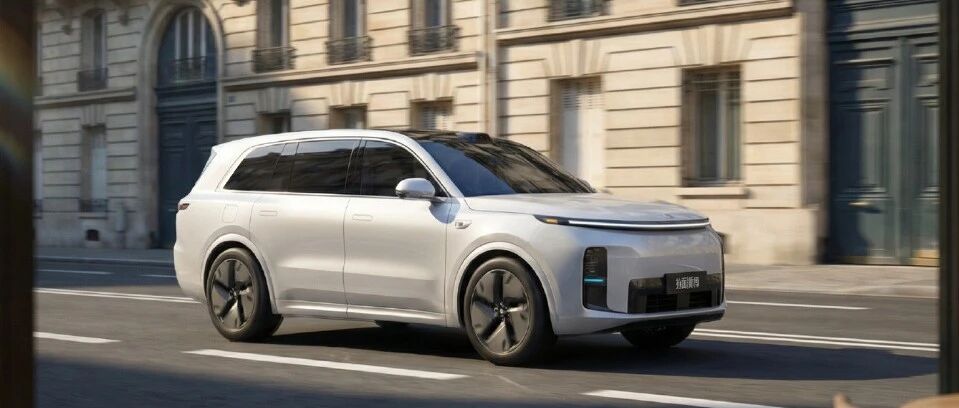
李想: 全新理想L9是具身智能机器人的开山之作。我们准备了十年,就等这一刻。
理想TOP2· 2026-02-05 08:25
Core Viewpoint - The company envisions the ultimate form of a car as a robot, not just a faster or smarter transportation tool, and has been progressively working towards this goal over the past decade [1]. Group 1: Development Timeline - In October 2018, the company launched the Li ONE, introducing sensory capabilities with microphones, radars, and cameras [1]. - In May 2021, the self-developed perception system was integrated into the 2021 Li ONE model [1]. - In October 2021, the project for a self-developed operating system was initiated [2]. - In June 2022, the Li L9 was released, featuring the first mass production of the self-developed central domain controller XCU [2]. - In November 2022, the project for self-developed chips was initiated [3]. - In March 2023, the project for a self-developed large model was initiated [4]. - In December 2023, the self-developed large model MindGPT was launched with OTA 5.0 [5]. - In April 2024, the Li L6 was released, marking the first mass production of the self-developed operating system Star Ring OS [6]. - In October 2024, the first end-to-end AD large model was delivered [7]. - In March 2025, the Star Ring OS was open-sourced [8]. - In August 2025, the VLA driver large model was integrated into the Li i8 [9]. Group 2: Future Vision - The upcoming Li L9 is positioned as a smart entity, equipped with a complete technology stack that transforms the car from a passive tool into an active partner [9]. - The company emphasizes that embodied intelligence must be integrated into a good car to create real value for users, dedicating 70% of its focus on automotive development [9]. - The company is preparing for its second decade in 2026, with the new Li L9 being a pioneering product in the realm of embodied intelligent robots [9].

2026款理想L9最值得观察的三条主线是销量/自动驾驶/具身智能
理想TOP2· 2026-02-05 07:47
Sales - The sales performance of the 2026 L9 model will significantly impact the revenue, net profit, and free cash flow limits for the company in 2026 and 2027, while the sales of the i6/L6 models will greatly influence the lower limits [1] - Observing delivery volumes, order messages, and consumer feedback one month, three months, and six months after the release of the 2026 L9 will provide better insights into consumer acceptance and the model's market performance [1] Autonomous Driving - The focus should be on the actual user value enhancement of autonomous driving by the company compared to competitors, rather than merely comparing which is superior [2][4] - The company has optimized the response time of its vehicles to approximately 350 milliseconds, which is a significant improvement over the current average of 550 milliseconds, potentially reducing accident rates by 50% [2] User Value and Interaction - The improvement in real user value is a fundamental anchor for sales, while the competition ranking is merely a marketing gimmick [4] - The company is expected to explore new interaction methods for its cockpit, potentially inspired by the "Doubao" smartphone, which emphasizes user-friendly interfaces and efficient operation paths [6][7][8] Embodied Intelligence - The company anticipates that 2026 will mark the beginning of a new era in embodied intelligence within the automotive sector, with products that differ significantly from past offerings [10] - The usability and delivery timeline of the embodied intelligence features in the 2026 L9 model are critical observation points, as initial public sentiment may suggest competitors could easily replicate these innovations [11] Battery and Charging Infrastructure - The 2026 L9 is expected to feature a 70 kWh battery with a CLTC range exceeding 400 kilometers, along with a commitment to a robust charging infrastructure [12] - The company's strategy to integrate charging as a product operation will likely resonate well with a significant portion of pure electric vehicle users, especially given the anticipated lack of comparable competition in 2026 [12]
多家车企1月销量出炉 出口成拉动销量重要因素
Zhong Guo Zhi Liang Xin Wen Wang· 2026-02-05 05:41
Core Insights - The overall sales of car manufacturers in January showed a year-on-year increase but a month-on-month decline, with exports becoming a significant factor in driving sales amid domestic market fluctuations [1][2][3] - The competition in the domestic market is intensifying, leading to a structural differentiation in the performance of new energy vehicles versus traditional fuel vehicles, as well as between new entrants and established brands [1][3] Group 1: Traditional Automakers - SAIC Motor Corporation achieved vehicle sales of 327,000 units, a year-on-year increase of 23.9% but a month-on-month decline of approximately 18.03%; overseas sales reached 105,000 units, up 51.7% year-on-year [1] - GAC Group sold 116,600 vehicles, marking an 18.47% year-on-year increase but a month-on-month drop of 37.79%; overseas sales grew by 68.59% year-on-year [1] - Geely Automobile reported sales of 270,200 units, a year-on-year increase of 1.29% and a month-on-month increase of 14.08%; overseas sales surged by 121% [2] Group 2: New Energy and Emerging Automakers - NIO delivered 27,200 vehicles, a year-on-year increase of 96.1% but a month-on-month decline of 43.53% [3] - The AITO brand under Huawei delivered 57,900 vehicles, a year-on-year increase of 65.6% but a month-on-month decline of 35.3% [3] - BYD's sales were significantly impacted by the reduction in new energy vehicle purchase tax, with January sales at 210,100 units, a year-on-year decline of 30.11% and a month-on-month decline of 50.04%; however, overseas sales exceeded 100,000 units, up 43.3% year-on-year [2][3] Group 3: Market Trends and Strategies - The January sales data indicates that the domestic automotive market, particularly in the new energy vehicle sector, is moving away from a universally high-growth model [3] - Many automakers are responding to market changes by increasing promotions, offering extended loan terms and low-interest rates, and some are directly reducing prices to maintain market share [3] - The need for automakers to develop unique competitive advantages is emphasized, especially in light of the changing subsidy policies and market dynamics [3]



腾讯等入股新石器无人车
Xin Lang Cai Jing· 2026-02-05 03:24
Group 1 - The core point of the article is the recent change in the shareholder structure of New Stone Technology's subsidiary, New Stone Intelligent Technology (Beijing) Co., Ltd, which now includes Guangxi Tencent Venture Capital Co., Ltd and Paili Investment Partnership as new shareholders [1] - New Stone Intelligent Technology was established in February 2018, with a registered capital of approximately 41.38 million RMB, and its business scope includes the manufacturing of industrial robots, research and development of intelligent robots, and sales of intelligent robots [1] - The current shareholders of New Stone Intelligent Technology include Yu Enyuan, a related company of Ideal Automotive, Beijing Chehejia Information Technology Co., Ltd, and the newly added shareholders [1]

8点1氪丨微信公关总监回应屏蔽元宝链接;vivo确认立项Vlog相机,对标大疆;贾国龙微博解禁,首发内容是速冻西兰花科普视频
3 6 Ke· 2026-02-05 00:04
Group 1 - Novo Nordisk's semaglutide sales reached 250.84 billion yuan in 2025, with a year-on-year growth of over 10% [5] - The sales breakdown includes 127.09 billion Danish kroner for Ozempic, 79.11 billion for Wegovy, and 22.09 billion for oral semaglutide [5] - In China, the total sales for all three semaglutide products amounted to 6.81 billion Danish kroner (approximately 7.49 billion yuan) [5] Group 2 - The Hong Kong High Court rejected Xu Jiayin's appeal regarding the appointment of a receiver and ordered him to pay 1.2 million HKD in legal fees by February 20 [6] - The National Healthcare Security Administration is conducting collective interviews with mental health insurance institutions to strengthen management and combat misuse of insurance funds [6][7] Group 3 - Panasonic's CFO announced potential layoffs could expand to 12,000 employees, following a previous plan to cut 10,000 jobs globally [8] - Multiple small and medium-sized banks have announced increases in deposit rates ahead of the Spring Festival, while some banks have opted to lower rates [8] Group 4 - Walmart's market capitalization surpassed 1 trillion USD, with a stock price increase of over 24% in the past year [10] - PayPal announced that Enrique Lores will take over as CEO on March 1, aiming to enhance execution efficiency and advance strategic initiatives [11] Group 5 - AMD reported a fourth-quarter net profit of 2.52 billion USD, with a year-on-year growth of 42% and revenue of 10.27 billion USD, exceeding market expectations [23] - Alphabet's fourth-quarter net profit was 34.455 billion USD, a 29.8% increase year-on-year, with total revenue of 113.83 billion USD [21]


全世界都在抢的车,中国却开始嫌弃
汽车商业评论· 2026-02-04 23:06
Core Viewpoint - The article discusses the significant decline in the growth rate of plug-in hybrid vehicles (PHEVs) in the Chinese automotive market, highlighting the competitive pressure from pure electric vehicles (EVs) and the changing consumer preferences that have led to this shift [4][6][7]. Group 1: Market Trends - In 2025, the growth rate of PHEVs dropped to 8.8%, with range-extended vehicles seeing a mere 6% increase, marking the first instance of consecutive monthly declines in this segment [6][7]. - The penetration rate of PHEVs in the new energy vehicle market surged from 17% in 2021 to 40% in 2024, but the market dynamics shifted dramatically in 2025 [4][6]. - The average price of pure electric vehicles fell by 15% from 168,000 yuan in 2024 to 143,000 yuan in 2025, while mainstream PHEVs remained in the 150,000 to 180,000 yuan range, erasing the price advantage previously held by PHEVs [11]. Group 2: Consumer Behavior - The average range of pure electric vehicles exceeded 528 kilometers in 2025, with many mainstream models surpassing 600 kilometers, significantly reducing consumer anxiety regarding range [15]. - The rapid development of charging infrastructure, with a car-to-charging station ratio of 2.5:1 and a total of 20.09 million charging facilities by the end of 2025, has made pure electric vehicles a more reliable choice for consumers [15]. - Consumers are increasingly viewing pure electric vehicles as a dependable option, leading to a decline in the perceived necessity of PHEVs, which were initially chosen to alleviate range anxiety [15][19]. Group 3: Technological Shifts - PHEVs are experiencing a shift towards larger battery capacities and faster charging solutions, with many manufacturers adopting battery sizes exceeding 60 kWh to enhance their appeal [27][29]. - The introduction of 800V high-voltage platforms and ultra-fast charging technologies is becoming standard, allowing for significant improvements in charging efficiency [15][27]. - The trend of integrating larger batteries into PHEVs is raising production costs, which could undermine their competitive pricing advantage [32][35]. Group 4: Regulatory Environment - New regulations set to take effect in 2026 will tighten the eligibility criteria for tax exemptions for PHEVs, making it more challenging for lower-end models to compete [39][40]. - The shift from a "universal" tax exemption policy to one that favors stronger models will further complicate the market landscape for PHEVs [37][41]. Group 5: Future Outlook - Despite the current challenges, the article suggests that PHEVs will maintain a significant market share, with a projected penetration rate of 36% in 2025, corresponding to 4.669 million units [51]. - The global market for PHEVs is expected to grow, with predictions indicating that their growth rates will surpass those of pure electric vehicles in the coming years [60][66]. - The unique energy structure and market conditions in China suggest that PHEVs will continue to play a crucial role in the automotive landscape, particularly in regions with less developed charging infrastructure [52][54].

恒生指数收涨0.05%,煤炭、内房股走高,科网股低迷
Jin Rong Jie· 2026-02-04 09:58
Market Overview - The Hang Seng Index closed up 0.05% at 26,847.32 points, while the Hang Seng Tech Index fell by 1.84% to 5,366.44 points [1]. Sector Performance - Coal stocks led the gains, with Yanzhou Coal Mining rising over 10% and China Shenhua Energy increasing by over 5% [1]. - Chip stocks showed weak performance, with Shanghai Fudan down over 5% and Huahong Semiconductor declining nearly 5% [1]. - The technology sector overall performed poorly, with Tencent Holdings down nearly 4% and Bilibili falling over 3% [1]. - Domestic property stocks collectively rose, with Shimao Group increasing over 14% and Sunac China rising over 8% [1]. Individual Stock Movements - Among the Hang Seng Index constituents, Xinyi Glass, China Shenhua, and China Resources Land had the highest gains [1]. - Conversely, Ctrip Group, Tencent Holdings, and NetEase saw the largest declines [1]. - In the Hang Seng Tech Index, Li Auto, Leapmotor, and Haier Smart Home showed the most significant increases [1]. - On the downside, Kingdee International, Ctrip Group, and Tongcheng Travel experienced the largest drops [1].