MEITUAN(03690)

Search documents
ETF复盘资讯|豪气冲天!沪指豪取17连阳,A股成交额创历史新高!商业航天、AI产业链掀涨停潮,通用航空ETF放量暴涨8.71%
Sou Hu Cai Jing· 2026-01-12 13:54
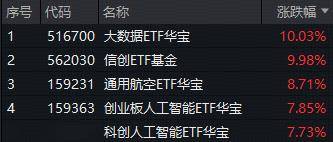
Market Overview - The A-share market continued its upward trend on January 12, with over 4,100 stocks rising and more than 200 stocks hitting the daily limit. The Shanghai Composite Index rose by 1.09% to close at 4,165.29, marking a new ten-year high and achieving a 17-day winning streak. The Shenzhen Component Index increased by 1.75%, and the ChiNext Index rose by 1.82. The total trading volume in the Shanghai and Shenzhen markets reached 36,450 billion, a significant increase of nearly 5,000 billion from the previous trading day, setting a record for the highest trading volume in A-share history [1]. AI Sector - The AI industry chain experienced a surge, with significant gains in ETFs focused on domestic computing power and AI applications. The Big Data ETF (516700) and the Xinchuang ETF (562030) both hit the daily limit, while the ChiNext AI ETF (159363) surged by 7.85%, reaching a new high since its listing. The Sci-Tech AI ETF (589520) also saw a substantial increase of 7.73%, closing at a new listing high [1][3]. - The entrepreneurial AI sector has shown robust performance, with the ChiNext AI ETF (159363) experiencing a trading volume exceeding 1 billion, and a net subscription of 352 million units. The current price of 1.127 yuan is approaching the pre-rights issue closing price of 1.191 yuan, indicating a potential "filling rights" scenario [5][8]. Commercial Aerospace and Satellite Navigation - The commercial aerospace and satellite navigation sectors are booming, with the General Aviation ETF (159231) rising by 8.71%, marking its largest single-day increase since its listing. The fund saw a net subscription of 36 million units in a single day. The military industry sector also performed well, with the military ETF (512810) rising by 5.97%, reaching a new high [1][4]. - The commercial aerospace industry in China is entering a rapid development phase, with expectations that the market size will reach 8 trillion yuan by 2030. The industry encompasses satellite manufacturing, rocket launches, and satellite applications, supported by national policies and strategic plans [5]. Hong Kong Market - The Hong Kong stock market saw a significant rally in AI stocks, with the Hong Kong Internet ETF (513770) rising by 5.36%. This surge reflects strong investor confidence and a positive market sentiment towards AI applications [2][10]. - Major internet companies in Hong Kong are leveraging their large user bases and advanced AI technologies to drive commercialization in the AI sector. Notable increases in user engagement and revenue from AI applications have been reported [12]. Investment Outlook - Analysts are optimistic about the ongoing bull market, suggesting that the current market environment is conducive to sector rotation and thematic investments, particularly in AI and semiconductor industries. The focus is on future industrial hotspots and the price increase chain of resource products [3][6]. - The AI application sector is viewed as a pivotal point for investment, with expectations for significant revenue realization in the coming years as AI technologies become more integrated into various industries [7][8].


智通港股通活跃成交|1月12日
智通财经网· 2026-01-12 11:01
Core Insights - On January 12, 2026, Alibaba-W (09988), Tencent Holdings (00700), and Xiaomi Group-W (01810) were the top three companies by trading volume in the Southbound Stock Connect, with trading amounts of 8.776 billion, 3.590 billion, and 2.802 billion respectively [1] - In the Shenzhen-Hong Kong Stock Connect, Alibaba-W (09988), Tencent Holdings (00700), and Meituan-W (03690) also led the trading volume, with amounts of 6.830 billion, 3.416 billion, and 2.100 billion respectively [1] Southbound Stock Connect Trading Activity - **Top Active Companies in Southbound Stock Connect:** - Alibaba-W (09988): Trading amount of 8.776 billion, net buy of -74.5144 million [2] - Tencent Holdings (00700): Trading amount of 3.590 billion, net buy of 1.184 billion [2] - Xiaomi Group-W (01810): Trading amount of 2.802 billion, net buy of 289 million [2] - Meituan-W (03690): Trading amount of 2.450 billion, net buy of -875 million [2] - SMIC (00981): Trading amount of 2.427 billion, net buy of -21.875 million [2] - Other notable companies include Kuaishou-W (01024) with a trading amount of 1.949 billion and a net buy of 948 million [2] Shenzhen-Hong Kong Stock Connect Trading Activity - **Top Active Companies in Shenzhen-Hong Kong Stock Connect:** - Alibaba-W (09988): Trading amount of 6.830 billion, net buy of 278 million [2] - Tencent Holdings (00700): Trading amount of 3.416 billion, net buy of 828 million [2] - Meituan-W (03690): Trading amount of 2.100 billion, net buy of 393 million [2] - Kuaishou-W (01024): Trading amount of 1.990 billion, net buy of 1.298 billion [2] - Xiaomi Group-W (01810): Trading amount of 1.869 billion, net buy of 484 million [2]

南向资金 | 快手-W获净买入22.45亿港元




Di Yi Cai Jing· 2026-01-12 10:12
Group 1 - Southbound funds recorded a net purchase of 7.306 billion HKD today [1] - Kuaishou-W, Tencent Holdings, and Southern Hang Seng Technology were the top three net purchases, with net buys of 2.245 billion HKD, 2.012 billion HKD, and 858 million HKD respectively [1] - On the sell side, China Mobile, Meituan-W, and Ping An of China experienced net sales of 1.03 billion HKD, 482 million HKD, and 342 million HKD respectively [1]
港股收盘(01.12) | 恒指收涨1.44% 美团、阿里齐走高 AI应用方向再掀热潮
智通财经网· 2026-01-12 08:42
Market Overview - The Hong Kong stock market indices collectively rose, with the Hang Seng Index increasing by 1.44% to close at 26,608.48 points, and a total trading volume of HKD 306.23 billion [1] - The Hang Seng Tech Index saw a significant rise of 3.1%, closing at 5,863.2 points, indicating a strong performance in the technology sector [1] Blue-Chip Stocks Performance - Meituan-W (03690) surged by 6.6% to HKD 105, contributing 57.12 points to the Hang Seng Index, with a trading volume of HKD 11.31 billion [2] - Alibaba Health (00241) rose by 10.23% to HKD 6.36, contributing 6.17 points to the index [2] - Kuaishou-W (01024) increased by 7.43% to HKD 80.25, contributing 26.89 points [2] - Other notable movements included a decline in Shenzhou International (02313) by 2.8% and Hansoh Pharmaceutical (03692) by 2.31%, which negatively impacted the index [2] Sector Highlights - The AI sector experienced a significant surge, with stocks like Maifushi (02556) rising by 32.09% and Zhipu (02513) by 31.4%, reflecting a growing interest in AI applications [3][4] - The commercial aerospace sector also saw gains, with Asia Pacific Satellite (01045) increasing by 18.16% and China Technology Group (01725) by 16.84% [5] - Gold stocks were active, with the price of gold surpassing USD 4,600, leading to increases in companies like China Silver Group (00815) and Lingbao Gold (03330) [5][6] Lithium Battery Sector - Lithium battery stocks showed mixed performance, with Ganfeng Lithium (01772) rising by 4.69% while CATL (03750) fell by 2.45% [6] - The recent adjustment in export tax policies for battery products is expected to impact the sector, with potential short-term benefits due to increased export orders before the tax changes take effect [7] Notable Stock Movements - Haowei Group (00501) debuted with a significant increase of 16.22%, closing at HKD 121.8, following its IPO pricing at HKD 104.8 [8] - Baiaosaitu-B (02315) reached a new high, rising by 10.03% to HKD 39.5, following a licensing agreement aimed at accelerating the development of bispecific antibody drug conjugates [9] - COSCO Shipping Energy (01138) continued to rise, up by 9.03% to HKD 11.47, driven by increased shipping demand in the Middle East [10]


【财经分析】2026年消费展望:政策精准赋能、市场纵深拓展、热点多元涌现
Xin Hua Cai Jing· 2026-01-12 08:17
Core Viewpoint - The Chinese consumer market is expected to deepen its development along the path of quality improvement and efficiency enhancement by 2026, driven by macroeconomic policies and emerging consumption trends [1][2]. Group 1: Macroeconomic Policies and Consumer Growth - The "old-for-new" policy has been effective in boosting consumer spending, with over 2.6 trillion yuan in sales benefiting more than 360 million consumers in 2025 [2][3]. - In 2026, the focus will shift to more targeted and effective macro policies, optimizing support areas, subsidy standards, and implementation mechanisms [2][3]. Group 2: County Market Dynamics - The county market is emerging as a new growth engine for consumption, with the instant retail sector expected to exceed 1 trillion yuan in 2026 [4][5]. - Major brands are accelerating their expansion into county markets, with notable growth in sectors like hospitality and dining [5]. Group 3: New Consumption Trends - New consumption hotspots are reshaping the market, including seasonal tourism driven by the ice and snow economy, which saw a 57% increase in bookings during the New Year period [6][8]. - Emotional consumption is gaining traction, with activities like rock climbing and cultural experiences driving new consumer ecosystems [7][8]. - The transformation of national cultural experiences is evident, with cities like Xi'an and Nanjing becoming popular travel destinations, integrating traditional culture with modern experiences [8].

港股科网股午后持续走强,快手(01024.HK)涨近7%,美团(03690.HK)涨超6%,百度(09888.HK)、阿里巴巴(09988.HK)涨超5...
Jin Rong Jie· 2026-01-12 06:33
Group 1 - Hong Kong tech stocks showed strong performance in the afternoon session, with Kuaishou (01024.HK) rising nearly 7% [1] - Meituan (03690.HK) increased by over 6% [1] - Baidu (09888.HK) and Alibaba (09988.HK) both saw gains of over 5% [1] - Other companies such as NetEase-S (09999.HK) and Tencent Holdings (00700.HK) also experienced upward movement [1]


美团试点开锁行业专项服务治理:上线“公安备案”标识,“开锁刺客”问题有望解决
Feng Huang Wang· 2026-01-12 06:02
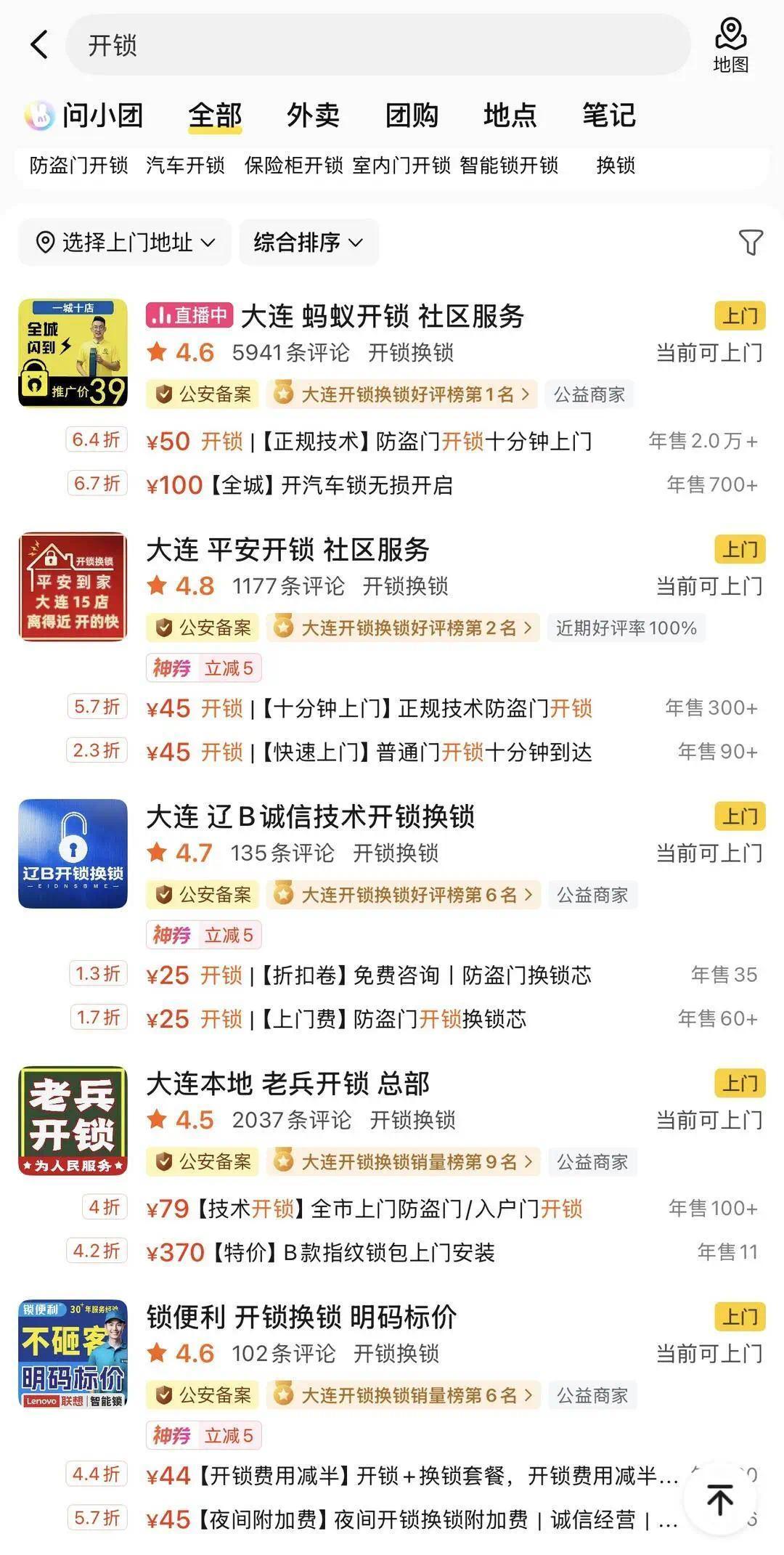
Core Insights - Meituan has launched a pilot program for the locksmith industry in Dalian, enhancing consumer transparency and safety through various measures [1][4] - The police have guided the initiative, resulting in a 100% police filing rate for locksmith businesses in Dalian, with some merchants experiencing a doubling in order volume and over a 50% increase in revenue [1][4] Group 1: Merchant Qualification and Evaluation - Meituan has established a qualification verification channel with the police to ensure that merchants possess the necessary police filing credentials [4] - A dynamic performance evaluation mechanism has been implemented, assessing merchants based on service timeliness, quality, and customer complaint rates, with high-performing merchants receiving increased traffic support [4] Group 2: Service Process and Consumer Education - Locksmiths are required to upload service steps in real-time and record the unlocking process via video, with the system monitoring pricing against market averages to trigger alerts for abnormal charges [4] - An AI consultation feature has been added to the Meituan app, allowing users to understand lock types and pricing standards before placing orders, while AI is also used to educate consumers on service processes and pricing rationale [4] Group 3: Future Expansion Plans - The successful experiences from the Dalian pilot will be gradually expanded to more cities across the country, leveraging platform technology to support the online transformation and service enhancement of traditional convenience service industries [4]
资本市场丨跻身市值榜上市企业 须从规模优势转向质量优势
Sou Hu Cai Jing· 2026-01-12 05:45
Core Insights - The latest "Top 500 Listed Companies in China" list for 2025 showcases leading enterprises in finance, energy, technology, consumption, and intelligent manufacturing, with major players like Tencent and ICBC demonstrating their industry leadership through trillion-level market capitalizations [1][10] - The presence of companies like Industrial Fulian, SMIC, and Cambricon in the rankings reflects the deep structural transformation of China's economy, indicating these firms are both stabilizers and pioneers in industrial upgrades [1][10] Group 1: Market Capitalization Rankings - The companies ranked from 21 to 30 include Sinopec (700.7 billion), Zhongji Xuchuang (677.8 billion), Yangtze Power (665.3 billion), Postal Savings Bank (641.7 billion), SMIC (632.9 billion), NetEase (614.0 billion), Midea Group (592.9 billion), Bank of Communications (590.8 billion), Cambricon (571.6 billion), and Meituan (570.2 billion) [3][10] Group 2: Economic Structural Transformation - The success of these companies is attributed to multiple factors, including industry scarcity, technological barriers, and stable business models, which create competitive advantages [4][11] - Companies like Zhongji Xuchuang and SMIC exemplify the dual drivers of technological innovation and market opportunities, with Zhongji Xuchuang capitalizing on the AI infrastructure wave [4][11] Group 3: Challenges and Opportunities - Companies face the challenge of transitioning from scale advantages to quality advantages, with risks related to technological iteration and high valuation sustainability [6][12] - The need for technological independence and improved profitability models is highlighted, particularly for firms like Zhongji Xuchuang and Cambricon, which must navigate rapid technological changes [6][12] Group 4: Future Trends - Future market leaders are expected to emerge from sectors such as high-end manufacturing, green energy, and innovative pharmaceuticals, with a focus on hard technology like semiconductors and AI [8][9] - The anticipated market structure will feature a three-tier system, with traditional giants at the base, tech newcomers leading, and niche champions filling in [8][9] Group 5: Investment Opportunities - The average market capitalization of the top 500 companies reached 185.6 billion, reflecting a significant increase, particularly in information technology, finance, and consumer discretionary sectors [23] - Companies are expected to enhance their value and market capitalization through innovation, digital transformation, and sustainable practices, aligning with national policies and market demands [21][24]


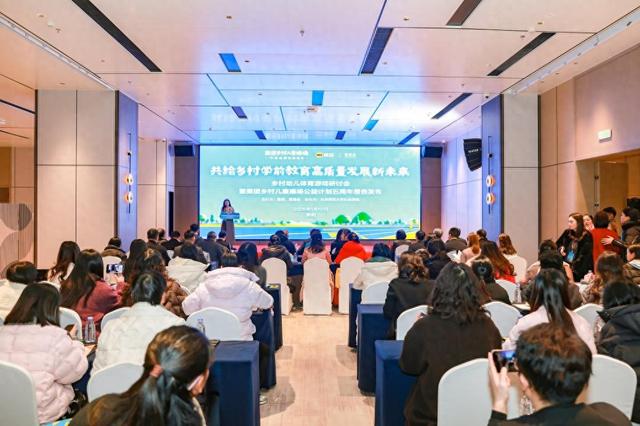
已建成4,535座,美团乡村儿童操场公益计划发布五周年报告
Huan Qiu Wang· 2026-01-12 05:40
Core Viewpoint - The "Meituan Rural Children's Playground Public Welfare Program" aims to improve early childhood education in rural areas by building multifunctional playgrounds and providing training for teachers and principals, thereby promoting balanced development in preschool education across urban and rural areas [1][3][6]. Group 1: Program Overview - The program, initiated by Meituan and the One Foundation, has established 4,535 playgrounds by the end of December 2025, benefiting 611,000 rural children [1][6]. - The program is recognized as the largest and most extensive public welfare project in China's preschool education sector [1][13]. - The first playground was completed in September 2020 in Guizhou Province, marking the beginning of a significant initiative to support rural education [6][10]. Group 2: Impact and Participation - The program has seen participation from 1.813 million public welfare businesses and 1.467 million caring netizens over five years, showcasing a robust community involvement [7]. - The project has created a new donation system that allows businesses to contribute easily, with an average of five playgrounds being donated daily since the second quarter of 2025 [7][8]. - Training sessions have been conducted for over 5,600 teachers across 2,979 kindergartens, enhancing the quality of education in rural areas [8][11]. Group 3: Educational Outcomes - The program has significantly improved children's physical habits and cognitive abilities, with children participating more frequently in physical activities and showing better performance in language and learning skills [10][11]. - Feedback from 97.3% of principals indicates that the program has enhanced teachers' ability to organize outdoor activities, fostering a positive cycle of continuous professional development [11][12]. - The initiative has been recognized for its potential to bridge the educational gap between urban and rural areas, contributing to the overall quality of human resources in the country [13].
观察 | 阿里双线作战:押注闪购与AI,不是左右互搏是大棋?
未可知人工智能研究院· 2026-01-12 05:02
Core Viewpoint - Alibaba is strategically focusing on both instant retail and AI, aiming to establish a strong user mindset and market position in the evolving landscape of consumer services [1][12][68]. Group 1: Market Positioning - Alibaba plans to invest heavily in instant retail, targeting to become the leader in this sector by 2026, indicating a rare assertive stance [1][12]. - The primary competition is not with Meituan or ByteDance, but rather in capturing user attention and decision-making processes [6][8]. - The instant retail market is projected to exceed 1 trillion by 2026 and reach 2 trillion by 2030, highlighting the significant growth potential [13]. Group 2: Strategic Resource Allocation - Alibaba's strategy involves concentrating resources on key areas during critical market phases, with over hundreds of billions allocated to instant retail in 2025 [19][20]. - The company is currently in a pivotal phase where its market share in instant retail has reached 42%, narrowing the gap with the leader [20][21]. - By focusing on instant retail, Alibaba aims to leverage this sector to enhance its overall local service ecosystem [23]. Group 3: Dual Focus on AI and Instant Retail - The simultaneous investment in AI is not a distraction but a strategic combination of short-term and long-term initiatives [30][41]. - AI is seen as a tool to reconstruct the consumer decision-making process, potentially increasing efficiency significantly [35][36]. - The integration of AI into various service scenarios aims to create a comprehensive ecosystem that connects shopping, delivery, and local services [40][62]. Group 4: Long-term Vision and Strategy - Alibaba's approach is to maintain a balance between immediate market needs and future technological advancements, avoiding a binary choice between focusing solely on instant retail or AI [45][68]. - The company is adopting a "rural encirclement of cities" strategy, starting with AI tools to capture users and gradually expanding into broader service areas [63]. - The success of Alibaba's strategy will be evident by 2026, depending on its ability to lead in instant retail and establish a strong user base for its AI initiatives [70].