MEITUAN(03690)

Search documents
查内卷!外卖平台股集体大涨,美团涨超7%,阿里涨近5%
Ge Long Hui· 2026-01-12 04:47
Group 1 - The core viewpoint of the article highlights a significant rise in the stock prices of food delivery platforms in the Hong Kong market, with Meituan increasing over 7%, Alibaba nearly 5%, and JD.com rising by 2% [1] - The State Council's Anti-Monopoly and Anti-Unfair Competition Committee has decided to investigate and assess the competitive status of the food delivery platform service industry to promote lawful and compliant operations and fair competition [1] - Meituan has expressed its strong support and commitment to cooperate with the investigation, while Taobao Shanguo and JD.com have also indicated their willingness to actively participate and comply with the assessment [1]

港股外卖平台股集体大涨,美团涨超7%,阿里涨近5%
Jin Rong Jie· 2026-01-12 04:07
Group 1 - The core viewpoint of the article highlights a significant increase in the stock prices of food delivery platforms in the Hong Kong market, with Meituan rising over 7%, Alibaba increasing nearly 5%, and JD.com up by 2% [1] Group 2 - The article indicates that the overall trend in the Hong Kong stock market for food delivery companies is positive, reflecting investor confidence in these platforms [1]


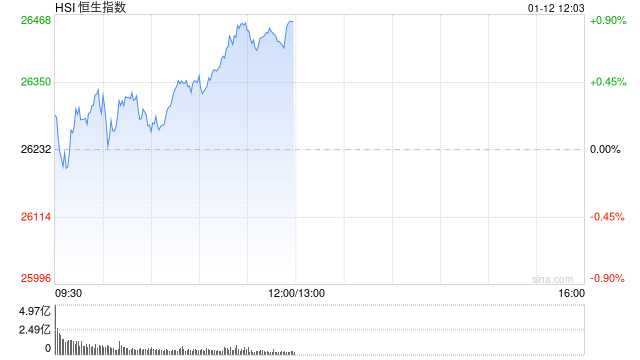
港股午评:恒指涨0.86% 科指涨2.08% 科网股普涨 AI概念股强势 智谱涨超31% 美团涨超7%
Xin Lang Cai Jing· 2026-01-12 04:03
Market Overview - The Hong Kong stock market indices opened higher, with the Hang Seng Index rising by 0.86% to 26,456.75 points, the Hang Seng Tech Index increasing by 2.08%, and the National Enterprises Index up by 1.08% [2][11]. AI Sector - AI concept stocks showed strong performance, with Zhihui rising over 31%. This surge is seen as a sign that domestic AI large model companies are transitioning from the research phase to a stage where technology and commercialization are aligning, providing a basis for future financing and valuation [4][13]. - According to Frost & Sullivan, the market size for China's large language models is projected to reach 5.3 billion yuan in 2024 and grow to 101.1 billion yuan by 2030, with a compound annual growth rate of 63.5% from 2024 to 2030 [4][13]. Entertainment Sector - The film sector saw significant gains, with Damai Entertainment increasing by over 6%. As of January 9, 2026, the total box office (including pre-sales) surpassed 1 billion yuan. Despite expectations that the 2026 Spring Festival box office may not reach the levels of 2025, the presence of popular directors and actors is expected to ensure a solid performance [5][14]. Commercial Aerospace Sector - The commercial aerospace sector continued to rise, with Asia Pacific Satellite increasing by 13%. Recent breakthroughs in China's reusable rocket technology are seen as a significant advancement, positioning the country closer to achieving low-cost and high-reusability in aerospace. This development is expected to benefit related industries such as aerospace manufacturing and satellite applications [6][15]. New Listings - Haowei Group debuted with a first-day increase of over 15%. The public offering was oversubscribed by 9.28 times, with 4.58 million shares allocated, representing about 10% of the total shares offered. The international placement was also oversubscribed by 9.73 times, with 41.22 million shares allocated, accounting for 90% of the total shares [7][17].



港股异动丨查内卷!外卖平台股集体大涨,美团涨超7%,阿里涨近5%
Ge Long Hui A P P· 2026-01-12 03:56
Core Viewpoint - The Hong Kong stock market saw a significant rise in shares of food delivery platforms, with Meituan up over 7%, Alibaba nearly 5%, and JD.com up 2% following the announcement of an investigation into the competitive landscape of the food delivery service industry by the State Council's Anti-Monopoly and Anti-Unfair Competition Committee [1] Group 1: Market Reaction - Shares of food delivery platforms in Hong Kong experienced a collective surge, indicating positive investor sentiment towards the sector [1] - Meituan's stock increased by more than 7%, reflecting strong market confidence [1] - Alibaba's shares rose nearly 5%, while JD.com saw a 2% increase, showcasing a broad-based rally in the sector [1] Group 2: Regulatory Developments - The State Council's Anti-Monopoly and Anti-Unfair Competition Committee has initiated an investigation to assess the competitive conditions within the food delivery service industry [1] - The investigation aims to promote lawful and compliant operations among food delivery platforms, fostering fair competition and a healthy market order [1] - Companies such as Meituan, Taobao Flash, and JD.com have expressed their support for the investigation and commitment to cooperate fully with the regulatory body [1]
政策红利密集释放,线上消费ETF基金(159793)冲击3连涨
Sou Hu Cai Jing· 2026-01-12 02:50
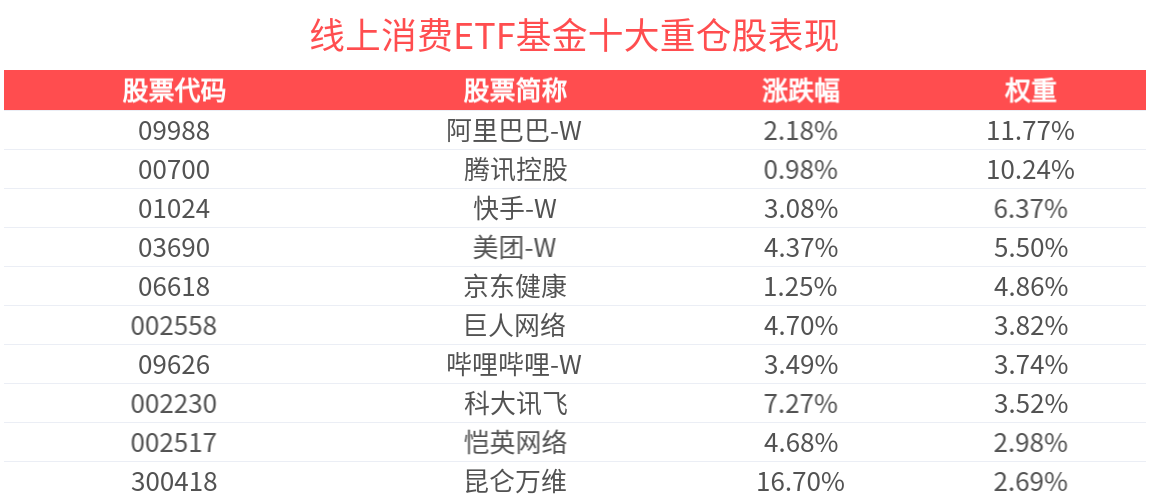
Group 1 - The core viewpoint of the news is the strong performance of the online consumption sector, highlighted by the significant rise in the China Securities Hong Kong-Shenzhen Online Consumption Theme Index, which increased by 4.79% [1] - The online consumption ETF fund also showed positive momentum, rising by 4.28% and achieving a price of 1.17 yuan, marking its third consecutive increase [1] - The National Business Work Conference held on January 10-11, 2026, emphasized boosting consumption as a top priority, with initiatives aimed at enhancing service consumption and creating a favorable international consumption environment [1] Group 2 - The China Securities Hong Kong-Shenzhen Online Consumption Theme Index includes 50 companies involved in online shopping, digital entertainment, online education, and telemedicine, reflecting the overall performance of the online consumption sector [2] - As of December 31, 2025, the top ten weighted stocks in the index accounted for 55.63% of the total index weight, with major players including Meituan-W, Tencent Holdings, and Alibaba-W [2] - The index's top stocks showed varying performance, with notable increases such as 20.00% for Yidian Tianxia and 16.70% for Kunlun Wanwei, indicating strong market interest in these companies [3]



ETF盘中资讯|监管启动外卖行业反垄断调查评估,美团涨近6%!港股互联网ETF(513770)涨超3%,连日大举吸金5.72亿元
Jin Rong Jie· 2026-01-12 02:48
Group 1 - The Hong Kong internet sector is experiencing a strong rally, with the Hong Kong internet ETF (513770) rising by 3.33% to recover above the 60-day moving average [1] - Major internet companies such as Meituan, Bilibili, Alibaba, Kuaishou, and Tencent have all seen significant gains, with Meituan up nearly 6% and Bilibili over 4% [1] - The Hong Kong internet ETF has attracted significant capital inflow, totaling 572 million yuan over the past five days, reaching a new historical high of 13.395 billion yuan [3] Group 2 - The State Council's Anti-Monopoly and Anti-Unfair Competition Committee has announced an investigation into the competitive landscape of the food delivery platform service industry [3] - Meituan supports the investigation, highlighting issues of irrational competition in the food delivery market, such as price wars and excessive subsidies [3] - Taobao Shanguo has expressed willingness to cooperate with the investigation and emphasized the importance of maintaining a fair market environment [3] Group 3 - The AI application sector is rapidly advancing, with significant improvements in model capabilities and cost reductions, leading to accelerated commercialization in various fields [3] - The Hong Kong internet ETF passively tracks the CSI Hong Kong Internet Index, which includes major companies like Alibaba, Tencent, and Xiaomi, indicating a strong focus on AI giants [3] - The top holdings of the ETF include Tencent (15.42% weight), Alibaba (14.50%), and Xiaomi (13.11%), reflecting a diversified investment in leading tech firms [3]
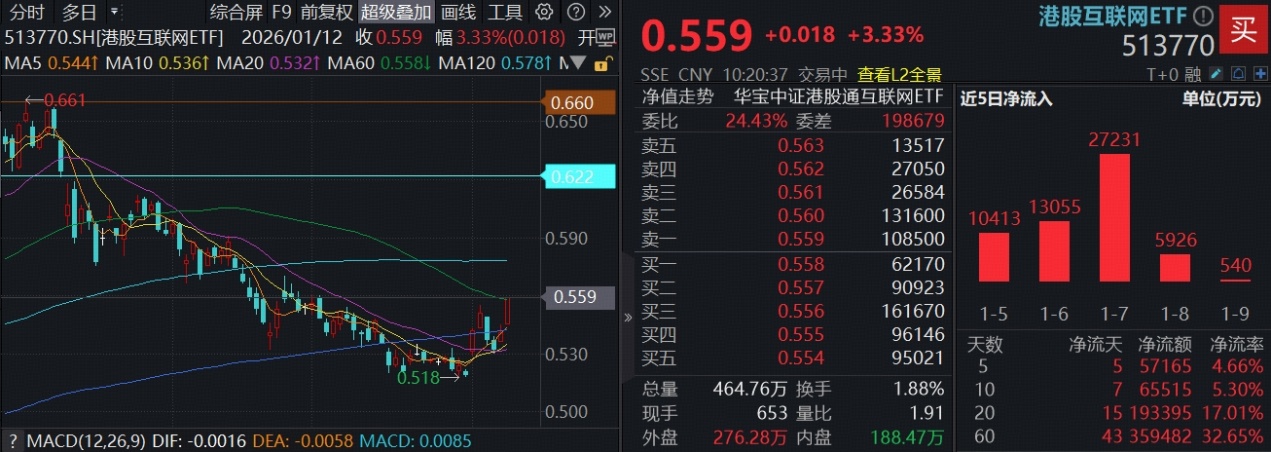
监管启动外卖行业反垄断调查评估,美团涨近6%!港股互联网ETF(513770)涨超3%,连日大举吸金5.72亿元
Xin Lang Cai Jing· 2026-01-12 02:41
Group 1: Market Performance - The Hong Kong internet sector saw significant gains, with the Hong Kong internet ETF (513770) rising by 3.33%, recovering above the 60-day moving average [1][7] - Major internet companies such as Meituan-W increased by nearly 6%, Bilibili-W by over 4%, Alibaba-W and Kuaishou-W by over 3%, and Tencent Holdings by over 1% [1][7] Group 2: Regulatory Developments - The State Council's Anti-Monopoly and Anti-Unfair Competition Committee announced an investigation into the competitive landscape of the food delivery platform service industry [3][9] - Meituan expressed strong support for the investigation, highlighting issues of irrational competition characterized by price wars, subsidies, and traffic control [3][9] - Taobao Flash expressed willingness to cooperate with the investigation and emphasized the importance of maintaining a fair and orderly market environment [3][9] Group 3: AI Applications and Investment Trends - AI applications are rapidly increasing, with CITIC Securities noting that advancements in model capabilities and significant reductions in inference and long-window costs are accelerating the commercialization of AI downstream applications [3][9] - The Hong Kong internet ETF (513770) and its linked funds have attracted significant capital, with a net inflow of 572 million yuan over five consecutive days, bringing the total size to 13.395 billion yuan, a new historical high [3][9]
美团-W涨超4% 监管部门启动外卖行业反垄断调查评估
Zhi Tong Cai Jing· 2026-01-12 02:17
Core Viewpoint - Meituan-W (03690) shares rose over 4%, currently up 4.57% at HKD 102.9, with a trading volume of HKD 2.433 billion. The State Council's Anti-Monopoly and Anti-Unfair Competition Committee announced an investigation into the competitive landscape of the food delivery service industry, which Meituan supports, highlighting issues of irrational competition such as price wars and excessive subsidies [1][1][1]. Group 1: Company Overview - Meituan is a leading local commerce platform in China, with core businesses including food delivery, flash purchase, and in-store hotel and travel services. The company is also actively developing new businesses like Xiaoxiang Supermarket and Kuaidilong, as well as expanding into overseas markets [1][1]. - The macroeconomic environment is the largest beta factor, with the service sector showing higher growth rates compared to retail goods, indicating greater growth potential and resilience for the platform [1][1]. Group 2: Industry Insights - The food delivery market has been facing significant issues related to irrational competition, including price competition, subsidies, and traffic control. Meituan has repeatedly called for a return to rational competition and opposes "involution" in the industry [1][1]. - The increasing online penetration rate in the food delivery sector is expected to provide a stable foundation for growth, with the in-store and flash purchase businesses accelerating their market penetration, leading to high growth potential [1][1].
港股异动 | 美团-W(03690)涨超4% 监管部门启动外卖行业反垄断调查评估
智通财经网· 2026-01-12 02:12
Group 1 - Meituan-W (03690) saw a stock price increase of over 4%, closing at 102.9 HKD with a trading volume of 2.433 billion HKD [1] - The State Council's Anti-Monopoly and Anti-Unfair Competition Committee announced an investigation into the competitive landscape of the food delivery service industry, which Meituan supports [1] - Meituan has highlighted issues of irrational competition in the food delivery market, such as price wars, subsidies, and traffic control, advocating for a return to rational competition [1] Group 2 - According to Caitong Securities, Meituan is a leading local business platform in China, with core operations in food delivery, flash purchase, and in-store travel services, while also developing new businesses like Xiaoxiang Supermarket and expanding into overseas markets [1] - The macroeconomic environment is identified as the largest beta factor, with the service sector showing higher growth rates compared to retail goods, indicating greater growth potential and resilience for the platform [1] - The increasing online penetration rate supports the stability of food delivery services, while the rapid growth of in-store and flash purchase businesses contributes to high growth [1]
港股开盘 | 恒指高开0.55% 科网股活跃 美团(03690)、百度(09888)涨超2%
智通财经网· 2026-01-12 01:40
Group 1 - The Hang Seng Index opened up by 0.55%, and the Hang Seng Tech Index rose by 0.88%, with notable gains in tech stocks like Meituan and Baidu, both increasing over 2% [1] - Lithium stocks showed strong performance, with Ganfeng Lithium and Tianqi Lithium both rising over 4%, while the precious metals sector also strengthened, with Zijin Mining up nearly 3% and China Aluminum increasing over 2% [1] - Citic Securities anticipates a second round of valuation recovery and performance resurgence in the Hong Kong stock market by 2026, driven by internal "15th Five-Year Plan" catalysts and external economic stimulus [1] Group 2 - Zheshang International views the fundamentals of the Hong Kong stock market as still weak, with a slight decline in the funding environment, but maintains a cautiously optimistic outlook for the mid-term market trends [2] - The firm highlights sectors that are relatively prosperous and benefit from policy support, including new energy, innovative pharmaceuticals, and AI technology, as well as low-valuation state-owned enterprises [2] - The expected performance of the Hong Kong stock market in spring 2026 is projected to be driven by "AI applications, PPI improvement, and expanded domestic demand," with a recommendation to focus on quality stocks in these areas [2]