MEITUAN(03690)

Search documents
研判2025!中国共享经济行业发展环境、产业链图谱、交易规模、市场集中度及前景展望:技术驱动与社会需求共振,共享经济交易规模有望达到4.8万亿元[图]
Chan Ye Xin Xi Wang· 2026-01-03 02:43
Core Insights - The sharing economy is an innovative economic model that enhances resource utilization efficiency, promotes economic development, and creates job opportunities [1][14] - In the transportation sector, models like bike-sharing and car-sharing have gained widespread adoption, alleviating urban traffic congestion and environmental pollution [1][14] - The market size of China's sharing economy is projected to reach 4.46 trillion yuan in 2024, with a year-on-year growth of 9.05% [1][14] - By 2025, the market size is expected to grow to 4.8 trillion yuan, driven by diverse consumer demands and the application of big data and artificial intelligence [1][14] Sharing Economy Overview - The sharing economy utilizes modern information technology to share usage rights, integrating vast and decentralized resources to meet diverse needs [2][8] - It represents a new economic form emerging from the information revolution, emphasizing sustainable development and optimal resource allocation [2][8] Development Environment - China's large population and expanding internet user base provide a robust market for the sharing economy, with the number of internet users growing from 688 million in 2015 to 1.108 billion in 2024 [7] - The internet penetration rate increased from 50.3% to 78.6% during the same period, supporting the innovation and market deepening of sharing economy models [7] Industry Evolution - The sharing economy began with the commercialization of the internet in 1993, evolving through various stages, including the rise of knowledge-sharing platforms and the impact of the 2008 financial crisis [8][9] - The period from 2013 to 2015 marked a golden age for the sharing economy in China, with increasing consumer acceptance and capital market interest [8][9] Industry Chain - The sharing economy industry chain consists of three main components: supply side, platform side, and client side [9][10] - The supply side focuses on renting usage rights and providing services, while the platform side integrates demand from providers and consumers to optimize resource allocation [9][10] Market Segmentation - The sharing economy includes various sectors such as transportation, healthcare, accommodation, and knowledge sharing, each with distinct market dynamics and growth potential [19][20] - The transportation sector is dominated by platforms like Didi and Hello Chuxing, while accommodation services are led by Meituan and Tujia [20] Future Trends - The market landscape of the sharing economy is expected to evolve, with competition shifting from scale and traffic to user lifecycle value and service ecosystem construction [23] - Compliance capabilities will become a core competitive advantage, with platforms integrating data security and consumer protection into their operations [24] - Governance models will transition from external regulation to platform autonomy and collaborative governance, leveraging technology for better risk management [26]



智通ADR统计 | 1月3日





智通财经网· 2026-01-03 00:08
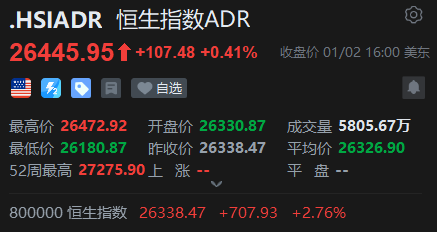
Group 1 - The Hang Seng Index (HSI) closed at 26,445.95, up by 107.48 points or 0.41% as of January 2, 16:00 Eastern Time [1] - The highest price during the trading session was 26,472.92, while the lowest was 26,180.87, with a trading volume of 58.0567 million [1] - The HSI has a 52-week high of 27,275.90 [1] Group 2 - Major blue-chip stocks showed mixed performance, with HSBC Holdings closing at HKD 125.368, up 0.86% from the Hong Kong close [2] - Tencent Holdings closed at HKD 627.621, reflecting a 0.74% increase from the Hong Kong close [2] Group 3 - Tencent Holdings (code: 00700) latest price is HKD 623.000, with an increase of HKD 24.000 or 4.01% [3] - Alibaba Group (code: 09988) latest price is HKD 149.000, up by HKD 6.200 or 4.34% [3] - HSBC Holdings (code: 00005) latest price is HKD 124.300, increasing by HKD 1.900 or 1.55% [3] - Other notable stocks include AIA Group (code: 01299) at HKD 83.300, up 4.26%, and Baidu Group (code: 09888) at HKD 143.800, up 9.35% [3]
即时零售大会战:谁失血 谁生长?
Zhong Guo Jing Ying Bao· 2026-01-02 19:35
文 李立 吴清 2025年,中国互联网商业舞台的中心,被一场前所未有、代价高昂的战役——"即时零售"大战牢 牢占据。 以阿里巴巴、美团、京东为代表的三大巨头,从年初的外卖补贴燃起战火,迅速蔓延至覆盖餐饮、生 鲜、商超、数码乃至美妆服饰的全品类展开近场零售争夺。 这场战争规模之大、卷入之深,几乎重新定义了电商与本地生活的边界,也向市场抛出了一系列尖锐问 题:天量投入换来了什么?这是一个真实可持续的新大陆,还是资本催生的海市蜃楼?血流不止的战 局,2026年又将走向何方? 账单:战损严重 当三大巨头相继交出2025年第三季度(自然年Q3)的财务成绩单时,市场预期被冰冷的数字证实:这 是一场代价惨烈的消耗战,目前看"没有赢家"。 阿里巴巴以利润换规模,生态协同初显效。阿里2026财年第二季度(对应自然年2025年Q3)营收 2477.95亿元,同比增长5%,但净利润同比下滑53%,经营利润更是同比暴跌85%。核心原因直指对"淘 宝闪购"(即时零售业务)的巨额投入。该季度阿里销售和市场费用高达665亿元,同比激增104.8%。 高投入带来了高增长:即时零售收入达229亿元,同比暴涨60%;淘宝闪购日订单峰值在8月曾达 ...


智通港股空仓持单统计|1月2日
智通财经网· 2026-01-02 10:32
Group 1 - The top three companies with the highest short positions are Vanke Enterprises (02202), Dongfang Electric (01072), and COSCO Shipping Holdings (01919), with short ratios of 18.64%, 17.51%, and 16.68% respectively [1][2] - The company with the largest increase in short positions is Dongfang Electric (01072), which saw an increase of 2.20% from the previous short ratio [1][2] - The companies with the largest decrease in short positions include Sanhua Intelligent Control (02050), Tianqi Lithium (09696), and Yuejiang (02432), with decreases of -1.42%, -0.82%, and -0.71% respectively [1][3] Group 2 - The latest short position data shows that Vanke Enterprises has 411 million shares shorted, while Dongfang Electric has 71.45 million shares, and COSCO Shipping Holdings has 480 million shares shorted [2] - The companies with the largest increases in short positions also include JAKS Resources B (01167) and CSPC Pharmaceutical Group (01093), with increases of 0.77% and 0.56% respectively [2] - The companies with the largest decreases in short positions also include Ganfeng Lithium (01772) and Sunac China (01918), with decreases of -0.68% and -0.55% respectively [3][4]



2025,互联网巨头们开始分化
首席商业评论· 2026-01-02 04:25
Core Viewpoint - The article discusses the performance and market dynamics of China's top internet companies in 2025, highlighting a clear differentiation among them in terms of market capitalization, profitability, and strategic direction as they transition from rapid expansion to a focus on quality growth [5][14]. Group 1: Market Capitalization and Rankings - The top 10 internet companies in China by market capitalization at the end of 2025 show stability in rankings, with Tencent, Alibaba, and Pinduoduo maintaining their positions, while other companies like Xiaomi and NetEase have seen upward movement [6][12]. - Tencent leads with a market cap of $728.7 billion, followed by Alibaba at $351.6 billion and Pinduoduo at $161.6 billion, with significant year-to-date stock price increases of 45%, 77%, and 17% respectively [9][10]. - The second tier includes Xiaomi, NetEase, and Meituan, with Xiaomi's market cap at $131.5 billion and a stock price increase of 14%, while Meituan's market cap has decreased by 32% [11][13]. Group 2: Revenue and Profitability Trends - Revenue growth is observed across the top companies, with only Baidu experiencing a slight decline, while Xiaomi leads with a 32.5% revenue increase [18]. - Profitability shows a stark contrast, with companies like Alibaba, Meituan, and JD.com facing pressure due to high marketing costs, particularly in the competitive food delivery sector, leading to "increased revenue without increased profit" [18][19]. - In contrast, companies like Tencent and NetEase have maintained strong profit margins through their gaming and social media ecosystems, with Tencent's gaming revenue exceeding $180 billion in the first three quarters of 2025 [20]. Group 3: Emerging Players and Market Dynamics - The mid-tier companies ranked 11th to 20th have shown significant stock price increases, indicating market recognition of their potential, with Giant Network leading with a 245% increase [23][24]. - Companies like Tencent Music and Kingsoft Office are highlighted as having potential for upward movement into the top tier, driven by their stable business models and market opportunities [25]. - The article emphasizes that while the top tier remains stable, the mid-tier companies are crucial to watch for future market shifts, as they may capitalize on emerging trends and niche markets [26].




互联网电商 25Q3 业绩总结及展望:即时零售转向 UE 修复,加速打造 AI 生态闭环
Shenwan Hongyuan Securities· 2025-12-31 13:46
Investment Rating - The report recommends investment in Alibaba, Meituan, Pinduoduo, and JD.com, indicating a positive outlook for these companies in the e-commerce sector [4]. Core Insights - Online consumption continues to grow steadily, with a total retail sales of 45.6 trillion yuan in the first 11 months of 2025, reflecting a year-on-year increase of 4.0%. The online retail sales reached 14.5 trillion yuan, up 9.1% year-on-year, with physical goods online retail sales growing by 5.7% to 11.8 trillion yuan, resulting in a penetration rate increase of 0.42 percentage points to 25.9% [1][12]. - The impact of the "old-for-new" policy from the previous year is starting to show, leading to a high base effect that is affecting growth rates. The express delivery business volume reached 180.74 billion pieces, a year-on-year increase of 14.9%, but this growth is slowing compared to the previous half of the year [1][12]. - The competition in the instant retail sector has peaked, with platforms shifting their strategies towards differentiation to improve user experience (UE). The report notes that the industry is entering a new phase of competition, focusing on quality and efficiency rather than just price competition [3][47]. Summary by Sections 1. Online Consumption and Retail Performance - Online consumption remains robust, with significant growth in penetration rates. The high base effect from last year's policies is now impacting growth rates, leading to a slowdown in the growth of express delivery and online retail sales [1][12]. - Major platforms are adjusting their strategies in response to the high base effect, with JD.com experiencing a notable decrease in GMV growth rates in Q3 [1][17]. 2. AI Investment and Development - The AI sector is witnessing intensified competition, with major internet companies launching numerous updates and iterations of AI models. The focus is shifting from broad capabilities to specialized strengths, enhancing user experience and application in consumer-facing products [3][34]. - Alibaba's cloud business is accelerating, with AI-related product revenues achieving triple-digit year-on-year growth for nine consecutive quarters, indicating a successful transition from technology investment to value realization [3][34]. 3. Instant Retail Sector Dynamics - The instant retail sector has seen a peak in competition, with platforms initially investing heavily to capture market share. However, as the market stabilizes, strategies are shifting towards differentiation and quality improvement [3][47]. - The report highlights that platforms like Meituan and Taobao are focusing on enhancing user experience and profitability, moving away from aggressive subsidy strategies [3][47]. 4. Performance of Major E-commerce Platforms - Alibaba's core business revenue growth remains strong, while Meituan's local business is under pressure. JD.com and Pinduoduo are expected to see profit recovery in the upcoming quarters, driven by strategic investments and operational efficiencies [3][4]. - The report notes that the profitability of platforms is becoming increasingly differentiated, with expectations for Alibaba and Meituan to see profit recovery soon [4].
2026年电商们打响全面战争
21世纪经济报道· 2025-12-31 12:50
Core Viewpoint - The essence of the e-commerce business is "traffic," and the competition in the industry has evolved into a complex and multi-dimensional landscape, driven by various factors such as technology, consumer habits, and supply chain dynamics [1][2]. Group 1: E-commerce Competition Dynamics - In February 2025, Liu Qiangdong initiated a fierce competition in the food delivery sector, disrupting the market with substantial subsidies, leading to increased spending on sales and marketing by major players like Meituan, Alibaba, and JD.com, which collectively spent an additional 614 billion yuan in the third quarter [1]. - The competition is characterized by a shift from traditional e-commerce to instant retail, with platforms like JD.com, Meituan, and Alibaba engaging in a "comprehensive war" rather than a zero-sum game [2][6]. - The integration of AI in consumer decision-making and the transition of supply chains from a focus on scale to efficiency and resilience are reshaping the industry's development logic [2]. Group 2: Strategic Moves and Financial Implications - JD.com launched a recruitment initiative for quality dining merchants, offering zero commission for early entrants, marking the beginning of the food delivery war [4]. - Alibaba's recent performance indicates a significant growth in its instant retail business, with revenues reaching 229.06 billion yuan, a 60% year-on-year increase, despite a 53% drop in net profit for the second quarter of fiscal year 2026 [6][7]. - The competitive landscape is intensifying, with platforms reflecting on their strategies, as evidenced by Meituan's CEO acknowledging the unsustainable nature of past competitive practices [9]. Group 3: Market Trends and Future Outlook - The ongoing battle for market share in instant retail is not just about creating new consumption scenarios but also about capturing traditional e-commerce users and offline market shares [7][10]. - The industry is entering a phase of refined and localized operations, moving away from "barbaric growth" towards a more sophisticated approach [2][12]. - The exploration of local life and instant retail by platforms like Xiaohongshu and Douyin continues, despite challenges, indicating that the competition will remain dynamic and multifaceted [10].

重庆美团三快小额贷款被罚56.7万元:违反信用信息采集、提供、查询相关管理规定
Xin Lang Cai Jing· 2025-12-31 12:39
Core Viewpoint - Chongqing Meituan SanKuai Microloan Co., Ltd. was fined 567,000 yuan for violating regulations related to credit information collection, provision, and inquiry as per the announcement from the People's Bank of China, Chongqing Branch [1][2][3] Group 1 - The fine imposed on Chongqing Meituan SanKuai Microloan Co., Ltd. amounts to 567,000 yuan [1][2][3] - The violation pertains to the management regulations regarding credit information collection, provision, and inquiry [1][2][3] - The administrative penalty was issued by the People's Bank of China, Chongqing Branch on December 23, 2025 [1][2][3]

图解丨2025年最后一天,南下资金大举买入中资银行股
Xin Lang Cai Jing· 2025-12-31 12:33
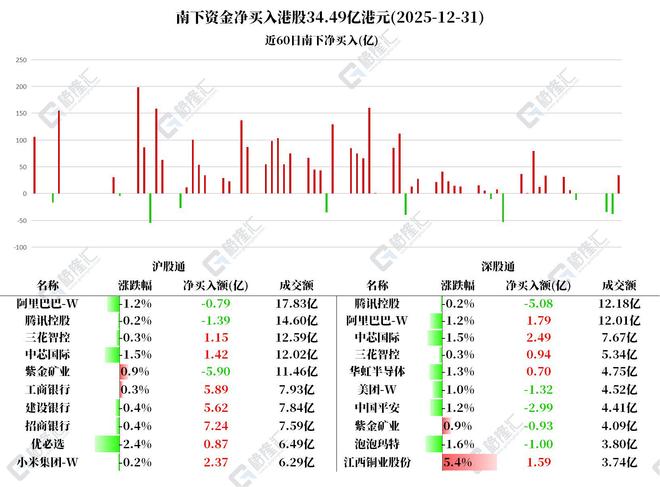
Group 1 - Southbound funds net bought Hong Kong stocks worth 3.449 billion HKD today [1] - The top net purchases included China Merchants Bank at 724 million HKD, Industrial and Commercial Bank of China at 589 million HKD, and China Construction Bank at 562 million HKD [1] - Notable net sales included Zijin Mining at 682 million HKD, Tencent Holdings at 646 million HKD, and China Ping An at 298 million HKD [1] Group 2 - Southbound funds have recorded a continuous net sell of Tencent for five consecutive days, totaling 3.94334 billion HKD [2]

美团平台洗浴中心搜索量同比增长超6倍
Sou Hu Cai Jing· 2025-12-31 12:00
Core Insights - The consumption trend for leisure and entertainment during the New Year period is significantly boosted by the festive atmosphere and winter weather conditions, leading to a notable increase in various service sectors [1][6] Group 1: Beauty and Personal Care - The search volume for beauty services such as haircuts, manicures, and eyelash extensions has doubled in the week leading up to New Year's Day, indicating a strong demand for beauty-related experiences [1] - The discussion volume around beauty services has increased by nearly 40% year-on-year, particularly among the 20-35 age group in major cities like Shanghai, Beijing, and Shenzhen [3] - Nearly 20,000 beauty service professionals on the platform saw their income grow by almost 100% during the weekend before New Year's, reflecting the high demand for beauty services [3] Group 2: KTV and Entertainment - The KTV industry has transformed into a dynamic entertainment space, integrating new technologies like AI for singing and scoring, as well as incorporating food and social activities, making it a popular choice for New Year celebrations [4] - KTV transaction volume has increased by nearly 30% year-on-year in the two weeks leading up to New Year's, with cities like Taiyuan and Changsha showing over 70% growth [6] - The post-00 generation is the fastest-growing demographic in KTV transactions, with a year-on-year increase of over 57%, highlighting a shift in consumer preferences towards entertainment experiences [6] Group 3: Bathing and Wellness - The search volume for keywords related to 24-hour bathing centers has surged by over 600%, indicating a growing trend for wellness and relaxation experiences during the winter season [1] - Over 1,000 quality bathing centers across the country saw a nearly 60% increase in transaction volume on the winter solstice, with cities like Harbin experiencing a staggering growth rate of over 211% [1]