Haitong Securities(06837)

Search documents
非银金融行业周报:继续看好低估值的非银板块-20251012
Shenwan Hongyuan Securities· 2025-10-12 06:12
Investment Rating - The report maintains a "Positive" outlook on the non-bank financial sector [1] Core Views - The report highlights a continuation of strong growth in the brokerage sector, with a significant increase in net profits expected for the first nine months of 2025. Key metrics include a 61% year-on-year increase in new A-share accounts and a 203% increase in average daily stock trading volume in September 2025 [2][5] - The brokerage sector is currently undervalued, with a price-to-book (PB) ratio of 1.48, placing it in the 47.8th percentile over the past decade [2] - The report notes a favorable market environment supporting continued high growth in brokerage performance, with specific recommendations for leading firms and those with strong international business capabilities [2][7] Summary by Sections Market Review - The Shanghai Composite Index rose by 1.47% during the period from September 29 to October 10, 2025, while the non-bank index increased by 3.18%. The brokerage, insurance, and diversified financial sectors reported gains of 4.42%, 0.89%, and 0.52%, respectively [5][6] Non-Bank Sector Insights - The report indicates that the insurance sector is benefiting from the implementation of a "de-involution" policy framework for non-auto insurance, which is expected to improve underwriting profitability for leading firms [2][16] - Specific investment recommendations include firms that are expected to benefit from improved competitive dynamics and those with strong earnings elasticity [2][7] Key Data Tracking - As of October 10, 2025, the average daily trading volume in the stock market was 26,034.09 billion yuan, reflecting an 18.99% increase from the previous period [14][32] - The report also tracks significant metrics such as the balance of margin financing and securities lending, which stood at 24,455.47 billion yuan as of October 9, 2025, marking a 31.2% increase from the end of 2024 [14][39]



国泰海通|金工:风格及行业观点月报(2025.10)
国泰海通证券研究· 2025-10-10 09:07
Core Insights - The style rotation model accurately predicted trends in Q3 2025, with signals favoring small-cap and growth stocks for Q4 2025 [1] - The industry rotation model showed positive excess returns in September, with a monthly return of 3.33% and an excess return of 2.43% relative to the benchmark [1] Style Rotation Model - For Q4 2025, the dual-driven rotation strategy indicates a comprehensive score of -1, predicting a preference for small-cap stocks [2] - The growth style is favored in Q4 2025, with a comprehensive score of -3 from the dual-driven rotation strategy [3] Industry Rotation Insights - In September, the composite factor strategy achieved an excess return of 2.43%, while the single-factor multi-strategy had an excess return of -1.02% [3] - For October, the recommended long positions in single-factor multi-strategy include the computer, communication, electronic, non-bank financial, and banking sectors [3] - The composite factor strategy recommends long positions in home appliances, non-ferrous metals, electronics, communication, and computers [3]



前9月32家券商分38.37亿承销保荐费 国泰海通夺第一
Zhong Guo Jing Ji Wang· 2025-10-09 23:29
Summary of Key Points Core Viewpoint - In the first nine months of 2025, a total of 78 companies were listed on the Shanghai Stock Exchange, Shenzhen Stock Exchange, and Beijing Stock Exchange, raising a total of 77.164 billion yuan in funds, with Huadian New Energy leading the fundraising efforts [1][2]. Group 1: Listing and Fundraising - A total of 78 companies were listed from January to September 2025, with 26 on the main board, 29 on the ChiNext, 8 on the Sci-Tech Innovation Board, and 15 on the Beijing Stock Exchange [1]. - The total fundraising amount for these companies reached 771.64 billion yuan, with Huadian New Energy raising 181.71 billion yuan, making it the top fundraiser [1]. Group 2: Underwriting and Sponsorship - 32 securities firms participated in the underwriting and sponsorship of the newly listed companies, earning a total of 3.837 billion yuan in fees [2][4]. - Guotai Junan Securities ranked first in underwriting fees, earning 501.01 million yuan from sponsoring 8 companies [2][5]. - CITIC Securities and CITIC Jianye followed, earning 408.05 million yuan and 399.19 million yuan respectively, with CITIC Securities sponsoring 6 companies [2][3]. Group 3: Detailed Ranking of Securities Firms - The top five securities firms earned a combined total of 1.896 billion yuan, accounting for 49.40% of the total underwriting fees [4]. - Other firms in the top ten included Shenwan Hongyuan, Guolian Minsheng, Dongxing Securities, and Orient Securities, with fees ranging from 134.38 million yuan to 171.31 million yuan [4][6].
国泰海通证券研究与机构业务委员会副总裁路颖: 经济转型与政策发力双轮驱动 投资者信心企稳回升
Sou Hu Cai Jing· 2025-10-09 22:11
Group 1 - The core viewpoint is that China's economic transformation and emerging business models are key drivers for the sustained rise of the stock market, with traditional economic cycles clearing out and stabilizing [1] - The focus of Chinese policy is shifting towards development, with fiscal expansion supporting livelihoods, boosting consumption, and improving corporate cash flow [1] - The "anti-involution" movement reflects a change in economic governance thinking, which is expected to provide conditions for stabilizing long-term return on equity (ROE) [1] Group 2 - In the real estate sector, residential investment as a percentage of GDP is projected to fall to 5.4% by Q2 2025, aligning with levels seen in the US, Japan, and South Korea, indicating a significant reduction in economic drag [1] - The total repayment amounts for domestic debts of real estate companies are forecasted to decrease annually, with figures of 469.4 billion, 319.4 billion, and 313.9 billion yuan for 2025, 2026, and 2027 respectively, suggesting that credit risk is largely cleared [2] - The manufacturing sector is experiencing a self-driven supply clearing, with capital expenditure decreasing by 10.6% year-on-year in Q1 2025, marking the lowest growth rate in nearly a decade [2] Group 3 - The implementation of more reasonable macroeconomic policies is effectively reducing tail risks in the economy and stabilizing investor expectations [2] - New economic opportunities are emerging in sectors such as AI and robotics, with accelerated capital expenditure, indicating a shift towards higher economic quality driven by transformation [2] - The "new three arrows" policy post-September 24, 2024, focuses on debt resolution, demand stimulation, and asset price stabilization, aiming to address the issue of insufficient domestic effective demand [2]
国泰海通俞枫:以全栈创新破局核心技术 做证券行业智能化先行者
Shang Hai Zheng Quan Bao· 2025-10-09 18:40
Core Insights - The article highlights Guotai Junan's commitment to digital transformation and innovation in the securities industry, emphasizing the development of a new generation of core trading systems and the integration of AI technologies [2][3][7]. Digital Transformation Strategy - Guotai Junan has positioned comprehensive digital transformation as a top priority during the 14th Five-Year Plan, aiming to create a "SMART investment bank" and transition from "AI in ALL" to "ALL in AI" [2][3]. - The company has undertaken numerous innovative research projects in cloud computing, big data, AI, and blockchain, contributing to technological advancements in the industry [2][3]. Core Trading System Development - The new core trading system, developed in collaboration with Huawei, utilizes distributed architecture and low-latency technologies, addressing the limitations of traditional systems [3][4]. - The system has achieved significant performance improvements, reducing transaction latency from 20 milliseconds to 200 microseconds and increasing single-node processing capacity from 2,500 to 8,000 orders per second [4][5]. Performance and Reliability - The new trading system has demonstrated exceptional performance and reliability, successfully handling a surge in trading volume during extreme market conditions [4][6]. - The system features automatic switching between primary and backup components, ensuring message integrity and business continuity [4][5]. Collaborative Innovation - Guotai Junan's partnership with Huawei and Huairui has led to the establishment of a joint innovation laboratory, enhancing the capabilities of the core trading system [5][6]. - The company has adopted a collaborative approach to overcome technical challenges, utilizing a gradual strategy for system upgrades [6]. AI Integration - Following the establishment of a robust technical foundation, Guotai Junan is focusing on AI integration, proposing an "ALL in AI" strategy to enhance trading efficiency and risk management [7]. - The company aims to leverage AI for intelligent decision-making, risk control, and efficiency improvements across trading processes [7].

国泰海通证券研究与机构业务委员会副总裁路颖:经济转型与政策发力双轮驱动投资者信心企稳回升
Zheng Quan Shi Bao· 2025-10-09 18:20
Group 1 - The core viewpoint is that China's economic transformation and emerging business models are key drivers for the continuous rise of the stock market, with traditional economic cycles clearing and stabilizing [1] - The focus of Chinese policy is shifting towards development, with fiscal expansion supporting livelihoods, boosting consumption, and improving corporate cash flow [1] - The decline in traditional economic sectors is reducing their drag on the economy, particularly in the real estate sector, where residential investment as a percentage of GDP is expected to fall to 5.4% by Q2 2025, aligning with experiences from the US, Japan, and South Korea [1] Group 2 - According to Wind statistics, the total repayment amounts for domestic debts of real estate companies in 2025, 2026, and 2027 are projected to be 469.4 billion, 319.4 billion, and 313.9 billion respectively, indicating a gradual decrease in credit risk [2] - The "new three arrows" policy post-September 24, 2024, aims to address debt issues, stimulate demand, and stabilize asset prices through monetary easing and debt restructuring [2] - Emerging sectors such as AI and robotics are seeing accelerated capital expenditure, indicating the initial emergence of new economic opportunities [2]
大类资产及择时观点月报(2025.10):债市观点发生改变-20251009
GUOTAI HAITONG SECURITIES· 2025-10-09 14:04
- The counter-cyclical allocation model predicts macroeconomic environments using credit spreads and term spreads, dividing them into Growth, Inflation, and Slowdown stages. For Q3 2025, the model forecasted an Inflation environment, allocating assets as follows: CSI 300 (20%), CSI 2000 (0%), Nanhua Commodity Index (30%), and ChinaBond Treasury Total Wealth Index (50%). The respective returns were 17.90%, 17.24%, 3.88%, and -1.28%[7][8] - The macro momentum monthly allocation signal for October 2025 indicates a positive signal for the stock market, driven by positive signals from economic growth and risk sentiment factors[9][10] - The composite industry trend factor, constructed from industry-level indicators, serves as a timing signal for market trends. When the factor exceeds a certain threshold, it signals potential market rallies, while a sharp drop near the peak triggers a sell signal. From January 2015 to September 2025, the cumulative return of the composite industry trend factor portfolio was 122.66%, with an excess return of 48.42%. As of September 2025, the factor value was -0.30, showing a decline but maintaining a positive signal[4][17][19] - The bond market timing signal for October 2025 shows a negative overall signal, influenced by factors such as PMI, inflation indicators (CRB Index, CPI), exchange rates (CFETS RMB Index, USD midpoint), interest rates (ChinaBond Treasury yields for 2, 5, and 10 years), and risk sentiment factors[13] - The gold market timing signal for October 2025 is positive, supported by fundamental and technical factors. Positive signals include actual interest rates, London gold moving averages (10-month and 20-month), global negative-yielding debt scale, and US M2. Negative signals include expected inflation and CFTC swap dealer positions[13][14]
金麒麟最佳投顾评选ETF组8月月榜丨东莞证券刘立超收益34%居榜首 湘财证券佘文智、国新证券周洋居第2、3位
Xin Lang Zheng Quan· 2025-10-09 07:12
Core Insights - The "Second Sina Finance Golden Unicorn Best Investment Advisor Selection" is currently underway, aiming to identify outstanding investment advisors and enhance the investment advisory IP construction [1] - The competition includes various categories such as stock simulation trading, ETF simulation trading, public fund simulation allocation, and social service evaluation, with over 10,000 investment advisors participating [1] ETF Simulation Trading Rankings - Liu Lichao from Dongguan Securities achieved the highest monthly return of 34.52% in the ETF simulation trading for September [2] - The second place was secured by She Wenzhi from Xiangcai Securities with a return of 24.66%, followed by Zhou Yang from Guoxin Securities with a return of 22.61% [2] - Other notable performers include Fan Chunqing from Nanjing Securities (19.86%) and Yang Yun from Zhongtai Securities (19.66%) [2][3] Performance Metrics - The top 10 investment advisors in the ETF simulation trading all reported returns above 16%, indicating strong performance in the simulated trading environment [2][3] - The rankings reflect a competitive landscape among investment advisors, showcasing their ability to generate significant returns in a simulated setting [1][2]




2025年1-9月A股IPO中介机构收费排行榜
Sou Hu Cai Jing· 2025-10-08 15:20
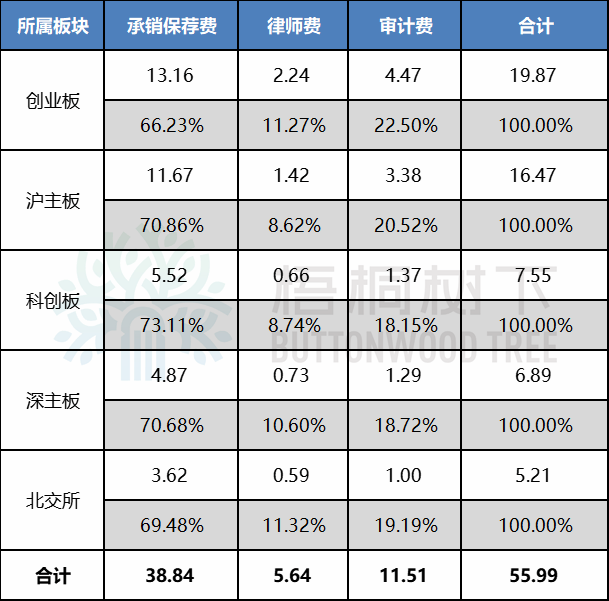
Core Insights - In the first nine months of 2025, a total of 78 companies were listed on the A-share market, representing a year-on-year increase of 13.04% compared to 69 companies in the same period last year [1] - The total fees charged by IPO intermediaries for these listings amounted to 5.599 billion yuan, with underwriting and sponsorship fees accounting for 3.884 billion yuan, legal fees for 564 million yuan, and audit fees for 1.151 billion yuan [1] Segment Analysis Underwriting and Sponsorship Fees - The total underwriting and sponsorship fees were highest in the ChiNext board, followed by the Shanghai Main Board, Sci-Tech Innovation Board, Shenzhen Main Board, and Beijing Stock Exchange [1] - The leading underwriting institution by total fees was Guotai Junan, with 501 million yuan from 9 deals, followed by CITIC Securities and Huatai United Securities with 486 million yuan and 404 million yuan respectively [5][7] Legal Fees - The top three law firms by total fees were Shanghai Jintiancheng, Shanghai Tongli, and Beijing Guofeng, with total fees of 89.3 million yuan, 49.9 million yuan, and 47.7 million yuan respectively [8][10] - The average legal fee was highest for the Shanghai Main Board at 837.58 thousand yuan, while the lowest was for the Beijing Stock Exchange at 391.07 thousand yuan [3][4] Audit Fees - The leading audit firms by total fees were Rongcheng, Tianjian, and Zhonghui, with total fees of 270 million yuan, 221 million yuan, and 151 million yuan respectively [11][13] - The average audit fee was highest for the Shanghai Main Board at 1.990 million yuan, and lowest for the Beijing Stock Exchange at 667.14 thousand yuan [3][4]


9月龙虎榜,排名揭晓
Zhong Guo Zheng Quan Bao - Zhong Zheng Wang· 2025-10-03 05:55
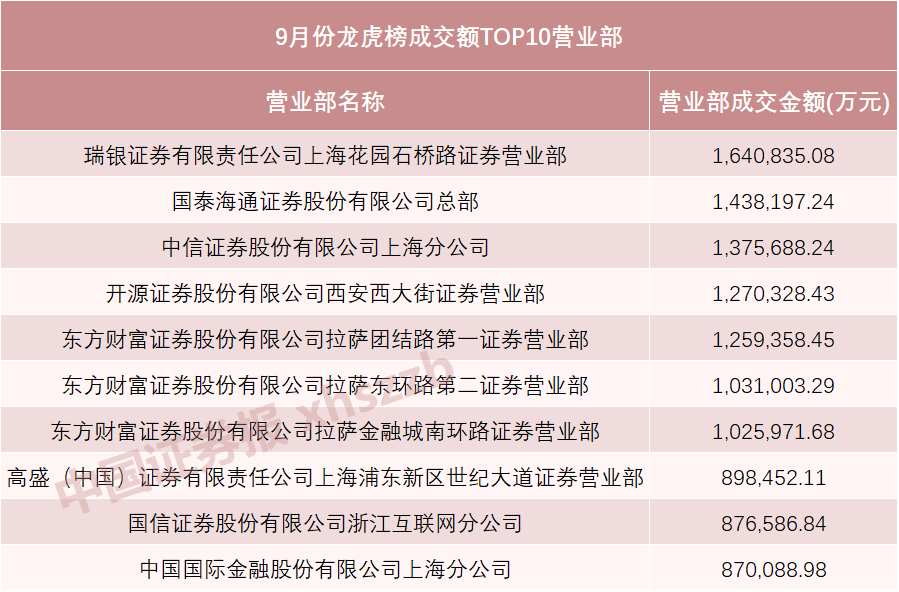
Core Insights - The A-share market experienced a volatile upward trend in September, with a total trading volume of approximately 53.18 trillion yuan [1] - The top trading department by transaction volume on the Dragon and Tiger List was UBS Securities Shanghai Huayuan Shiqiao Road Securities Department, with a transaction amount of 16.408 billion yuan [4] - The top 100 trading departments accounted for about 74.65% of the total transaction amount of 34.4478 billion yuan in September [2] Trading Volume and Rankings - In September, 2,647 brokerage departments made 7,949 appearances on the Dragon and Tiger List, with a total transaction amount of 344.478 billion yuan [2] - The top 10 trading departments by transaction amount in September are as follows: - UBS Securities Shanghai Huayuan Shiqiao Road: 16.408 billion yuan - Guotai Junan Securities Headquarters: 14.382 billion yuan - CITIC Securities Shanghai Branch: 13.757 billion yuan - Kaiyuan Securities Xi'an Xidajie: 12.703 billion yuan - Dongfang Caifu Securities Lhasa Tuanjie Road: 12.594 billion yuan - Dongfang Caifu Securities Lhasa Donghuan Road: 10.31 billion yuan - Dongfang Caifu Securities Lhasa Financial City: 10.259 billion yuan - Goldman Sachs (China) Securities Shanghai Pudong Century Avenue: 8.985 billion yuan - Guoxin Securities Zhejiang Internet Branch: 8.766 billion yuan - China International Capital Corporation Shanghai Branch: 8.701 billion yuan [3][4] Brokerage Performance - Guotai Junan had the highest number of departments on the top 100 list, with 14 departments, followed by CITIC Securities and Huatai Securities with 8 each, and Dongfang Caifu with 6 [5] - Foreign brokerages had fewer departments on the list, but notable transaction amounts, with UBS Securities leading and Goldman Sachs also making the top ten [6] Investment Trends - The most favored sectors among the top trading departments were robotics and satellite communication stocks, with companies like Wolong Electric Drive and Sanwei Communication appearing frequently in the top buy lists [7] - Analysts from Dongfang Securities and CITIC Jianzhong expressed optimism about the humanoid robot sector, highlighting significant orders and production expectations that could create investment opportunities [7]