NIO(09866)

Search documents
7年贷+减配,买车“套路”大揭秘
3 6 Ke· 2026-02-04 08:51
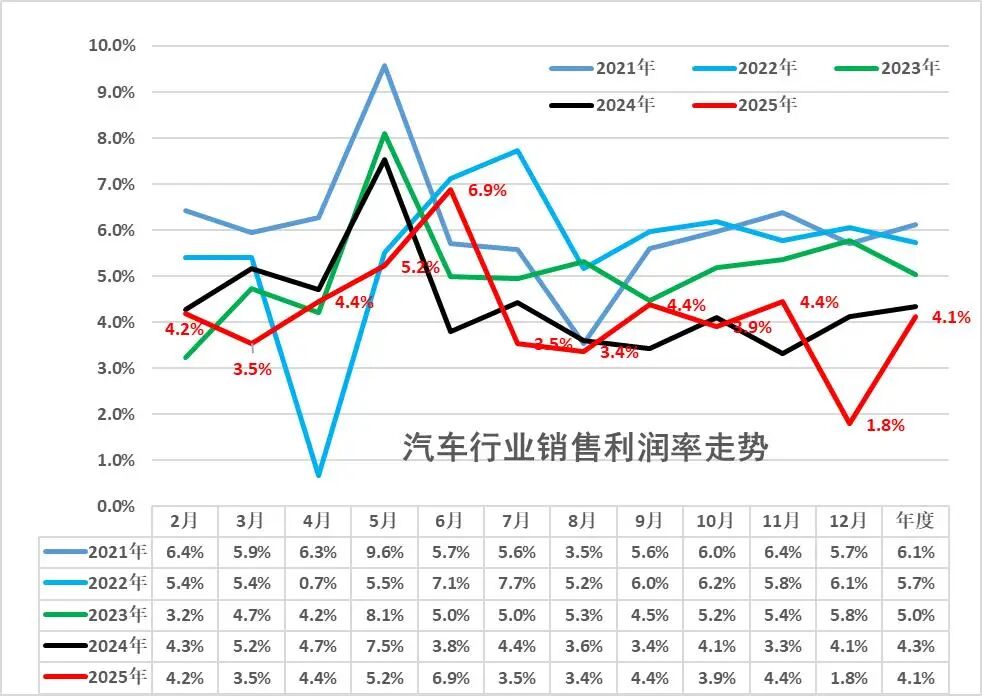
Core Insights - The automotive industry is experiencing a significant promotional frenzy with over 20 brands and more than 75 models offering aggressive discounts, driven by a drastic drop in sales profit margins to 1.8% in December, halving from the previous year [1][3] Group 1: Profitability Challenges - The average profit margin for the automotive industry over the past two years has been consistently low at 4.1%, below the industrial average of 5.9% [3] - The production of vehicles increased by 10% in 2025, reaching 34.78 million units, but this growth did not translate into higher profits, leading to financial strain on manufacturers [3] - Rising raw material costs are a significant burden, with aluminum prices increasing costs by approximately 600 yuan per vehicle, copper by 1200 yuan, and lithium costs adding around 3800 yuan for electric vehicles, resulting in an overall cost increase of 4000-7000 yuan per vehicle [3][6] Group 2: Market Dynamics - Policy changes, such as the reduction of subsidies for trade-ins and the halving of new energy vehicle purchase tax exemptions, have led to a 28% year-on-year drop in passenger car sales in January [9][11] - The introduction of new national battery safety standards will require costly upgrades to battery structures and thermal management systems, adding an estimated 2000 yuan to the cost of low-end models [11] Group 3: Manufacturer Strategies - To combat high costs and a cooling market, manufacturers are extending loan terms to 7 years to lower monthly payments, a strategy initiated by Tesla and quickly adopted by competitors [12][14] - Cost-cutting measures include reducing vehicle specifications and using mixed battery supplies from different brands, which may impact long-term quality and reliability [14][15] Group 4: Consumer Guidance - Consumers are advised to scrutinize financing options, as some "low monthly payment" plans may actually be leasing agreements rather than traditional loans, affecting ownership and liability [17] - It is crucial for consumers to consider the total cost of ownership, including depreciation, interest, insurance, and maintenance, especially given the rapid technological advancements in the automotive sector [17][19]




重仓新能源的车厂们
投中网· 2026-02-04 07:13
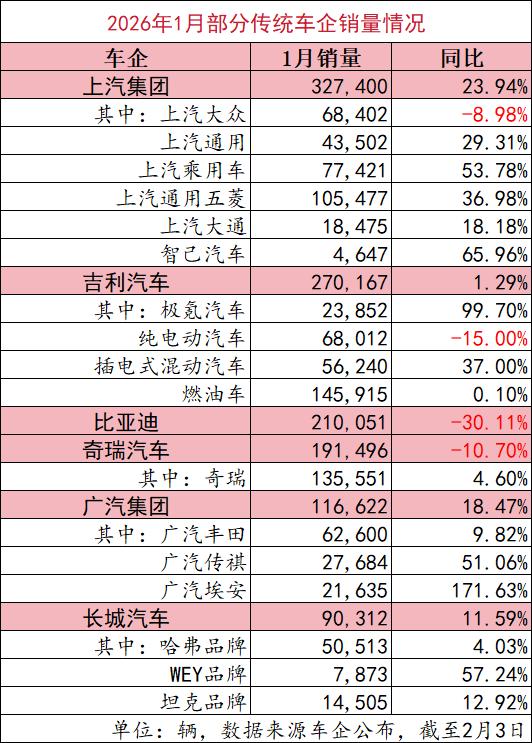
Core Viewpoint - The Chinese automotive market in January 2026 is characterized by a stark contrast, with most automakers experiencing negative growth, particularly in the new energy vehicle (NEV) sector, highlighting the importance of having a diversified product lineup that includes both fuel and electric vehicles [5][6][7]. Sales Performance Summary - In January, the retail sales of passenger cars are expected to reach 1.8 million units, a month-on-month decline of 20.4%, with NEV sales around 800,000 units, marking a penetration rate drop to 44.4%, nearly 10 percentage points lower than the peak at the end of 2025 [6][7]. - Traditional automakers like SAIC, Geely, and GAC Toyota reported stable sales due to their dual strategy of offering both fuel and NEVs, with SAIC's total sales reaching 327,400 units, a year-on-year increase of 23.94% [10][11]. - Geely's total sales were 270,167 units, with fuel vehicles contributing significantly to its performance, while BYD faced a 30.11% decline in NEV sales, indicating the challenges faced by companies heavily reliant on NEVs [12][15]. Market Dynamics - The differentiation in sales performance among automakers is attributed to their strategic choices, particularly the presence of a fuel vehicle base, which enhances resilience against market fluctuations [9][19]. - The demand for fuel vehicles surged during the pre-Spring Festival period, as consumers preferred mature technology and the convenience of fuel vehicles for long-distance travel, further supported by the limited impact of policy changes on fuel vehicles [19][20]. Export Growth - Exports have become a crucial support for many leading automakers, with companies like Chery and SAIC reporting significant increases in overseas sales, indicating a dual strategy of maintaining domestic stability while expanding globally [17][18]. Future Outlook - The current market conditions signal a shift from policy-driven growth to market-driven dynamics, emphasizing the need for automakers to maintain a balanced portfolio of fuel and NEVs to navigate future uncertainties [22]. - Companies that can effectively manage their fuel vehicle base while rapidly advancing in the NEV sector are likely to emerge as market leaders, while those focusing solely on NEVs may face greater risks during market fluctuations [21][22].




债市早报:资金面整体平稳;债市以震荡为主
Jin Rong Jie· 2026-02-04 03:26
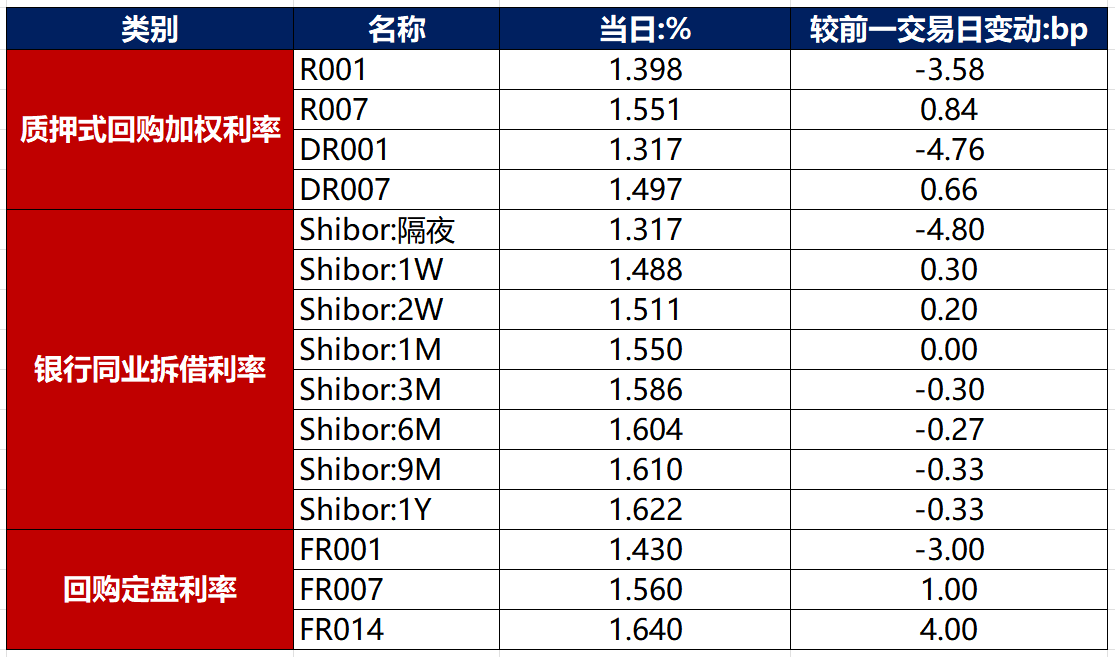
Group 1: Domestic News - The 2026 Central Document was released, focusing on agricultural modernization and rural revitalization, emphasizing the need for reforms in rural collective property rights and controlling new village-level debts [2] - The document encourages the use of special bonds and long-term treasury bonds to support major projects in agriculture and rural areas, enhancing the effectiveness of financial support for agriculture [2] Group 2: Monetary Policy - The central bank announced an increase in the amount of 3-month reverse repos, conducting an operation of 800 billion yuan, resulting in a net injection of 100 billion yuan after accounting for maturing repos [3] - The central bank's Shanghai headquarters is actively promoting financial reforms in the free trade zone, aiming to enhance cross-border financial services and the convenience of cross-border RMB business [3] Group 3: International News - The U.S. House of Representatives approved a funding bill to end a partial government shutdown, with a vote of 217 to 214, sending the bill to the President for signature [4] - Despite the approval, a funding shortfall risk remains, particularly for the Department of Homeland Security, which has funding only until February 13 [4] Group 4: Commodity Market - International crude oil prices rose, with WTI crude up 1.72% to $63.21 per barrel and Brent crude up 1.56% to $67.33 per barrel [5] - Gold futures increased by 6.94% to $4975.30 per ounce, while natural gas prices rose by 3.49% to $3.377 per million British thermal units [5] Group 5: Bond Market Dynamics - The bond market showed mixed performance, with short-term bonds weaker and medium to long-term bonds slightly stronger; the yield on the 10-year government bond fell by 0.40 basis points to 1.8110% [9] - The central bank conducted a 7-day reverse repo operation with a total of 1055 billion yuan at a rate of 1.40%, resulting in a net withdrawal of 2965 billion yuan due to maturing repos [6][7] Group 6: Credit Bonds - No credit bonds showed price deviations exceeding 10% on February 3, indicating stable trading conditions in the secondary market [11] - Companies like Zhongjun Group and Yida China are facing financial difficulties, with Zhongjun unable to repay a bond and Yida receiving a lawsuit for debt recovery [11][12] Group 7: Convertible Bonds - The convertible bond market saw a collective rebound, with major indices rising between 2.51% and 2.79%, and trading volume increasing significantly [13] - Notable individual bonds like Baichuan Convertible Bond surged over 17%, while some bonds experienced declines, such as Huazheng Convertible Bond, which fell over 4% [14] Group 8: Overseas Bond Market - U.S. Treasury yields showed mixed movements, with the 10-year yield down 1 basis point to 4.28%, while the 2-year yield remained unchanged at 3.57% [16] - European government bond yields generally increased, with Germany's 10-year yield rising by 2 basis points to 2.89% [18]

重仓新能源的车厂,1月大多数都很惨
3 6 Ke· 2026-02-04 01:48
Core Viewpoint - The Chinese automotive market in January 2026 is characterized by a stark division, with traditional fuel vehicle manufacturers showing resilience while pure electric vehicle brands face significant challenges due to market fluctuations and policy changes [1][10]. Sales Performance - Total retail sales of passenger cars in January are expected to reach 1.8 million units, a month-on-month decline of 20.4% and a slight year-on-year increase [1]. - New energy vehicle (NEV) retail sales may reach around 800,000 units, with a penetration rate dropping to 44.4%, nearly 10 percentage points lower than the peak at the end of 2025 [1]. Traditional Automakers - Traditional automakers like Geely, SAIC, and GAC Toyota, which maintain a dual strategy of fuel and new energy vehicles, reported stable sales. For instance, SAIC's total sales reached 327,400 units in January, a year-on-year increase of 23.94% [2][3]. - Geely's total sales were 270,167 units, with fuel vehicle sales contributing significantly to its performance, achieving a year-on-year growth of 1.29% [4]. - GAC's sales reached 116,622 units, with GAC Toyota's sales growing by 9.82% [6]. New Energy Vehicle Brands - New energy vehicle brands are experiencing a downturn, with BYD's sales dropping by 30.11% year-on-year, and domestic sales plummeting by 53.22% [7]. - New entrants like Hongmeng Zhixing and Xiaomi saw significant growth, but others like Li Auto and Xpeng faced declines due to high previous bases and insufficient new product launches [9][17]. Export Market - Exports have become a crucial support for many leading automakers, with Chery exporting 119,600 units in January, accounting for nearly 60% of its sales [9]. - SAIC's exports reached 105,000 units, a year-on-year increase of 51.7%, while BYD and Geely also reported substantial export growth [9]. Market Dynamics - The market's division is attributed to a combination of policy shifts and the seasonal demand associated with the Chinese New Year, which has favored fuel vehicles [10][12]. - Fuel vehicles are perceived as a necessity for family gatherings during the holiday season, leading to increased sales of traditional models [12]. Strategic Insights - The current market scenario emphasizes the importance of maintaining a fuel vehicle base while pursuing new energy strategies. Companies that can balance both will likely fare better in market fluctuations [14][15]. - Future competition will hinge on the ability to innovate and meet mainstream market demands in the new energy sector, as evidenced by the performance of traditional automakers [15][17].

销量环比下滑超20%,单车成本激增7000元:2026车市开局承压
Xin Hua Cai Jing· 2026-02-04 01:16
Core Viewpoint - The automotive market in China experienced a significant month-on-month decline in January 2026, influenced by changes in tax policies and early consumer demand, while year-on-year sales remained relatively stable [1]. Group 1: Market Performance - In January 2026, the retail sales of narrow passenger vehicles in China were approximately 1.8 million units, representing a month-on-month decrease of 20.4% and a slight year-on-year increase of 0.3% [1]. - The retail sales of new energy vehicles (NEVs) in January were around 800,000 units, showing a year-on-year decline of 40.2%, but a month-on-month growth of 7.5% [1]. - Major traditional automakers like SAIC and Geely surpassed BYD in sales, with SAIC selling 327,000 units (up 23.9% year-on-year) and Geely selling 270,200 units (up 1.3% year-on-year) [2]. Group 2: New Energy Vehicle Segment - In the new energy vehicle sector, brands like Xiaomi, Hongmeng Zhixing, and NIO saw significant year-on-year growth, with Xiaomi's sales increasing by 95% to over 39,000 units [3][4]. - NIO delivered 27,200 units in January, marking a 96% year-on-year increase, driven by the new ES8 model [4]. - Conversely, companies like XPeng and Li Auto experienced declines, with XPeng's deliveries down 47% month-on-month and 34% year-on-year [4]. Group 3: Cost Pressures - The automotive industry is facing rising costs, with single-vehicle costs increasing by 4,000 to 7,000 yuan due to surging prices of key materials like lithium, aluminum, and DRAM [5][6]. - The price of battery-grade lithium carbonate rose from 75,700 yuan per ton at the beginning of 2025 to 146,600 yuan per ton by February 3, 2026, a nearly 94% increase [5]. - UBS reported that the cost increases in metals and chips could compress profit margins significantly, with potential reductions of 33% to 93% for vehicles priced at 150,000 yuan [6]. Group 4: Strategic Directions - To counteract rising costs and stagnant market demand, automakers are focusing on international expansion, with Chery exporting 119,600 units in January, accounting for nearly 60% of its total sales [7]. - BYD's overseas sales exceeded 100,000 units, a year-on-year increase of 43.3%, while Geely's exports grew by over 120% [7]. - Companies are also targeting the high-end market, with Great Wall Motors launching the WEY brand's flagship V9X, indicating a competitive push in the premium segment [9]. Group 5: Market Outlook - The automotive consumption index for January 2026 was reported at 31.1, reflecting a cautious consumer sentiment influenced by various factors, including the upcoming Spring Festival and changes in tax policies [10]. - Industry experts suggest that the market may not see a clear recovery until March or the end of the first quarter [10].
“宝,马上”,车企马年“邪修”营销
汽车商业评论· 2026-02-03 23:09
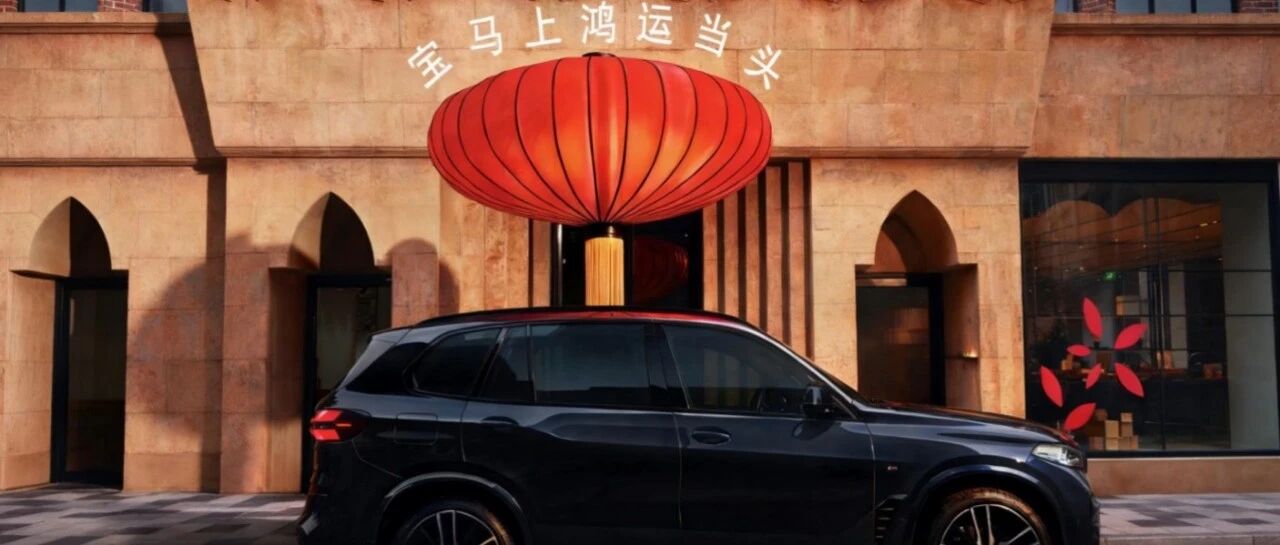
Core Viewpoint - The article discusses innovative marketing strategies adopted by automotive companies during the winter sales season in January 2026, highlighting how they engage consumers through unique experiences and cross-industry collaborations [3][4]. Group 1: Winter Marketing Strategies - January is a critical month for car companies, often referred to as the winter testing season, where numerous companies gather in regions like Inner Mongolia for vehicle testing [5]. - Traditional testing methods are becoming less effective in attracting attention, leading companies to create engaging winter experiences, such as Great Wall Motors' collaboration with Harbin Tourism Bureau for the "Harbin Ice and Snow Happy Week" [8][10]. - The "Long Spring First Ice Pot," a giant ice structure in Changchun, has become a popular destination, attracting over 1,000 vehicles for ice drifting experiences since its opening on January 10, 2026 [10][12]. Group 2: Cross-Industry Collaborations - Cross-industry marketing remains a popular strategy, with companies like Wangwang and Dong Mingzhu engaging in partnerships to attract consumer attention [15][20]. - Notable interactions include a humorous exchange between GAC Group's chairman and Gree Electric's chairman, which, despite being misinterpreted, enhanced the collaboration's visibility [22]. - BMW's playful marketing campaign during the New Year featured various humorous themes, effectively combining cultural elements with brand promotion [23][25]. Group 3: Community Engagement Initiatives - Xiaopeng Motors launched a "1000 Mobile Charging Stations" initiative, providing charging cables to 1,000 car owners, addressing the real needs of consumers during the Spring Festival [29][30]. - This initiative not only alleviates charging anxiety but also fosters a sense of community among car owners, enhancing brand warmth and consumer pride [33]. Group 4: Cultural and Brand Positioning - Volvo's innovative marketing approach involved a real-life simulation of a racing game, effectively engaging consumers by mimicking gaming experiences [34][37]. - GAC Aion capitalized on local cultural phenomena by creating a music video related to a trending song, thereby connecting emotionally with the audience [38][41]. - NIO's collaboration with the talk show "Thirteen Invitations" reflects a commitment to deeper values and long-term engagement rather than superficial marketing [42][45]. Group 5: Year-End Reflections and Celebrations - The automotive industry has seen a surge in year-end celebrations, with companies like Chasing and Mercedes-Benz using these events to enhance brand image and consumer engagement [49][51]. - The collective celebration of Mercedes-Benz's 140th anniversary showcased the industry's youthful spirit and creativity, with various brands participating in playful marketing campaigns [51].


Nio stock price crash gains steam as vehicle deliveries surge: is it a buy?
Invezz· 2026-02-03 14:02
Group 1 - Nio's stock price has continued its downward trend, reaching a low of $4.52, the lowest level since August of the previous year [1] - Despite a significant increase in January deliveries, the stock price did not respond positively [1] - The recent performance indicates ongoing challenges for the company in the market [1]
Nio Strategic Metals Announces Updates on Its Non-Brokered Private Placement
TMX Newsfile· 2026-02-03 13:30
Core Viewpoint - Nio Strategic Metals Inc. is conducting a non-brokered private placement to raise funds for its operations, with strong demand leading to an expected oversubscription of shares [1][3]. Group 1: Private Placement Details - The company announced a proposed private placement of up to 27,002,255 common shares at a price of $0.155 per share, aiming for gross proceeds of up to $4,185,350 [2]. - Due to high demand, the company anticipates issuing an additional 5,255,810 common shares, potentially raising total gross proceeds to $5,000,000 by issuing up to 32,258,065 common shares [3]. - The closing of the transaction is expected in February 2026, subject to customary closing conditions, and the shares will be subject to a four-month hold period [4]. Group 2: Company Overview - Nio Strategic Metals is focused on becoming a ferroniobium producer and holds niobium properties in Oka and near Mont-Laurier, as well as another exploration property in Quebec [7].

新势力格局生变:问界、小米、零跑成新第一梯队
Jing Ji Guan Cha Wang· 2026-02-03 12:42
据经济观察报-经济观察网 2026年1月,新势力车企销量格局发生显著变化。问界汽车、小米汽车和零 跑汽车以3万辆至4万辆的交付量,形成了新的"第一梯队"。具体来看,问界汽车1月交付约4万辆,同比 增长83%;小米汽车1月交付超3.9万辆,去年同期为超2万辆;零跑汽车1月全系交付达3.21万辆,同比 增长27%。与此同时,理想汽车、蔚来汽车和小鹏汽车1月销量在2万辆到3万辆之间,变为"第二梯 队"。蔚来1月交付新车2.72万辆,同比增长96.1%;理想汽车交付2.77万辆,同比下滑7.55%;小鹏汽车 交付2万辆,同比下滑34.07%。问界、小米与蔚来同比增幅显著。 ...

同比普涨、环比普跌,1月车企销量“开门红”成色不足
经济观察报· 2026-02-03 12:15
Core Viewpoint - The automotive industry experienced a mixed performance in January 2026, with many companies reporting year-on-year sales growth due to a low sales base from the previous year, but a significant month-on-month decline due to the end of full tax exemptions and consumer hesitation [2][3]. Group 1: Overall Market Performance - In January 2026, the automotive industry achieved a positive year-on-year growth, largely influenced by the low sales base from January 2025 when the Spring Festival occurred [2]. - Month-on-month sales for most companies declined significantly, attributed to the end of full tax exemptions for new energy vehicles and the lack of clear local subsidy policies, leading to consumer hesitation [2][3]. Group 2: Company-Specific Performance - Geely's sales reached 270,200 units in January, a year-on-year increase of 1.29% and a month-on-month increase of 14%. New energy vehicle sales accounted for 46% of total sales [3][4]. - BYD sold 210,100 units in January, with overseas sales of 100,000 units showing a year-on-year growth of 43.3% [4]. - Chery Group's sales were 200,300 units, down 10.72% year-on-year and 18.23% month-on-month, with new energy vehicle sales at 52,100 units [5]. - GAC Group reported sales of 116,600 units, a year-on-year increase of 18.47%, but a month-on-month decline of 37.79% [5]. - SAIC Group's sales data showed a retail volume of over 78,000 units for its passenger vehicle segment, a year-on-year increase of 9.8% [6]. Group 3: New Energy Vehicle Segment - New energy vehicle sales for Geely were 124,300 units, with a year-on-year growth of 3% [4]. - BYD's new energy vehicle sales were 177,500 units, contributing significantly to its overall performance [4]. - The new energy vehicle segment is showing resilience, with companies like AITO (问界) and Xiaomi Auto reporting substantial year-on-year growth [7][8].