NTES(09999)

Search documents
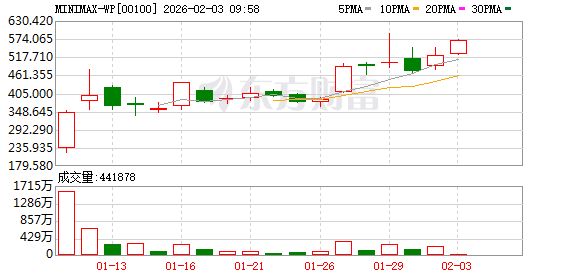
港股AI应用股走强 MINIMAX涨近5%
Mei Ri Jing Ji Xin Wen· 2026-02-03 02:03
每经AI快讯,2月3日,港股AI应用股走强。截至发稿,MINIMAX-WP(00100.HK)涨4.68%、网易- S(09999.HK)涨2.98%、智谱(02513.HK)涨2.76%。 (文章来源:每日经济新闻) ...


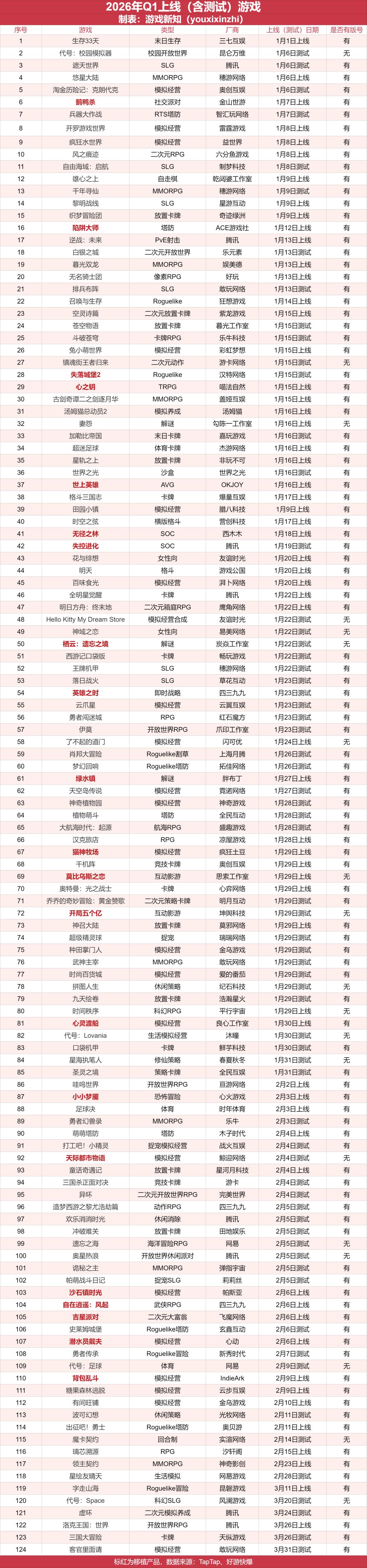
2026年Q1共124款新品:21款Steam移植游戏,腾讯网易快手趣加神仙打架
3 6 Ke· 2026-02-03 00:35
Core Insights - The gaming industry is witnessing a significant influx of new titles, with 124 games either launched or in testing in Q1 2026, of which 84.7% have obtained approval numbers [1][44] - A notable trend is the migration of 21 games from the Steam platform to mobile, indicating a shift towards innovative gameplay and artistic styles that may rejuvenate the mobile gaming market [1][44] - Several new games have shown promising market performance, including "Survival 33 Days," "Crazy Water World," "Goose Duck," "Counterattack: Future," and "Arknights: End of the World," which have all achieved strong rankings in various app stores [6][10][15][17] Game Launches and Performance - Five standout games have performed well at the start of 2026, with "Survival 33 Days" leading the charge, achieving top rankings on both WeChat and Douyin mini-game platforms shortly after launch [6][8] - "Crazy Water World," a survival simulation game, has also maintained a strong presence in the top 10 of mini-game rankings and is showing upward momentum in the iOS charts [10][11] - "Goose Duck," a social deduction game, has rapidly gained a large user base, surpassing 1 million users within six days of its mobile launch [13] - "Counterattack: Future," a PvE shooter, has successfully positioned itself within the top 20 of the iOS game rankings shortly after its release [15] - "Arknights: End of the World," a strategy RPG, has also made a strong debut, reaching the top ranks in the iOS charts [17] Upcoming Titles and Trends - The upcoming quarter is set to feature several high-potential titles, including Tencent's "Kingdom of Rock," NetEase's "Forgotten Sea," and FunPlus's "Imo," all of which are expected to enter testing soon [19][30] - The trend of porting games from PC to mobile is gaining traction, with complex genres like SOC and Roguelike also being adapted for mobile platforms, indicating a broader acceptance of diverse gameplay styles in the mobile market [44][48] - The industry is experiencing a renewed sense of optimism, with the potential for quality products to thrive despite challenges, suggesting a possible turnaround in market sentiment [47]



盘前必读丨美股收涨存储板块爆发;白银基金将进行资产重估
Di Yi Cai Jing· 2026-02-03 00:01
Group 1 - The market is expected to enter a medium to long-term consolidation phase after a short-term momentum decline [10] - The Shanghai government has initiated a program to purchase second-hand housing for affordable rental housing projects, targeting new citizens, young people, and graduates [5] - The Ministry of Industry and Information Technology has approved a new national standard for automotive door handles, set to be implemented in 2027, addressing safety and usability issues [5] Group 2 - The National Development and Reform Commission and other departments have released guidelines for the construction of a low-altitude economy standard system, aiming for over 300 standards by 2030 [3] - The Ministry of Finance has introduced a temporary method for long-term asset input tax deduction, allowing full deduction for mixed-use assets upon purchase [4] - The stock of Guokai Military Industry has experienced significant price fluctuations, with a recent announcement clarifying that its commercial aerospace projects are still in the R&D phase and have minimal impact on revenue [7]



智通ADR统计 | 2月3日
智通财经网· 2026-02-02 22:23
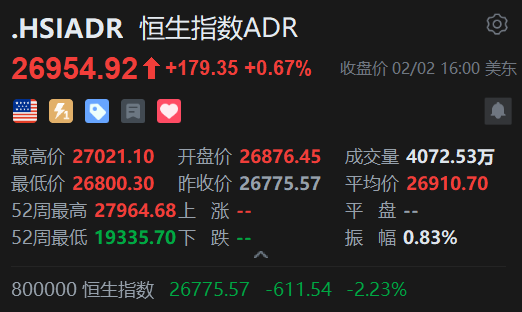
Market Overview - The Hang Seng Index (HSI) closed at 26,954.92, up by 179.35 points or 0.67% as of February 2, 16:00 Eastern Time [1] - The index reached a high of 27,021.10 and a low of 26,800.30 during the trading session, with a trading volume of 40.725 million shares [1] Major Blue-Chip Stocks Performance - HSBC Holdings closed at HKD 139.961, increasing by 3.91% compared to the Hong Kong close [2] - Tencent Holdings closed at HKD 595.694, down by 0.47% compared to the Hong Kong close [2] Stock Price Movements - Tencent Holdings: Latest price HKD 598.500, down by HKD 7.500 or 1.24% [3] - Alibaba Group: Latest price HKD 163.300, down by HKD 5.900 or 3.49% [3] - HSBC Holdings: Latest price HKD 134.700, down by HKD 1.900 or 1.39% [3] - AIA Group: Latest price HKD 89.050, down by HKD 1.300 or 1.44% [3] - Meituan: Latest price HKD 94.850, down by HKD 2.350 or 2.42% [3] - BYD Company: Latest price HKD 91.000, down by HKD 6.750 or 6.91% [3] - Kuaishou Technology: Latest price HKD 77.000, down by HKD 3.150 or 3.93% [3]




网易-S:预计2026年2月11日公布年报
Xin Lang Cai Jing· 2026-02-02 14:09
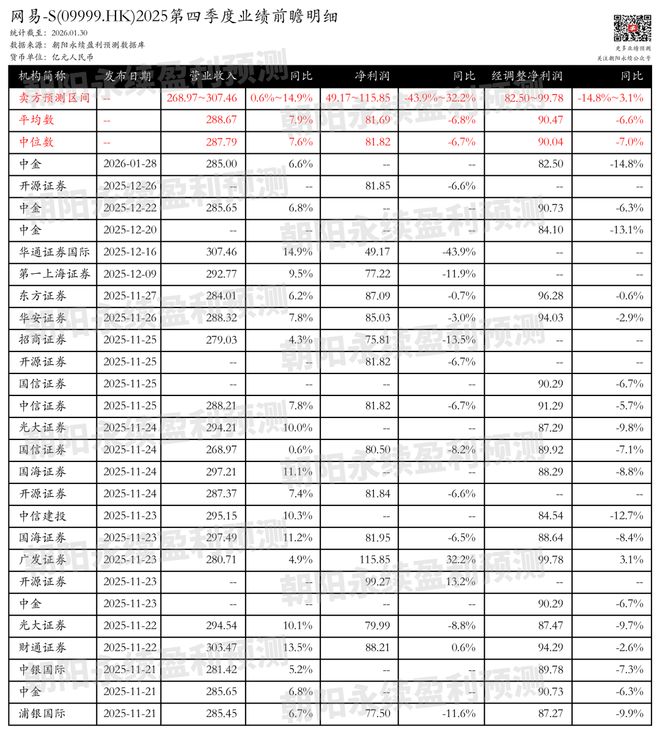
来源:朝阳永续 1. 最近拟披露财报发布日 预测经调整净利润82.50~99.78亿元,同比变动-14.8%~3.1%。 关注后续财报数据披露后能否超预期,朝阳永续港股季度业绩前瞻数据将为投资者提供业绩鉴定。 网易-S(09999.HK)将于2026年2月11日公布2025年年报。 2. 网易-S第四季度业绩预期怎么样? 截至目前,根据朝阳永续季度业绩前瞻数据: 预测营业收入268.97~307.46亿元,同比增长0.6%~14.9%; 预测净利润49.17~115.85亿元,同比变动-43.9%~32.2%; 开源证券认为:网易-S在2025Q3实现营业收入284亿元,同比增长8.2%,归母净利润86亿元,同比增长 31.8%。公司毛利率同比提升1.2个百分点至64.1%,净利率提升5.4个百分点至31.0%。合同负债达195亿 元,同比增长25%,递延收入逐步释放,有望驱动业绩延续高增。公司预计2025-2027年归母净利润分 别为357/383/429亿元,当前股价对应PE分别为16.6/15.5/13.8倍。公司看好储备游戏逐步上线、优质产 品出海、AI赋能深化共同驱动业绩增长。 (注:本文内容基于朝 ...
多家游戏上市公司发布业绩预告;1月版号名单发布
2 1 Shi Ji Jing Ji Bao Dao· 2026-02-02 09:10
Industry Dynamics - The first batch of game licenses for 2026 has been officially issued, totaling 182 games, including 177 domestic games and 5 imported games, marking a high value for recent years [3][4] - Notable games that received licenses include NetEase's "Yao Yao Chess," 37 Interactive's "Douluo Dalu: Qicheng," and Giant Network's "Moonlight Night: Master Duel" [4] Company Updates - NetEase's "Yanyun Sixteen Sounds" won multiple awards at the 2025 TapTap Annual Game Awards, including Best Game and Best Narrative [5] - Century Huatong forecasts a revenue of approximately 38 billion yuan for 2025, representing a year-on-year growth of about 68%, with net profit expected to surge by 357.47% to 475.34% [6] - Perfect World anticipates turning a profit in 2025, projecting a net profit of 720 million to 760 million yuan [7] - Gigabit expects a net profit of 1.69 billion to 1.86 billion yuan, a year-on-year increase of 79% to 97% [8] - Glacier Network predicts a turnaround with a net profit of 436 million to 516 million yuan, recovering from a loss of 247 million yuan in the previous year [9] - Electric Soul Network forecasts a loss of 160 million to 230 million yuan for 2025, marking its first annual loss since going public [10] - NetEase's Montreal studio has reportedly undergone layoffs, primarily affecting the quality assurance department [11] Overseas and Compliance - Valve, the parent company of Steam, is facing a collective lawsuit in the UK, accused of abusing its dominant position in the PC gaming market, with claims for damages amounting to 6.56 billion pounds (approximately 62.40 billion yuan) [12] - Google has launched a new interactive world AI creation tool, Project Genie, which allows users to generate playable 3D environments [13] - Ubisoft plans to lay off up to 200 employees at its Paris headquarters following a restructuring announcement [14]




网易邮箱企业邮箱
Sou Hu Cai Jing· 2026-02-02 04:42
在数字化办公环境中,电子邮件作为基础沟通工具,承担着信息传递与存储的重要功能。针对组织化办公需求,一些服务商推出了专门面向企业用户的邮箱 系统。这类系统与个人邮箱存在一定差异,下面将从几个方面进行介绍。 二、系统架构特点 从技术层面看,企业邮箱采用分布式架构设计。这种设计使得系统能够承载大量并发请求,保证服务的稳定性。存储系统采用多重备份机制,防止数据因硬 件故障而丢失。 安全防护体系包含多个层面:传输层通过加密协议保障数据安全;应用层设有反垃圾邮件机制和病毒检测功能;管理层提供登录验证、操作审计等功能。这 些安全措施共同构建了邮箱系统的防护网络。 一、企业邮箱的基本概念 企业邮箱是一种以组织域名为标识的电子邮箱服务。每个邮箱地址通常包含员工姓名或工号及企业自有域名,形成统一对外形象。与个人邮箱相比,这种邮 箱在管理权限、安全配置和功能扩展方面具有不同特点。 企业邮箱系统通常包含邮件收发、联系人管理、日程安排等基础功能,同时集成了协同办公相关模块。管理员可通过后台管理系统对员工账号进行统一管 理,包括权限分配、空间设置和安全策略部署。 三、管理功能详解 企业邮箱的管理功能主要体现在以下几个方面: 为适应移动办 ...
黄金、有色金属板块掀跌停潮,两大牛股复牌跌停
Di Yi Cai Jing· 2026-02-02 01:45
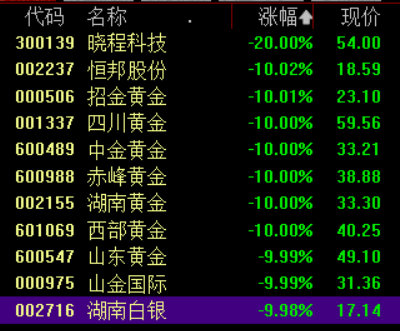
Group 1: Market Overview - The gold and non-ferrous metal sectors experienced significant declines, with multiple stocks hitting the daily limit down, including Hunan Gold, Xiaocheng Technology, and Western Gold [1][2] - International gold and silver prices saw substantial drops on January 30, marking some of the largest single-day declines in decades due to profit-taking and short-term futures traders closing long positions [1] Group 2: Stock Performance - Xiaocheng Technology's stock fell by 20.00% to 54.00, while Hunan Gold and Western Gold both dropped by 10.00% to 33.30 and 40.25 respectively [2] - The Shanghai Composite Index decreased by 0.93% to 4079.71, while the Shenzhen Component Index fell by 0.54% to 14128.87, contrasting with a 0.65% increase in the ChiNext Index [3][4] Group 3: Sector Analysis - The market saw a wave of limit-downs in the gold and base metal sectors, with oil, gas, chemicals, agriculture, coal, and steel industries also experiencing notable declines [4] - Conversely, sectors such as photovoltaic and ultra-high voltage themes showed resilience and strength amid the broader market downturn [4] Group 4: Additional Market Movements - The Hong Kong stock market opened lower, with the Hang Seng Index down 1.06% and the Hang Seng Tech Index down 1.29%, influenced by significant drops in major telecom operators [8][9] - The People's Bank of China conducted a 750 billion yuan reverse repurchase operation at an interest rate of 1.40%, with 1505 billion yuan of reverse repos maturing on the same day [7]




李亚鹏6小时直播销售额达1.6亿;月之暗面公开喊话百度;黄仁勋否认对OpenAI不满,透露将巨额投资;国际巨头被曝拟裁员3万人...
Sou Hu Cai Jing· 2026-02-02 01:26
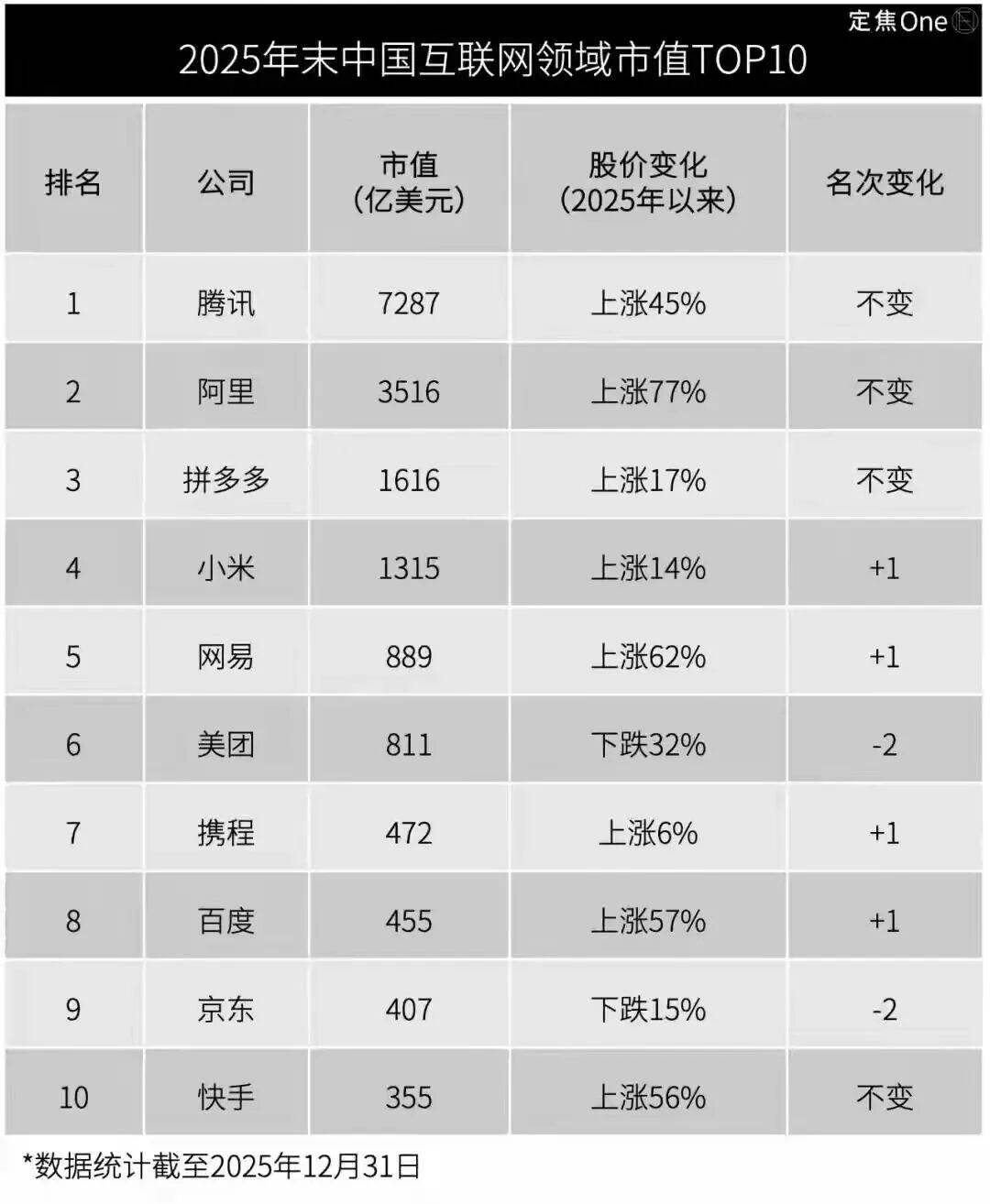
Group 1: Market Capitalization of Chinese Internet Companies - Tencent leads the market with a valuation of $72.87 billion, experiencing a 45% increase since the beginning of 2025 [1] - Alibaba follows with a market cap of $35.16 billion, showing a 77% rise [1] - Pinduoduo ranks third with a valuation of $16.16 billion, up by 17% [1] - Xiaomi's market cap is $13.15 billion, increasing by 14% [1] - NetEase has a valuation of $8.89 billion, with a significant 62% increase [1] - Meituan's market cap is $8.11 billion, but it has seen a decline of 32% [1] - Ctrip's valuation stands at $4.72 billion, with a modest increase of 6% [1] - Baidu's market cap is $4.55 billion, reflecting a 57% rise [1] - JD.com has a valuation of $4.07 billion, down by 15% [1] - Zhongren ranks last with a market cap of $3.55 billion, with a drastic drop of 245,606% [1] Group 2: Tax Policy Changes - The Ministry of Finance and the State Administration of Taxation announced a new VAT exemption policy for small-scale taxpayers, effective from January 1, 2026 [3] - The new threshold for monthly sales is set at 100,000 yuan, and for quarterly sales at 300,000 yuan [3] - For single transactions, the threshold is 1,000 yuan, applicable on a daily basis for multiple transactions [3] Group 3: AI and Technology Developments - Nvidia's CEO Jensen Huang denied any dissatisfaction with OpenAI and announced plans for a significant investment in the company [5] - Apple is reported to have acquired the Israeli company Q.ai for approximately $2 billion, marking its second-largest acquisition in history [5] - Waymo is seeking to raise about $16 billion at a valuation close to $110 billion, with Alphabet expected to contribute $13 billion [18] Group 4: Corporate Actions and Market Reactions - Oracle is reportedly considering laying off 30,000 employees due to financial pressures from AI infrastructure investments [11] - The company is also evaluating the sale of its healthcare software division, Cerner, acquired for $28.3 billion [11] - Recent fluctuations in gold prices have led to increased consumer activity in gold purchases in Shenzhen [3]

指数研究|全球主要指数估值跟踪0201(实战版)
Xin Lang Cai Jing· 2026-02-01 15:13
文/定龙骑牛 徒步滚雪球 编审/王小鱼 (3)中国资产最佳对冲:A股更多反映"全球制造业周期"和"国内财政杠杆",而纳指反映"全球科技创新周期"。两者驱动力来源完全不同。在配置模型 中,两者的相关性极低,是真正的有效多样化。 1.2 走势与展望: 当前美股市场机会与风险并存,整体风险较前期有所上升,但核心投资逻辑尚未被破坏。 以后美股相关的讨论,或加急的更新,都用这个账号发布! 为方便复盘及大家伙儿分散投资风险,我会定期跟踪美股科技的估值情况。如无特别说明,本文使用PE-TTM(滚动市盈率)数据均来自iFind。 一、纳指100 1.1 配置必要性: 结合第一性原理看清资产收益的本质。纳指100的配置价值在于三个底层驱动力: (1)全要素生产率的收割机:经济增长的本质是劳动力、资本和生产率的提升。纳指100代表了当前人类社会全要素生产率(TFP)提升的最高水平。投 资纳指100,本质上是在做多"技术取代人力"和"算法驱动增长"的必然趋势。 (2)全球资本的"高质量回笼":在全球不确定性增加的背景下,资金倾向于流向拥有最强自由现金流的企业。纳指100成分股多为垄断型科技巨头,它们 不仅赚钱多,还通过巨额股份回购 ...