
CM BANK(600036)

Search documents
你的支付优惠用了吗?各大银行加入双十一“狂欢”,算的什么账?
Sou Hu Cai Jing· 2025-11-08 00:51
Core Viewpoint - The annual Double Eleven shopping season has officially started, with major commercial banks launching various promotional activities to stimulate consumer spending and boost business before the year-end [1][2]. Group 1: Promotional Activities by Banks - Major banks such as China Construction Bank, Bank of China, Agricultural Bank of China, and others have introduced cashback, discounts, installment benefits, and exclusive offers to attract consumers [1]. - Construction Bank offers a maximum discount of 400 yuan for credit card customers using installment payments on platforms like Alipay and Taobao, while Bank of China provides a random discount of up to 118 yuan for transactions made through Alipay [2]. - Other banks, including China Merchants Bank and Ping An Bank, have also launched various cashback and discount campaigns to engage customers during this shopping season [2]. Group 2: Strategic Insights - Experts suggest that the banks' promotional strategies represent a cost-effective method to acquire and retain customers, activating dormant accounts with low-cost random discounts [5]. - The focus on marketing during peak shopping seasons aims to enhance the usage of bank cards over third-party payment channels, thereby driving growth in credit and debit card transactions [5]. - Recommendations for banks post-Double Eleven include offering temporary credit limit increases and integrating with government consumption voucher programs to enhance customer experience and engagement [5].





A+H板块添丁添财 AH股溢价结构分化
Zheng Quan Shi Bao· 2025-11-07 18:14
Core Insights - The Hang Seng AH Premium Index has slightly rebounded to 118.42 points as of November 7, following a low of 115.44 points on October 2, indicating a shift in market dynamics for A+H shares [1] Group 1: Recent H-Share Listings - Several well-known A-share companies have recently listed on the Hong Kong stock market, contributing to the AH Premium Index's movements [2] - Junsheng Electronics, listed on November 6, aims to raise funds for automotive intelligent solutions, smart manufacturing, and global expansion, but has seen a cumulative drop of 15.91% since listing, with an A-share premium of 71.63% over H-shares [2] - Seres, which listed on November 5, has experienced a cumulative decline of 13.31%, with an A-share premium of 33.41% over H-shares [2] Group 2: Premium Structure and Trends - The AH premium structure has become more differentiated, with five A+H stocks showing "price inversion" as of November 7, including Ningde Times and Midea Group, with Ningde Times showing the largest premium inversion at -22.303% [4] - The overall trend indicates that the phenomenon of A-shares having premiums over H-shares exceeding 300% has disappeared, with only 30 out of 166 A+H stocks having premiums over 100% [5] - The premium rates for some companies, such as Hongye Futures and Sinopec Oilfield Services, exceed 200%, while others like WuXi AppTec and Zijin Mining have premiums below 5% [5] Group 3: Expansion of A+H Market - The pace of expansion in the A+H market is accelerating, with companies like Baile Tianheng starting their IPO process and planning to raise up to 3.358 billion HKD [6] - The A+H market is becoming a crucial link between A-share and H-share markets, providing investors with more cross-market investment options [7] - Differences in investor structures and trading mechanisms between A-shares and H-shares are fundamental factors contributing to the observed price disparities [7]







11月7日国企改革(399974)指数跌0.1%,成份股深南电路(002916)领跌
Sou Hu Cai Jing· 2025-11-07 09:57
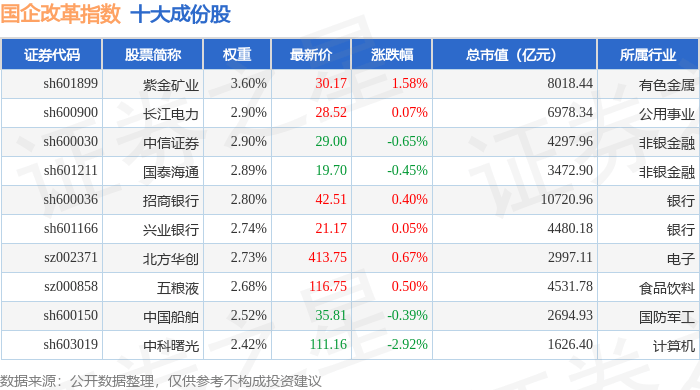
Core Points - The State-Owned Enterprise Reform Index (399974) closed at 1916.43 points, down 0.1% with a trading volume of 135.68 billion yuan and a turnover rate of 0.7% [1] - Among the index constituents, 43 stocks rose while 56 fell, with Wanhua Chemical leading the gainers at a 5.79% increase and Shenzhen South Circuit leading the decliners at a 3.36% decrease [1] Index Constituents Summary - The top ten constituents of the State-Owned Enterprise Reform Index include: - Zijin Mining: 3.60% weight, latest price 30.17 yuan, market cap 801.84 billion yuan, sector: Non-ferrous metals [1] - Changjiang Electric Power: 2.90% weight, latest price 28.52 yuan, market cap 697.83 billion yuan, sector: Utilities [1] - CITIC Securities: 2.90% weight, latest price 29.00 yuan, market cap 429.80 billion yuan, sector: Non-banking financial [1] - Taihai Chemical: 2.89% weight, latest price 19.70 yuan, market cap 347.29 billion yuan, sector: Non-banking financial [1] - China Merchants Bank: 2.80% weight, latest price 42.51 yuan, market cap 1072.10 billion yuan, sector: Banking [1] - Xingye Bank: 2.74% weight, latest price 21.17 yuan, market cap 448.02 billion yuan, sector: Banking [1] - North Huachuang: 2.73% weight, latest price 413.75 yuan, market cap 299.71 billion yuan, sector: Electronics [1] - Wrigley: 2.68% weight, latest price 116.75 yuan, market cap 453.18 billion yuan, sector: Food and Beverage [1] - China Shipbuilding: 2.52% weight, latest price 35.81 yuan, market cap 269.49 billion yuan, sector: Defense and Military [1] - Zhongke: 2.42% weight, latest price 111.16 yuan, market cap 162.64 billion yuan, sector: Computer [1] Capital Flow Analysis - The net outflow of main funds from the index constituents totaled 4.52 billion yuan, while retail investors saw a net inflow of 2.98 billion yuan [1] - Notable net inflows from retail investors were observed in Wanhua Chemical, TCL Zhonghuan, and China Satellite, while significant outflows were noted in China Chemical and China Unicom [2]




4000点拉锯战 | 谈股论金
水皮More· 2025-11-07 09:39
Market Overview - The three major A-share indices experienced a slight decline today, with the Shanghai Composite Index falling below the 4000-point mark, closing at 3997.56 points, down 0.25% [2][3] - The Shenzhen Component Index decreased by 0.36%, closing at 13404.06 points, while the ChiNext Index fell by 0.51%, closing at 3208.21 points [2][3] - The total trading volume in the Shanghai and Shenzhen markets was 199.91 billion, a decrease of 56.2 billion from the previous day [2][3] Market Dynamics - The market showed a tug-of-war around the 4000-point level, entering its fifth round of fluctuations [3] - The indices opened lower due to the significant drop in the US market, with a notable outflow of capital, totaling 471 billion, including 415 billion from northbound funds [3][4] - A total of nearly 3000 stocks declined, while just over 2000 stocks rose, indicating a bearish sentiment in the market [3] Sector Performance - Strong sectors included chemical raw materials (especially organic silicon), batteries (including lithium), and photovoltaic equipment [4] - Weak sectors included AI software, internet services, software development, gaming, semiconductors, and consumer electronics, which have shown continuous weakness [4] External Influences - The A-share market's decline was influenced by a significant drop in the US market, particularly in major tech stocks like Nvidia and Microsoft, both of which saw a 10% drop from their recent highs [5] - Concerns regarding OpenAI's financial discussions and potential government guarantees have led to a sell-off in technology stocks globally [4][5] Key Stock Movements - Notable stock movements included PetroChina rising by 6%, Cambrian rising by 4%, and China Merchants Bank increasing by nearly 4% [6] - The performance of these key stocks contributed significantly to the indices, masking the broader trend of declines among most stocks [6] Market Sentiment - The market sentiment remains cautious, with both bulls and bears adopting a careful approach due to profit-taking pressures and previous strong rebounds [5][6] - The rapid recovery of the indices after a significant drop indicates a volatile market environment, where similar patterns may not be easily replicated [6]



金融行业双周报:央行重启购债操作,有望缓解银行负债压力-20251107
Dongguan Securities· 2025-11-07 09:27
Investment Ratings - Banking: Overweight (Maintain) [1] - Securities: Market Weight (Maintain) [1] - Insurance: Overweight (Maintain) [1] Core Insights - The central bank's resumption of bond purchases aims to alleviate liquidity pressure on banks and enhance their lending capacity [1][4] - The securities industry has shown strong performance in the first three quarters of 2025, with a net profit of CNY 1,837.82 billion, a year-on-year increase of 61.25% [3][50] - The insurance sector is experiencing a strategic adjustment period due to changes in interest rates, with significant profit growth reported by major insurers [4] Summary by Sections Market Review - As of November 6, 2025, the banking, securities, and insurance indices have changed by +0.25%, +0.62%, and -0.67% respectively, while the CSI 300 index increased by +1.89% [12][19] - Among the sub-sectors, Chongqing Bank (+8.44%), Northeast Securities (+10.09%), and China Ping An (+1.90%) performed the best [12][19] Valuation Situation - As of November 6, 2025, the banking sector's price-to-book (PB) ratio is 0.78, with state-owned banks at 0.84 and joint-stock banks at 0.62 [21][22] - The securities sector's PB ratio is 1.54, indicating potential for valuation recovery [25] Recent Market Indicators - The one-year Medium-term Lending Facility (MLF) rate is 2.0%, with the one-year and five-year Loan Prime Rates (LPR) at 3.0% and 3.50% respectively [32][33] - The average daily trading volume of A-shares is CNY 19,673.61 billion, reflecting a decrease of 14.41% [38][40] Industry News - The insurance industry is adapting to new regulatory frameworks and interest rate changes, with a focus on optimizing product structures and enhancing profitability [43][44] - The central bank's actions are expected to provide a more stable liquidity environment for banks, especially as year-end liquidity fluctuations increase [48] Company Announcements - Major banks and insurers have reported varying earnings growth, with significant increases in net profits for companies like China Life and Xinhua Insurance [46][47]





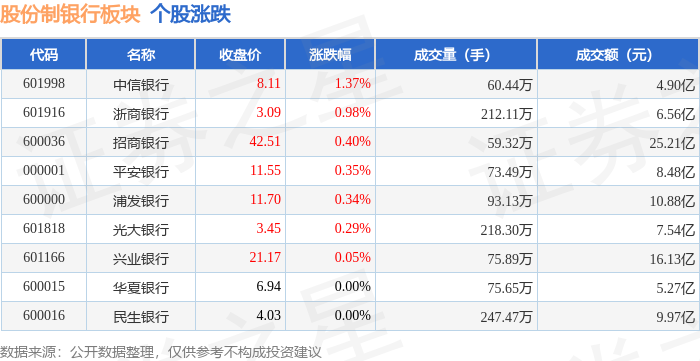
股份制银行板块11月7日涨0.42%,中信银行领涨,主力资金净流出1513.37万元
Zheng Xing Xing Ye Ri Bao· 2025-11-07 08:37
Core Insights - The banking sector saw a slight increase of 0.42% on November 7, with CITIC Bank leading the gains [1] - The Shanghai Composite Index closed at 3997.56, down 0.25%, while the Shenzhen Component Index closed at 13404.06, down 0.36% [1] Banking Sector Performance - CITIC Bank's closing price was 8.11, with a rise of 1.37% and a trading volume of 604,400 shares, amounting to a transaction value of 490 million [1] - Other notable banks included Zhejiang Commercial Bank at 3.09 (up 0.98%), China Merchants Bank at 42.51 (up 0.40%), and Ping An Bank at 11.55 (up 0.35%) [1] - The overall trading volume for the banking sector showed mixed results, with some banks experiencing slight increases while others remained flat or decreased [1] Fund Flow Analysis - The banking sector experienced a net outflow of 15.13 million from institutional investors, while retail investors saw a net inflow of 18.1 million [1] - Specific banks like China Merchants Bank had a net inflow of 17.9 million from institutional investors, while CITIC Bank faced a net outflow of 24.62 million from retail investors [2] - The overall trend indicates a divergence in fund flows, with institutional investors pulling back while retail investors are more active in the sector [2]


上市银行大类资产配置跟踪:信贷投放稳健,债券配置灵活性提升
Ping An Securities· 2025-11-07 08:10
Industry Investment Rating - The investment rating for the banking sector is "Outperform" [1] Core Insights - The proportion of corporate loans has increased, while retail demand recovery is being monitored. As of mid-2025, the proportion of corporate loans among listed banks rose by 1.65 percentage points from the end of 2024 to 60.2%. The manufacturing sector's loans accounted for 18.5% of corporate loans, reflecting a recovery in the operations of manufacturing enterprises [3][12] - The flexibility in bond allocation has increased, with bond trading helping to stabilize market fluctuations. In the first half of 2025, listed banks saw a significant decline in other comprehensive income and fair value changes due to interest rate fluctuations. Some banks, primarily state-owned, increased bond trading to enhance investment returns and stabilize net profit growth [3][6] - Asset quality pressure is manageable, with a focus on risks in the retail sector. The overall asset quality remains stable, with the non-performing loan (NPL) ratio for A-share listed banks holding steady at 1.15% as of Q3 2025. However, the average NPL ratio for retail loans increased by 15 basis points to 1.58% compared to the end of 2024 [3][6] Summary by Sections Corporate Loan Structure - The overall asset structure of listed banks shows an increase in loan allocation, with the loan proportion rising by 0.1 percentage points from the end of 2024. State-owned banks increased interbank asset allocation, while small and medium-sized banks focused more on loan issuance [12][19] - Corporate loans remain the primary focus of credit allocation, with corporate loans accounting for 91.1% of all new loans in the first nine months of 2025. Short-term corporate loans made up 33.7% of new corporate loans [17][18] Bond Investment Preferences - The preference for flexible bond allocation has increased, with banks primarily investing in government bonds and central bank bills. The proportion of OCI accounts has risen, indicating a shift towards more flexible investment strategies [6][3] Asset Quality and Risk Monitoring - The asset quality of the banking sector is stable, with a non-performing loan ratio of 1.15% as of Q3 2025. The retail loan sector has shown slight increases in NPL ratios, necessitating ongoing monitoring of risks in this area [3][6]


招商银行南昌分行:以四维服务构建银发金融守护网
Zhong Guo Jin Rong Xin Xi Wang· 2025-11-07 07:18
Core Viewpoint - The Nanchang branch of China Merchants Bank is enhancing its services for elderly clients by creating a comprehensive service network that emphasizes warmth, care, and personalized attention during the Double Ninth Festival [1] Group 1: New Service Paradigm for the Elderly - The bank is focusing on optimizing the service environment and processes to cater to the specific needs of elderly clients, including visual and mobility considerations [2] - All branches are undergoing renovations to create elderly-friendly spaces, featuring large fonts for signage and comfortable seating [2] - Special service protocols have been established, including priority service windows for elderly clients to facilitate quick transactions without waiting in line [2] Group 2: Human-Centered Care Experience - Personalized interactions are being emphasized to make elderly clients feel respected and valued beyond just transactional relationships [3] - The bank has introduced unique services such as "anti-fraud health tea" and educational materials to raise awareness about fraud while providing a comfortable environment [3] - During the Double Ninth Festival, the bank engaged over 180 elderly clients through various activities aimed at educating them about fraud prevention [3] Group 3: Comprehensive Service Ecosystem - The bank is extending its services beyond physical branches by integrating community engagement and outreach programs [4] - Activities such as outdoor movie screenings and financial consultations in community spaces have attracted significant participation from elderly residents [4] - A financial service team is proactively visiting elderly clients at home to assist with banking needs and provide festive gifts [4] Group 4: Risk Prevention Measures - A comprehensive risk control system has been established, focusing on fraud prevention through education and proactive measures [6] - Regular training on fraud cases is conducted for staff to ensure they can identify and respond to potential scams effectively [6] - The bank has successfully intervened in potential fraud cases, demonstrating its commitment to safeguarding elderly clients [6]
多家股份行城商行前三季发力个人房贷
Feng Huang Wang· 2025-11-07 02:27
Core Insights - The latest reports indicate a significant increase in personal housing loans from several listed banks, contrasting with the decline observed in state-owned banks' mortgage lending [1][2][6][7] Group 1: Personal Housing Loan Growth - Nearly ten listed banks, including Minsheng Bank, Ping An Bank, and others, reported a clear increase in personal housing loans by the end of Q3 compared to the beginning of the year [1][2] - Specific banks like Ping An Bank reported a housing loan balance of 3,523.50 billion yuan, growing by 8.1% from the beginning of the year [2] - Minsheng Bank's mortgage loan balance increased by 180.41 billion yuan, marking a growth of 3.24% [2] Group 2: State-Owned Banks' Decline - The six major state-owned banks experienced a reduction of over 1,000 billion yuan in personal housing loans in the first half of the year, continuing a downward trend for three consecutive years [1][6] - By the end of Q3, the total personal housing loan balance for these banks was approximately 25.086 trillion yuan, reflecting a decrease of 1,078 billion yuan since the beginning of the year [6] Group 3: Market Dynamics and Regional Insights - The demand for housing loans remains strong in certain regions, such as Jiangsu, Zhejiang, and Shanghai, prompting banks to increase mortgage lending [4][5] - The new personal housing loans issued in key economic regions accounted for 87.70% of the total new loans issued by Shanghai Pudong Development Bank, indicating a regional focus in lending strategies [3] Group 4: Overall Market Trends - As of the end of Q3 2025, the total personal housing loan balance in the market was 37.44 trillion yuan, showing a year-on-year decline of 0.3% despite the growth from smaller banks [7] - The overall trend suggests that while some smaller banks are increasing their mortgage lending, it is not sufficient to offset the overall decline in the personal housing loan market driven by the larger state-owned banks [7]

沪深300ESGETF南方(560180)开盘跌0.34%
Xin Lang Cai Jing· 2025-11-07 01:47
Core Viewpoint - The article discusses the performance of the Hu-Shen 300 ESG ETF managed by Southern Fund Management, highlighting its recent market activity and returns since inception [1]. Group 1: Fund Performance - The Hu-Shen 300 ESG ETF (560180) opened at 1.182 yuan, experiencing a decline of 0.34% [1]. - Since its inception on April 13, 2023, the fund has achieved a return of 18.78%, with a monthly return of 1.07% [1]. Group 2: Major Holdings - Key stocks in the fund include: - Ningde Times: down 0.30% - Kweichow Moutai: unchanged at 0.00% - China Merchants Bank: up 0.14% - Zhongji Xuchuang: down 1.18% - Changjiang Power: up 0.04% - Midea Group: up 0.31% - BYD: down 0.53% - Industrial Bank: up 0.57% - Industrial and Commercial Bank of China: unchanged at 0.00% - Heng Rui Pharmaceutical: down 0.67% [1].


