SAIC MOTOR(600104)

Search documents
乘用车板块1月15日跌0.58%,北汽蓝谷领跌,主力资金净流出8.72亿元
Zheng Xing Xing Ye Ri Bao· 2026-01-15 08:53
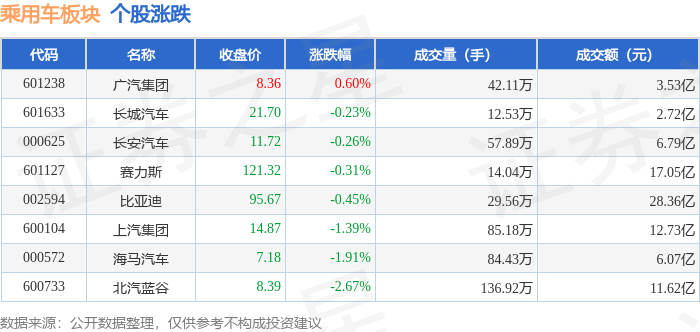
Core Viewpoint - The passenger car sector experienced a decline of 0.58% on January 15, with Beiqi Blue Valley leading the drop, while the Shanghai Composite Index fell by 0.33% and the Shenzhen Component Index rose by 0.41% [1]. Group 1: Market Performance - The closing price for GAC Group was 8.36, with an increase of 0.60% and a trading volume of 421,100 shares, amounting to 353 million yuan [1]. - Great Wall Motors closed at 21.70, down by 0.23%, with a trading volume of 125,300 shares and a transaction value of 272 million yuan [1]. - Changan Automobile's closing price was 11.72, decreasing by 0.26%, with a trading volume of 578,900 shares and a transaction value of 679 million yuan [1]. - The closing price for Seres was 121.32, down by 0.31%, with a trading volume of 140,400 shares and a transaction value of 1.705 billion yuan [1]. - BYD closed at 95.67, down by 0.45%, with a trading volume of 295,600 shares and a transaction value of 2.836 billion yuan [1]. - SAIC Motor's closing price was 14.87, down by 1.39%, with a trading volume of 851,800 shares and a transaction value of 1.273 billion yuan [1]. - Haima Automobile closed at 7.18, down by 1.91%, with a trading volume of 844,300 shares and a transaction value of 607 million yuan [1]. - Beiqi Blue Valley closed at 8.39, down by 2.67%, with a trading volume of 1,369,200 shares and a transaction value of 1.162 billion yuan [1]. Group 2: Fund Flow Analysis - The passenger car sector saw a net outflow of 872 million yuan from main funds, while retail funds had a net inflow of 540 million yuan [1]. - GAC Group experienced a net inflow of 23.84 million yuan from main funds, while retail funds had a net outflow of 46.64 million yuan [2]. - Great Wall Motors had a net outflow of 0.7565 million yuan from main funds, with a net inflow of 15.78 million yuan from retail funds [2]. - Changan Automobile faced a net outflow of 44.50 million yuan from main funds, while retail funds had a net inflow of 28.43 million yuan [2]. - Beiqi Blue Valley had a significant net outflow of 164 million yuan from main funds, with a net inflow of 91.78 million yuan from retail funds [2]. - BYD saw a net outflow of 32.57 million yuan from main funds, while retail funds had a net inflow of 301 million yuan [2].







上汽集团发预增,预计2025年度归母净利润90亿元到110亿元,同比增加438%到558%
Zhi Tong Cai Jing· 2026-01-15 08:49
上汽集团(600104)(600104.SH)发布公告,公司预计2025年度实现归属于母公司所有者的净利润为90 亿元到110亿元,将增加73亿元到93亿元,同比增加438%到558%。 公司2025年实现整车批发销量450.75万辆,比上年同期增长12.32%。公司2024年完成 JSW MG Motor India Private Limited 股权转让及增资扩股,该事项增加公司2024年度归属于母公司所有者的净利润 51.78亿元人民币。 ...

AI 时代:智能驾驶从技术想象走向产业现实
Zhong Guo Qi Che Bao Wang· 2026-01-15 08:30
Core Insights - The automotive industry is undergoing a profound transformation driven by artificial intelligence (AI), moving from early concept validation to practical implementation, reshaping the entire industrial ecosystem from technology development to business models [1][2]. Group 1: Restructuring the Automotive Value Chain - The core of the AI era is "cognition," contrasting with the "computation" focus of the information age, characterized by data-driven societal mechanisms, algorithm-influenced decision-making, and human-machine collaboration [4]. - AI systems possess learning, reasoning, and self-optimization capabilities, participating as "cognitive partners" in production, management, and service processes, significantly impacting manufacturing, transportation systems, and urban operations [4][5]. - Multiple countries have elevated AI to a national strategic level, promoting technological innovation and industrial application integration through systematic policies [4]. Group 2: Technological Pathways in Autonomous Driving - Three differentiated technological routes have emerged in the global autonomous driving sector: 1. The robust route represented by Waymo, utilizing a combination of lidar, radar, and cameras, achieving L4-level commercial operations but facing high costs and slow scalability [6]. 2. The aggressive route advocated by Tesla, relying on a "pure vision" approach with lower hardware costs, primarily applied in L2+/L3-level driving assistance, but facing challenges in extreme scenarios [6]. 3. The system redundancy route explored by Zoox, focusing on physical redundancy in vehicle structure and sensor layout, aiming for L4/L5-level fully autonomous driving but with a longer commercialization cycle [6]. - Autonomous driving technology has demonstrated high reliability in practical applications, such as Waymo vehicles operating smoothly in complex urban environments, enhancing passenger safety and trust through transparent real-time interaction [6][7]. Group 3: Future of Autonomous Driving - There is no "one correct" technological answer for autonomous driving; companies must balance safety, cost, scalability, and reliability [7]. - As AI agent capabilities evolve, computing costs decrease, and regulatory frameworks improve, autonomous driving is expected to expand from pilot projects to broader applications [7]. - Future competition will focus not only on sensors or algorithms but also on system engineering capabilities, data loop construction, and long-term technological patience, marking the beginning of a significant revolution in mobility [7].
上汽集团(600104.SH):预计2025年归母净利润为90亿元到110亿元,同比增加438%到558%
Ge Long Hui A P P· 2026-01-15 08:09
预计2025年度实现归属于母公司所有者的扣除非经常性损益的净利润70亿元到82亿元,与上年同期相 比,将增加124亿元到136亿元,同比增加229%到251%。 格隆汇1月15日丨上汽集团(600104.SH)公布,经财务部门初步测算,公司预计2025年度实现归属于母公 司所有者的净利润为90亿元到110亿元,将增加73亿元到93亿元,同比增加438%到558%。 ...
上汽集团:2025年净利润同比预增438%—558%
Zheng Quan Shi Bao Wang· 2026-01-15 08:06
人民财讯1月15日电,上汽集团(600104)1月15日公告,预计2025年度实现归属于母公司所有者的净利 润为90亿元—110亿元,同比增加438%—558%。公司2025年实现整车批发销量450.75万辆,比上年同期 增长12.32%。 ...
上汽集团:2025年净利同比预增438%~558%
Mei Ri Jing Ji Xin Wen· 2026-01-15 07:52
每经AI快讯,1月15日,上汽集团(600104.SH)公告称,公司发布2025年度业绩预告,预计归属于母公司 所有者的净利润为90亿元到110亿元,同比增加438%到558%。公司2025年实现整车批发销量450.75万 辆,比上年同期增长12.32%。 ...
上汽集团(600104) - 2025 Q4 - 年度业绩预告
2026-01-15 07:50
证券代码:600104 证券简称:上汽集团 公告编号:临 2026-004 上海汽车集团股份有限公司 2025 年度业绩预告 本公司董事会及全体董事保证本公告内容不存在任何虚假记载、误导性陈述或者重大 遗漏,并对其内容的真实性、准确性和完整性承担法律责任。 (二)每股收益:0.145 元。 重要内容提示: 经财务部门初步测算,公司预计2025年度实现归属于母公司所 有者的净利润为90亿元到110亿元,与上年同期相比,将增加73亿元 到93亿元,同比增加438%到558%。 一、 本期业绩预告情况 (一)业绩预告期间 2025 年 1 月 1 日至 2025 年 12 月 31 日 (二)业绩预告情况 经财务部门初步测算,公司预计 2025 年度实现归属于母公司所 有者的净利润为 90 亿元到 110 亿元,将增加 73 亿元到 93 亿元,同 比增加 438%到 558%。 预计 2025 年度实现归属于母公司所有者的扣除非经常性损益的 净利润 70 亿元到 82 亿元,与上年同期相比,将增加 124 亿元到 136 亿元,同比增加 229%到 251%。 二、 上年同期经营业绩和财务状况 (一)归属于母公司 ...
上汽集团:2025年全年净利润同比预增438.00%—558.00%
2 1 Shi Ji Jing Ji Bao Dao· 2026-01-15 07:48
Core Viewpoint - The company anticipates a significant increase in net profit for 2025, projecting a range of 9 billion to 11 billion yuan, representing a year-on-year growth of 438.00% to 558.00% [1] Group 1: Main Business Impact - The company expects to achieve wholesale vehicle sales of 4.5075 million units in 2025, an increase of 12.32% compared to the previous year [1] - In 2024, the company's joint venture, SAIC General Motors Co., Ltd., and its subsidiaries will recognize asset impairment provisions, which will reduce the net profit attributable to the parent company by 7.874 billion yuan [1] Group 2: Non-Operating Profit and Loss Impact - The company completed the transfer of equity and capital increase in JSW MG Motor India Private Limited in 2024, which will increase the net profit attributable to the parent company by 5.178 billion yuan [1]
上汽集团:预计2025年归母净利润同比增加438%到558%
Xin Lang Cai Jing· 2026-01-15 07:36
上汽集团发布业绩预告,公司预计2025年度实现归属于母公司所有者的净利润为90亿元到110亿元,与 上年同期相比,将增加73亿元到93亿元,同比增加438%到558%。 ...
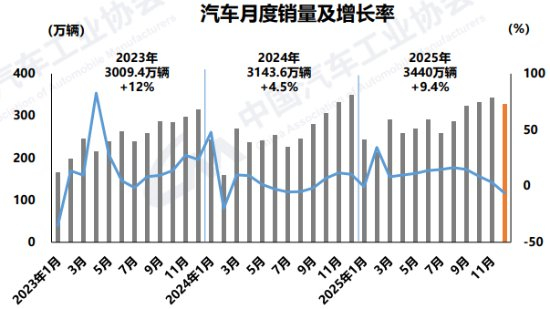
2025年汽车产销超3400万辆,10家车企集团稳居“百万俱乐部”
Zhong Guo Jing Ji Wang· 2026-01-15 06:41
Group 1 - The core viewpoint of the article highlights the robust growth of China's automotive industry in 2025, achieving a total vehicle sales target of approximately 32.3 million units, with a notable increase in new energy vehicle (NEV) sales reaching around 15.5 million units, reflecting a year-on-year growth of about 20% [1][10] - The China Association of Automobile Manufacturers (CAAM) reported that in 2025, the production and sales of automobiles reached 34.5 million and 34.4 million units respectively, marking a year-on-year increase of 10.4% and 9.4%, maintaining China's position as the world's largest automotive market for 17 consecutive years [1][3] - NEV production and sales in 2025 were 16.6 million and 16.5 million units respectively, with year-on-year growth of 29% and 28.2%, indicating that NEVs accounted for over 50% of the domestic market, solidifying their dominance [1][10] Group 2 - In 2025, the automotive industry faced external pressures such as trade protectionism and global supply chain restructuring, yet it demonstrated resilience and vitality, achieving both scale and quality improvements in production and sales [3] - The export of automobiles reached 7.1 million units in 2025, with a year-on-year increase of 21.1%, becoming a key driver for positive growth in the Chinese automotive market [3][10] - The passenger vehicle market saw a significant surge, with production and sales surpassing 30 million units for the first time, achieving 30.3 million and 30.1 million units respectively, reflecting year-on-year growth of 10.2% and 9.2% [3][4] Group 3 - Ten automotive groups achieved sales exceeding one million units in 2025, collectively accounting for 83.9% of total automotive sales, with notable players including BYD, SAIC, and Geely [4] - The market share of domestic brands in the passenger vehicle segment increased, with a market share of 68.8% in December 2025, up 2.7 percentage points from the previous year [4][5] - The sales of traditional fuel vehicles continued to decline, with 13.4 million units sold in 2025, a decrease of 4% year-on-year, highlighting a shift towards electric vehicles [5][10] Group 4 - The article emphasizes the importance of the transition to electric vehicles, noting that while NEVs have not yet achieved a majority in overall sales, they have surpassed 50% in domestic sales [8][10] - The automotive market is transitioning from a growth phase to a more mature phase, with consumer behavior influenced by various factors including policy changes and income expectations [12] - Looking ahead to 2026, the forecast predicts total automotive sales of 34.75 million units, with NEV sales expected to reach 19 million units, reflecting a year-on-year growth of 15.2% [12]