SAIC MOTOR(600104)

Search documents
汽车行业周报:汽车反内卷新政出台,行业价格乱象有望纠正-20251215
CHINA DRAGON SECURITIES· 2025-12-15 09:34
Investment Rating - The report maintains an investment rating of "Recommended" for the automotive industry [2]. Core Viewpoints - The introduction of the automotive anti-involution policy is expected to correct price irregularities in the industry, with the potential for marginal recovery in profit margins across the supply chain [5][15]. - The National Market Supervision Administration released the "Guidelines for Compliance with Automotive Industry Pricing Behavior," which aims to regulate pricing practices from production to sales [5][15]. - Major automakers such as BYD, BAIC Group, and Xpeng Motors have expressed their support for the new guidelines, indicating a collective effort to address unreasonable competition [5][15]. Industry Dynamics - The automotive sector is witnessing a shift towards L3 and L4 autonomous driving technologies, with companies like Ideal Auto planning to launch their first L4 model within three years [5][24]. - The market is seeing new model launches, including the Geely Lynk 10 EM-P and Dongfeng Lantu Zhaiguang L, among others [5][31]. - The automotive sector's performance has outpaced the broader market, with the automotive index showing a gain of 0.16% compared to a decline of 0.08% in the CSI 300 index during the week of December 8 to December 12, 2025 [5][36]. Data Tracking - In November 2025, retail sales of passenger vehicles reached 2.225 million units, a year-on-year decrease of 8.22%, while retail sales of new energy vehicles increased by 4.03% to 1.321 million units [5][47]. - The penetration rate of new energy vehicles in retail sales reached 59.4%, up 6.99 percentage points year-on-year [5][57]. - The inventory coefficient for automotive dealers was reported at 1.57 in November 2025, indicating a significant increase compared to the previous year [5][70]. Investment Recommendations - The report suggests focusing on companies in a strong new product cycle, such as Great Wall Motors, Seres, SAIC Motor, and Xpeng Motors [5]. - It also highlights supply chain leaders and companies involved in humanoid robotics and intelligent driving as potential investment targets [5]. - For commercial vehicles, it recommends focusing on leading companies like Weichai Power and Yutong Bus, which are expected to benefit from the industry's recovery [5].





上汽集团(600104):首次覆盖:巨头革新,华为助力
Shanghai Aijian Securities· 2025-12-15 09:33
Investment Rating - The report gives a "Buy" rating for the company, marking its first coverage [6]. Core Insights - The company is undergoing a significant transformation towards electric and intelligent vehicles, supported by a strategic partnership with Huawei, which is expected to enhance its product offerings and user experience [6]. - The company has a complete automotive industry chain and a diverse brand matrix, which positions it well in the competitive landscape of the automotive industry [6]. - Financial forecasts indicate a strong rebound in net profit from 2025 onwards, with expected profits of 10.75 billion, 13.34 billion, and 16.15 billion yuan for 2025, 2026, and 2027 respectively [6]. Financial Data and Profit Forecast - Revenue projections for the company are as follows: - 2023: 744.71 billion yuan - 2024: 627.59 billion yuan (down 15.7% YoY) - 2025E: 668.57 billion yuan (up 6.5% YoY) - 2026E: 697.79 billion yuan (up 4.4% YoY) - 2027E: 746.77 billion yuan (up 7.0% YoY) [5][17] - Net profit forecasts are: - 2023: 14.11 billion yuan - 2024: 1.67 billion yuan (down 88.2% YoY) - 2025E: 10.75 billion yuan (up 545.2% YoY) - 2026E: 13.34 billion yuan (up 24.1% YoY) - 2027E: 16.15 billion yuan (up 21.1% YoY) [5][17] - The company's gross margin is expected to improve from 1.7% in 2023 to 11.1% by 2027 [5][17]. Market Position and Competitive Landscape - The company ranks second in cumulative automobile sales in China for the first ten months of 2025, with a market share of 12.8% [7]. - The automotive industry is experiencing intensified competition, particularly as domestic brands rise and joint ventures face pressure [6]. Strategic Initiatives - The company is restructuring its passenger vehicle segment to enhance operational efficiency and resource synergy [6]. - The collaboration with Huawei aims to penetrate the mainstream intelligent electric vehicle market, leveraging Huawei's technological expertise [6].
上汽集团、国泰海通等新设股权投资合伙企业,出资额10.9亿
Sou Hu Cai Jing· 2025-12-15 07:24
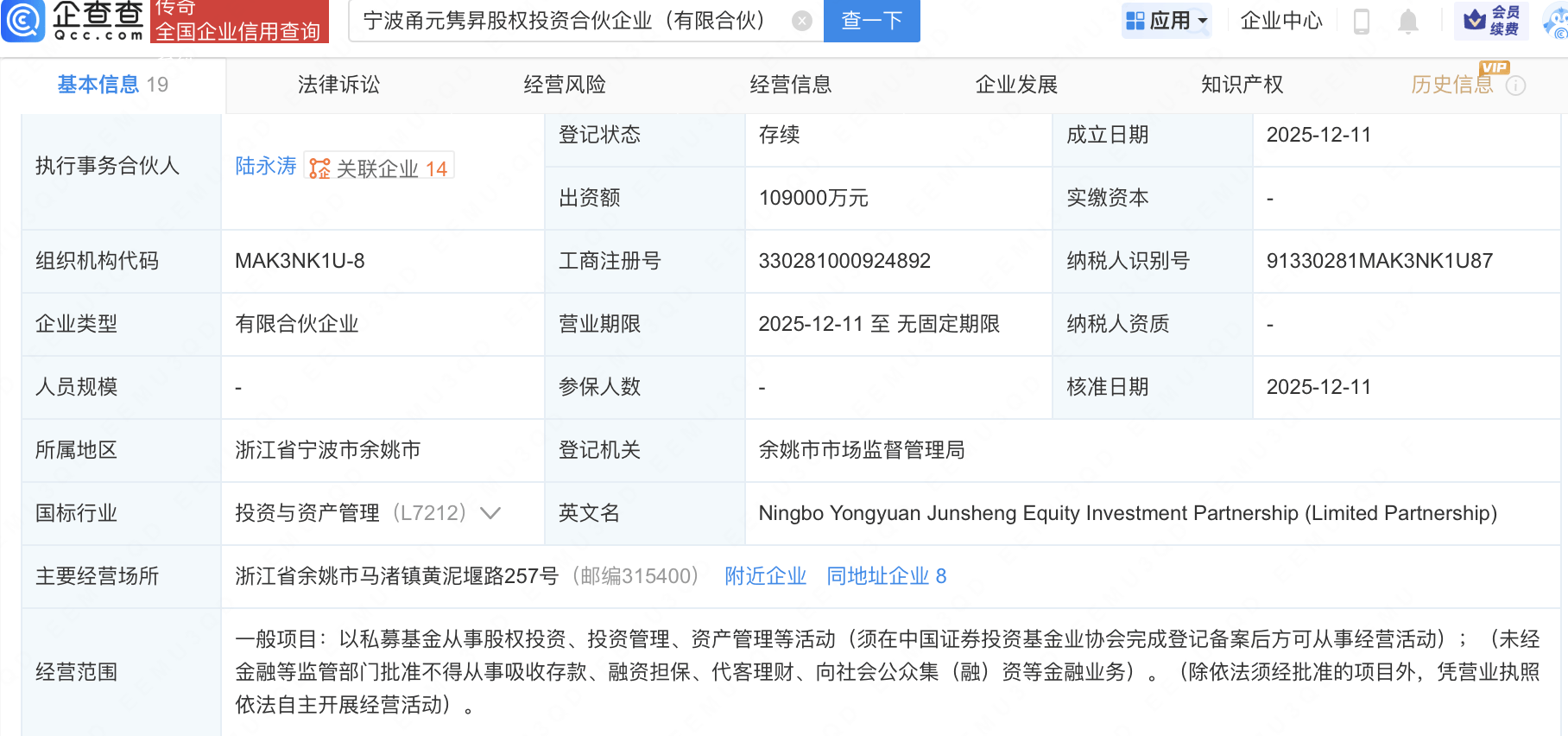
Group 1 - Ningbo Yongyuan Junsheng Equity Investment Partnership (Limited Partnership) has been established with a capital contribution of 1.09 billion yuan, focusing on private equity investment, investment management, and asset management activities [1][2] - The partnership is jointly held by subsidiaries of SAIC Motor Corporation Limited and Guotai Junan Securities Co., Ltd., indicating strong backing from major state-owned enterprises [1][3] - The registered office of the partnership is located in Yuyao City, Zhejiang Province, and it is classified under the investment and asset management industry [2][3] Group 2 - The equity structure of the partnership includes several key partners, with Yuyao Shunxin Investment Co., Ltd. holding 27.52%, Shanghai Automotive Group Financial Holdings Co., Ltd. holding 24.77%, and Ningbo Yongyuan Investment Fund Co., Ltd. holding 18.35% [3] - Other partners include Zhejiang Yongyuan Caitong Fuzhe High-end Equipment Industry Equity Investment Partnership and Guotai Junan Zhenyu Investment Co., Ltd., which hold 18.35% and 9.17% respectively [3]


“技术+新能源+出海”,铸就优秀车企成长“利刃”|说商道市
Chang Sha Wan Bao· 2025-12-15 07:08
Group 1 - The core viewpoint of the article highlights that three Chinese automakers, Geely, BYD, and SAIC, have achieved over 90% of their annual sales targets by the end of November 2025, with Geely leading at 93% completion rate [1][2] - Geely's success is attributed to the popularity of its models, including the Geely Xingyuan and the Galaxy series, which have contributed to its strong sales performance [1] - BYD's completion rate of 91% is supported by the widespread adoption of its intelligent technology and the growth of its mid-to-high-end brands, particularly the success of the Tang brand [2] Group 2 - SAIC's sales performance benefits from its strong foundation in traditional fuel vehicles and the emergence of its own brands like "Zhiji" and the collaboration with Huawei on the "Shangjie" brand [2] - The overseas market has become a crucial factor for Chinese automakers in achieving their annual targets, with BYD's overseas sales in November reaching 131,661 units, a 297% increase year-on-year [3] - Continuous technological innovation, adherence to the new energy vehicle strategy, and expansion into overseas markets are identified as key factors for the success of these leading Chinese automakers [3]


上汽集团、国泰海通等新设股权投资合伙企业
Zheng Quan Shi Bao Wang· 2025-12-15 06:12
Group 1 - The core point of the article is the establishment of Ningbo Yongyuan Junsheng Equity Investment Partnership (Limited Partnership) with a capital contribution of 1.09 billion yuan, focusing on private equity investment, investment management, and asset management activities [1] - The company is jointly held by Shanghai Automotive Group Financial Holdings Co., Ltd., a wholly-owned subsidiary of SAIC Motor Corporation, and Guotai Junan Securities Co., Ltd., a wholly-owned subsidiary of Guotai Junan [1]
长安/江铃/大通份额超20%争冠,“二龙”排名上升,11月轻客销4万辆增14%!
第一商用车网· 2025-12-15 02:38
Core Viewpoint - The light commercial vehicle (LCV) market in China has shown a significant growth trend, achieving an 8-month consecutive increase in sales, with November 2025 sales reaching 40,500 units, a year-on-year growth of 14% [2][6][20]. Group 1: Market Performance - In November 2025, the overall bus market sold 53,200 units, with a month-on-month increase of 7% and a year-on-year increase of 16% [1]. - The light bus market accounted for 76.14% of total bus sales in November, a slight decrease from the previous month [1]. - Cumulatively, from January to November 2025, the light bus market sold 403,700 units, marking an 11% year-on-year increase, which is the highest in five years [4][15]. Group 2: Sales Trends - The light bus market has experienced a fluctuating trend over the past five years in November, with 2025's sales being the highest in this period, surpassing the lowest sales in November 2022 by 14,200 units [4]. - The cumulative sales from January to November 2025 exceeded 400,000 units, with an increase of over 41,400 units compared to the same period last year [4][15]. Group 3: Company Performance - In November 2025, the top ten companies in the light bus market had a combined market share of 97.90%, with Changan, Jiangling, and Maxus leading the market, each exceeding 20% market share [13]. - Changan and Maxus saw significant year-on-year sales increases of 44% and 79%, respectively, while Jiangling grew by 10% [10][16]. - Among the top ten companies, five experienced sales growth while five saw declines, with the most significant drop being 48% for one company [10]. Group 4: Market Share Dynamics - From January to November 2025, Changan, Jiangling, and Maxus captured 28.92%, 22.15%, and 21.13% of the light bus market share, respectively [17]. - Compared to the previous year, Changan, Jiangling, and Maxus increased their market shares by 4.76, 0.81, and 3.35 percentage points, respectively [18].



研判2025!中国雾灯行业产业链、市场规模、竞争格局及发展趋势分析:行业市场规模持续上涨,未来有望向智能化升级[图]
Chan Ye Xin Xi Wang· 2025-12-15 01:35
Core Viewpoint - The fog light industry in China is experiencing significant growth, with the market size projected to increase from 1.88 billion yuan in 2015 to 5.11 billion yuan in 2024, reflecting a compound annual growth rate (CAGR) of 11.7% [1][7]. Industry Overview - Fog lights are essential automotive lighting devices used in adverse weather conditions to ensure driving safety. They are categorized into front and rear fog lights, with specific color and design features [3][4]. - The industry chain includes upstream components such as metals, plastics, LED chips, and optical lenses; midstream involves manufacturing fog lights; and downstream applications cover passenger cars, commercial vehicles, and new energy vehicles [6]. Market Dynamics - The growth of the fog light market is supported by government policies mandating the installation of compliant fog lights in vehicles, which has increased the installation rate [1][7]. - Rising living standards and the increasing number of vehicles, particularly the surge in new energy vehicles, are driving new demand for fog lights [1][7]. Competitive Landscape - Domestic companies like Xingyu Co., Ltd. and Huayu Vision are expanding rapidly in the mid-range market while gradually entering the high-end sector. Numerous small and medium-sized manufacturers focus on niche markets due to limitations in technology and funding [8]. Industry Trends 1. **Technological Innovation and Smart Development**: The adoption of LED technology is expected to enhance performance, with improvements in brightness, color temperature, and precision in light distribution. Laser fog lights may emerge as a new breakthrough due to their superior penetration and brightness [12]. 2. **Global Expansion**: Chinese fog light manufacturers are poised to accelerate their overseas presence, leveraging a complete supply chain and competitive pricing to capture global market share [12]. 3. **Increasing Industry Concentration**: The industry is expected to consolidate, with weaker companies facing potential elimination, while stronger firms may expand through mergers and acquisitions, enhancing overall competitiveness [13].


A股重要调整 明起实施
2 1 Shi Ji Jing Ji Bao Dao· 2025-12-14 14:41
Core Viewpoint - The periodic sample adjustment of various indices, including the Shanghai Stock Exchange 50 and ChiNext indices, is set to take effect, reflecting a shift towards including more emerging industry leaders and enhancing the technology attributes of these indices [1][9]. Index Adjustments - The Shanghai Stock Exchange 50 Index will replace 4 samples, while the Shanghai 180 Index will replace 7 samples, and the Shanghai 380 Index will replace 38 samples [1]. - The ChiNext Index will see 8 samples replaced, with notable additions including companies like Aosheng Technology and Shenghong Technology [1][3]. - The CSI 500 Index will replace 50 samples, and the CSI 1000 Index will replace 100 samples, indicating a significant overhaul [1]. Emerging Industry Focus - The adjustments will increase the representation of strategic emerging industries, with the ChiNext Index's strategic emerging industry weight reaching 93% [9]. - The new sample companies have shown a 13% year-on-year increase in R&D expenses, with 30 companies having an R&D intensity exceeding 10% [9]. - The weight of strategic emerging industries in the ChiNext 50 Index is now at 98%, with new generation information technology industries, such as artificial intelligence and chips, accounting for 45% [9]. ETF Rebalancing - Following the index adjustments, ETFs tracking these indices will also undergo rebalancing to align with the new sample compositions [8].


欧洲电动车贸易战卡壳,政要密集访华求转机,中方底线绝不动摇
Sou Hu Cai Jing· 2025-12-14 13:40
哈喽大家好,今天小无带大家聊聊中欧谈判这出越演越上头的热闹大戏。 前阵子马克龙刚结束访华,德国外长瓦德富尔就马不停蹄赶过来,后面德国总理默茨、英国首相斯塔默 还排着队,这访华节奏跟赶庙会似的,热闹得很。 很多人以为是中欧关系回暖了,说白了,这就是欧洲产业急得跳脚了,不得不来谈。12月11日商务部发 言人何亚东一官宣,大家才确认,中欧围绕电动车加税的谈判这周已经重启。 反转开局 我寻思着,中方这波操作太有必要了。毕竟之前谈判时,欧盟就玩过小动作,绕开中国机电商会直接对 接中企,摆明了想搞事情。 现在提前把规矩立好,就是怕他们再耍小聪明,耽误谈判进度,毕竟谈的是产业分歧,不是让他们来分 化咱们的。 欧盟这边最有意思的地方,就是总把自己当"铁板一块",结果内部早就吵成了一锅粥。 之前他们搞的加税方案就藏着小心思,不同中企税率差得离谱,比亚迪只要交17%,上汽却要交 35.3%,足足两倍还多。合着这是想拉一派打一派,用税率当筹码逼中方让步啊? 内部漏洞 更拧巴的是,欧盟里的国家想法根本不一样。法国为了抢话语权,一个劲喊着对华强硬,支持加电动车 税;但波兰、匈牙利这些中东欧国家,巴不得多接些中国的产业转移,带动自己经济 ...

中国燃油车,在海外杀疯了!
商业洞察· 2025-12-14 09:22
Core Viewpoint - The article discusses the significant transformation of Chinese fuel vehicles from being ridiculed to becoming competitive in international markets, highlighting their successful export growth and market penetration in regions where electric vehicles face challenges [5][31]. Group 1: Export Growth of Chinese Fuel Vehicles - Since 2020, for every four cars exported from China, three have been fuel vehicles [8]. - In 2021, China exported 2.015 million cars, with 1.705 million being fuel vehicles, accounting for 84.6% of total exports [9]. - In 2022, the total car export volume reached 3.111 million, with fuel vehicles increasing to 2.342 million, representing 78.2% [10]. - In 2023, the export volume of traditional fuel vehicles was 3.707 million, making up 75.4% of total exports [11]. - Projections for 2024 indicate that fuel vehicle exports will reach 4.574 million, maintaining a share of 78.1% [12]. Group 2: Market Performance and Competitive Advantage - Chinese fuel vehicles have gained significant market share in regions like Eastern Europe, Latin America, and Africa, with Chinese manufacturers capturing nearly 16% of the South African market in the first half of the year, up from 10% the previous year [14]. - In Chile, Chinese fuel vehicles account for nearly one-third of the market, while traditional brands like Chevrolet and Nissan have seen sales declines of 34% to 45% [15]. - The competitive edge of Chinese fuel vehicles lies in their cost-effectiveness and superior configurations compared to traditional brands, allowing consumers to purchase higher-spec models for similar prices [21][22]. Group 3: Strategic Adaptations and Local Production - Chinese automakers are establishing production bases in key markets such as Thailand, Brazil, and Russia to reduce costs and enhance local supply chains [26]. - This strategy not only helps in avoiding tariffs and logistics costs but also allows for better market integration and responsiveness to local demands [26]. - Some joint venture brands are leveraging Chinese manufacturing advantages to create globally competitive vehicles, with exports constituting nearly 70% of their total sales [29]. Group 4: Future Outlook - The narrative of Chinese fuel vehicles represents a quiet yet robust response to the global shift towards electric vehicles, focusing on markets where practical needs outweigh technological aspirations [31]. - Despite challenges in brand recognition and scale compared to established players like Toyota and Volkswagen, Chinese manufacturers are poised to leverage their complete industrial chain and strategic initiatives to enhance global competitiveness [32].