KWEICHOW MOUTAI(600519)

Search documents
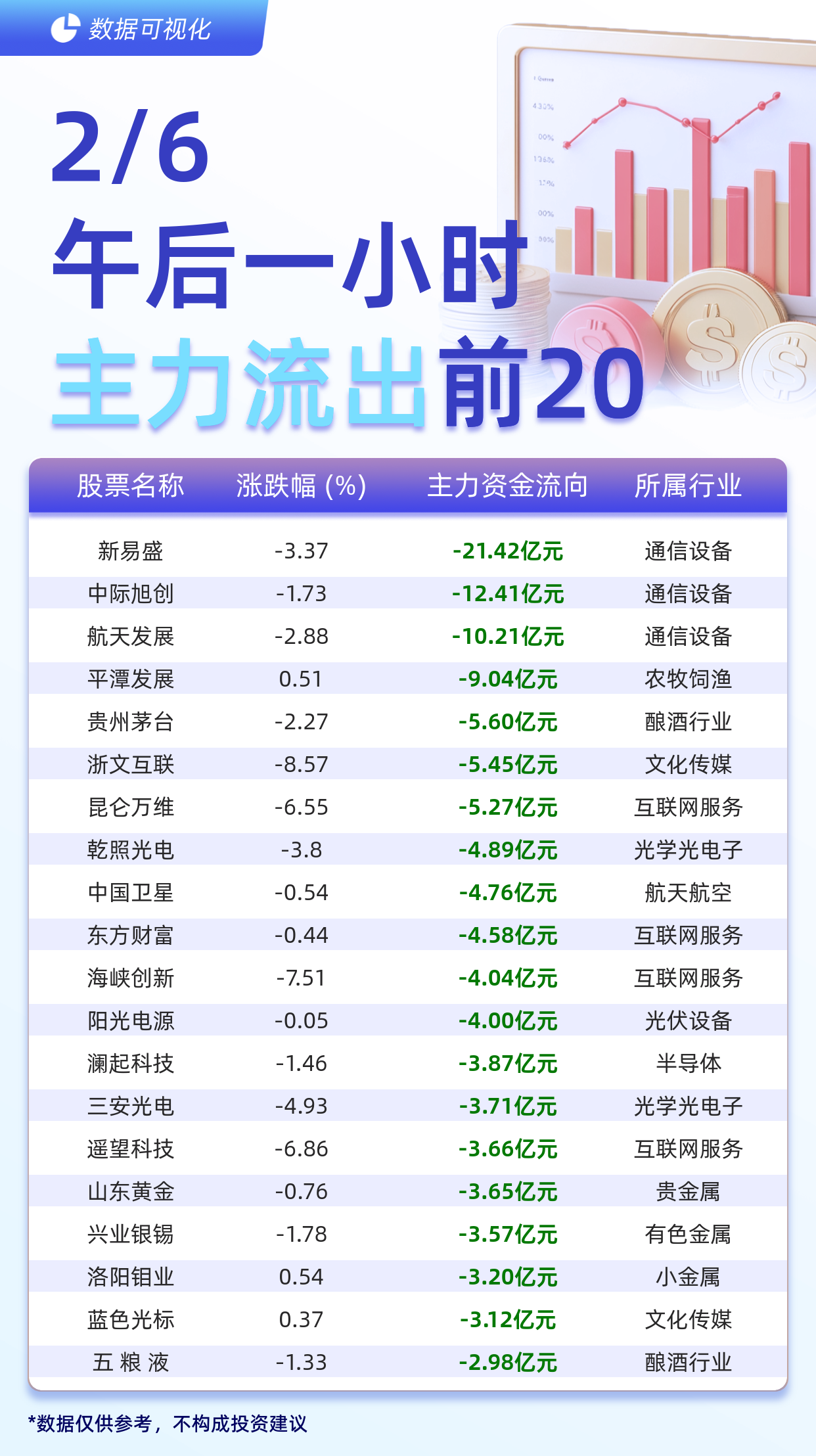
主力个股资金流出前20:新易盛流出21.42亿元、中际旭创流出12.41亿元
Jin Rong Jie· 2026-02-06 06:27
Main Points - The main focus of the news is on the significant outflow of capital from various stocks, highlighting the top 20 stocks with the largest capital outflows as of February 6, with New Yisheng leading at -21.42 billion yuan [1][2][3] Group 1: Stock Performance - New Yisheng experienced a capital outflow of -21.42 billion yuan, indicating a strong sell-off in the communication equipment sector [1][2] - Zhongji Xuchuang saw a capital outflow of -12.41 billion yuan, also within the communication equipment industry [1][2] - Aerospace Development had a capital outflow of -10.21 billion yuan, reflecting investor sentiment in the communication equipment sector [1][2] - Pingtan Development reported a capital outflow of -9.04 billion yuan, indicating challenges in the agriculture and animal husbandry sector [1][2] - Kweichow Moutai faced a capital outflow of -5.60 billion yuan, suggesting potential concerns in the liquor industry [1][2] Group 2: Sector Analysis - The communication equipment sector is notably affected, with three companies (New Yisheng, Zhongji Xuchuang, and Aerospace Development) among the top outflows [1][2] - The liquor industry, represented by Kweichow Moutai, shows a significant outflow, which may indicate market volatility or changing consumer preferences [1][2] - The internet services sector is also impacted, with companies like Kunlun Wanwei and Dongfang Caifu experiencing outflows of -5.27 billion yuan and -4.58 billion yuan respectively [1][2][3] Group 3: Additional Stocks - Other notable stocks with significant outflows include Sunshine Power (-4.00 billion yuan) in the photovoltaic equipment sector and Sanan Optoelectronics (-3.71 billion yuan) in the optical and optoelectronic sector [1][3] - The precious metals sector, represented by Shandong Gold, saw an outflow of -3.65 billion yuan, indicating potential investor caution [1][3] - The cultural media sector, with companies like Zhejiang Wenlian and Blue Focus, also faced outflows of -5.45 billion yuan and -3.12 billion yuan respectively, reflecting market dynamics in this industry [1][3]






促消费政策加码落地,消费ETF嘉实(512600)布局A股消费复苏行情
Xin Lang Cai Jing· 2026-02-06 02:57
Group 1 - The A-share market opened lower on February 6, 2026, with the major consumption index down by 1.06% as of 10:08 AM, indicating mixed performance among constituent stocks [1] - The food and beverage industry is showing a recovery trend, particularly in the liquor sector, driven by macro policy optimization, low valuation levels, and improvements in leading companies' fundamentals [1] - Optimized real estate policies and intensive domestic demand support measures have boosted market expectations for a recovery in consumer scenarios [1] Group 2 - The top ten weighted stocks in the major consumption index as of January 30, 2026, include Kweichow Moutai, Wuliangye, Yili, Muyuan Foods, Luzhou Laojiao, Shanxi Fenjiu, Wens Foodstuff, Haitian Flavoring, Dongpeng Beverage, and Haida Group, collectively accounting for 67.37% of the index [1] - The consumption ETF managed by Harvest (512600) tracks the major consumption index, which encompasses leading consumer stocks across various sectors, with liquor being the largest sector, accounting for over 38% of the index [2] - Investors can also access the consumption recovery trend through the consumption ETF linked fund (009180) [3]





i茅台连崩两日?此前茅台刚回应
Xin Lang Cai Jing· 2026-02-06 01:56
2月6日,继昨日i茅台小程序"卡崩"后,早上仍有网友发现程序卡顿,无法抢购。 责任编辑:宋雅芳 此前,茅台证券投资部门对新浪财经《酒业内参》表示:"感谢您来电/留言反馈,公司已经关注到消费 者反映的问题。节日临近,i茅台APP访问量大幅增加,我们正进一步优化系统功能,同步增加客服坐 席,以便更好地响应大家的需求,感谢您的理解和支持。"新浪声明:新浪网登载此文出于传递更多信 息之目的,并不意味着赞同其观点或证实其描述。文章内容仅供参考,不构成投资建议。投资者据此操 作,风险自担。 ...
i茅台又崩了
Di Yi Cai Jing· 2026-02-06 01:56
在2月5日出现抢购页面无法访问后,2月6日9:00开始,部分网友反馈茅台抢购页面再次崩溃。 (文章来源:第一财经) ...
中银晨会聚焦-20260206-20260206
Bank of China Securities· 2026-02-06 01:32
Core Insights - The report highlights the contradiction faced during the "14th Five-Year Plan" period, where carbon reduction pressures are increasing while the growth rate of new energy installations is slowing down. The introduction of a national capacity price policy is expected to open up space for new energy installations and support high-yield investment options for power companies during the "14th Five-Year Plan" investment intensity [5][6][9]. Group 1: Energy Storage Industry - The national capacity price policy, issued on January 30, 2026, aims to establish a mechanism that balances power supply stability, green energy transformation, and efficient resource allocation. This policy is expected to support the development of adjustable power sources and enhance the installation of new energy [7][9]. - The report estimates that the demand for energy storage will show a high growth trend, with new energy storage installations expected to reach 66.43 GW and 189.48 GWh in 2025, representing year-on-year increases of 52% and 73% respectively [8][9]. - The capacity price policy is seen as the final piece needed for energy storage development, potentially increasing project returns from approximately 6.5% to over 8% under current subsidy conditions. This is expected to stimulate investment interest from state-owned enterprises in new energy storage projects [8][9]. Group 2: Investment Recommendations - The report suggests prioritizing investments in leading companies involved in energy storage integration and upstream battery cells, recommending firms such as Sungrow Power Supply, Trina Solar, LONGi Green Energy, JinkoSolar, CATL, and Eve Energy. It also advises monitoring companies like Haisum, Sungrow Electric, Canadian Solar, and Penghui Energy [9].





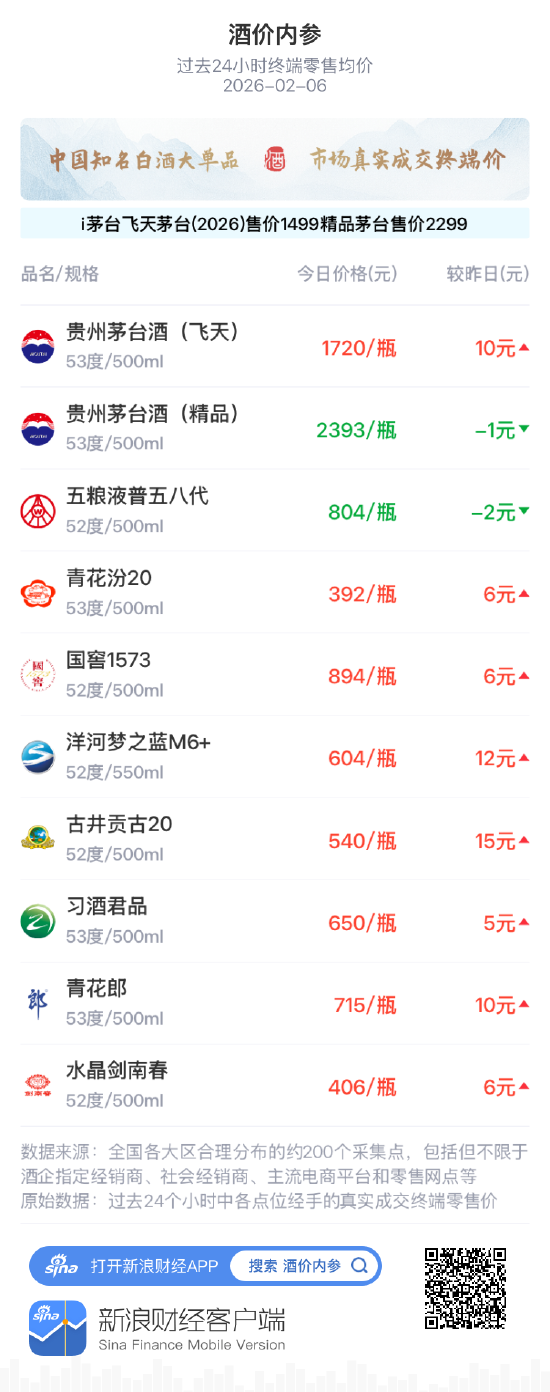
酒价内参2月6日价格发布 精品茅台微跌1元
Xin Lang Cai Jing· 2026-02-06 01:30
Core Insights - The core insight of the news is that the retail prices of major Chinese liquor brands have significantly increased, with the average price of the top ten products reaching a new high since 2026, indicating a strong market recovery and demand surge ahead of the Spring Festival [1][6]. Price Trends - The total retail price for a package of the top ten liquor products is 9118 yuan, which is an increase of 67 yuan from the previous day [1][6]. - Among the top ten products, eight saw price increases while two experienced declines, reflecting a general upward trend in the market [1][6]. - The most notable price increases include: - Gujinggong 20, up 15 yuan per bottle, reaching a 30-day high [1][6]. - Yanghe Dream Blue M6+ increased by 12 yuan per bottle [1][6]. - Both Feitian Moutai and Qinghua Lang rose by 10 yuan per bottle [1][6]. - Other products like Qinghua Fen 20, Guojiao 1573, and Shuijing Jian Nan Chun increased by 6 yuan per bottle [1][6]. - The only products that saw price declines were Wuliangye Pu 58 and boutique Moutai, which fell by 2 yuan and 1 yuan respectively [1][6]. Market Analysis - The data for the "Liquor Price Reference" is collected from approximately 200 points across various regions, ensuring a comprehensive and accurate representation of the market [2][7]. - The recent price trends are attributed to several factors: - The upcoming Spring Festival, which traditionally boosts consumer demand [8]. - Improved macroeconomic policies that enhance domestic demand [8]. - A shift in investment strategies, with institutional holdings at historically low levels [8]. - The current state of the liquor industry is characterized by a "five-bottom phase" in terms of policy, inventory, sales, and pricing, suggesting a potential turning point for the market [8].



开源证券:白酒板块迎来较强上涨 大众品投资机会聚焦零售、原奶/乳制品及餐饮供应链
智通财经网· 2026-02-06 01:29
Core Viewpoint - The liquor sector is experiencing a strong rally driven by a combination of macro policies, valuation adjustments, and fundamental improvements, indicating a recovery from the cyclical bottom [1][2]. Group 1: Liquor Sector Analysis - The recent surge in the liquor sector is attributed to the convergence of multiple factors, including ongoing optimization of real estate policies and supportive domestic demand policies, which have boosted market expectations for consumption recovery [1]. - The valuation of the liquor sector has dropped to historical lows after significant adjustments, with the proportion of active equity public funds holding liquor stocks decreasing to 2.9% by Q4 2025, indicating a clearer and more reasonable chip structure [1]. - The performance of leading companies like Kweichow Moutai, with better-than-expected pricing and sales, has validated the resilience of terminal demand in the liquor market [1]. Group 2: Recovery Logic and Sustainability - The current recovery in the liquor sector is deemed sustainable, as the industry is positioned at a cyclical bottom, with a clear upward repair logic in fundamentals [2]. - The demand for liquor is gradually recovering, with high-end liquor prices returning to reasonable levels, stimulating genuine consumer demand, especially with the upcoming Spring Festival driving concentrated demand for family gatherings and gift-giving [2]. - The marginal reduction of negative impacts from previous alcohol bans has stabilized market expectations, contributing to a more stable core consumption demand for liquor [2]. Group 3: Broader Food and Beverage Sector Insights - The bottom recovery logic observed in the liquor sector is applicable to other food and beverage sub-sectors, such as beer and condiments, which are also at dual bottoms in terms of valuation and fundamentals [3]. - If the demand in the catering industry rebounds and consumption policies are strengthened, multiple sub-sectors are expected to replicate the recovery trend seen in the liquor sector [3]. Group 4: Investment Opportunities for 2026 - For 2026, investment opportunities in the consumer goods sector are focused on three key areas: snacks, raw milk/dairy products, and the catering supply chain [4]. - The snack sector is expected to maintain high growth, with leading companies benefiting from strategies like big product focus and multi-channel layouts, leading to improved net profit margins [4]. - The raw milk sector is seeing an optimization in supply-demand dynamics, with milk prices expected to stabilize and benefit both upstream farms and downstream dairy companies [4]. - The catering supply chain is poised to benefit from the recovery in dining consumption, particularly with the Spring Festival enhancing industry performance [4].
酒价内参2月6日价格发布 洋河梦之蓝M6+上涨12元
Xin Lang Cai Jing· 2026-02-06 01:24
Core Insights - The core point of the news is the significant increase in the retail prices of major Chinese liquor brands, with the average price of the top ten products reaching a new high since 2026, indicating a recovery in the market driven by seasonal demand and improved macroeconomic conditions [1][6]. Price Trends - The average retail price of the top ten liquor products rose to 9118 yuan, an increase of 67 yuan from the previous day [1][6]. - Eight out of the ten products saw price increases, with notable rises including: - Gujinggong 20, up 15 yuan per bottle, reaching a 30-day high [1][6]. - Yanghe Dream Blue M6+ increased by 12 yuan per bottle [1][6]. - Both Feitian Moutai and Qinghua Lang rose by 10 yuan per bottle [1][6]. - The only two products that experienced price declines were: - Wuliangye Pu 58th generation, down 2 yuan per bottle [1][6]. - Premium Moutai adjusted down by 1 yuan per bottle, maintaining a high price level [1][6]. Market Analysis - The data for the "Liquor Price Reference" is collected from approximately 200 sampling points across various regions, ensuring a comprehensive and objective representation of the market [2][7]. - The recent performance of the liquor sector has been buoyed by three main factors: 1. The upcoming Spring Festival, which traditionally boosts consumption [8]. 2. Improved macroeconomic policies that enhance domestic demand [8]. 3. A shift in capital market dynamics, with institutional holdings at historically low levels [8]. - The current state of the liquor industry is characterized by a "five-bottom phase" in terms of policy, inventory, sales, wholesale prices, and production-sales dynamics, suggesting a potential turning point in the market [8].
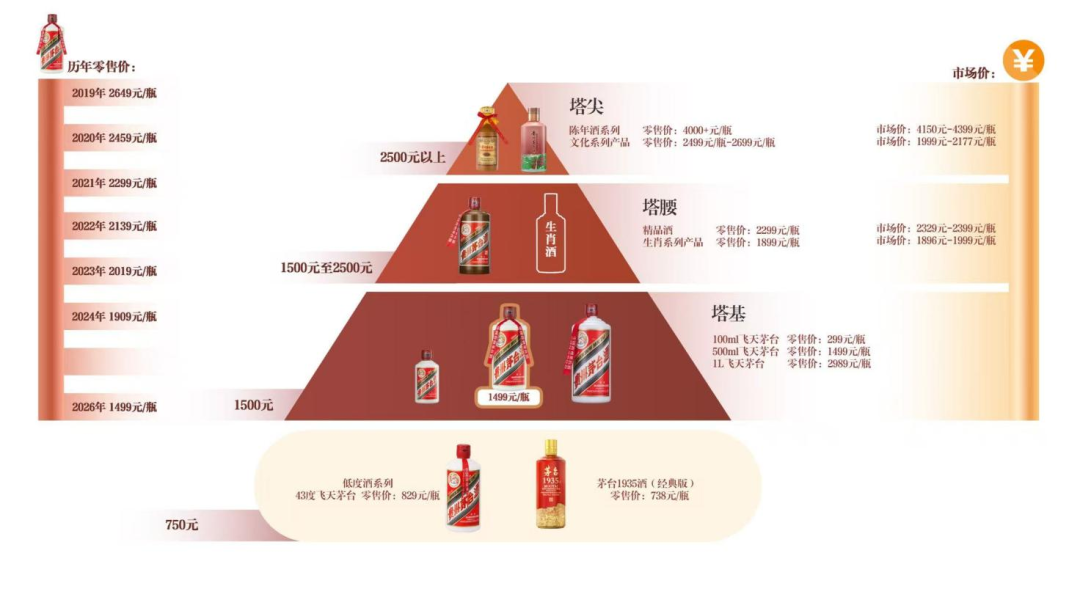
茅台市场化改革满月调研:扩大真实消费触达全渠道热销 战略转向提振抗周期韧性
2 1 Shi Ji Jing Ji Bao Dao· 2026-02-06 00:49
Core Insights - Moutai has initiated a consumer-centric market reform aimed at enhancing accessibility and authenticity in purchasing its products, resulting in significant consumer engagement and sales growth [1][3][39] Group 1: Sales Performance - Moutai's self-operated store in Chongqing reported a 41% year-on-year increase in foot traffic since early January, with peak daily visits reaching around 300 [1][7] - The online platform iMoutai saw over 15.31 million active users in January, with 6.28 million new registrations and over 2.12 million orders, including 1.43 million for the flagship 500ml Moutai [3][5] - Moutai's stock price rose to 1555 yuan per share, reflecting a more than 16% increase in recent days, with market capitalization nearing 2 trillion yuan [3][40] Group 2: Market Reform Impact - The market reform has led to a significant increase in demand for various Moutai products, with many stores reporting supply shortages [3][17] - The reform is seen as a strategic shift towards a direct-to-consumer model, enhancing Moutai's ability to tap into previously unmet consumer demand [39][41] - Moutai's pricing strategy has adjusted to reflect market conditions, with some products seeing price increases while maintaining consumer demand [25][40] Group 3: Consumer Engagement - The reform has attracted a new customer base, with approximately 40% of recent store visitors being first-time buyers [8][9] - Moutai has implemented enhanced customer service measures, including proactive communication and product education in stores [11][12] - The company is also catering to international tourists, offering products that resonate with cultural interests [10] Group 4: Channel Strategy - Moutai is transitioning to a multi-channel marketing system that includes self-sale, distribution, consignment, and agency sales, enhancing market penetration [29][31] - The self-operated channel serves as a price stabilizer, ensuring consistent pricing across various sales channels [29] - The reform has encouraged distributors to actively engage with new consumer segments, shifting from passive to proactive sales strategies [31] Group 5: Operational Efficiency - Moutai has improved its supply chain responsiveness, with significant enhancements in delivery efficiency, achieving a 75% on-time delivery rate within five days for online orders [37] - The company is expanding its logistics capabilities by adding new distribution centers to manage increased order volumes [36] - Moutai is addressing service challenges by expanding its customer service team and implementing AI solutions to improve response times [38]