
HAIER SMART HOME(600690)

Search documents
激活内需焕新动力,红顶奖携手业界共绘家电行业新蓝图
Jing Ji Wang· 2025-12-25 09:57
Core Insights - The 17th China High-end Home Appliance Trend Release and Red Top Award Ceremony was held in Beijing, focusing on the theme "Brilliant and Extraordinary" [1] - The event highlighted the resilience of China's home appliance and manufacturing industries in global competition, supported by external demand and market vitality [2] - A report on the 2025 China high-end home appliance market indicates a significant shift towards premiumization and emotional value among consumers, with notable growth in online retail sales of high-end appliances [2] Group 1 - The Red Top Award aims to promote quality living and guide consumer trends in the high-end home appliance sector [1] - Numerous well-known home appliance brands participated in the event, showcasing the industry's collective strength [1] - The event featured a special appearance by a robot, engaging in discussions on AI topics with representatives from various brands [3] Group 2 - The report released during the event shows that from January to September, online retail sales of coffee machines, robotic vacuums, pet air purifiers, and large TVs experienced double-digit growth [2] - The event included an AI art and high-end home appliance exhibition, merging technology and art to highlight the industry's innovative spirit [3] - The Red Top Award's founder emphasized the importance of social responsibility and the commitment to enhancing the high-end appliance industry's contributions to society [3]



白色家电板块12月25日跌0.02%,澳柯玛领跌,主力资金净流出2.89亿元
Zheng Xing Xing Ye Ri Bao· 2025-12-25 09:08
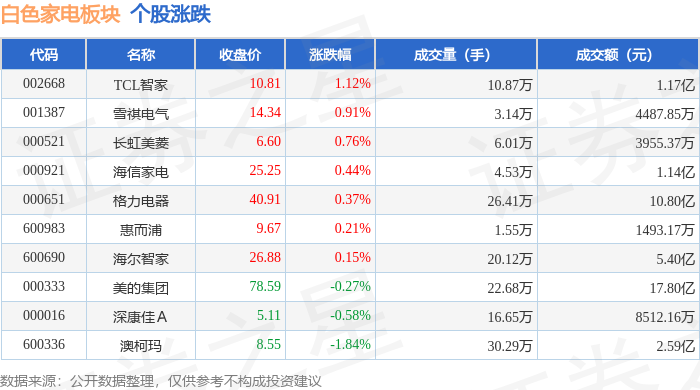
Core Viewpoint - The white goods sector experienced a slight decline of 0.02% on December 25, with Aucma leading the drop, while the Shanghai Composite Index rose by 0.47% and the Shenzhen Component Index increased by 0.33% [1] Group 1: Market Performance - The closing price for TCL Smart Home was 10.81, with an increase of 1.12% and a trading volume of 108,700 shares, amounting to 117 million yuan [1] - Snowball Electric closed at 14.34, up by 0.91%, with a trading volume of 31,400 shares [1] - Changhong Meiling's closing price was 6.60, reflecting a 0.76% increase with a trading volume of 60,100 shares [1] - Hisense Home Appliances closed at 25.25, up by 0.44%, with a trading volume of 45,300 shares [1] - Gree Electric Appliances closed at 40.91, increasing by 0.37% with a trading volume of 264,100 shares [1] - Whirlpool closed at 9.67, up by 0.21%, with a trading volume of 15,500 shares [1] - Haier Smart Home closed at 26.88, reflecting a 0.15% increase with a trading volume of 201,200 shares [1] - Midea Group closed at 78.59, down by 0.27%, with a trading volume of 226,800 shares [1] - Deep Konka A closed at 5.11, down by 0.58%, with a trading volume of 166,500 shares [1] - Aucma closed at 8.55, leading the decline with a drop of 1.84% and a trading volume of 302,900 shares [1] Group 2: Capital Flow - The white goods sector saw a net outflow of 289 million yuan from main funds, while retail investors contributed a net inflow of 228 million yuan [1] - TCL Smart Home experienced a net inflow of 1.38 million yuan from main funds, while retail investors had a net inflow of 589,560 yuan [2] - Changhong Meiling had a net inflow of 4.08 million yuan from main funds, but saw outflows from both retail and speculative funds [2] - Aucma faced a significant net outflow of 33.82 million yuan from main funds, while retail investors contributed a net inflow of 13.64 million yuan [2] - Gree Electric Appliances had a net outflow of 68.64 million yuan from main funds, with retail investors contributing a net inflow of 41.71 million yuan [2]


海尔印度出售49%股权,这波操作真是明智之举
点拾投资· 2025-12-25 08:24
Core Viewpoint - Haier Smart Home's decision to sell 49% of its stake in its Indian subsidiary to Warburg Pincus and Bharti Group is a strategic move to mitigate risks and enhance operational efficiency in the current international environment [1][4]. Group 1: Foreign Investment Environment in India - India's foreign direct investment (FDI) has faced challenges, with net FDI dropping to -$616 million by August 2025, indicating a capital outflow [3]. - The Indian government has implemented stricter approval processes for investments from neighboring countries since 2020, increasing uncertainty for foreign companies, particularly Chinese firms [3]. - High-profile cases, such as Xiaomi being fined ₹4.8 billion and investigations into OPPO and Vivo, highlight the risks foreign companies face in India [3]. Group 2: Strategic Benefits of Haier's Move - The sale allows Haier to recover historical investments, as its Indian operations have seen a compound annual growth rate (CAGR) of 25% over the past seven years, positioning it as a leader in the industry [5]. - The involvement of Warburg Pincus and Bharti Group, both reputable financial investors, is expected to enhance Haier's operational prospects in India, providing local market insights and resources [5][6]. - The Indian home appliance market is projected to grow from $77.74 billion in 2024 to $135.33 billion by 2034, with a CAGR of 5.70%, making it one of the fastest-growing markets globally [5]. Group 3: Risk Mitigation - By introducing local capital, Haier can better navigate geopolitical risks and regulatory challenges in India, effectively distributing risks related to policies, laws, and taxes [6]. - This strategic partnership serves as a form of "insurance" for Haier's assets in a complex international landscape [6]. - The move is characterized as a strategic advancement rather than a retreat, allowing Haier to recover costs, integrate local resources, and mitigate political risks simultaneously [6].

印度外资大逃亡,海尔智家股权出让谋求新发展
Jin Tou Wang· 2025-12-25 08:03
在这样的市场环境中,海尔智家引入本土资本作为战略股东的操作堪称精妙。Bharti集团作为印度本土 综合性巨头,手握深厚的本地资源与对政策理解的精准到位;华平投资则是全球知名私募股权机构,兼 具资本运作经验与全球资源。两大股东的加持,既呼应了TikTok引入甲骨文、银湖资本、阿联酋MGX 等投资者实现美国市场合规的成功路径,更让海尔印度的运营风险实现实质性分流。 三重利好:这波操作的明智之处 具体来看海尔智家腾挪印度股权的"这波操作",将为其带来三重实质性利好。 首先,是可以有效回收历史资金,实现资金回笼,落袋为安。海尔深耕印度市场超20年,累计投资超3 亿美元,过去七年更是实现了25%的年复合增长率,稳居行业前列。此次股权出让,恰逢企业价值高 位,不仅能全额回收前期建厂等投入,更能将多年积累的利润转化为实实在在的现金流,为母公司财务 报表注入强心剂。尽管官方未披露交易金额,但多方消息证实,此次估值已远超历史投资规模,收益相 当可观。 史诗级的外资逃亡在印度发生了!路透社近期报道指出,自2025年初以来,印度股市/股权市场有将近 170亿美元的资金撤离印度,这一速度为几十年从未有过。 而近期海尔智家(60069 ...
海尔印度出售49%股权是当前形势下最好的选择
Jin Tou Wang· 2025-12-25 08:03
12月24日,海尔印度出售49%股权的事引发了市场关注。 有媒体认为这是"一举三得":既有效回收了历史资金;还更好地整合当地资源,有利于未来长期发展;又 有效规避了地缘政治风险,保障资产安全。 也有媒体认为这是"被迫割让":把半壁江山让给了印度财阀和美国资本,自己只攥着象征性的49%。 大家对此褒贬不一。那真实的情况到底是怎么样的呢?今天就让我们来梳理一下。 当前形势下最好的选择 要了解海尔印度出售股权,首先要明白印度的投资环境,以及对中国企业的态度。 从投资环境上看,印度市场年需求超过300亿美元,已成为仅次于美国和中国的全球第三大家电市场。 然而,这片热土同时被称为"外资坟场"。印度法律体系素有"高标准立法、普遍性违法、选择性执法"之 名。其法规体系庞杂、内容模糊,在商业与经济领域存在大量涉及刑事处罚的条款,极大推高企业合规 成本与运营风险。同时,政策层面,印度政府在关税、外资持股比例、环保标准等方面频繁变动,中央 与地方对法规的解释时有差异,令投资者难以形成稳定预期。 从对中企态度看,从vivo、小米被冻结资产,到TikTok被迫退出,印度明摆着不欢迎"外来控盘者"。你 可以来赚钱,但不能当"话事人"。 ...
出售49%股权,海尔印度仍保持最大单一股东地位
Cai Fu Zai Xian· 2025-12-25 07:23
Core Viewpoint - Haier's sale of 49% stake in its Indian subsidiary has sparked mixed reactions, with some viewing it as a strategic move to recover funds and integrate local resources, while others see it as a forced concession to local and foreign capital [1] Group 1: Investment Environment - India's market demand exceeds $30 billion, making it the third-largest home appliance market globally, following the US and China [2] - The Indian investment environment is characterized by a complex legal system that increases compliance costs and operational risks for foreign companies [2] - The Indian government frequently changes regulations regarding tariffs, foreign ownership, and environmental standards, creating instability for investors [2] Group 2: Challenges for Chinese Companies - Chinese companies face significant challenges in India, as evidenced by the asset freezes of Vivo and Xiaomi, and TikTok's exit, indicating a lack of welcome for foreign control [2] - Despite Haier's 20 years in India with over 100 billion rupees (approximately $12 million) in annual revenue and a vast sales network, it remains an outsider without local support [2][3] Group 3: Strategic Implications of Stake Sale - Selling the stake is seen as a necessary step for Haier to navigate the Indian market, as local partnerships are essential for IPOs, project approvals, and capacity expansion [3] - Haier's decision to sell equity is not a sign of defeat but a strategic move to integrate into the local business ecosystem [4] Group 4: Haier's Competitive Position - Haier retains a 49% stake and remains the largest single shareholder, maintaining control over core operations while incentivizing local management [5] - Haier's market share in the refrigerator segment is 14%, and it is expected to see a 36% revenue increase in 2024, showcasing its competitive strength against major brands [5] Group 5: Lessons for Other Companies - Haier's approach serves as a lesson for other Chinese companies struggling in India, highlighting the importance of local connections and navigating the complex business environment [6] - The Indian market presents significant potential but is fraught with challenges that require more than just product offerings to succeed [6]
最新“全球品牌中国线上500强”季度榜单出炉:大疆首次进入前10、泡泡玛特上升显著
Zhong Guo Jing Ji Wang· 2025-12-25 07:19
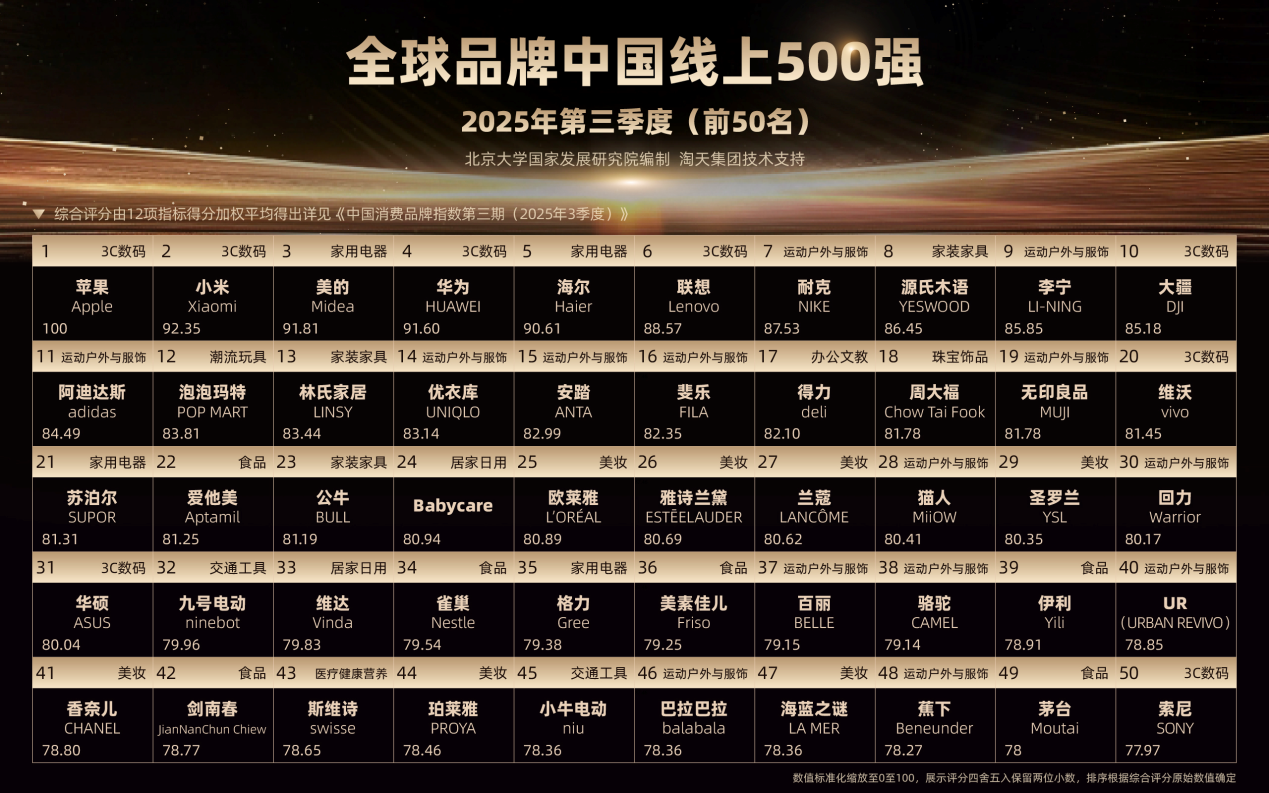
Core Insights - The latest quarterly "China Online Consumption Brand Index" (CBI) indicates a year-on-year increase of 0.92%, reflecting a growing preference for branded products among online consumers [1] - DJI and Pop Mart have made significant strides, with DJI entering the top 10 of the "Global Brand China Online 500" list for the first time, while Pop Mart ranks 12th [1][6] Industry Trends - The CBI index shows notable growth in sectors such as women's apparel, 3C electronics, daily cosmetics, outdoor sports, pet products, men's apparel, and home furnishings, indicating a heightened consumer focus on quality and brand [4] - The women's apparel sector saw a significant increase of over 5 points in its index, suggesting rapid brand and quality upgrades driven by supportive operational strategies from platforms like Taobao [4] - The food and trendy toy sectors experienced a decline in their CBI, attributed to cyclical fluctuations and policy constraints affecting high-end liquor consumption [5] Brand Performance - The top five brands in the "Global Brand China Online 500" for Q3 are Apple, Xiaomi, Midea, Huawei, and Haier, with DJI and Pop Mart showing remarkable growth [6] - Seasonal demand and product innovation are key drivers for brand performance, with DJI leveraging new product features to enhance user experience and Pop Mart capitalizing on its original IPs [8] - The index emphasizes real consumer purchasing behavior, moving beyond traditional metrics like revenue and profit to assess brand competitiveness based on sales, pricing, search, and customer reviews [8] Strategic Insights - The CBI series aims to promote quality and innovation in online consumption, encouraging brands to compete on quality rather than just cost, which is essential for fostering a positive market cycle [9]




最新"全球品牌中国线上500强"季度榜单出炉,大疆首次进入前10、泡泡玛特上升显著
Ge Long Hui· 2025-12-25 06:54
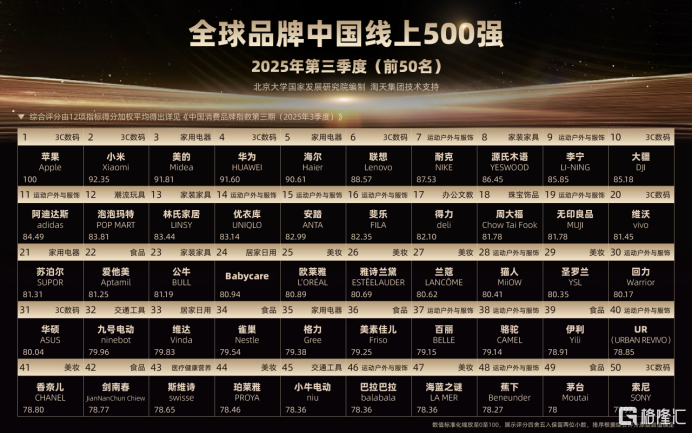
Core Insights - The latest quarterly "China Online Consumption Brand Index" (CBI) and "Global Brand China Online Top 500" (CBI500) indicate a continued rise in consumer preference for brand goods, with the CBI reaching 62.65, a year-on-year increase of 0.92% [1] - DJI and Pop Mart have shown rapid growth, with DJI entering the top 10 of the CBI500 for the first time, and Pop Mart ranking 12th [1] Industry Trends - The CBI series indices reflect a macroeconomic trend of consumption recovery and a shift towards high-quality development, with a notable increase in the core CPI by 0.6% year-on-year in the first three quarters [1][4] - Significant growth in the CBI index was observed in sectors such as women's clothing, 3C smart products, daily beauty products, outdoor sports, pet supplies, men's clothing, and home furnishings, indicating a heightened consumer focus on quality and brand [4][5] - The women's clothing sector saw a notable increase of over 5 points in its index, driven by intensified competition and a focus on quality upgrades [4] Brand Performance - The top five brands in the CBI500 remain consistent with previous quarters: Apple, Xiaomi, Midea, Huawei, and Haier [6] - Brands like DJI and Pop Mart have improved their rankings significantly due to product innovation and seasonal demand, with DJI leveraging unique features in its products and Pop Mart capitalizing on its original IP [6][7] - New entrants in the food category, such as Guangzhou Restaurant and Crab Taotai, benefited from seasonal demand for mooncake gift boxes, while educational brands like Deli and Morning Glory also saw significant improvements [6] Consumer Behavior - The CBI500 rankings are based on real consumer purchasing behavior, utilizing 12 metrics including sales, price, search volume, and positive reviews to assess brand competitiveness [7] - The emphasis on quality and innovation is seen as a key driver for brand strength, moving away from cost-based competition towards a focus on quality, brand differentiation, and value [8]

海尔印度出售49%股权,这波操作真是明智之举
Jin Tou Wang· 2025-12-25 06:24
Core Viewpoint - Haier Smart Home's decision to sell 49% of its stake in its Indian subsidiary to Warburg Pincus and Bharti Group is a strategic move to mitigate risks and enhance operational efficiency in the current international environment [1][2]. Group 1: Investment and Financial Implications - The sale allows Haier to recover historical investments, as its Indian operations have seen a compound annual growth rate of 25% over the past seven years, indicating strong market performance [3]. - The transaction is expected to exceed historical investment amounts, although specific figures have not been disclosed [4]. Group 2: Market and Operational Strategy - The Indian home appliance market is projected to grow from $77.74 billion in 2024 to $135.33 billion by 2034, with a compound annual growth rate of 5.70%, making it one of the fastest-growing markets globally [4]. - Collaborating with local partners like Warburg Pincus and Bharti Group will enable Haier to leverage local networks and resources, enhancing product innovation and market penetration [4]. Group 3: Risk Management - By introducing local capital, Haier can better navigate geopolitical risks and regulatory challenges in India, effectively distributing risks related to policies, laws, and taxes [4]. - This strategic move is seen as a way to safeguard assets in a complex international landscape, particularly in a market where foreign investments face scrutiny [2][4].
碳中和怎么改变生活?海尔智家以全新方案解题
Jin Tou Wang· 2025-12-25 06:24
Core Viewpoint - The concept of carbon neutrality is not just a national strategy or industry issue, but directly impacts individual quality of life and health, as highlighted by Haier Smart Home's recent conference [1] Group 1: Carbon Footprint and Energy Consumption - Household appliances account for over 20% of global electricity consumption, indicating that every use of appliances contributes to carbon emissions [2] - Energy-saving measures have transitioned from merely a cost-saving choice to a personal contribution to environmental protection [2] Group 2: Green Innovation and Product Success - True green innovation should enhance user experience without imposing high costs, as demonstrated by Haier's successful products [3] - Notable products include the "Lazy Three-Tub Washing Machine," which saves over 50% in time and has sold over 300,000 units, and the "Mai Lang Refrigerator," which consumes less than one kilowatt-hour per day and has surpassed one million units in sales within three quarters [3] - The X11 washing machine is 70% more energy-efficient than the highest efficiency standards, while the Combo washing machine, despite being three times the industry average price, has sold over one million units in 15 months due to its 50% energy savings [3] Group 3: Integration of Green Practices in Daily Life - Haier is advancing from product energy savings to scenario-based energy savings, utilizing smart technology to optimize energy consumption in homes and buildings [4] - The "Building Brain" system has saved 4.5 billion kilowatt-hours of electricity and reduced carbon emissions by approximately 4 million tons, equivalent to planting over 200 million trees [4] - Haier's green initiatives extend beyond households to commercial and industrial applications, including efforts in the Asia's largest low-carbon ice surface and setting carbon emission intensity targets in the Australia-New Zealand market [4] Group 4: User-Centric Approach and Global Initiatives - All of Haier's carbon neutrality actions are ultimately aimed at benefiting users by providing green, healthy, and economical appliances while reducing environmental impact from manufacturing [5] - The company has launched a global carbon neutrality initiative, emphasizing the need for collaboration across the supply chain and user participation in achieving carbon neutrality [5] - The choices consumers make, such as selecting energy-efficient appliances, contribute to carbon neutrality, making it a tangible part of daily life [5]