SCSF(600779)

Search documents
水井坊总经理胡庭洲去年薪酬高达623.4万是董事长范祥福5倍多
Xin Lang Cai Jing· 2025-07-21 04:37
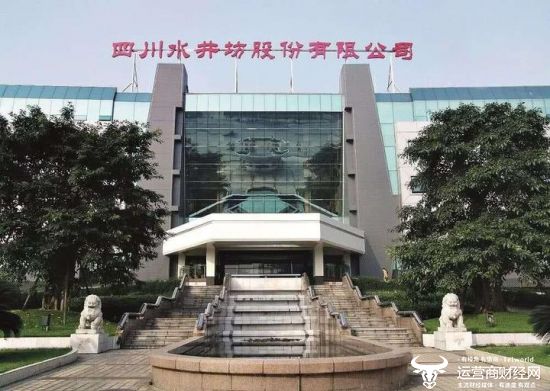
Core Viewpoint - The company, Shui Jing Fang, is forecasting a decline in both revenue and net profit for the first half of 2025 compared to the same period last year, while its new general manager, Hu Tingzhou, has a notably high salary of 6.234 million yuan for 2024 [1][3]. Group 1: Financial Performance - For the period from January 1 to June 30, 2025, the company expects to achieve revenue of 1.498 billion yuan, a decrease of 222 million yuan, representing a year-on-year decline of 12.84% [3]. - The projected net profit for the same period is 105 million yuan, showing a decline compared to the previous year [3]. - In contrast, the company anticipates a sales volume increase of 543 thousand liters, which is a year-on-year increase of 14.54%, all attributed to mid-to-high-end liquor sales [3]. - For the full year of 2024, the company expects to achieve total revenue of approximately 5.217 billion yuan, reflecting a year-on-year growth of 5.32%, and a net profit of about 1.341 billion yuan, with a year-on-year increase of 5.69% [3]. Group 2: Management and Strategy - Hu Tingzhou, who became the general manager in July 2024, is noted to have the highest salary among disclosed executives at 6.234 million yuan [3]. - Other executives' salaries include Chairman Fan Xiangfu at 1.112 million yuan [3]. - Hu Tingzhou has a background in management, having previously served as the general manager of Hershey China and held various management positions in multiple companies [3]. - In March 2025, Hu Tingzhou discussed the company's marketing strategy, which segments the market into "fortress cities," "pioneer cities," and "potential cities," allowing for tailored sales strategies for different markets [3].


食品饮料行业周报:即时零售“反内卷”,短期爆发转向常态化布局-20250721
Huaxin Securities· 2025-07-21 01:11
Investment Rating - The report maintains a "Recommended" investment rating for the food and beverage industry [5][8]. Core Views - The report highlights a shift from short-term explosive growth in instant retail to a more normalized layout, indicating a stabilization in the market dynamics [5][7]. - The white liquor sector is experiencing inventory adjustments, with companies taking measures to stabilize prices amid increasing industry pressures [5][6]. - The new consumption sector is expected to see a reduction in aggressive subsidy wars, but competition will remain a constant factor [7][8]. Summary by Sections Industry News - In June, the manufacturing value added of the liquor and tea industry grew by 3.4% year-on-year [17]. - The production of white liquor from January to June reached 1.916 million kiloliters [17]. - The China Chain Store and Franchise Association issued a statement against "involution" competition in instant retail [17]. Company News - Water井坊 reported a 13% decrease in total revenue for H1 2025, with a net profit drop of 57% [5]. - 酒鬼酒 expects a net profit of 0.08-0.12 billion yuan for H1 2025, down 90%-93% year-on-year [5]. - Guizhou Moutai launched its first live broadcast on Douyin for Moutai sauce-flavored liquor [17]. Investment Insights - The white liquor sector is seeing low valuations, with many companies engaging in stock buybacks and increasing dividends, indicating potential for future capital inflows [5]. - The mass consumer goods sector is facing profit pressure due to cost fluctuations, with companies like洽洽食品 and 甘源食品 reporting significant declines in net profits [6]. - The beverage sector is approaching peak season, with a focus on new consumption opportunities, particularly in tea and chain dining [8]. Key Company Focus and Earnings Forecast - The report emphasizes companies such as 泸州老窖, 古井贡酒, and 贵州茅台, all rated as "Buy" with projected earnings per share (EPS) growth [10][12]. - The beverage market is expected to benefit from changes in retail channels, with companies like 沪上阿姨 and 茶百道 highlighted for their growth strategies [8][10].





食饮行业周报(2025年7月第3期):龙头白马持续反弹,大众品Q2业绩表现分化-20250720
ZHESHANG SECURITIES· 2025-07-20 11:52
Investment Rating - The industry rating is maintained as "Positive" [4] Core Views - The rotation between old and new consumption sectors continues, with leading brands in liquor and dairy products rebounding. The performance of mass-market products in Q2 shows divergence, with new consumption-related stocks experiencing rapid growth despite previous adjustments in performance expectations. Traditional channel reforms have impacted some stocks, leading to ongoing adjustments in performance [1][3][33] - The liquor sector is expected to have limited downside potential for leading companies, with high ROE, dividends, and cautious profit assumptions indicating a valuation floor. Recommended stocks include Guizhou Moutai, Shanxi Fenjiu, and Luzhou Laojiao [2][12] - New consumption trends are anticipated to continue, with potential for recovery in the second half of the year. Focus on low-priced or undervalued stocks with future catalysts, including Wei Long, Yili, and Wancheng Group [1][3][33] Summary by Sections Liquor Sector - The liquor sector remains at a low point, with a focus on potential policy catalysts and rebound opportunities. Leading brands with strong market positions are prioritized for investment. Recommended stocks include Guizhou Moutai, Wuliangye, and Shanxi Fenjiu [2][12] - Recent performance shows a positive trend, with Luzhou Laojiao, Yanghe, and Jiu Gui Jiu leading in gains, while Jinzhidao and Huangtai Jiuye faced declines [5][39] Mass-Market Products - The new consumption paradigm is reshaping the food and beverage investment landscape. Despite a recent pullback, the long-term trend remains positive, with clear opportunities for continued investment. Focus on stocks that align with new consumption trends, such as Wei Long, Yili, and Wancheng Group [3][33] - The mass-market sector has seen significant fluctuations, with stocks like Huangshi Group and Guoquan showing strong gains, while stocks like Ganyuan and Gu Ming faced notable declines [39][42] Performance Metrics - From July 14 to July 18, the Shanghai Composite Index rose by 1.09%, with non-dairy beverages and liquor sectors showing gains of 2.16% and 1.30%, respectively. Conversely, frozen foods and snacks experienced declines of 2.26% and 1.10% [39][40] - The valuation levels for the food and beverage industry have adjusted, with the liquor sector showing the highest valuation increase this week [43]


食品饮料行业周报:白酒报表侧出清开启,关注山姆、水饮侧布局机遇-20250720
CMS· 2025-07-20 11:31
Investment Rating - The report maintains a recommendation for the industry, indicating a positive outlook for the sector as a whole [5]. Core Insights - The actual demand in the liquor industry has significantly decreased in Q2 2025, with companies like Water Well and Jiu Gui Jiu showing early indicators of industry performance through their earnings forecasts [1][18]. - Moutai's establishment of a joint venture and Jiu Gui Jiu's collaboration with Pang Dong Lai for product launches reflect the multi-faceted strategies employed by major liquor companies to mitigate industry pressures and enhance annual performance [1][18]. - The beverage sector is expected to see leading water companies continue to capture market share, with Farmer Spring's market share rapidly recovering, leading to potential upward revisions in profit forecasts [1][18]. - The snack sector is facing short-term challenges due to rising costs and increased expenses, with a focus on new product launches and net profit margin improvements in the second half of the year [1][18]. - The pet sector presents a buying opportunity following recent corrections, with a focus on valuation shifts in the second half of the year [1][18]. Summary by Sections Core Company Tracking - Moutai is forming platform companies with provincial distributors to develop local cultural Moutai products, which is expected to stabilize pricing and support annual targets while alleviating pressure on the main product's volume growth [12]. - Water Well reported a 13% decline in revenue and a 57% drop in net profit for H1 2025, with significant Q2 revenue declines attributed to inventory reduction pressures and policy impacts [13]. - Jiu Gui Jiu's net profit for H1 2025 is expected to drop by 90%-93%, with a 43% revenue decline, as the company increases sales expenses and new product promotion efforts [14]. - Hai Tian Wei Ye anticipates rapid overseas growth and is enhancing its market share through localized strategies and channel expansion [15]. - Qia Qia Food's net profit is projected to decrease by 71%-76% in H1 2025, with expectations for improvement in H2 as costs normalize [16]. - Gan Yuan Food's net profit is expected to decline by 55%-56% in H1 2025, with plans to strengthen sales of new and core products in H2 [17]. Investment Recommendations - The report suggests focusing on liquor companies that are adjusting their strategies in response to market pressures, particularly those with a safety margin in valuations [18][19]. - In the beverage sector, companies like Farmer Spring and Uni-President China are expected to perform well, while traditional consumer stocks like Moutai and Lu Zhou Lao Jiao are recommended for their recovery potential [19]. - The report highlights opportunities in the snack sector with companies like Qia Qia and Gan Yuan, emphasizing the importance of new product launches and margin improvements [19].



食饮吾见 | 一周消费大事件(7.14-7.18)
Cai Jing Wang· 2025-07-19 05:49
Group 1: Water Well Square - The company expects a 14.54% increase in sales volume for the first half of 2025, but anticipates a 12.84% decline in revenue to 1.498 billion yuan [1] - The net profit attributable to shareholders is projected to be 105 million yuan, a decrease of 56.52% compared to the same period last year [1] - The second quarter faced pressure from traditional consumption scenarios such as business banquets, leading to a slowdown in the recovery of shipments [1] Group 2: PepsiCo - PepsiCo reported Q2 2025 net sales of 22.726 billion USD (approximately 164.887 billion yuan) with an operating profit of 1.789 billion USD (approximately 12.98 billion yuan) [2] - The company achieved an organic sales growth of 2.1% [2] - New products such as "Milk Naked Rice Cake" and "Dragon Fruit Dried Fruit" have been introduced in the Chinese market, with the latter quickly entering the top 10 dried fruit list at Sam's Club [2] Group 3: Good Products Shop - The company announced the introduction of Wuhan State-owned Assets as a strategic investor, aiming to enhance global supply chain collaboration and food ecosystem development [3] - This change in control is seen as a strategic upgrade to better respond to the new phase of industry development [3] - The partnership will focus on creating a comprehensive industrial ecosystem through supply chain, brand, and channel collaboration [3] Group 4: KKR Acquisition - KKR's acquisition of Vista International Inc. was completed on July 4, 2025, granting KKR indirect control of 85% of the company [4] - Vista International primarily operates in the beverage sector within China [4] - The company was previously fully owned by an individual before the acquisition [4] Group 5: Starbucks and Fast Food Chains - Starbucks China, Yum China, and McDonald's China participated in the third China International Supply Chain Promotion Expo [5][6] - Starbucks showcased sustainable development innovations, while Yum China launched a development plan focusing on food safety and environmental concerns [6] - McDonald's emphasized its local supply chain partnerships and plans for global expansion [6] Group 6: Zhou Black Duck - The company expects total revenue for the first half of 2025 to be between 1.2 billion and 1.24 billion yuan, reflecting a year-on-year decline of approximately 1.5% to 4.7% [7] - Profit is projected to grow by 55.2% to 94.8%, driven by improved store management and reduced raw material costs [7] Group 7: Xiaobai Xiaobai - The company launched a partner program aimed at retaining and attracting talent by allowing top-performing employees to become store partners [8] - The plan aims to add 50 to 100 partner stores annually [8] - The first batch of 21 partners has already signed agreements, with five stores currently in operation [8] Group 8: BreadTalk - The company clarified that the closure of 11 stores in Chengdu was due to the expiration of franchise agreements, not a broader business failure [9] - The company is working on refunding customers with unspent gift cards and plans to open over 40 new stores [9] Group 9: Quanjude - The company expects a net profit of 11 to 14 million yuan for the first half of 2025, a decline of 52.28% to 62.51% year-on-year [10] - The restaurant industry continues to face significant market pressure, affecting customer traffic and revenue [10] Group 10: Yonghui Supermarket - The company anticipates a net loss of 240 million yuan for the first half of 2025, marking a shift from profit to loss [13] - The loss is attributed to a strategic transformation and the closure of 227 underperforming stores [13] - The company is undergoing significant supply chain reforms to establish a "quality retail" mindset [13]


中经酒业周报∣1-6月烟酒收入同比增长5.5%,4项行业标准正式发布,多家酒企发布上半年业绩预告
Xin Hua Cai Jing· 2025-07-18 07:14
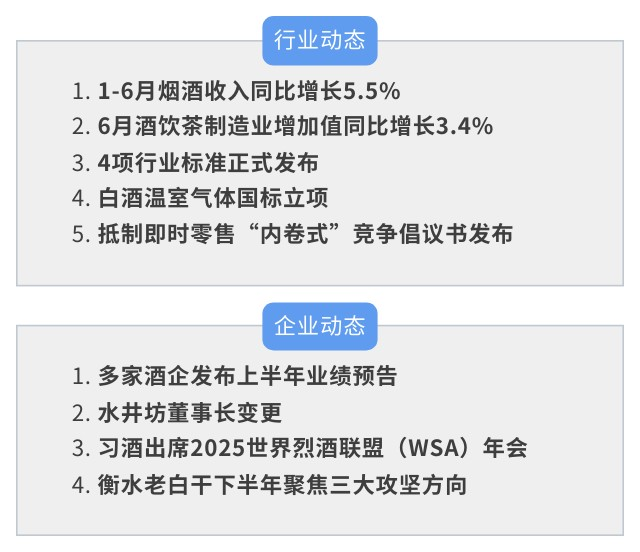
Industry Dynamics - In the first half of 2023, the revenue from tobacco and alcohol increased by 5.5% year-on-year, totaling 331.6 billion yuan, while June's revenue was 51.6 billion yuan, showing a decline of 0.7% year-on-year [4] - The added value of the beverage and tea manufacturing industry grew by 3.4% year-on-year in June, with a 4.7% increase in the first half of the year [4] - Four industry standards related to fermented rice wine and fruit wines were officially released, set to be implemented on February 1, 2026 [4] - A national standard for the carbon footprint quantification of liquor was included in the 2025 national standard plan [5] - The China Chain Store & Franchise Association issued a proposal to resist "involution" competition in instant retail, emphasizing the need for fair market practices and sustainable development [5] Company Dynamics - Multiple liquor companies released their performance forecasts for the first half of 2023, showing a significant divergence in results. The white liquor sector generally performed poorly, with Shui Jing Fang's net profit dropping by 56.52% and other companies like Jiu Gui Jiu and Shun Xin Agriculture also reporting substantial declines [7] - Some companies, such as Chuan Jiu Group and Qinghai Spring, reported growth in revenue and profits, while the beer sector, led by Yan Jing Beer, saw a net profit increase of 40%-50% [7] - The wine and yellow wine sectors faced losses, attributed to rising costs and inadequate market expansion [7] - The chairman of Shui Jing Fang Group was replaced, marking a significant change in leadership [10] - Hengshui Laobaigan plans to focus on three key areas in the second half of the year: deepening core market channels, enhancing differentiated operations for banquet scenarios, and accelerating the implementation of a digital marketing system [10]


帝亚吉欧CEO闪电离职,水井坊换帅背后藏着中国市场困局
Sou Hu Cai Jing· 2025-07-18 03:44
Core Viewpoint - The sudden leadership change at Diageo has triggered significant market reactions, prompting the company to expedite the search for a new CEO to stabilize potential market volatility [1][9]. Group 1: Leadership Changes - Diageo is currently seeking a new CEO following the unexpected departure of Debra Crew, who led the company since 2020 and implemented several strategic initiatives [3][9]. - Water Margin Group, a key player in Diageo's China strategy, has also undergone significant personnel changes, with Sudhindra Shivnegere Rajarao replacing Cristina Samin Suner as chairman and general manager [3][7]. Group 2: Financial Performance - Diageo's Q3 FY2025 report shows an organic sales growth of 5.9%, reaching $4.376 billion, indicating overall stable growth [6]. - However, regional performance reveals a stark contrast, with North America growing at 6.2%, Latin America and the Caribbean at 28.5%, while the Asia-Pacific region only saw a 1.6% increase, primarily due to weak performance in China and Southeast Asia [6][7]. Group 3: Strategic Implications - The leadership changes at both the group and regional levels are seen as a response to immediate market pressures and a proactive shift in global strategic planning for the next five years [9]. - The new leadership at Water Margin Group is expected to implement a more aggressive localization strategy to address the current growth challenges in the Chinese market [7][9]. - The appointment of Bence Bokor, who specializes in digital marketing and channel innovation, may be crucial for engaging younger consumer demographics [7].

白酒消费结构转型之际,水井坊中高档酒销售量逆势增14.54%
Chang Jiang Shang Bao· 2025-07-18 03:07
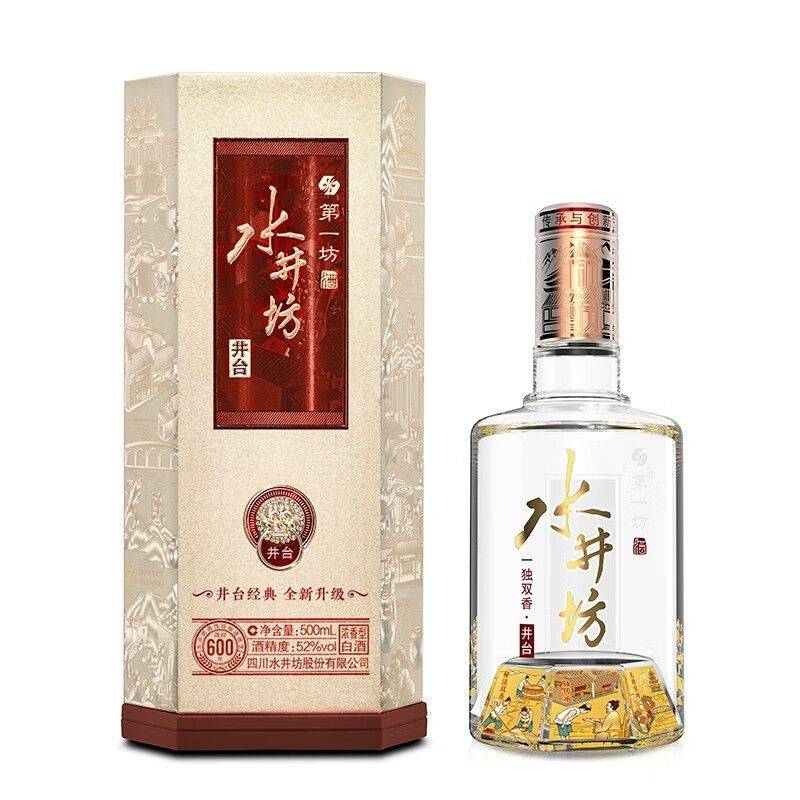
Industry Overview - The Chinese liquor industry is undergoing unprecedented structural changes due to macroeconomic shifts and generational consumption changes [1][3] - The China Alcoholic Drinks Association reports a continued decline in both volume and price in the first half of 2025, with production down 7.2% year-on-year [3] - 59.7% of liquor companies reported a decrease in operating profit, and 50.9% experienced a decline in revenue, primarily due to reduced customer numbers and average transaction values [3] Company Performance - Water Jiufang's revenue is expected to decline by 12.84% year-on-year, amounting to approximately 1.5 billion yuan, while its net profit is projected to drop by 56.52% [4][5] - Despite the overall decline, Water Jiufang's sales volume of mid-to-high-end liquor increased by 14.54%, indicating a shift towards quality and brand value [4][5] - The company maintains a reasonable inventory level, which is crucial for future growth and sustainable operations [5][6] Strategic Focus - The liquor industry is expected to focus on "strengthening fundamentals, restructuring, and innovation" as key strategies for transformation [4] - Water Jiufang is adapting to consumer demands by launching a new high-end brand and planning to introduce lower-alcohol products to cater to younger consumers [6] - The company emphasizes the importance of building a value loop around "quality, brand, and culture" as the industry shifts from growth to competition in existing markets [6]
白酒不香?中国白酒销量暴跌40%,年轻人为何集体抛弃‘国粹’?
Sou Hu Cai Jing· 2025-07-17 23:56
Core Insights - Water Margin's 2025 semi-annual performance forecast indicates a revenue of 1.498 billion yuan, a decrease of 12.84% year-on-year, and a net profit of 105 million yuan, down 56.52% compared to the previous year [1] - Despite a significant increase in sales volume by 543 thousand liters (14.54% year-on-year), the revenue decline highlights challenges in key consumption scenarios such as banquets and business dinners [1][3] - The overall white liquor market is experiencing a downturn, with major brands like Kweichow Moutai also showing signs of slowing growth, as indicated by their recent financial reports [3] Company Performance - Water Margin's expected sales volume growth contrasts sharply with its revenue and profit decline, suggesting deeper issues within the market [3] - Kweichow Moutai's net profit growth has slowed down significantly, with 2022 to 2024 profits of 627.17 billion yuan, 747.34 billion yuan, and 867.28 billion yuan, reflecting a decreasing growth rate [3] Industry Challenges - The white liquor market is facing a combination of economic cycles and consumer confidence issues, leading to reduced business dining activities [5] - Structural imbalances in supply and demand are evident, with excess production capacity and compressed profit margins for distributors [5] - The rise of e-commerce platforms employing low-price strategies is negatively impacting the average price of premium liquor brands [5] - Changing consumer behaviors, particularly among younger generations preferring lower-alcohol beverages, are reshaping the market dynamics [7]
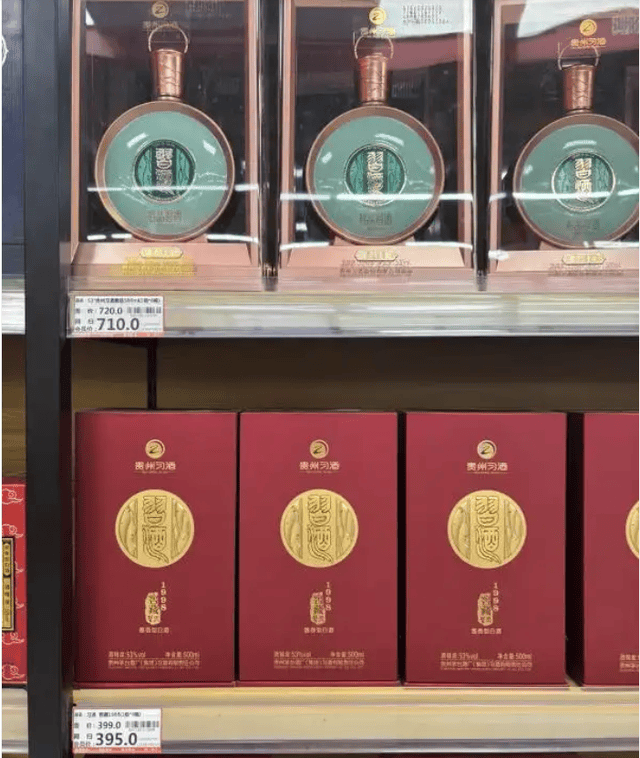
相继入局低度白酒赛道 低度酒能否成为头部酒企穿越周期的良药?
Sou Hu Cai Jing· 2025-07-17 10:54
Core Viewpoint - The Chinese liquor industry is facing challenges such as shrinking competition, declining prices, and increasing inventory pressure, prompting leading liquor companies to enter the low-alcohol liquor market to seek growth opportunities [2][6]. Group 1: Industry Trends - Major liquor companies like Wuliangye, Luzhou Laojiao, and Jiugui Liquor are actively discussing the trend towards low-alcohol products during their annual shareholder meetings [2][3]. - The low-alcohol liquor segment is expected to become a new growth area for leading liquor companies, as they adapt to the younger consumer demographic and the trend of lower alcohol content [2][3][6]. Group 2: Company Strategies - Wuliangye plans to reintroduce a 29-degree liquor product after 20 years, with market research already underway for three different flavors, expected to launch in September [3][5]. - Luzhou Laojiao has successfully developed a 28-degree product and is testing even lower alcohol content options [3][5]. - Other companies like Moutai, Shanxi Fenjiu, and Yanghe are also increasing their focus on low-alcohol products, with various new offerings in development [3][5]. Group 3: Market Dynamics - The low-alcohol segment is seen as a potential second growth curve for some liquor companies, with Luzhou Laojiao reporting that the proportion of low-alcohol products in their portfolio has increased from 15% to around 50% [6][8]. - The overall revenue growth for liquor companies has been declining, with only two out of twenty companies achieving double-digit revenue growth in the first quarter of 2025 [6][7]. Group 4: Historical Context - The low-alcohol trend in the Chinese liquor market has historical precedents, with previous waves of low-alcohol product launches occurring in the 1970s and 1980s, but the market has predominantly favored high-alcohol products [8][9][10]. - The introduction of low-alcohol products has often faced challenges, as seen in past attempts where many low-alcohol offerings did not meet market expectations and were eventually discontinued [9][11]. Group 5: Consumer Preferences - A survey indicated that among young consumers aged 25 to 35, only 19% prefer traditional liquor, while 52% favor beer, highlighting the need for liquor companies to adapt to changing consumer preferences [3][6]. - The pricing strategy for low-alcohol products is critical, as companies must balance affordability for younger consumers with maintaining a premium brand image [13][15].