SCSF(600779)

Search documents
量价齐跌、利润腰斩,白酒如何走出阵痛期?| 白酒半年特辑②
Sou Hu Cai Jing· 2025-07-28 00:44
Core Viewpoint - The Chinese liquor industry is facing severe challenges in 2025 due to a combination of policy adjustments, consumption structure transformation, and deep competition, leading to declining production, prices, and profits [2][6]. Group 1: Industry Performance - Major liquor companies such as Shunxin Agriculture, Shui Jing Fang, and Jiu Gui Jiu have reported significant declines in net profits, with some experiencing drops of over 90% [2][3]. - The overall industry is experiencing a "volume and price decline," with production volume down 7.6% year-on-year in the first five months of 2025, and a cumulative decline of 69.5% from 2016 to 2024 [5][6]. - The first quarter of 2025 saw a slight increase in revenue of 0.38% for large-scale liquor enterprises, but total profits decreased by 0.73%, indicating a clear downward trend [5][6]. Group 2: Market Dynamics - The industry is facing "three heavy cold currents": persistent price fluctuations, high inventory levels, and a collapse in consumption scenarios [8][10][11]. - Price declines are evident, with liquor prices dropping by 2.0% year-on-year in the first half of 2025, and over 60% of companies experiencing price inversions [8][9]. - Inventory pressure is significant, with an average inventory turnover period of 900 days, and over 58% of distributors reporting increased stock levels [10][11]. Group 3: Consumer Behavior and Trends - Consumer demand is shifting towards more rational spending, with a notable decrease in high-end liquor purchases and a preference for lower-priced products [12][13]. - The traditional consumption scenarios, such as business banquets and gift-giving, are shrinking, leading to a decline in sales during peak seasons [11][12]. - The rise of low-alcohol and foreign liquor preferences among younger consumers is further diluting the market for traditional liquor [11][12]. Group 4: Strategic Responses - Liquor companies are urged to adapt by targeting the mass market with affordable and quality products, as the market for low-cost liquor is expected to grow significantly [14]. - Product innovation is essential, with a focus on lower alcohol content to meet the health-conscious preferences of younger consumers [14]. - Companies are exploring new sales channels, including online platforms and instant retail, to enhance market reach and efficiency [14][15].



食品饮料周观点:关注中报成长标的,白酒底部看绝对价值-20250727
GOLDEN SUN SECURITIES· 2025-07-27 10:46
Investment Rating - The report maintains an "Increase" rating for the food and beverage industry, indicating a positive outlook for the sector [5]. Core Views - The liquor industry is strengthening its internal capabilities, with companies focusing on management, product, and channel improvements. The industry is currently at a low valuation and is expected to stabilize as sales pressure eases [2]. - In the beer and beverage sector, East Peak Beverage reported impressive mid-year results, while the industry continues to show high growth potential despite intense competition [3]. - The report highlights the ongoing transformation in product selection at Sam's Club, emphasizing operational efficiency through local supply chain adjustments [4]. Summary by Sections Liquor Industry - The liquor sector is in a phase of continuous improvement, with major companies like Guizhou Moutai and Shanxi Fenjiu enhancing their management and product offerings. The industry is currently experiencing a seasonal downturn, but valuations are low, suggesting potential for recovery [2]. Beer and Beverage Sector - The beer segment is advised to focus on high-growth products and structural performance, with companies like Yanjing Beer and Zhujiang Beer being highlighted. East Peak Beverage's revenue for the first half of 2025 reached 10.737 billion yuan, a year-on-year increase of 36.37% [3]. Food Sector - Sam's Club is undergoing a significant product selection transformation, with a shift towards national best-selling items to improve operational efficiency. The report notes that the low-temperature dairy market is performing better than the ambient temperature segment [4][7].




中经酒业周报∣7月中旬全国白酒环比价格总指数保持稳定,《柔雅型白酒》团标通过评审,茅台、五粮液设立科技类子公司
Xin Hua Cai Jing· 2025-07-25 03:00
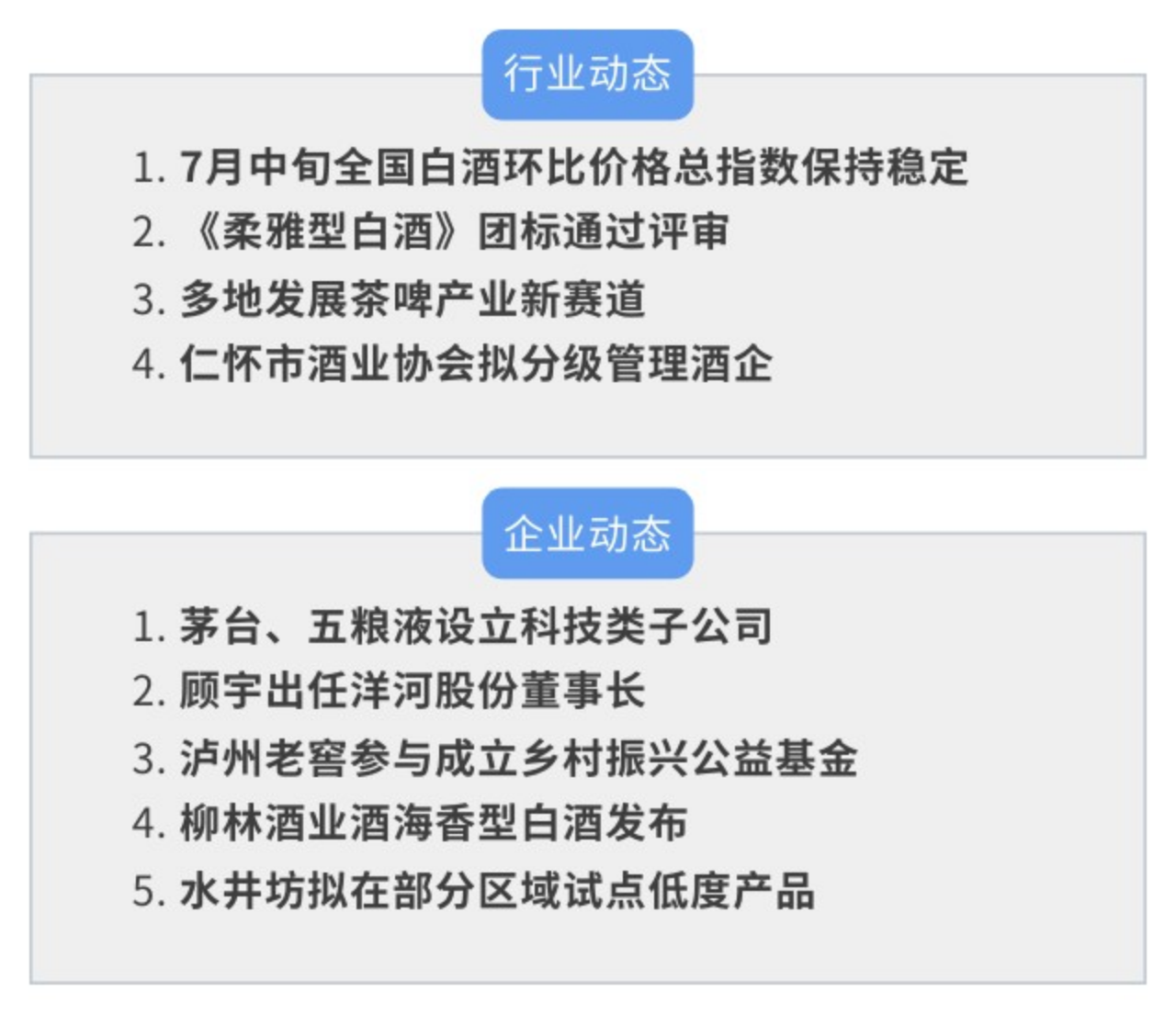
Industry Dynamics - The national white liquor price index remained stable at 100.00 in mid-July, with the famous liquor index also at 100.00, while local liquor saw a slight decrease of 0.01% to 99.99. The base price index for national white liquor wholesale prices increased by 8.34% to 108.34, with famous liquor up by 10.38% to 110.38, local liquor up by 3.74% to 103.74, and base liquor up by 10.21% to 110.21 [1] - The "Soft Elegant White Liquor" group standard was approved, defining the production process and style characteristics, which will help standardize production, inspection, and sales, promoting healthy industry development [1] - The tea beer industry is emerging, with strategic partnerships formed in Guizhou and Anhui to develop tea-infused beer products, aligning with consumer demand for low-alcohol and healthy beverages [2][3] - The Guizhou Renhuai City Liquor Industry Association introduced a tiered management system for liquor companies, categorizing them into "reliable," "basic compliance," and "high-risk" enterprises, with penalties for violations and rewards for outstanding performance [4] Company Developments - Wuliangye established a technology subsidiary with a registered capital of 100 million yuan, focusing on fermentation process optimization and technology research [5] - Kweichow Moutai announced the establishment of a scientific research institute with a registered capital of 1 billion yuan, aiming to enhance product quality and explore new growth areas [5] - Gu Yu was elected as the chairman of Yanghe Co., marking a leadership change [5] - Luzhou Laojiao announced a partnership to establish a rural revitalization public welfare fund with a total donation of 20 million yuan over three years [5] - Liulin Liquor launched a new fragrance type, "Jiu Hai Xiang," utilizing a unique fermentation process and a standardized production system [5] - Shui Jing Fang is testing low-alcohol products below 38 degrees in select markets [6]


白酒公司集体降度,靠“小甜水”找增量
Xin Lang Cai Jing· 2025-07-24 02:06
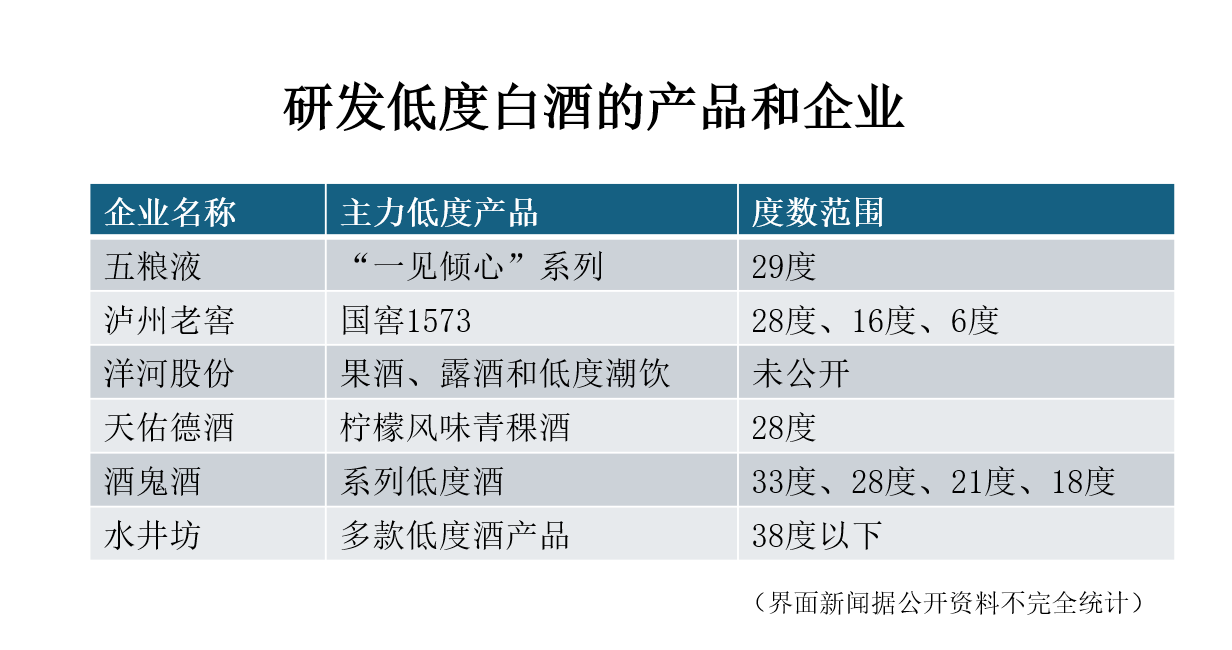
Group 1 - The core viewpoint of the articles highlights a significant shift in the Chinese liquor industry, with major companies developing and promoting low-alcohol products below 38 degrees, aiming to attract younger consumers and diversify their product lines [1][3][9] - Major companies like Wuliangye, Luzhou Laojiao, and Yanghe are actively participating in this trend, with Wuliangye planning to launch a 29-degree product and Luzhou Laojiao already having developed a 28-degree version [2][3][4] - The low-alcohol market is projected to grow significantly, with estimates suggesting it will exceed 74 billion yuan by 2025, reflecting a compound annual growth rate of 25%, which is much higher than the overall growth of the liquor industry [3][9][10] Group 2 - The shift towards low-alcohol products is driven by changing consumer preferences, particularly among younger demographics, where over 60% prefer low-alcohol options due to the harshness of high-alcohol beverages [3][9] - Companies are not only focusing on low-alcohol products but are also exploring cocktail mixes to create a more diverse flavor profile suitable for summer consumption [5][6] - The industry is witnessing a competitive landscape where traditional high-alcohol brands are adapting to market demands, with the success of low-alcohol products hinging on the companies' ability to innovate in brewing techniques and expand distribution channels [9][10]

抢先看!上市公司可持续发展报告涉税看点
Sou Hu Cai Jing· 2025-07-22 12:21
Core Viewpoint - As of April 30, 2024, a total of 2,462 A-share listed companies in China have published their sustainable development reports, with a notable focus on tax compliance management practices within these reports [1][3]. Group 1: Implementation of Sustainable Development Reporting - The "Guidelines for Sustainable Development Reporting of Listed Companies" came into effect on May 1, 2024, marking a new phase in the standardized disclosure of sustainable information [3]. - Companies included in major indices must disclose their 2025 sustainable development reports by April 30, 2026, while other companies are encouraged to voluntarily adopt these guidelines [3]. Group 2: Tax Compliance Commitments - Listed companies contributed a total of 4.54 trillion yuan in taxes in 2024, accounting for 25.96% of the national tax revenue, with many companies making commitments to comply with tax laws in their reports [3][5]. - Baoshan Iron & Steel Co., Ltd. outlined seven commitments regarding tax compliance, emphasizing adherence to local tax laws and transparent relationships with government entities [4]. Group 3: Tax Management Practices - Zhejiang Lino Fluid Control Technology Co., Ltd. highlighted its tax management procedures and commitment to tax compliance, reflecting the growing importance of tax issues among stakeholders [6]. - New Wind Technology Co., Ltd. adapted its internal tax management processes to align with business model changes and conducted employee training to enhance tax awareness [7]. Group 4: Digitalization and Risk Management - ZTE Corporation has established a global tax compliance committee to oversee tax governance and ensure compliance, reflecting a trend towards digitalization in tax management [9]. - Tianma Microelectronics Co., Ltd. developed a tax risk control system to monitor and manage tax risks proactively, shifting from reactive to preventive measures [10].





食品饮料行业 2025 年中报前瞻:白酒出清探底,食品亮点频现
Huachuang Securities· 2025-07-22 09:25
Investment Rating - The report maintains a "Recommended" rating for the food and beverage industry, particularly highlighting opportunities in the liquor sector and food products [1] Core Insights - The liquor industry is undergoing extreme pressure testing, with a significant focus on inventory clearance and bottoming out of financial reports. The second quarter has shown weak demand due to seasonal factors and regulatory impacts, leading to a notable decline in sales and pricing pressures [5][10] - High-end liquor brands like Moutai are expected to maintain growth, while mid-tier brands face challenges with declining revenues and profits. The overall industry is in a deep clearance phase, with potential for recovery as regulations stabilize [5][12] - The consumer goods sector shows mixed performance, with snacks and beverages remaining strong, while other segments like frozen foods and chain restaurants face ongoing demand pressures [20][25] Summary by Sections 1. Liquor Sector - The liquor industry is experiencing extreme pressure, with weak demand in the second quarter and significant inventory levels. Major brands like Moutai and Wuliangye are expected to show modest growth, while others like Yanghe and Luzhou Laojiao are facing declines [5][11][12] - Moutai's revenue is projected to grow by 7% in Q2, while Wuliangye is expected to see a 1% increase. In contrast, brands like Yanghe and Luzhou Laojiao are forecasted to decline by 35% and 8% respectively [11][12] 2. Consumer Goods - The overall demand for consumer goods remains weak, but segments like snacks and beverages are performing well. For instance, East Peak is expected to see a 33% increase in revenue, while other snack brands are also showing positive trends [20][25] - The beverage sector is projected to see positive growth, with major brands like Qingdao Beer and Yanjing expected to report increases in revenue and profit [25][26] 3. Investment Recommendations - The report suggests focusing on high-performing stocks in the short term while considering long-term investments in liquor brands that are currently at their bottom. Brands like Moutai and Gujing are recommended for their lower risk profiles [7][8] - For consumer goods, companies like Anqi and East Peak are highlighted for their growth potential, while traditional dairy brands like Yili and Mengniu are suggested for a bundled investment approach [7][8]



白酒股午后震荡拉升,泸州老窖、山西汾酒均涨超4%
news flash· 2025-07-22 05:14
Group 1 - The core viewpoint of the article highlights the significant rise in the stock prices of Chinese liquor companies, particularly Luzhou Laojiao and Shanxi Fenjiu, which both increased by over 4% [1] - Other companies in the sector, such as Jinshiyuan and Gujing Gongjiu, also saw gains exceeding 3%, indicating a positive trend across the industry [1] - The article suggests that "smart money" is flowing into these stocks, hinting at a strategic investment interest in the liquor sector [1]


水井坊:已研发并在部分区域市场试点推出38度以下白酒产品
news flash· 2025-07-21 07:50
Core Viewpoint - The company has developed and is piloting products with an alcohol content below 38 degrees in certain regional markets, focusing on white liquor [1] Company Summary - The company, Shui Jing Fang, has successfully researched and launched new products with an alcohol content of less than 38 degrees [1] - The new products are specifically categorized as white liquor [1]
酒业半年大考:八仙过海寻出路,三大趋势定格局
Sou Hu Cai Jing· 2025-07-21 07:29
Industry Overview - In 2024, the production of large-scale liquor enterprises is expected to reach 4.145 million kiloliters, a year-on-year decrease of 1.8%, while sales revenue is projected to increase to 796.38 billion yuan, a year-on-year increase of 5.3%, indicating a unique trend of "declining volume but increasing profit" [2] - By the first half of 2025, 59.7% of liquor companies reported a decline in operating profit, and 50.9% experienced a contraction in revenue, with an average inventory turnover period of 900 days, up 10% year-on-year, highlighting significant challenges in the industry [2] Key Trends - The industry is witnessing a simultaneous trend of "contraction and concentration," with smaller companies exiting the market and leading firms shifting focus from "high-speed growth" to "steady development" [3] - A "channel revolution" is underway, with major companies moving towards direct consumer engagement through new sales channels like online platforms and instant retail, indicating a shift in power from distributors to brands [4] - Consumer demand is evolving, driven by younger consumers, leading to product upgrades towards lower alcohol content and diverse flavors, with major brands launching new products to cater to these trends [5] Company Performance - **Kweichow Moutai**: Aims for a 9% revenue growth by 2025, with a first-quarter revenue of 51.443 billion yuan, up 11.07%, and a net profit of 26.847 billion yuan, up 11.56%, demonstrating strong execution of its strategic goals [6][7] - **Wuliangye**: Targets revenue growth in line with macroeconomic conditions, reporting a first-quarter revenue of 36.940 billion yuan, up 6.05%, and a net profit of 14.860 billion yuan, up 5.80%, with ongoing channel reforms [6][8] - **Luzhou Laojiao**: Focuses on low-alcohol products, with a first-quarter revenue of 9.352 billion yuan, up 1.78%, and a net profit of 4.593 billion yuan, up 0.41%, indicating a strong market position in lower alcohol segments [6][9] - **Shanxi Fenjiu**: Reports a first-quarter revenue of 16.523 billion yuan, up 7.72%, and a net profit of 6.648 billion yuan, up 6.15%, with ongoing efforts in national expansion and product innovation [6][10] - **Guojiao**: Achieves a first-quarter revenue of 5.099 billion yuan, up 9.17%, and a net profit of 1.644 billion yuan, up 7.27%, driven by a focus on the wedding market [6][12] Strategic Shifts - The industry is transitioning from "incremental expansion" to "stock optimization," with companies focusing on refining existing markets rather than pursuing aggressive growth [17] - A shift from "channel-driven" to "consumer-driven" strategies is evident, with companies prioritizing direct consumer engagement and enhancing consumer experiences [18] - The trend is moving from "high alcohol content" to "low and diverse products," with major brands launching lower alcohol options to attract younger consumers [20] - Companies are increasingly emphasizing "long-term value" over short-term performance, with a focus on cultural branding and sustainable growth strategies [21] - The shift from "national expansion" to "regional deepening" is becoming a survival strategy for many companies, focusing on local market penetration and brand recognition [22][23]
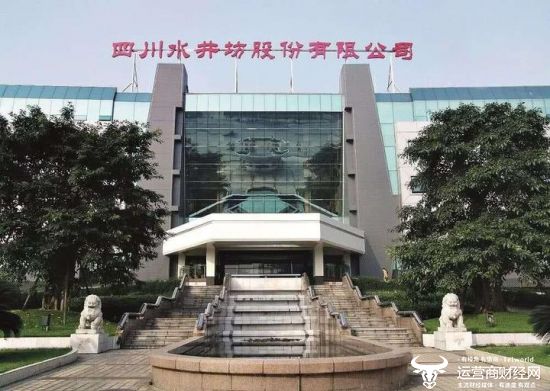
水井坊总经理胡庭洲去年薪酬高达623.4万是董事长范祥福5倍多
Xin Lang Cai Jing· 2025-07-21 04:37
Core Viewpoint - The company, Shui Jing Fang, is forecasting a decline in both revenue and net profit for the first half of 2025 compared to the same period last year, while its new general manager, Hu Tingzhou, has a notably high salary of 6.234 million yuan for 2024 [1][3]. Group 1: Financial Performance - For the period from January 1 to June 30, 2025, the company expects to achieve revenue of 1.498 billion yuan, a decrease of 222 million yuan, representing a year-on-year decline of 12.84% [3]. - The projected net profit for the same period is 105 million yuan, showing a decline compared to the previous year [3]. - In contrast, the company anticipates a sales volume increase of 543 thousand liters, which is a year-on-year increase of 14.54%, all attributed to mid-to-high-end liquor sales [3]. - For the full year of 2024, the company expects to achieve total revenue of approximately 5.217 billion yuan, reflecting a year-on-year growth of 5.32%, and a net profit of about 1.341 billion yuan, with a year-on-year increase of 5.69% [3]. Group 2: Management and Strategy - Hu Tingzhou, who became the general manager in July 2024, is noted to have the highest salary among disclosed executives at 6.234 million yuan [3]. - Other executives' salaries include Chairman Fan Xiangfu at 1.112 million yuan [3]. - Hu Tingzhou has a background in management, having previously served as the general manager of Hershey China and held various management positions in multiple companies [3]. - In March 2025, Hu Tingzhou discussed the company's marketing strategy, which segments the market into "fortress cities," "pioneer cities," and "potential cities," allowing for tailored sales strategies for different markets [3].