
CMS(600999)

Search documents
598.7亿元,券商争相发行科创债,超千亿仍在路上
Zheng Quan Shi Bao· 2025-10-20 14:11
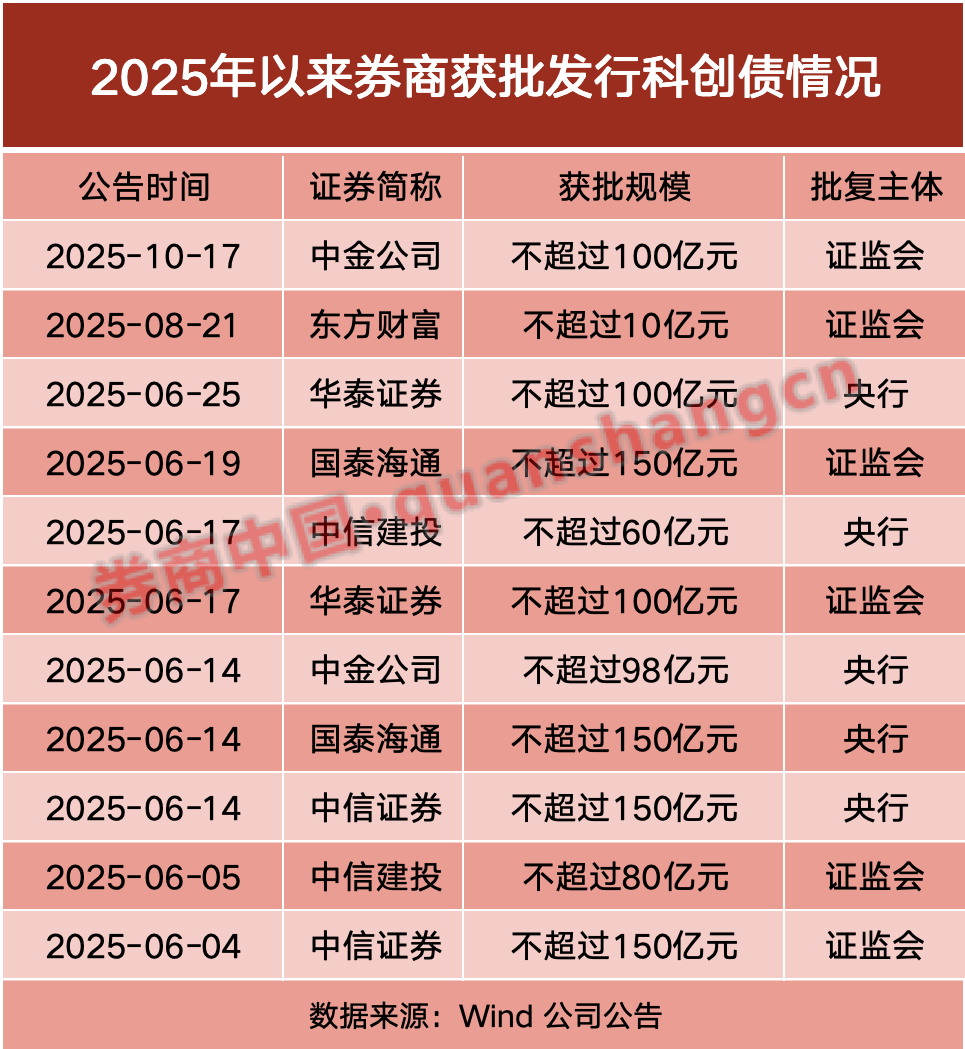
Core Insights - The issuance of technology innovation bonds by securities firms has become increasingly active since the new policy was introduced in May [1][3] - As of now, six listed securities firms have announced approval to issue a total of 114.8 billion yuan in technology innovation bonds, with 43 firms having issued 59.87 billion yuan [2][3] Summary by Category Issuance Overview - The technology innovation bonds mainly include "technology innovation corporate bonds" issued on stock exchanges and "technology innovation bonds" issued in the interbank market, regulated by the CSRC and the central bank respectively [3] - Since the policy was introduced, six listed securities firms have received regulatory approval to issue a total of 114.8 billion yuan in technology innovation bonds over the next two years [3][4] Characteristics of Issuance - The issuance of technology innovation bonds shows three main characteristics: a wide range of issuers, a flexible term structure, and low interest rates [5][6] - The leading issuer is China Merchants Securities with a scale of 10 billion yuan, followed by CITIC Securities (9.7 billion yuan) and Guotai Junan Securities (5.9 billion yuan) [6][7] Term Structure and Interest Rates - The term structure of the issued bonds includes 1-year, 2-year, 3-year, 5-year, and 10-year bonds, with nearly 50% being 3-year bonds [8] - The interest rates for the issued bonds range from 1.64% to 2.29%, primarily concentrated in the 1.7% to 2.0% range, which is lower than the average rate of 1.88% for ordinary corporate bonds issued this year [8] Market Participation - The funds raised from the issuance of technology innovation bonds are mainly used to support businesses in the technology innovation sector, with significant participation from mainstream investment institutions [8] - The recent listing of the second batch of technology innovation bond ETFs has attracted additional funds to some of the newly issued bonds [9]

598.7亿元!券商争相发行科创债,超千亿仍在路上
券商中国· 2025-10-20 13:17
Core Viewpoint - The article highlights the active role of securities firms in issuing technology innovation bonds since the new policy was introduced in May, with significant participation from major firms and a total issuance of 598.7 billion yuan in technology innovation bonds so far this year [1][2][3]. Group 1: Issuance Overview - As of now, six listed securities firms have announced approval to issue a total of 114.8 billion yuan in technology innovation bonds, with 43 firms having issued 598.7 billion yuan in total [3][4]. - The issuance includes both "technology innovation corporate bonds" regulated by the CSRC and "technology innovation bonds" regulated by the central bank, reflecting a broad response from various financial institutions [3][4]. Group 2: Characteristics of Technology Innovation Bonds - The issuance of technology innovation bonds shows three main characteristics: a wide range of issuers, a flexible term structure, and low interest rates [5][6]. - Major securities firms lead in issuance scale, with China Merchants Securities issuing 100 billion yuan, followed by CITIC Securities at 97 billion yuan and Guotai Junan Securities at 59 billion yuan [6][7]. - The term structure of the bonds is primarily short to medium-term, with nearly 50% being three-year bonds, and some firms issuing bonds with terms of up to ten years [6][8]. Group 3: Interest Rates and Market Response - The coupon rates for the issued technology innovation bonds range from 1.64% to 2.29%, with most concentrated between 1.7% and 2.0%, indicating lower financing costs compared to the average rate of 1.88% for ordinary corporate bonds [9]. - The funds raised from these bonds are primarily aimed at supporting technology innovation businesses, with strong participation from mainstream investment institutions [9]. - The recent listing of the second batch of technology innovation bond ETFs has attracted additional investment into these bonds, with significant increases in holdings observed [9].

天溯计量创业板IPO过会:被追问业绩增长可持续性,招商证券保荐
Sou Hu Cai Jing· 2025-10-20 09:00
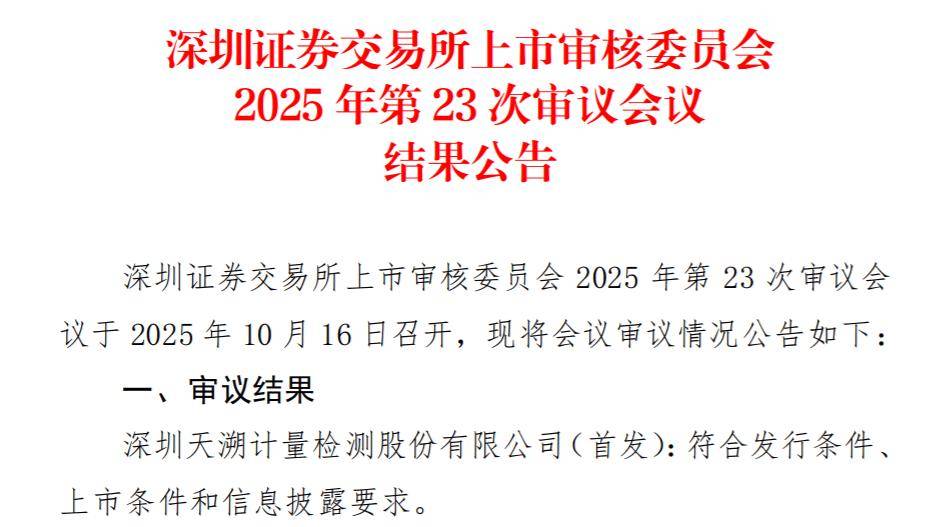
Core Viewpoint - Shenzhen Tian Su Measurement and Testing Co., Ltd. has successfully passed the IPO review for the ChiNext board, with China Merchants Securities as the sponsor [2]. Company Overview - Tian Su Measurement was established in 2009 and operates as an independent third-party measurement and testing service provider, focusing on calibration, testing, and certification services [4]. - The company's clients span various sectors, including biomedicine, automotive, new energy, rail transit, energy and power, light industry, and equipment manufacturing [4]. Financial Performance - The total assets of Tian Su Measurement have increased from 464.55 million yuan in 2022 to an estimated 729.19 million yuan by June 30, 2025 [5]. - The company's net profit has shown growth from 84.39 million yuan in 2022 to an estimated 55.58 million yuan in the first half of 2025 [5]. - The operating revenue for the years 2022 to 2025 is projected to be 597 million yuan, 726 million yuan, 800 million yuan, and 409 million yuan respectively [5]. Future Projections - For the first nine months of 2025, the company expects operating revenue to grow by approximately 9.89% to 12.49% compared to the same period in 2024 [6]. - The net profit attributable to the parent company is projected to increase by 8.03% to 11.04% year-on-year [6].

招商证券:行业政策频出 补贴有望推动氢能发展加速
智通财经网· 2025-10-20 08:02
Core Insights - The current share of non-electric utilization of renewable energy is less than 1%, significantly lower than in the electricity sector, indicating a vast potential for growth in hydrogen, ammonia, and methanol applications [1][2][3] Group 1: Policy Developments - The National Development and Reform Commission (NDRC) has issued the "Central Budget Investment Management Measures for Energy Conservation and Carbon Reduction," which supports key sectors in energy conservation and carbon reduction, including green methanol and sustainable aviation fuel (SAF) production projects [1][3] - The NDRC's support for low-carbon projects includes a funding ratio of 20% of the total investment for eligible new or ongoing projects, marking a significant policy shift towards supporting green methanol and SAF [1][3] Group 2: Industry Trends - The global renewable energy consumption issue is becoming increasingly critical, with hydrogen and methanol non-electric utilization seen as a promising avenue for future development [2][3] - The domestic wind and solar cumulative installed capacity is projected to reach approximately 1.4 billion kilowatts by 2024, with a target of 3.6 billion kilowatts of new installations, indicating robust growth in the renewable energy sector [2] Group 3: Market Opportunities - The green methanol industry is progressing rapidly, driven by global shipping decarbonization efforts and EU emissions trading policies, with significant potential for green methanol as an alternative fuel [4] - There is a growing focus on biomass gasification and fermentation routes for green methanol production, with gasifiers and electrolyzers being critical components, highlighting investment opportunities in production and equipment sectors [4]
机构称板块估值仍在低位,证券ETF龙头(159993)净申购4800万份
Xin Lang Cai Jing· 2025-10-20 07:53
Group 1 - The core viewpoint indicates that the market experienced fluctuations with the CSI Securities Leading Index showing mixed performance among its constituent stocks, highlighting a notable increase in Everbright Securities by 1.98% and a decline in GF Securities [1] - The market saw a significant trading volume of 1.74 trillion yuan, which is a decrease of 200.5 billion yuan compared to the previous trading day, indicating a contraction in market activity [1] - Open Source Securities forecasts improvements in investment banking, derivatives, and public fund businesses, suggesting that leading brokerages' overseas business growth and organic growth orientation will drive return on equity (ROE) expansion, while the sector's valuation remains low with noticeable underweight from institutions [1] Group 2 - As of September 30, 2025, the top ten weighted stocks in the CSI Securities Leading Index accounted for 79.09% of the index, with notable companies including East Money Information, CITIC Securities, and Huatai Securities [2]





招商证券:黄鸡高景气延续 白羽鸡9月转亏
智通财经网· 2025-10-20 06:52
Group 1 - The report from China Merchants Securities indicates that the supply of white feather chicken chicks is tight in September, leading to a rise in chick prices, although the support for prices is limited due to cost control needs in the breeding sector [1][3] - The average price of white feather chicken chicks in September was 3.27 yuan per chick, down 8.3% year-on-year and 0.7% month-on-month; the average price of broiler chickens was 6.99 yuan per kilogram, down 3.2% year-on-year and 2.4% month-on-month [1] - The breeding sector is experiencing losses due to rising chick costs and low broiler prices, with an average loss of 1 yuan per chick in September [1] Group 2 - The yellow feather chicken market saw a significant recovery in September, with prices rising due to improved demand and the upcoming National Day and Mid-Autumn Festival [2][3] - The average price of fast-growing yellow chickens in September was 5.41 yuan per jin, up 2.5% year-on-year and 6% month-on-month; the average price of Xueshan grass chickens was 8.95 yuan per jin, up 5.1% year-on-year and 3% month-on-month [2] - Major companies in the yellow feather chicken sector have seen a reduction in out-of-pocket costs, with costs dropping to around 5.6 yuan per jin for Wens Foodstuffs and below 5.5 yuan per jin for Lihua [2][3] Group 3 - The supply of parent stock for white feather chickens is expected to be tight in the second half of 2025 due to a significant decrease in overseas imports, which will also affect the supply of commercial broiler chicks in 2026 [3] - The current low inventory levels of parent stock for yellow feather chickens, combined with ongoing industry losses, are setting the stage for future price increases [3] - The long-term outlook for the ice-fresh yellow feather chicken market remains positive, driven by changing consumer habits, the implementation of sales bans, and economic recovery [3]
1.75亿,券商App月活创年内新高!最新排名来了
Zhong Guo Ji Jin Bao· 2025-10-20 06:17
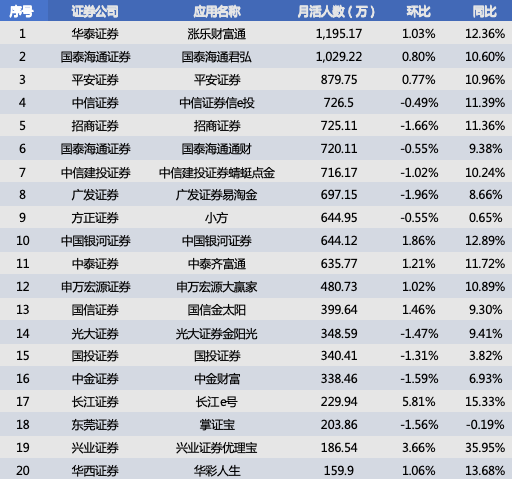
Core Insights - The active user base of securities apps has reached approximately 175 million in September 2025, marking a month-on-month increase of 0.74% and a year-on-year increase of 9.73%, setting a new monthly record for the year [1][2] Group 1: User Activity and Rankings - Two securities apps surpassed 10 million monthly active users, while 11 apps exceeded 6 million, with Huatai Securities' "Zhangle Wealth" leading at 11.95 million users [2][3] - The top five securities firms maintained their positions, with Huatai Securities, Guotai Junan, and Ping An Securities ranking first, second, and third respectively [2][3] - The overall growth momentum of monthly active users for securities apps has slowed, with some experiencing slight month-on-month declines [1][2] Group 2: Year-on-Year Growth - The app "Yuli Bao" from Industrial Securities saw a year-on-year increase of 35.95%, while several other apps also reported growth exceeding 20% [2][3] - Only one app, Dongguan Securities' "Changzheng Bao," experienced a year-on-year decline of 0.19% [2][3] Group 3: AI Integration in Securities Apps - The rapid development of AI technology has led to increased demand for its application in the securities industry, with firms investing in financial technology to enhance their app services [4] - Huatai Securities launched an independent AI application terminal "AI Zhangle," integrating AI capabilities across key functions such as stock selection and trading [4] - The industry is focusing on creating differentiated services through AI, addressing challenges such as professional adequacy and compliance risks [4][5]
1.75亿,券商App月活创年内新高!最新排名来了
中国基金报· 2025-10-20 06:12
Core Insights - The active user count for securities apps in China has surpassed 175 million in September 2025, marking a month-on-month increase of 0.74% and a year-on-year increase of 9.73%, setting a new record for the year [2][4] - The competition among brokerage apps is intensifying, with two apps exceeding 10 million active users and eleven apps surpassing 6 million [2][4] - Major players like Huatai Securities, Guotai Junan, and Ping An Securities lead the market in terms of active user numbers [3][4] User Activity Metrics - The top three brokerage apps by active users are: 1. Huatai Securities - 11.95 million [5] 2. Guotai Junan - 10.29 million [5] 3. Ping An Securities - 8.80 million [5] - The overall growth trend in active users for brokerage apps has slowed down, with some apps experiencing slight month-on-month declines [2][4] Year-on-Year Growth - Notable year-on-year growth includes: - Xinyi Securities' Youlibao app with a 35.95% increase [4] - Guojin Securities and Guohai Securities both exceeding 20% growth [4] - Dongguan Securities' app saw a minor decline of 0.19% year-on-year [4] AI Integration in Brokerage Apps - The rapid development of AI technology is driving the need for its application in the securities industry [6][7] - Brokerages are increasingly integrating AI into their apps, enhancing features like intelligent trading tools and advisory services [7] - Huatai Securities launched an independent AI application terminal, "AI Zhangle," which integrates AI capabilities across key functions [7] - Guotai Junan introduced a new AI-driven app, "Lingxi," to deepen the integration of AI with diverse customer service scenarios [7] Future Directions for AI in Securities - The focus is on creating personalized AI services that act as "super AI service assistants" for users [8] - The digital transformation in the securities industry should be practical and integrated with specific business needs, supported by technology, personnel, and institutional frameworks [8]


招商证券香港:维持特步国际(01368.HK)“增持”评级 目标价7.7港元
Sou Hu Cai Jing· 2025-10-20 03:53
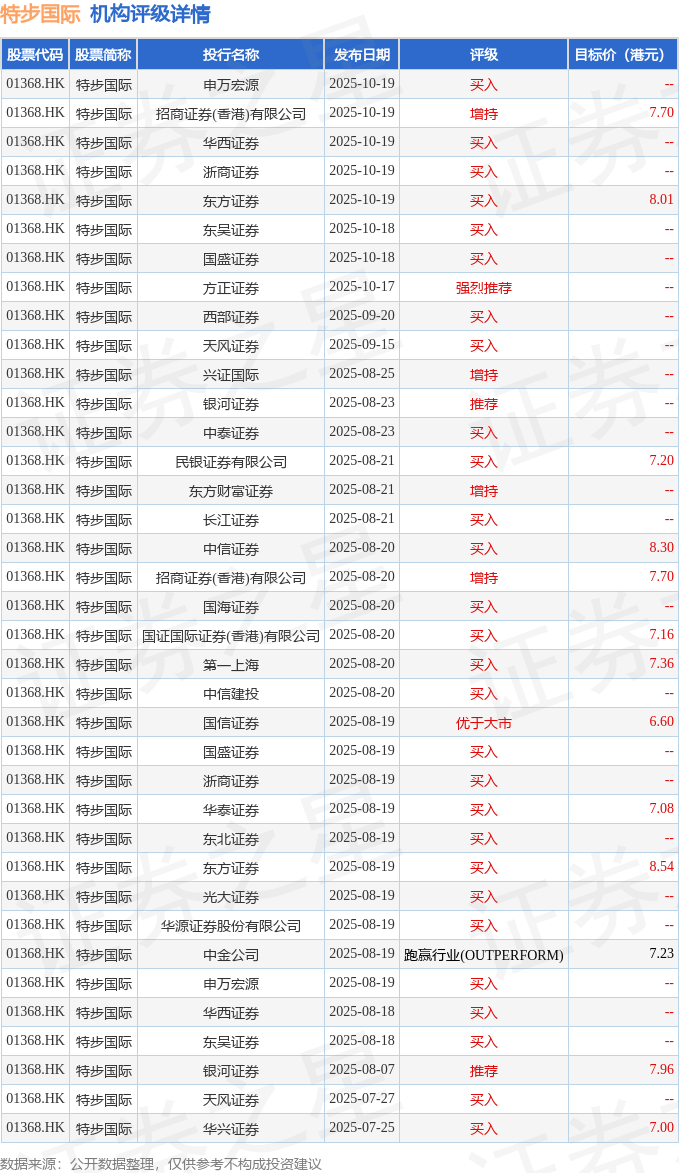
招商证券香港发布研报称,特步国际(01368.HK)重申2025全年业绩指引,并预计四季度将实现强劲增 长,并维持2025-27年盈利预测不变。鉴于"X Young"和索康尼持续拉动增长,该行的目标价基于12.5倍 26年中期市盈率,仍属于自2015年以来的长期平均估值水平,维持目标价7.7港元,维持增持评级。 投行对该股的评级以买入为主,近90天内共有28家投行给出买入评级,近90天的目标均价为7.53港元。 申万宏源最新一份研报给予特步国际买入评级。 机构评级详情见下表: | 股票代码 | 股票简称 | 投行名称 | 发布日期 | 评级 | 目标价(港元) | | --- | --- | --- | --- | --- | --- | | 01368.HK | 特步国际 | 申万宏源 | 2025-10-19 | 买人 | -- | | 01368.HK | 特步国际 | 招商证券(香港)有限公司 | 2025-10-19 | 增持 | 7.70 | | 01368.HK | 特步国际 | 华西证券 | 2025-10-19 | 买人 | | | 01368.HK | 特步国际 | 浙商证券 | 2025 ...
招商证券香港:维持特步国际“增持”评级 目标价7.7港元
Zhi Tong Cai Jing· 2025-10-20 03:26
Core Viewpoint - Xtep International (01368) reaffirms its full-year performance guidance for 2025, expecting strong growth in Q4, while maintaining profit forecasts for 2025-2027. The target price is set at HKD 7.7, based on a 12.5x mid-term P/E ratio for 2026, aligning with long-term average valuation levels since 2015 [1]. Group 1 - Xtep's main brand retail sales recorded low single-digit year-on-year growth in Q3, driven by double-digit percentage expansion in e-commerce sales and strong demand for running shoes [1]. - The "X Young" series continues to positively impact the overall brand performance, with average retail discounts maintained at 25%-30% and channel inventory turnover at 4-4.5 months [1]. - Despite concerns regarding the impact of e-commerce adjustments on the Double Eleven promotion, management anticipates a gradual recovery in e-commerce sales in Q4 [1]. Group 2 - Saucony contributed significantly to the group's growth, with retail sales increasing over 20% year-on-year, primarily due to more than 30% growth in offline business driven by rising consumer demand for high-end sports and running shoes [2]. - Strategic operational adjustments were made in the online business, focusing on reducing exposure to low-priced products and tightening discount levels, which may limit short-term growth but is expected to improve profit margins [2]. - Management expects this cautious operational strategy to support a gradual recovery in e-commerce sales in Q4 [2].