
DTCIC(601001)

Search documents
华源证券:“查超产”改善供需 煤价反弹或助力25Q3煤企业绩环比转增
Zhi Tong Cai Jing· 2025-10-24 07:21
Core Viewpoint - The recent "overproduction check" policy in the coal industry has led to a significant supply-side contraction, which is expected to stabilize and potentially increase coal prices in the long term [1][6]. Group 1: Supply-Side Policy Impact - The "overproduction check" initiated by the National Energy Administration on July 10, 2025, has resulted in a notable decrease in domestic raw coal production, with year-on-year declines of -3.8% and -3.2% in July and August respectively [1]. - The cumulative supply-demand surplus has decreased sharply from 96.29 million tons in the first half of the year to 14.96 million tons by the end of August 2025 [1]. - The price of Qinhuangdao 5500 kcal thermal coal increased from 621 CNY/ton on June 30, 2025, to 699 CNY/ton by September 30, 2025, marking a cumulative increase of 12.6% in Q3 [1]. Group 2: Price Trends and Performance - The average price of Qinhuangdao 5500 kcal thermal coal in Q3 2025 was reported at 672 CNY/ton, reflecting a quarter-on-quarter increase of 6.5% [2]. - The long-term contract price for thermal coal showed a slight decline of -0.7% in Q3, but this is not expected to have a significant negative impact due to the recovery of contract fulfillment rates [2]. - The price of coking coal saw a substantial increase, with the average price for main coking coal at Jing Tang Port reaching 1562 CNY/ton, up 18.8% quarter-on-quarter [2]. Group 3: Production and Cost Management - The overall production of listed coal companies remains within approved capacity limits, with minor overproduction expected to have limited impact on performance [3]. - Cost control has become a key strategy for coal companies in response to declining prices, with significant reductions in labor, material, and safety production costs observed in Q2 2025 [4]. - As coal prices rebound in Q3, it is anticipated that companies will maintain their cost levels rather than pursue further reductions [4]. Group 4: Seasonal Demand and Future Outlook - Despite September typically being a low-demand season for coal, the supply-side contraction is expected to keep prices stable, with a slight increase of 0.1% in September [6]. - The winter season is projected to see stronger demand for heating coal, which, combined with ongoing supply-side policies, may lead to a tighter coal supply and sustained high prices [6]. Group 5: Investment Recommendations - Companies to watch include stable large-scale thermal coal producers such as China Shenhua (601088), China Coal Energy (601898), and Shaanxi Coal and Chemical Industry (601225) [7]. - High-elasticity coal companies like Yanzhou Coal Mining (600188) and Jincheng Anthracite Mining (601001) are also recommended for potential investment [7]. - Quality coking coal companies such as Huaibei Mining (600985) and Pingdingshan Tianan Coal (601666) are highlighted as attractive investment opportunities [7].






寒流来袭,这个板块有“热”的理由丨每日研选
Shang Hai Zheng Quan Bao· 2025-10-24 00:59
Group 1 - The coal sector is regaining attention due to improved supply-demand dynamics and strong cash flow, making it a potential target for "high-low cut" funds [1] - Coal prices and indices have performed well since October, driven by supply constraints from production checks and increased coal demand due to temperature fluctuations [2] - The coal sector is currently undervalued, with a demand for price recovery, particularly for companies like Yanzhou Coal Mining and Jinneng Holding [2] Group 2 - Future coal inventory demand is expected to grow, with limited supply increases, leading to a strong coal price outlook for Q4 [3] - The coal sector is projected to see renewed market interest, particularly in coal, banking, and agriculture, as these sectors are expected to perform well in Q4 [4] - The investment value of leading coal companies is highlighted due to their high dividends and strong cash flow, with a focus on companies like China Shenhua and Shanxi Coking Coal [5] Group 3 - The target price for thermal coal has been raised to 750-800 RMB/ton due to sustained demand and supply constraints [6] - The likelihood of a "La Niña" phenomenon this winter could lead to increased natural gas prices in Europe and Asia, prompting interest in natural gas-related companies [8]


晋控煤业:截至10月20日,公司股东人数为58000余户
Zheng Quan Ri Bao Wang· 2025-10-23 09:41
证券日报网讯晋控煤业(601001)10月23日在互动平台回答投资者提问时表示,截至10月20日,公司股 东人数为58000余户。 ...
晋控煤业跌2.03%,成交额1.07亿元,主力资金净流出1102.58万元
Xin Lang Cai Jing· 2025-10-22 02:06
Core Viewpoint - Jinko Coal Industry's stock price has shown fluctuations with a recent decline of 2.03%, while the company has experienced a year-to-date increase of 19.86% in stock price [1][2]. Financial Performance - For the first half of 2025, Jinko Coal Industry reported a revenue of 5.965 billion yuan, a year-on-year decrease of 19.16%, and a net profit attributable to shareholders of 876 million yuan, down 39.01% year-on-year [2]. - The company has distributed a total of 6.083 billion yuan in dividends since its A-share listing, with 3.640 billion yuan distributed over the past three years [2]. Stockholder Information - As of September 19, 2025, the number of shareholders for Jinko Coal Industry was 56,000, a decrease of 1.75% from the previous period, with an average of 29,887 circulating shares per shareholder, an increase of 1.79% [2]. - The top ten circulating shareholders include Hong Kong Central Clearing Limited, holding 22.0111 million shares, and Ruiyuan Growth Value Mixed A, holding 15.9652 million shares, with some fluctuations in their holdings [3]. Market Activity - As of October 22, 2025, Jinko Coal Industry's stock was trading at 15.48 yuan per share, with a total market capitalization of 25.909 billion yuan and a trading volume of 1.07 billion yuan [1]. - The stock has seen a net outflow of 11.0258 million yuan from main funds, with significant buying and selling activity from large orders [1]. Business Overview - Jinko Coal Industry, established on July 25, 2001, and listed on June 23, 2006, primarily engages in coal mining, washing, processing, and sales, with coal accounting for 94% of its revenue [1]. - The company operates within the coal mining sector, specifically focusing on thermal coal, and is categorized under various investment themes such as scarce resources and state-owned assets in Shanxi [1].
煤炭月度供需数据点评:9月:煤价平稳,看好板块四季度投资机会-20251021
Shanxi Securities· 2025-10-21 09:22
Investment Rating - The report upgrades the coal industry investment rating to "Leading the Market" for the fourth quarter, indicating expected performance exceeding the benchmark index by over 10% [1][37]. Core Insights - The coal price remained stable in September, with expectations for investment opportunities in the sector during the fourth quarter. The report highlights a potential recovery in coal prices and demand due to seasonal factors and policy changes [1][7]. - Domestic coal supply continues to contract, while coal imports are expected to increase as domestic production is controlled. The report suggests that if coal prices stabilize and rebound, this could further stimulate import demand [6][7]. - The report emphasizes that the fourth quarter may see better performance than the third quarter, with coal prices expected to recover due to limited supply growth and anticipated demand during the winter peak [7]. Supply and Demand Summary - Supply: From January to September 2025, the cumulative output of raw coal reached 3.57 billion tons, a year-on-year increase of 2.0%, but the growth rate is declining. In September alone, the output was 412 million tons, down 1.8% year-on-year but up 5.38% month-on-month [4]. - Demand: The terminal demand in the first nine months of 2025 was supported by manufacturing and infrastructure investments. Fixed asset investment decreased by 0.5% year-on-year, with manufacturing investment up 4.0% and infrastructure investment up 1.1%. However, real estate investment fell by 13.9% [4]. Import Data Summary - In September, coal imports increased month-on-month, but the cumulative import volume from January to September 2025 was 34.6 million tons, a year-on-year decrease of 11.1%. The September import volume was 46 million tons, down 3.34% year-on-year but up 7.64% month-on-month [5]. Price Analysis - In September, coal prices showed a stable upward trend, with different price movements across various coal types. The report notes that while prices for Shanxi premium mixed 5500 thermal coal and other types adjusted, they exhibited varying degrees of increase month-on-month [6]. Investment Recommendations - The report recommends focusing on coal sector investments in the fourth quarter, highlighting that the overall valuation of the sector is low and there is potential for a rebound. Specific companies to watch include Jin Kong Coal Industry, Shan Coal International, and Huayang Co., with a focus on elastic varieties [7].


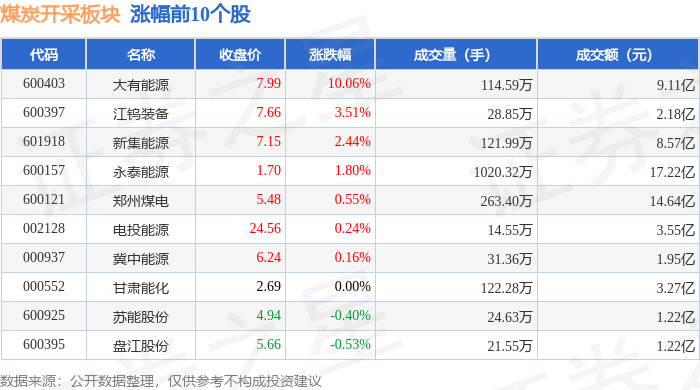
煤炭开采板块10月21日跌1.16%,兖矿能源领跌,主力资金净流出10.1亿元
Zheng Xing Xing Ye Ri Bao· 2025-10-21 08:28
Core Viewpoint - The coal mining sector experienced a decline of 1.16% on October 21, with Yanzhou Coal Mining Company leading the drop, while the overall Shanghai Composite Index rose by 1.36% [1] Group 1: Market Performance - The Shanghai Composite Index closed at 3916.33, up 1.36%, and the Shenzhen Component Index closed at 13077.32, up 2.06% [1] - The coal mining sector saw significant individual stock movements, with Daya Energy rising by 10.06% to a closing price of 7.99, while several other stocks also posted gains [1] Group 2: Trading Volume and Capital Flow - The coal mining sector had a net outflow of 1.01 billion yuan from main funds, while retail investors saw a net inflow of 528 million yuan [2][3] - The trading volume for Daya Energy reached 1.1459 million hands, with a transaction value of 911 million yuan, indicating strong investor interest [1] Group 3: Individual Stock Analysis - Major stocks in the coal mining sector included: - Daya Energy: Closing price 7.99, up 10.06%, with a transaction value of 911 million yuan [1] - Jiangte Equipment: Closing price 7.66, up 3.51%, with a transaction value of 218 million yuan [1] - New集 Energy: Closing price 7.15, up 2.44%, with a transaction value of 857 million yuan [1] - Conversely, stocks like 中煤能源 and 晋控煤业 saw declines of 3.10% and 2.95%, respectively, indicating mixed performance within the sector [2]

煤炭行业周报:安监趋严、供给收紧,大面积降温预计助推煤价持续上涨-20251020
Shenwan Hongyuan Securities· 2025-10-20 07:43
Investment Rating - The report rates the coal industry as "Overweight" indicating a positive outlook for the sector [3]. Core Insights - The report highlights that stricter safety regulations and supply constraints are expected to drive coal prices higher, particularly in the context of the upcoming winter heating season [3]. - It notes significant increases in spot prices for thermal coal, with prices for Q4500, Q5000, and Q5500 thermal coal at Qinhuangdao port rising by 36, 41, and 39 RMB/ton respectively [3]. - The report emphasizes the expected continued upward momentum in thermal coal prices due to seasonal demand and tightening supply [3]. Summary by Sections Recent Industry Policies and Developments - The report discusses various projects, including a major energy logistics project in Xinjiang with a total investment of 2.56 billion RMB, aimed at enhancing energy security [4]. - It mentions the construction of a coal-to-natural gas project in Northeast China, which is expected to convert 7.5 million tons of low-quality coal into 1.33 billion cubic meters of natural gas annually [8]. Price Movements - Thermal coal prices have seen significant increases, with various regions reporting price hikes, such as a 20 RMB/ton increase in Datong and a 40 RMB/ton increase in Yulin [9]. - Coking coal prices remained stable, with prices reported at 1485 RMB/ton in Shanxi [12]. Supply and Demand Dynamics - The report indicates a decrease in daily coal inflow to the Bohai Rim ports, with an average of 1.4914 million tons, down 15.46% week-on-week [20]. - Conversely, coal outflow from the same ports increased by 24.93%, indicating a shift in supply-demand dynamics [20]. Shipping Costs - Domestic coastal shipping costs have risen significantly, with average freight rates reported at 43.05 RMB/ton, an increase of 28.96% [27]. Company Valuations - The report provides a valuation table for key companies in the coal sector, highlighting their stock prices, market capitalizations, and earnings per share (EPS) forecasts [32]. - For instance, China Shenhua's stock price is reported at 41.90 RMB with a market cap of 832.5 billion RMB and an EPS forecast of 2.95 RMB for 2024 [32].
国泰海通:煤价持续大涨 风偏下降背景下低位煤炭吸引力提升
智通财经网· 2025-10-20 06:09
Core Insights - The coal industry is experiencing a dual improvement in supply and demand, leading to higher-than-expected coal prices, with supply-side policies reducing overproduction and increasing safety inspections [1][2] - The La Niña phenomenon is expected to drive winter storage demand due to cold weather predictions, while unusual high temperatures in southeastern coastal areas have led to record-high daily coal consumption [1] - The market is shifting towards defensive dividend attributes and coal's low baseline fundamentals, enhancing its attractiveness [1] Supply Side - The coal supply contraction is leading the entire industry, with national coal production in July and August at 380 million and 390 million tons, significantly lower than the average monthly production of approximately 400 million tons over the past 18 months [2] - In August, the industrial raw coal production was 390 million tons, a year-on-year decrease of 3.2%, with a slight month-on-month increase of 10 million tons [2] - The total annual coal production is expected to be around 4.75 billion tons, a year-on-year decrease of 30 to 50 million tons [2] Demand Side - The total electricity consumption in August grew by 4.6%, a significant increase from the 2.5% growth in Q1, with expectations for the annual growth rate to exceed 5% [2] - Despite entering the typical demand off-season in September and October, demand has exceeded expectations, maintaining high levels in the East China region post the October holiday [2] Coal Prices - As of October 17, 2025, the price of Q5500 coal at Huanghua Port was 750 RMB/ton, an increase of 34 RMB/ton (4.7%) from the previous week [3] - Domestic supply remains stable while imports are expected to continue declining, with Q3 profits anticipated to rebound due to improved demand [2][3] Coking Coal - As of October 17, 2025, the price of main coking coal at Jingtang Port was 1690 RMB/ton, up 30 RMB/ton (1.8%) [3] - The average daily iron and steel production has slightly decreased, but demand is expected to remain strong [3] Investment Recommendations - The report recommends investing in core dividend stocks such as China Shenhua (601088.SH), Shaanxi Coal and Chemical Industry (601225.SH), and China Coal Energy (601898.SH) [3] - Continued recommendations include Yanzhou Coal Mining (600188.SH) and Jincheng Anthracite Mining (601001.SH) [3]

行业周报:煤价势如破竹至煤电均分750元,静待上穿过程-20251019
KAIYUAN SECURITIES· 2025-10-19 15:18
Investment Rating - The investment rating for the coal industry is "Positive" (maintained) [1] Core Viewpoints - The report indicates that the prices of thermal coal and coking coal have reached a turning point, with thermal coal prices expected to rebound and stabilize above the long-term contract price of around 700 CNY per ton, with a potential target of 750 CNY per ton in 2025 [6][7][16] - The report highlights that the coal market is experiencing a significant price increase, with thermal coal prices rising to 748 CNY per ton as of October 17, 2025, marking a 6.1% increase from the previous period [6][20] - The investment logic is based on two main aspects: cyclical elasticity and stable dividends, suggesting that the coal sector is at a favorable entry point for investment [8][17] Summary by Sections Investment Logic - Thermal coal is categorized as a policy-driven commodity, with prices expected to recover to long-term contract levels due to the dual-track pricing mechanism [7][16] - Coking coal prices are more influenced by supply and demand fundamentals, with target prices set based on the ratio of coking coal to thermal coal prices [7][16] Market Performance - The coal index increased by 4.17% in the week, outperforming the CSI 300 index by 6.39 percentage points [11][28] - Major coal companies showed significant price increases, with the top performers being Dayou Energy (+53.13%), Zhengzhou Coal Electricity (+15.93%), and China Coal Energy (+11.68%) [11][28] Price Indicators - As of October 17, 2025, the Qinhuangdao Q5500 thermal coal price was 748 CNY per ton, reflecting a 6.1% increase [20] - The price of coking coal at Jingtang Port reached 1710 CNY per ton, up from 1630 CNY, indicating a 4.91% increase [21][23] Investment Recommendations - The report suggests four main lines for coal stock selection: cyclical logic (e.g., Jinko Coal and Yanzhou Coal), dividend logic (e.g., China Shenhua and Zhongmei Energy), diversified aluminum elasticity (e.g., Shenhua Holdings), and growth logic (e.g., Xinji Energy and Guanghui Energy) [8][17]


“逆袭”的背后
GOLDEN SUN SECURITIES· 2025-10-19 13:55
Investment Rating - The report maintains a "Buy" rating for key coal companies such as China Shenhua, Shaanxi Coal, and Yancoal [11]. Core Viewpoints - The coal industry is experiencing a strong price increase driven by robust demand and supply constraints, with expectations for prices to peak by year-end [4][10]. - The report emphasizes that the current price increase is not merely a rebound but a reversal, supported by regulatory actions limiting production and extreme weather conditions affecting demand [4][10]. - The coal market is expected to maintain a bullish trend due to ongoing supply restrictions and seasonal demand increases, particularly in the context of winter storage needs [10][12]. Summary by Sections Market Review - The CITIC Coal Index rose to 3812.86 points, up 4.27%, outperforming the CSI 300 Index by 6.49 percentage points [2][77]. - Since October, the price of North Port thermal coal has increased by 34 CNY/ton, reaching 739 CNY/ton, while the CITIC Coal Index has risen by 8.8% [3][10]. Industry Trends - The report highlights a significant decline in coal production due to regulatory checks on overproduction, with July and August showing year-on-year decreases [10]. - Extreme weather conditions have led to increased coal demand, particularly in southern regions experiencing high temperatures, while northern areas face rapid cooling [10][12]. - The report notes that safety inspections and regulatory measures are expected to further constrain supply, potentially leading to price increases beyond market expectations [10][12]. Key Areas of Analysis - **Thermal Coal**: Strong demand from non-electric sectors and winter storage needs are driving prices higher, with port inventories significantly reduced due to limited rail transport [12][15]. - **Coking Coal**: The report indicates that downstream demand for coking coal is robust, with prices rising as steel mills replenish their inventories [12][37]. - **Coke**: The market for coke remains tight, with high iron production supporting demand, although profitability for coke producers has declined [12][53]. Investment Strategy - The report recommends focusing on companies with strong earnings potential such as Lu'an Environmental Energy and Yancoal, as well as state-owned enterprises like China Shenhua and China Coal Energy [11][12].