
CSEC,China Shenhua(601088)

Search documents
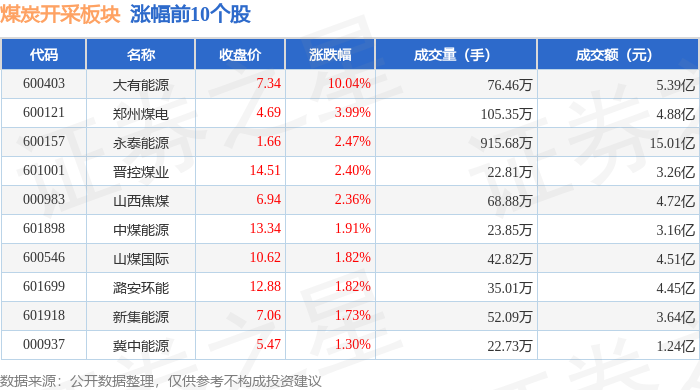
煤炭开采板块1月20日涨1.28%,大有能源领涨,主力资金净流入3.71亿元
Zheng Xing Xing Ye Ri Bao· 2026-01-20 08:59
Group 1: Market Performance - The coal mining sector increased by 1.28% compared to the previous trading day, with Dayou Energy leading the gains [1] - The Shanghai Composite Index closed at 4113.65, down 0.01%, while the Shenzhen Component Index closed at 14155.63, down 0.97% [1] Group 2: Individual Stock Performance - Dayou Energy (600403) closed at 7.34, up 10.04% with a trading volume of 764,600 shares and a transaction value of 539 million [1] - Zhengzhou Coal Power (600121) closed at 4.69, up 3.99% with a trading volume of 1,053,500 shares [1] - Yongtai Energy (600157) closed at 1.66, up 2.47% with a trading volume of 9,156,800 shares [1] - Other notable stocks include Jinkong Coal Industry (601001) at 14.51, up 2.40%, and Shanxi Coking Coal (000983) at 6.94, up 2.36% [1] Group 3: Capital Flow Analysis - The coal mining sector saw a net inflow of 371 million from main funds, while retail funds experienced a net outflow of 143 million [2] - Dayou Energy had a main fund net inflow of 176 million, representing 32.63% of its trading volume, while retail funds saw a net outflow of 112 million [3] - Yongtai Energy recorded a main fund net inflow of 141 million, with a retail net outflow of 64.86 million [3]





煤炭开采行业月报:25年产量微增、进口减、需求弱,26年关注美国、印尼煤炭市场机会
GOLDEN SUN SECURITIES· 2026-01-20 08:24
Investment Rating - The report maintains a "Buy" rating for key companies in the coal mining sector, including China Shenhua, China Coal Energy, and Yanzhou Coal Mining [10]. Core Insights - The coal production in December 2025 saw a slight year-on-year decrease of 1%, with a total output of 440 million tons. The annual output for 2025 was 4.83 billion tons, reflecting a 1.2% increase compared to the previous year. For 2026, the domestic thermal coal production is expected to increase by only 20-30 million tons to 3.85 billion tons, representing a growth of approximately 0.6% [1][13]. - Coal imports in December 2025 increased by 11.94% year-on-year, totaling 58.597 million tons. However, the total imports for the year were 49.027 million tons, a decline of 9.6% compared to 2024. The report anticipates stable coal import levels in 2026, with significant attention on potential changes from the U.S. and Indonesia [2][17][18]. - The report highlights a 3.2% year-on-year decrease in thermal power generation in December 2025, with total industrial power generation for the year increasing by 2.2%. The decline in thermal power generation is contrasted with growth in renewable energy sources, although their growth rates have slowed [3][21]. Summary by Sections Production - December coal production decreased by 1% year-on-year, with a total of 440 million tons produced. The daily average production was 14.1 million tons, and the total for 2025 was 4.83 billion tons, up 1.2% from 2024. The report predicts strict policies will continue into 2026, limiting production increases primarily to new mines [1][13]. Imports - December coal imports rose by 11.94% year-on-year to 58.597 million tons, with a monthly increase of 33.01% from November. The total imports for 2025 were 49.027 million tons, down 9.6% from the previous year. The report expects stable import levels in 2026, with a focus on U.S. and Indonesian market dynamics [2][17][18]. Demand - December thermal power generation fell by 3.2% year-on-year, while total industrial power generation saw a slight increase of 0.1%. The report notes that while thermal power generation declined, renewable energy sources experienced growth, albeit at a slower pace [3][21].


25年产量微增、进口减、需求弱,26年关注美国、印尼煤炭市场机会
GOLDEN SUN SECURITIES· 2026-01-20 08:21
Investment Rating - The report maintains a "Buy" rating for key companies in the coal mining sector, including China Shenhua, China Coal Energy, and Yanzhou Coal Mining [10][36]. Core Insights - The coal production in December 2025 saw a slight year-on-year decline of 1%, with a total output of 440 million tons. The annual production for 2025 was 4.83 billion tons, reflecting a growth of 1.2% compared to the previous year. For 2026, the domestic thermal coal production is expected to increase by only 20-30 million tons, reaching 3.85 billion tons, which is a growth of approximately 0.6% [1][13]. - Coal imports in December 2025 increased by 11.94% year-on-year, totaling 58.597 million tons. However, the total imports for the year were 49.027 million tons, a decrease of 9.6% compared to 2024. The report anticipates stable coal import levels in 2026, with significant attention on potential changes from the U.S. and Indonesia [2][17][21]. - The report highlights a 3.2% year-on-year decline in thermal power generation in December 2025, with total industrial power generation showing a marginal increase of 0.1%. The overall industrial power generation for the year was 971.59 billion kWh, up 2.2% from 2024 [3][22]. Summary by Sections Production - December coal production decreased by 1% year-on-year, with a total of 440 million tons produced. The daily average production was 14.1 million tons, and the total for 2025 was 4.83 billion tons, up 1.2% [1][13][14]. Imports - December coal imports rose by 11.94% year-on-year, amounting to 58.597 million tons. The total imports for 2025 were 49.027 million tons, down 9.6% from the previous year. The report expects stable import levels in 2026, with a focus on U.S. and Indonesian market dynamics [2][17][21]. Demand - Thermal power generation in December 2025 fell by 3.2% year-on-year, while total industrial power generation increased slightly by 0.1%. The total for the year was 971.59 billion kWh, reflecting a 2.2% increase from 2024 [3][22].
上市公司重大资产重组、股权激励计划月度跟踪(2025年12月):系列政策协同加持,并购重组和股权激励有望激发市场活力-20260120
Shenwan Hongyuan Securities· 2026-01-20 07:07
Group 1: Core Insights - The report highlights that the A-share market is expected to gain momentum through accelerated mergers and acquisitions (M&A) and stock incentive plans, driven by supportive policies from the China Securities Regulatory Commission (CSRC) [8][12][18] - In December 2025, a total of 12 major asset restructuring plans were announced, predominantly in the machinery and equipment sector, with over half currently in the board proposal stage [12][22] - The report identifies key cases of interest, including WISCO's acquisition of 100% equity in WISCO Mining and Luzhong Mining, which aims to transition the company’s main business to black metal mining [22][24] Group 2: M&A Overview - In 2025, there were 134 disclosed major asset restructuring cases, with the electronics industry leading the count [8][12] - The report notes that the majority of December's restructuring cases involved companies with a market capitalization of less than 5 billion, indicating a trend towards smaller firms engaging in M&A [12][18] - The primary motives for these restructurings were strategic cooperation and horizontal integration, with 5 and 4 cases respectively [12][22] Group 3: Stock Incentive Plans - Approximately 91% of the stock incentive plans announced in 2025 have begun implementation, indicating strong engagement from companies in this area [28][33] - In December 2025, 39 new stock incentive plans were released, with the electronics and machinery sectors being the most active [33][41] - The majority of these plans had an incentive total that represented 1% to 2% of the total share capital, reflecting a conservative approach to equity incentives [33][41]



能源央企重组从规模扩张到生态构建
Zhong Guo Dian Li Bao· 2026-01-20 03:49
Group 1 - The core point of the news is the successful restructuring between China Petroleum & Chemical Corporation and China Aviation Oil Group, signaling a clear direction for future strategic mergers and professional integration among state-owned enterprises [1] - The restructuring and integration aim to enhance the operational efficiency of state-owned capital, with significant growth in total assets from 68.8 trillion yuan at the end of the 13th Five-Year Plan to an expected 91 trillion yuan by the end of 2024, reflecting an annual growth rate of 7.3% [2] - During the 14th Five-Year Plan, state-owned enterprises are projected to increase their value-added and total profits by over 40% and 50% respectively compared to the 13th Five-Year Plan, with improvements in labor productivity and return on net assets [2] Group 2 - The restructuring is not only about scale expansion but also about a systematic transformation towards new productive forces, with state-owned enterprises investing 8.6 trillion yuan in strategic emerging industries since the 14th Five-Year Plan, significantly increasing revenue contributions [3] - State-owned enterprises have contributed over 10 trillion yuan in taxes and fees since the 14th Five-Year Plan, accounting for approximately 80% of crude oil, 70% of natural gas, and 60% of electricity supply [3] Group 3 - Three types of restructuring models are identified: horizontal mergers for synergy, vertical integration to streamline supply chains, and professional integration to enhance quality [4][5][6] - Horizontal mergers focus on deepening integration within business segments, exemplified by China Shenhua Energy's acquisition of key subsidiaries to enhance competitiveness [4] - Vertical integration aims to connect upstream and downstream sectors, as seen in the merger of China National Nuclear Corporation and China Nuclear Engineering Corporation, creating a complete nuclear power industry chain [5] Group 4 - Future restructuring will increasingly focus on technological breakthroughs and the development of new productive forces, with a dual approach of exiting inefficient businesses while investing in strategic emerging industries [8] - Professional integration is expected to deepen, targeting specific key areas and high-end niche markets, such as inspection and testing, industrial software, and data services [8] - The construction of open and collaborative industrial ecosystems will become a significant development direction, with state-owned enterprises potentially transforming into industry organizers or service providers [9] Group 5 - Key areas for future restructuring activity are anticipated to include strategic mineral resources, high-end manufacturing, digital technology, green and low-carbon energy, and life sciences [10]

中国神华20260116
2026-01-19 02:29
Summary of China Shenhua's Conference Call Company Overview - **Company**: China Shenhua Energy Company Limited - **Industry**: Coal and Power Generation Key Points Pricing Mechanism and Sales Strategy - In 2026, the coal pricing mechanism is flexible, allowing for negotiated pricing to reflect price fluctuations. The company uses a method of back-calculating port prices from pit prices, with a cap on prices if they exceed a certain limit. January pricing is primarily determined through negotiations, with some reference to the national coal trading center's guidance price [2][3] - The average transportation cost for coal sales is between 80-120 RMB per ton, but actual full transportation costs may be higher [2][5] - Coal sales are categorized based on unified scheduling and pit sales, divided into annual long-term contracts, monthly long-term contracts, and spot sales, without distinguishing between coal types or sales locations [2][5] Production and Sales Performance - As of November, the company achieved 90.9% of its coal production target and 84% of its sales target, with sales slightly below expectations due to market demand. Power generation completed approximately 7.5%, correlating with electricity demand [2][6] - The company expects to maximize external coal procurement in 2026, contingent on not incurring losses, with plans dependent on downstream customer demand and pricing conditions [2][7] Financial Outlook and Capital Expenditure - The capacity electricity price compensation ratio is expected to increase to 50-70% in 2026, significantly impacting revenue diversification. Auxiliary service income is also anticipated to rise due to improved mechanisms and increased new installations [2][4][7] - Capital expenditure for 2026-2027 is projected to be between 30 billion to 50 billion RMB, covering maintenance and new projects, including coal mines and power stations [4][10] Market Conditions and Profitability - Long-term electricity prices are expected to decline by about 1-2 cents in most provinces in 2026, with capacity price increases offsetting some of the decline. Fuel cost changes are critical for profitability, with further budget assessments needed for 2027 [4][7] - The company is actively pursuing auxiliary service revenues to mitigate profit decline risks due to falling long-term electricity prices [7] New Energy and Coal Chemical Projects - As of the third quarter, the company's installed capacity for new energy projects is approximately 3.5 GW, with plans to adjust based on market demand and policy direction. However, the company does not prioritize new energy development, focusing instead on coal-based operations [8] - The company is upgrading its coal-to-olefins project in Baotou, increasing capacity from 600,000 tons to 1.35 million tons, expected to be completed by 2027 [8][9] Strategic Partnerships and Cost Management - The company signed a long-term contract for over 200 million tons of coking coal with Mongolia's ETT, managed by the State Energy Group, indicating strategic procurement considerations [12] - Cost reductions in 2025 were attributed to adjustments in safety production fee standards, with ongoing measures planned for 2026 to maintain cost control despite profit stability pressures [12] Transportation and Supply Chain - Most coal from Xinjiang is consumed locally, with annual external transport volumes between 10 million to 20 million tons. The company is exploring various transportation routes to optimize costs and efficiency [13][14] Dividend Policy - The company commits to a dividend payout ratio of no less than 65% of the net profit attributable to shareholders for 2025-2027, with the recent acquisition not expected to impact this policy [15] Import Strategy - The State Energy Group's coal import strategy is flexible and adjusts based on market conditions and operational needs, rather than adhering to a fixed annual plan [16]
国海证券晨会纪要-20260119
Guohai Securities· 2026-01-19 01:03
Group 1 - The A-share market in 2025 experienced significant changes, primarily driven by valuation increases across various sectors, with the non-ferrous metals industry leading the gains [4] - The overall A-share market performance can be divided into four phases: Phase 1 (Jan-Mar): Technology concepts led the "tech bull"; Phase 2 (Apr-Jun): External shocks and internal support boosted the market; Phase 3 (Jun-Nov): Liquidity and economic conditions resonated, accelerating trends; Phase 4 (Nov-Dec): A period of consolidation after the main index rise [4] - Key characteristics of the 2025 A-share market include a new level of total market capitalization, continuous inflow of new funds, and a shift in market structure, with the electronics sector reaching the highest market value for the first time [4] Group 2 - Yonyou Network expects a reduction in losses for 2025, projecting a net profit of -1.3 billion to -1.39 billion yuan, with revenue expected to be between 9.17 billion and 9.27 billion yuan [6][8] - The company is transitioning to a subscription-based business model, which is expected to impact revenue growth rates, despite a recovery in contract signing amounts starting from the second quarter of 2025 [7] - The launch of the BIP "Ontology-Driven Agent" aims to enhance AI capabilities in enterprises, shifting from probabilistic generation to logical execution, providing a new foundation for high-quality AI applications [10][11] Group 3 - Ant Group's collaboration with Weining Health has led to the rapid deployment of AI products, with the monthly active users of the Ant Health app exceeding 30 million, indicating strong market penetration [12][13] - Weining Health's WiNEX series AI products have been implemented in nearly 150 medical institutions, enhancing clinical decision-making and documentation efficiency [14] - The Chinese medical software system market is projected to reach 11.5 billion yuan by 2029, with Weining Health focusing on domestic innovation and adaptation [15][16] Group 4 - The People's Bank of China reported stable loan rates and increased corporate loan issuance, indicating a positive outlook for the banking sector [18][19] - The December social financing data showed a year-on-year increase in new loans, primarily driven by corporate loans, suggesting a robust lending environment [19][20] Group 5 - The UK AR7 offshore wind auction results exceeded expectations, with a total auction volume of 8.4GW, marking a 58% increase from the previous round, indicating strong future demand for offshore wind projects [21][22] - Domestic manufacturers are expected to benefit from increased orders as a result of the AR7 auction outcomes, with significant growth anticipated in the offshore wind sector [24] Group 6 - Tencent Holdings is projected to achieve a revenue of 195.4 billion yuan in Q4 2025, with strong growth in its gaming and advertising segments [25][26] - The company is expected to maintain robust performance across its core businesses, with AI capabilities enhancing its overall ecosystem [27] Group 7 - The coal market is expected to see price support due to seasonal demand and supply constraints, with current prices at 695 yuan/ton [28][31] - The coking coal market is experiencing a recovery in demand as steel production increases, leading to a rise in coking coal prices [29][30] Group 8 - The State Grid's investment during the 14th Five-Year Plan is projected to reach 4 trillion yuan, significantly boosting the power equipment supply chain [41] - The focus on new energy systems and AI integration in power operations is expected to enhance operational efficiency and support the growth of emerging industries [41]





煤价上行回归合理价格,坚定稳煤价逻
Zhong Guo Neng Yuan Wang· 2026-01-19 00:45
Group 1 - The core viewpoint of the report indicates that coal prices are returning to reasonable levels, with a slight decline in thermal coal prices, and an expectation for gradual recovery to around 750 RMB/ton [1][2] - As of January 17, the Qinhuangdao Q5500 thermal coal price is 695 RMB/ton, down 4 RMB/ton from the previous period, having previously reached the estimated target price range of 800-860 RMB/ton [1][2] - The report highlights that the recent price drop is attributed to a combination of supply tightening due to regulatory actions and increased demand driven by seasonal heating needs [2][3] Group 2 - The investment logic suggests that both thermal and coking coal prices have reached a turning point, with thermal coal prices expected to undergo a recovery process influenced by policy adjustments and market dynamics [3] - The report outlines a four-step process for thermal coal price recovery, including the restoration of long-term contracts and achieving a balance in profitability between coal and power companies [3] - Coking coal prices are more influenced by market supply and demand fundamentals, with target prices linked to the price ratio between coking and thermal coal [3] Group 3 - The investment recommendation emphasizes a dual logic of cyclical recovery and stable dividends, suggesting that coal stocks are positioned for upward price movement due to low historical price levels and improving supply-demand fundamentals [4] - The report identifies four main investment lines in coal stocks, focusing on cyclical logic, dividend potential, diversified aluminum exposure, and growth logic [4] - Specific coal companies are highlighted as beneficiaries of these trends, including Jin控煤业, 兖矿能源, 中国神华, and others [4]


行业周报:煤价上行回归合理价格,坚定稳煤价逻辑-20260118
KAIYUAN SECURITIES· 2026-01-18 14:44
Investment Rating - The investment rating for the coal industry is "Positive" (maintained) [1] Core Views - The report emphasizes that coal prices are returning to reasonable levels, reinforcing the logic of stable coal prices. The price of thermal coal has slightly decreased, with the Qinhuangdao Q5500 thermal coal closing at 695 CNY/ton as of January 17, down 4 CNY/ton from the previous period. The report anticipates a gradual recovery to a reasonable price of 750 CNY/ton, with narrow fluctuations expected [3][4] - The long-term investment logic remains unchanged, driven by a dual influence of tightening supply and increasing demand. Supply constraints are a continuation of the strict production checks initiated in July, while demand is rising due to the heating season and increased industrial production [3][4] Summary by Sections Investment Logic - Thermal coal prices are expected to rise through a four-step process: repairing central and local long-term contracts, reaching the coal-electricity profit-sharing line, and approaching the breakeven point for power plants, estimated at around 750 CNY/ton for 2025. The upper limit for coal prices is predicted to be between 800-860 CNY/ton [4][15] - Coking coal prices are more influenced by supply and demand fundamentals, with target prices based on the ratio of coking coal to thermal coal prices. The current ratio indicates target prices for coking coal at 1608 CNY, 1680 CNY, 1800 CNY, and 2064 CNY [4][15] Investment Recommendations - The report outlines a dual logic for coal stocks: cyclical elasticity and stable dividends. With both thermal and coking coal prices at historical lows, there is significant room for rebound. The report identifies four main lines for stock selection: 1. Cyclical logic: Jin控煤业, 兖矿能源 for thermal coal; 平煤股份, 淮北矿业, 潞安环能 for metallurgical coal 2. Dividend logic: 中国神华, 中煤能源, 陕西煤业 3. Diversified aluminum elasticity: 神火股份, 电投能源 4. Growth logic: 新集能源, 广汇能源 [5][16] Key Market Indicators - The coal index fell by 3.11% this week, underperforming the CSI 300 index by 2.54 percentage points. The average PE ratio for the coal sector is 15.12, and the PB ratio is 1.33, both ranking among the lowest in the A-share market [10][25][29]
库存去化&寒潮来临,短期煤价有望平稳偏强
Xinda Securities· 2026-01-18 12:03
Report Industry Investment Rating - The investment rating for the coal mining industry is "Bullish" [2] Report's Core View - The coal industry is at the beginning of a new upward cycle, with fundamental and policy factors in resonance. It is advisable to allocate coal stocks on dips. The underlying investment logic of coal production capacity shortage remains unchanged, and coal prices have established a bottom and are expected to rise. High - quality coal enterprises have core asset attributes such as high profitability, high cash flow, high ROE, and high dividends. The coal sector is still undervalued, and its valuation is expected to increase. The coal supply bottleneck is expected to last until the "15th Five - Year Plan", and coal prices are likely to remain high. The report continues to be bullish on the coal sector and recommends top - down attention to several types of coal companies [3][11][12] Summary by Directory 1. This Week's Core View and Key Focus - **Core View**: The coal industry is in the early stage of a new upward cycle. The supply side shows an increase in the utilization rate of sample power and coking coal mine wells. On the demand side, there are differences in coal consumption between inland and coastal areas, and non - electric demand also shows different trends. Coal prices stopped falling and rebounded since late December, but the rebound momentum weakened this week. In the future, inventory depletion and the upcoming cold wave will support coal prices, and the market is expected to be stable and slightly strong before the holiday. The coal sector has high - dividend support and upward elasticity, making it a cost - effective investment [11] - **Investment Suggestions**: Focus on companies with stable operations and performance, those with large previous declines and high elasticity, and high - quality metallurgical coal companies. Also, pay attention to other related companies [12] - **Key Focus**: In 2025, China's coal imports decreased by 9.6% year - on - year; India's coal production was basically flat with a slight decline; global seaborne coal trade decreased by 2.8% [13] 2. This Week's Performance of the Coal Sector and Individual Stocks - The coal sector fell 3.33% this week, underperforming the broader market. The CSI 300 fell 0.57% to 4731.87. The top - three sectors in terms of gains were computer, electronics, and media [14] - The power coal, coking coal, and coke sectors fell 3.46%, 3.66%, and 4.38% respectively [17] - The top - three gainers in the coal mining and washing sector were Anyuan Coal Industry (3.97%), Huayang Co., Ltd. (2.90%), and Diantou Energy (0.81%) [20] 3. Coal Price Tracking - **Coal Price Index**: As of January 16, the comprehensive transaction price of CCTD Qinhuangdao thermal coal (Q5500) was 688.0 yuan/ton, up 2.0 yuan/ton week - on - week; the comprehensive average price index of Bohai Rim thermal coal (Q5500) was 686.0 yuan/ton, up 1.0 yuan/ton week - on - week; the annual long - term agreement price of CCTD Qinhuangdao thermal coal (Q5500) was 684.0 yuan/ton, down 10.0 yuan/ton month - on - month [24] - **Thermal Coal Price**: At ports, the market price of Qinhuangdao Port thermal coal (Q5500) from Shanxi was 697 yuan/ton on January 17, up 1 yuan/ton week - on - week. At production sites, prices in some areas were stable while in Datong, it decreased. Internationally, FOB and CIF prices showed different trends [30] - **Coking Coal Price**: At ports, the prices of coking coal in Jingtang Port and Lianyungang increased. At production sites, prices in some areas increased while in others they were stable. The CIF price of Australian Peak Downs hard coking coal in China increased [32] - **Anthracite and Pulverized Coal Injection Price**: The coking anthracite car - loading price in Jiaozuo was flat, while the prices of pulverized coal injection in Changzhi and Yangquan decreased [40] 4. Coal Supply and Demand Tracking - **Coal Mine Capacity Utilization**: As of January 16, the capacity utilization rate of sample power coal mine wells was 90.6%, up 0.3 percentage points week - on - week; the capacity utilization rate of sample coking coal mine wells was 88.47%, up 3.1 percentage points week - on - week [47] - **Import Coal Price Difference**: As of January 16, the price difference between domestic and foreign 5000 - kcal and 4000 - kcal thermal coal decreased [43] - **Coal - fired Power Consumption and Inventory**: Inland 17 provinces saw a decrease in coal inventory and an increase in daily consumption, while coastal 8 provinces saw a decrease in both inventory and consumption [44] - **Downstream Metallurgical Demand**: The Myspic composite steel price index increased slightly, the price of first - grade metallurgical coke was flat, the blast furnace operating rate decreased, the profit per ton of coke decreased, the profit per ton of steel in the blast furnace increased, the iron - scrap price difference decreased, and the blast furnace scrap consumption ratio decreased [65][66] - **Downstream Chemical and Building Materials Demand**: Urea prices in some regions increased, the national methanol price index decreased, the national ethylene glycol price index decreased, the national acetic acid price index increased, the national synthetic ammonia price index increased, the national cement price index decreased, the cement clinker capacity utilization rate decreased, the float glass operating rate decreased, and chemical weekly coal consumption increased [72][76] 5. Coal Inventory Situation - **Thermal Coal Inventory**: Qinhuangdao Port's coal inventory increased to 550.0 tons; 55 ports' thermal coal inventory decreased to 6830.8 tons; the inventory of 462 sample mines decreased to 283.9 tons [91] - **Coking Coal Inventory**: The production - site inventory decreased to 272.4 tons, the six - port inventory decreased to 298.9 tons, the inventory of independent coking plants increased to 954.8 tons, and the inventory of sample steel mills increased to 802.2 tons [92] - **Coke Inventory**: The inventory of coking plants decreased to 40.6 tons, the four - port inventory increased to 188.1 tons, and the inventory of sample steel mills increased to 650.33 tons [94] 6. Coal Transportation Situation - **International and Domestic Coal Transportation**: As of January 16, the China Yangtze River Coal Transportation Comprehensive Freight Index (CCSFI) was 704 points, down 3.6 points week - on - week [107] - **Ratio of Cargo to Ships at Four Northern Ports**: As of January 16, the inventory at four ports in the Bohai Rim was 1465.2 tons, the number of anchored ships was 99, and the ratio of cargo to ships was 14.8, down 1.96 week - on - week [102] - **Daqin Line Coal Transportation**: The average daily coal shipment volume on the Daqin Line this week was 118.0 tons, up 9.75 tons week - on - week [107] 7. Weather Situation - As of January 16, the Three Gorges outbound flow was 9180 cubic meters per second, up 23.22% week - on - week [114] - In the next 10 days, there will be precipitation in some areas, and a cold wave will affect many regions with significant temperature drops [114] - In the long - term (January 27 - 30), there will be precipitation in some areas, and the average temperature in some regions will be lower or higher than normal [114] 8. Listed Company Valuation Table and Key Announcements - **Listed Company Valuation Table**: The table shows the closing prices, net profit attributable to shareholders, EPS, and PE of key listed companies from 2024A to 2027E [115] - **Key Announcements**: Xinji Energy released its 2025 performance report; Pingdingshan Tianan Coal Mining Co., Ltd. announced the progress of its controlling shareholder's strategic restructuring; Guanghui Energy announced a guarantee - related关联交易; Meijin Energy announced a guarantee for its subsidiary and its 2025 performance forecast [116][117][118] 9. This Week's Important Industry News - By 2030, Guizhou's coal production and trial - operation capacity will reach 260 million tons per year [119] - Yunnan will increase coal resource exploration and promote the release of advanced coal production capacity [119] - 20 coal mines in Ordos passed the intelligent acceptance [119] - Guizhou has made breakthroughs in the coal and unconventional natural gas fields [119] - Jiangsu released its 2026 major project list, including one coal - related project [120]

