SERES(601127)

Search documents
车企太卷,赛力斯携手字节押注机器人
3 6 Ke· 2025-10-23 11:00
Core Insights - The automotive industry is increasingly competitive, with companies focusing on advanced driving technology and intelligent cockpit systems, resembling the dynamics of the consumer electronics market [1][4] - Seres, a subsidiary of the company, has partnered with ByteDance's Volcano Engine to explore embodied intelligence, indicating a strategic shift towards robotics rather than just automotive innovation [1][8] Group 1: Market Dynamics - The competition in the new energy vehicle market has intensified, with companies needing to differentiate themselves beyond just vehicle manufacturing [3][4] - Seres achieved impressive sales figures, with over 300,000 units sold in the first half of 2025, primarily driven by the Wanjie model, but revenue declined by 4.06% year-on-year to 62.402 billion yuan [3][4] Group 2: Strategic Shift - Seres must find a second growth curve to escape the traditional automotive model and embrace a technology narrative that aligns with global trends in embodied intelligence [4][12] - The collaboration with ByteDance is seen as a move to access a more open and experimental approach to technology development, contrasting with the more controlled partnership with Huawei [8][12] Group 3: Future Outlook - The focus on embodied intelligence represents a significant shift in the industry, where the ability to act in the physical world will redefine the value of AI beyond traditional applications [13][14] - Seres aims to leverage its existing data and real-world scenarios to establish a competitive edge in the emerging field of embodied intelligence, positioning itself as a potential leader in the next generation of technology [16][19]



赛力斯:2025年半年度拟派发现金红利5.06亿元
Xin Lang Cai Jing· 2025-10-23 10:57
赛力斯公告称,2025年半年度权益分派方案已获2025年第二次临时股东大会通过。本次利润分配以总股 本1,633,366,086股为基数,每股派发现金红利0.31元(含税),共计派发现金红利5.06亿元。股权登记 日为2025年10月29日,除权(息)日和现金红利发放日为2025年10月30日。重庆小康控股等三家公司为 自行发放对象,不同股东类型扣税标准有别。 ...
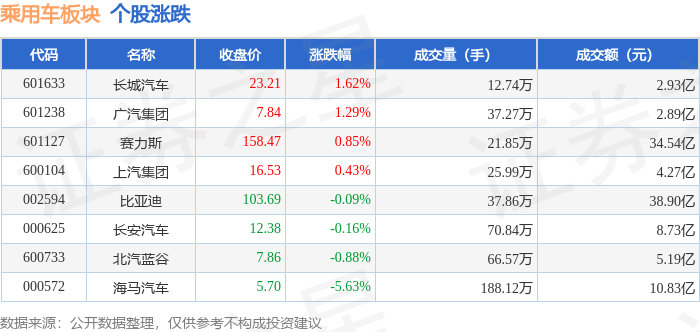
乘用车板块10月23日涨0.39%,长城汽车领涨,主力资金净流出7.76亿元
Zheng Xing Xing Ye Ri Bao· 2025-10-23 08:14
Core Insights - The passenger car sector experienced a slight increase of 0.39% on October 23, with Great Wall Motors leading the gains [1] - The Shanghai Composite Index closed at 3922.41, up 0.22%, while the Shenzhen Component Index also rose by 0.22% to 13025.45 [1] Passenger Car Sector Performance - Great Wall Motors (601633) closed at 23.21, up 1.62% with a trading volume of 127,400 shares and a turnover of 293 million yuan [1] - GAC Group (601238) saw a closing price of 7.84, increasing by 1.29% with a trading volume of 372,700 shares and a turnover of 289 million yuan [1] - Seres (601127) closed at 158.47, up 0.85% with a trading volume of 218,500 shares and a turnover of 3.454 billion yuan [1] - SAIC Motor (600104) closed at 16.53, up 0.43% with a trading volume of 259,900 shares and a turnover of 427 million yuan [1] - BYD (002594) closed at 103.69, down 0.09% with a trading volume of 378,600 shares and a turnover of 3.890 billion yuan [1] - Changan Automobile (000625) closed at 12.38, down 0.16% with a trading volume of 708,400 shares and a turnover of 873 million yuan [1] - BAIC Blue Valley (600733) closed at 7.86, down 0.88% with a trading volume of 665,700 shares and a turnover of 519 million yuan [1] - Haima Automobile (000572) saw a significant decline of 5.63%, closing at 5.70 with a trading volume of 1.8812 million shares and a turnover of 1.083 billion yuan [1] Fund Flow Analysis - The passenger car sector experienced a net outflow of 776 million yuan from institutional investors, while retail investors saw a net inflow of 607 million yuan [1] - Notable fund flows include: - Seres (601127) had a net inflow of 67.44 million yuan from institutional investors, but a net outflow of 63.23 million yuan from retail investors [2] - GAC Group (601238) saw a net inflow of 5.95 million yuan from institutional investors, with retail investors contributing a net inflow of 6.76 million yuan [2] - Great Wall Motors (601633) had a slight net outflow of 29,000 yuan from institutional investors, but retail investors contributed a net inflow of 611,670 yuan [2] - BYD (002594) experienced a significant net outflow of 563 million yuan from institutional investors, while retail investors contributed a net inflow of 419 million yuan [2]



亮点满满!第三十二届中国汽车工程学会年会暨展览会隆重开幕
Zhong Guo Qi Che Bao Wang· 2025-10-23 02:36
Core Insights - The 32nd China Society of Automotive Engineers Annual Conference and Exhibition (SAECCE 2025) commenced in Chongqing, featuring over 120 sessions and the launch of the Automotive Innovation Technology Exhibition (AITX) with eight thematic exhibition areas [2][4]. Industry Growth and Achievements - Since the 14th Five-Year Plan, China's automotive industry has significantly increased production and sales, with both surpassing 31 million units in 2024, marking a historical high and maintaining the world's largest automotive market for 16 consecutive years. New energy vehicle sales rose from under 1.4 million in 2020 to nearly 13 million in 2024, increasing market share from 5.4% to over 40% [4]. - Technological advancements include a 30% reduction in the cost of power batteries, a 30% increase in the average range of new electric passenger vehicles to 500 kilometers, and an increase in the application of L2-level assisted driving features in new cars from approximately 16% to over 60% [4][5]. Ecosystem Development - China has established the world's largest and most resilient automotive industry system, fostering diverse innovation scenarios and a robust infrastructure network. This includes pilot projects in fuel cell vehicles, battery swapping, and intelligent connected vehicles [5]. Regional Development and Strategic Importance - Chongqing is positioned as a key city in China's automotive landscape, benefiting from national strategies such as the Belt and Road Initiative and the Chengdu-Chongqing Economic Circle. The city aims to become a hub for intelligent connected new energy vehicles, emphasizing high-quality manufacturing and technological innovation [7]. Awards and Recognition - The 2025 Automotive Industry Rao Bin Award was presented to Zhu Huarong, Chairman of China Changan Automobile Group, highlighting the progress of Chinese brands from a weak automotive nation to a strong one [11][13]. Collaborative Initiatives - The "Transparent Supply Chain for the Automotive Industry" project was launched to create a unified data standard system and promote a transparent and collaborative supply chain ecosystem among major automotive companies [15]. - The "CSAE Automotive Science and Technology Innovation (Chongqing) Alliance" was established to integrate government, industry, academia, research, finance, and application, aiming to enhance the development of Chongqing's automotive industry [17]. Industry Dialogue and Perspectives - Discussions at the conference emphasized the importance of high-quality development, innovation, and global competitiveness. Key figures highlighted the need for a respectful and orderly industry environment, avoiding excessive competition [19][20]. - The transition from low-end to high-end markets for Chinese brands was noted, with a focus on brand strength and safety in the context of new energy and intelligent transformation [22][26]. Future Trends and Innovations - The automotive industry is shifting towards system innovation, integrating electric and intelligent technologies. The future of vehicles is seen as a convergence point for energy, data, and user experience, driving a revolution in mobility and lifestyle [26][28]. - The conference also showcased the launch of the 2025 annual projects by the China Automotive Research Institute, focusing on advanced topics in intelligent connected vehicles [32].




推动要素向科技创新和新兴产业集聚 A股公司借力重组转型升级
Jing Ji Ri Bao· 2025-10-22 23:38
Core Insights - The current economic transformation in China is driving listed companies to pursue mergers and acquisitions (M&A) for industrial upgrades and strategic transitions [1][4] - The A-share M&A market has seen increased activity, with 3,470 transactions in the first three quarters of this year, a year-on-year increase of 7.93%, and 134 major asset restructuring events, up 83.56% [2] - Traditional industries are actively engaging in M&A to enter emerging sectors, reflecting a deeper understanding of the urgency for development model transformation [4][7] M&A Market Activity - The A-share market has experienced a surge in M&A activity, with significant growth in both the number of transactions and major asset restructurings [2] - Companies are focusing on sectors encouraged by national policies, such as semiconductors, high-end equipment, new energy, and artificial intelligence [2][4] - The implementation of supportive policies by regulatory bodies has further stimulated M&A enthusiasm among companies [3][5] Strategic Growth Initiatives - Companies are increasingly looking to cultivate a "second growth curve" through M&A, which is seen as a key engine for opening new growth paths [3] - The trend of traditional industries entering new sectors indicates a shift towards strategic emerging industries, aiming to create new growth points [4][7] - The integration of resources through M&A is expected to enhance the efficiency of resource allocation and improve the quality of listed companies [7] Policy Support and Future Outlook - Recent policy changes have provided a favorable environment for M&A, with regulatory support aimed at facilitating industry transformation and growth [3][5] - The future of M&A activity is anticipated to remain robust, driven by the ongoing economic transformation and the need for companies to adapt to new market conditions [2][4] - The focus on long-term value creation and effective resource allocation will shape the capital market's valuation system [7]
第三十二届中国汽车工程学会年会开幕 张兴海:创新与安全驱动产品高端化
Quan Jing Wang· 2025-10-22 12:50
Core Insights - The transformation of new automobiles offers users a new driving experience and provides opportunities for the high-end development of Chinese brands [1] - The company emphasizes the importance of long-term commitment to technological innovation to enhance product capabilities, which in turn creates value and commercial returns [1][3] Group 1: Technological Innovation and User Experience - The company adheres to the philosophy that "intelligence reshapes luxury, and safety is the greatest luxury," focusing on technological innovation with safety as the foundation and intelligence as the core advantage [1] - The company has developed over 106 self-researched warning algorithms to provide proactive smart services throughout the product lifecycle [1][2] Group 2: Performance Metrics - The "Wenjie" assisted driving system has accumulated approximately 3.8 billion kilometers, preventing potential collision risks over 2 million times, and providing proactive services over 200,000 times [2] - During the recent National Day and Mid-Autumn Festival, the "Wenjie" system covered over 500 million kilometers, with assisted driving accounting for 200 million kilometers, a 150% increase year-on-year [2] Group 3: Safety and Quality Assurance - The intelligent safety system has prevented over 40,000 potential collisions, a 70% increase year-on-year, and the accident rate for vehicles with assisted driving is one-fifth of those without it [2] - The company is building a "Sailis Industry Brain" through cross-industry collaboration to enhance operational efficiency and ensure product quality and safety [2] Group 4: Commitment to High-End Development - The company acknowledges that while initial progress has been made in the high-end development of Chinese autonomous products, there is still a long way to go [3] - The company aims to actively respond to the national call for quality enhancement and promote high-quality development through technological innovation [3]

四家车企重金砸向新总部 重庆、广州满弦PK汽车城
Zhong Guo Jing Ji Wang· 2025-10-22 10:45
40亿元、40.5亿元、51.6亿元……近来,多家车企豪掷千金,"卷"起了新总部。 10月20日,小鹏汽车正式搬迁至位于广州天河智慧城、总投资40亿元的新总部。今年,长安汽车(000625)投资40.5亿元在重庆鲤鱼池投建全球新总部,预 计2027年落成投入使用。赛力斯(601127)更是豪掷51.6亿元,在重庆礼嘉投建包括新总部、新研发基地在内的"赛力斯全球汽车公园"。去年11月,广汽集 团(601238)总部办公地址从珠江新城CBD搬迁至广州市番禺区。 四个"搬家"的企业"两两作对",以"传统车企+造车新势力"的组合分列广州和重庆,也凸显了中国五大汽车生产基地(上海、长春、北京、广州、重庆)中"两 强"的竞逐之势。 车企密集投建或搬迁新总部,并非单纯的"办公升级",更是中国汽车产业在"双碳"战略引领、新能源转型深水区、区域经济协同发展三重背景下的必然选 择。"豪掷"背后,既有国家政策的顶层牵引,离不开地方政府的精准赋能,更是企业应对市场竞争的主动突围。 汽车产业投资热情依旧 宏观来看,近年来,中国汽车产业虽面临"内卷"挑战,但国民经支柱产业地位愈发稳固。日前,国家统计局新闻发言人在2025年前三季度国民经 ...

智能驾驶深度报告:世界模型与VLA技术路线并行发展
Guoyuan Securities· 2025-10-22 08:56
Investment Rating - The report does not explicitly state an investment rating for the smart driving industry Core Insights - The smart driving industry is experiencing rapid evolution driven by "end-to-end" and "smart driving equity" concepts, with significant growth in both new energy vehicle sales and smart driving functionalities [3][4][9] - The penetration rate of L2-level smart driving in new energy vehicles in China has increased from approximately 7% in 2019 to around 65% by the first half of 2025, indicating a strong correlation between new energy vehicle sales and the adoption of smart driving technologies [9][10] - The smart driving market is projected to exceed 5 trillion yuan by 2030, with a compound annual growth rate driven by technological advancements and increased consumer acceptance [15][16] Summary by Sections 1. "Equity + End-to-End" Accelerating Smart Driving Evolution - The smart driving industry has seen a significant increase in new energy vehicle sales, which has created a positive feedback loop for the adoption of smart driving technologies [9][10] - The penetration of L2-level smart driving features in new energy vehicles has rapidly increased, reflecting the growing consumer acceptance and market expansion of smart driving technologies [9][10] 2. End-to-End Smart Driving Review - The evolution of end-to-end smart driving can be categorized into four main stages, with advancements in perception, decision-making, and control processes [30][32] - The introduction of the "occupancy network" has enhanced environmental perception capabilities, allowing for more accurate and stable decision-making in complex driving scenarios [46][47] 3. VLA Technology Route - The VLA (Vision-Language-Action) model is emerging as a key driver of paradigm shifts in autonomous driving, integrating visual, linguistic, and action modalities into a cohesive framework [70][71] - The VLA model's development is divided into four stages, with significant advancements in task understanding and execution capabilities [76][77] 4. World Model Technology Route - The world model approach emphasizes physical reasoning and spatial understanding, representing a long-term evolution path for smart driving technologies [69][70] - The integration of world models with cloud computing is expected to enhance the iterative optimization of end-to-end smart driving systems [65][66]




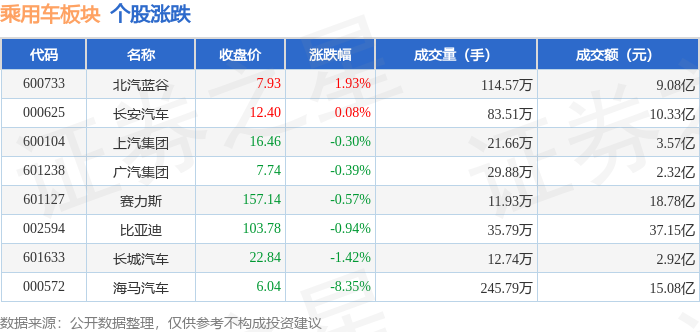
乘用车板块10月22日跌0.67%,海马汽车领跌,主力资金净流出13.48亿元
Zheng Xing Xing Ye Ri Bao· 2025-10-22 08:19
Core Insights - The passenger car sector experienced a decline of 0.67% on October 22, with Haima Automobile leading the drop [1] - The Shanghai Composite Index closed at 3913.76, down 0.07%, while the Shenzhen Component Index closed at 12996.61, down 0.62% [1] Market Performance - The closing prices and percentage changes for key passenger car stocks are as follows: - BAIC Blue Valley: 7.93, +1.93% - Changan Automobile: 12.40, +0.08% - SAIC Motor: 16.46, -0.30% - GAC Group: 7.74, -0.39% - Seres: 157.14, -0.57% - BYD: 103.78, -0.94% - Great Wall Motors: 22.84, -1.42% - Haima Automobile: 6.04, -8.35% [1] Capital Flow - The passenger car sector saw a net outflow of 1.348 billion yuan from institutional investors, while retail investors contributed a net inflow of 849 million yuan [1] - The detailed capital flow for selected stocks indicates: - BAIC Blue Valley: Institutional net inflow of 142 million yuan, retail net outflow of 82.86 million yuan - Great Wall Motors: Institutional net inflow of 5.47 million yuan, retail net outflow of 13.43 million yuan - SAIC Motor: Institutional net outflow of 4.07 million yuan, retail net inflow of 18.21 million yuan - GAC Group: Institutional net outflow of 25.53 million yuan, retail net inflow of 19.10 million yuan - Changan Automobile: Institutional net outflow of 76.71 million yuan, retail net inflow of 69.96 million yuan - Seres: Institutional net outflow of 98.72 million yuan, retail net inflow of 32.12 million yuan - Haima Automobile: Institutional net outflow of 264 million yuan, retail net inflow of 19.5 million yuan - BYD: Institutional net outflow of 1.027 billion yuan, retail net inflow of 648.17 million yuan [2]