
INDUSTRIAL BANK(601166)

Search documents
兴业银行发行“丝路文旅卡” 助力一带一路文旅深度融合
Jing Ji Guan Cha Wang· 2025-09-22 07:58
经济观察网 9月21日,第八届丝绸之路(敦煌)国际文化博览会在甘肃省敦煌市开幕。博览会期间,兴业银 行(601166)正式发布的"兴业银行丝路文旅卡",是"金融+文旅"领域的创新实践。该卡融合丝路文化 元素,覆盖文旅消费全场景,同时通过数字化服务实现文旅消费场景广泛覆盖,精准对接产业链企业需 求,激发消费潜力。此次金融服务旨在为甘肃文旅高质量发展注入新动力,推动"一带一路"人文互通与 经贸合作。 ...

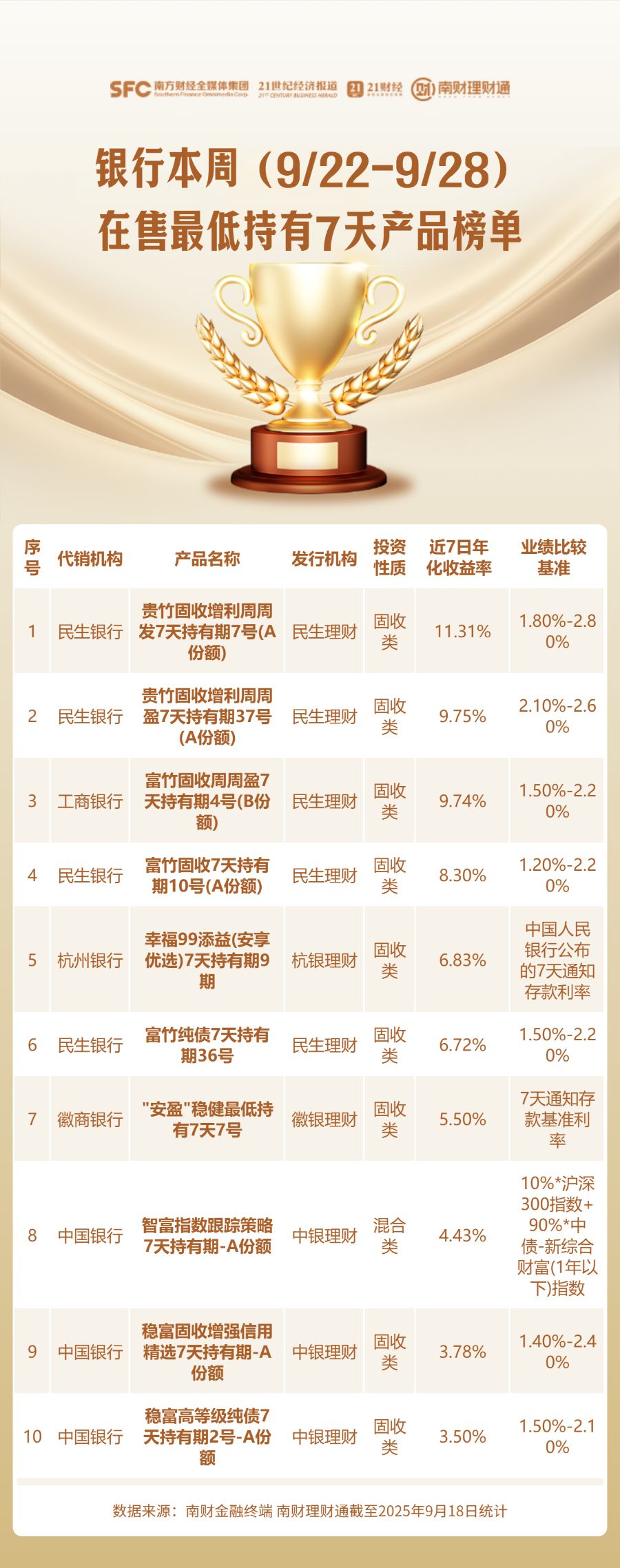
银行渠道本周在售最低持有期理财产品榜单(9/22-9/28)
2 1 Shi Ji Jing Ji Bao Dao· 2025-09-22 07:04
Core Viewpoint - The article emphasizes the importance of distinguishing between various bank wealth management products with similar names and characteristics, providing a weekly performance ranking of these products to assist investors in making informed choices [1][2]. Group 1: Product Performance Rankings - The article presents a ranking of wealth management products based on their annualized returns for different holding periods: 7 days, 14 days, 30 days, and 60 days [1]. - For the 7-day holding period, the top-performing product is from Minsheng Bank with an annualized return of 9.75% [4]. - The 14-day holding period rankings show Minsheng Bank's product achieving an annualized return of 8.34% [6]. - In the 30-day holding period, Hangzhou Bank leads with a return of 24.26% [11]. - For the 60-day holding period, China Bank's product tops the list with a return of 26.21% [15]. Group 2: Investment Institutions - The ranking includes products from 28 distribution institutions, such as Industrial and Commercial Bank of China, Bank of China, Agricultural Bank of China, and others [1]. - The performance data is sourced from the Nanfang Financial Terminal, ensuring a comprehensive overview of available products [4][11][15]. Group 3: Methodology and Data Collection - The performance metrics are calculated based on the annualized yield over the respective holding periods, with the same institution and product series retained for comparison [1]. - The article advises investors to refer to the actual product listings on the banks' apps, as availability may vary due to factors like quota exhaustion [1].






兴业银行南京分行为江苏企业撑起汇率“安全伞”
Sou Hu Cai Jing· 2025-09-22 05:50
Group 1 - The core issue faced by many foreign trade enterprises is the erosion of export profits due to exchange rate fluctuations [1] - Industrial Bank Nanjing Branch has tailored a "12-month price stabilization plan" for a lithium battery state-owned enterprise with an annual export of 200 million USD, helping the company to lock in future exchange rates [1] - A leading domestic lithium battery ternary precursor company, which receives nearly 20 million USD monthly, previously lost over 10 million USD in profits due to incorrect timing in currency exchange [1] Group 2 - The bank has introduced an "FX Derivative Discount Package" aimed at small and medium-sized enterprises, offering a minimum margin of 0 and up to 100% fee reduction [2] - From January to August, the bank visited over 500 foreign trade enterprises, including nearly 100 state-owned enterprises, and facilitated nearly 1.5 billion USD in foreign exchange derivatives [2] - The bank emphasizes its social responsibility in stabilizing foreign trade and market, focusing on enhancing exchange rate risk management services for enterprises [2]
银行业周度追踪2025年第37周:银行股调整后股东增持加速-20250922
Changjiang Securities· 2025-09-21 23:30
Investment Rating - The report maintains a "Positive" investment rating for the banking sector [11] Core Insights - Recent adjustments in bank stocks have led to accelerated share buybacks by state-owned shareholders and management, indicating strong recognition of investment value [2][6] - The systematic increase in holdings by state-owned shareholders reflects a demand to optimize financial equity layouts amid asset scarcity, highlighting the core advantages of low valuations, stable profits, and dividends in bank stocks [7][41] - The report emphasizes the long-term investment value of regional leading city commercial banks, particularly after two rounds of debt restructuring [7][41] Summary by Sections Shareholder Activity - In the past week, banks such as Qingdao Bank, Nanjing Bank, and Chengdu Bank have disclosed progress in share buybacks by state-owned shareholders, showcasing their confidence in investment value [2][6] - Nanjing Bank has seen its state-owned shareholder, Nanjing High-tech, increase its stake by 1.05%, bringing its total holding to 9.99% [6][41] - Other banks, including Suzhou Bank and Qingdao Bank, have also reported significant buyback plans, with Suzhou Bank's shareholders increasing their holdings by 856 million yuan earlier this year [6][41] Market Performance - The banking index has experienced a cumulative decline of 4.1% this week, underperforming the CSI 300 index by 3.6% and the ChiNext index by 6.4% [9][20] - Despite the recent downturn, the long-term investment logic remains solid, with individual stocks like Qilu Bank showing resilience due to management buybacks [9][20] Dividend and Earnings Outlook - The report notes that the expected dividend yield for leading city commercial banks has risen to around 5%, with specific banks like Jiangsu Bank and Chengdu Bank reaching yields of 5.5% [7][8] - The stability of the banking sector's fundamentals is highlighted, with expectations for net interest income to maintain stable growth despite market fluctuations [8][40] - Mid-term dividends are set to commence, with several banks planning to distribute dividends in the fourth quarter, creating an attractive entry point for absolute return funds [8][40] Valuation and Investment Opportunities - The report suggests that the recent valuation adjustments have created significant investment opportunities in bank stocks, particularly for those focusing on dividend yields [7][44] - The ongoing adjustments in the bond market and the anticipated stabilization of loan interest rates are expected to support the banks' revenue streams [8][44]


银行群体为何易出ESG评级优等生 政策+治理双轮驱动下的绿色进化论
Zhong Guo Jin Rong Xin Xi Wang· 2025-09-21 23:19
Core Viewpoint - The MSCI ESG rating of CITIC Bank has been upgraded by two levels to the highest rating of AAA, reflecting the overall improvement of the banking industry's ESG performance in China, driven by regulatory policies and the banks' own efforts [1][2]. Group 1: ESG Ratings and Performance - As of September 19, five banks in China have achieved the MSCI ESG rating of AAA, including CITIC Bank, which upgraded on September 8, 2023 [2]. - Among 42 A-share listed banks, 25 banks have an ESG rating of A or above, indicating that nearly 60% of these banks have high ratings [2]. - The banking sector's ESG ratings outperform other industries, attributed to lower environmental and social risks and better digital infrastructure [2]. Group 2: ESG Reporting and Green Finance - All 42 A-share listed banks have disclosed their 2024 ESG reports, significantly higher than the overall ESG report disclosure rate of 46.83% for A-share listed companies [3]. - The rapid growth of green finance in the banking sector has significantly contributed to the improvement of ESG ratings, with major banks like ICBC and Bank of China leading in green loan balances [3]. - By June 2025, the banking sector's green loan balance is expected to reach approximately 42 trillion yuan [3]. Group 3: Regulatory and Policy Drivers - National policies and regulatory requirements have driven the continuous improvement of ESG performance in the banking sector, including guidelines from the former CBIRC and the central bank's carbon reduction support tools [4]. - The emphasis on information disclosure in the banking sector has been reinforced by regulatory frameworks, enhancing transparency and accountability [4]. Group 4: Governance and Management - Major banks are integrating ESG into their corporate strategies, viewing it as a catalyst for business innovation and risk management [5]. - Banks have established comprehensive ESG management systems, with governance structures that include dedicated committees for overseeing ESG initiatives [6]. - Training programs on ESG-related knowledge are being implemented to enhance management capabilities within banks [6]. Group 5: Social Dimensions and Community Impact - The banking sector has made significant strides in consumer rights protection and inclusive finance, with banks like CITIC Bank and China Merchants Bank implementing systematic compliance measures [7]. - The promotion of inclusive finance is evident, with banks disclosing increases in loans to small and micro enterprises [7]. - In rural revitalization efforts, banks have increased agricultural loan balances and provided substantial funding for community projects [8]. Group 6: Climate Change and Innovation - The banking sector is increasingly focusing on climate issues, conducting risk assessments related to climate change and developing innovative financial products to support green transitions [9]. - Banks are beginning to disclose financing emissions as part of their ESG reports, with pilot projects already underway [9]. - Innovative financing solutions, such as ESG-linked loans, are being introduced to incentivize environmentally friendly practices among borrowers [10][11].




银行群体为何易出ESG评级优等生
Zhong Guo Zheng Quan Bao· 2025-09-21 20:17
Core Insights - The MSCI ESG rating of CITIC Bank has been upgraded by two levels to the highest AAA rating, making it one of five banks in the A-share market to achieve this rating [1][2] - China's banking sector is leading in ESG performance compared to other industries, with 25 out of 42 listed banks rated A or above [2][3] - The improvement in ESG ratings is attributed to both regulatory support and the banks' own efforts in governance and green finance innovation [1][4] ESG Performance - As of September 19, five banks, including CITIC Bank, have achieved the AAA rating in the MSCI ESG ratings [1] - The average ESG rating of the banking sector is higher than that of other industries, with nearly 60% of listed banks rated A or above [2] - The disclosure rate of ESG reports among A-share listed banks is significantly higher than the overall market, with 100% of banks disclosing their 2024 ESG reports compared to 46.83% for all A-share companies [2] Green Finance Growth - The scale of green finance in the banking sector has been growing rapidly, with major banks like ICBC and Bank of China leading in green loan balances [3] - As of June 2023, ICBC's green loan balance exceeded 6 trillion yuan, while Bank of China's green loan balance reached 4.54 trillion yuan, growing by 16.95% compared to the end of 2024 [3] - The total green loan balance in the banking sector is projected to reach approximately 42 trillion yuan by June 2025 [3] Governance and Strategy - Banks are increasingly integrating ESG into their corporate strategies, with many viewing it as a catalyst for business innovation and risk management [4][5] - Major banks have established comprehensive ESG management systems, with clear responsibilities for ESG-related risk management at the board level [4] - Training programs on ESG governance and sustainable development are being implemented, with ICBC training over 120,000 employees in 2024 [5] Social Responsibility - Banks are enhancing their performance in consumer rights protection and inclusive finance, contributing positively to their ESG ratings [6][7] - For instance, CITIC Bank and China Merchants Bank have implemented systematic compliance management measures for financial marketing [6] - In inclusive finance, China Merchants Bank reported a balance of 887.68 billion yuan in loans to small and micro enterprises by the end of 2024, an increase of 83.4 billion yuan from the previous year [7] Climate Change Initiatives - The banking sector is increasingly focusing on climate-related issues, conducting stress tests and scenario analyses to assess the impact of climate change on their assets [8][9] - Banks are leveraging digital capabilities to support industrial transformation towards green and low-carbon practices [9] - Notable projects include Bank of China's financing for a carbon capture project and CITIC Bank's issuance of a green loan linked to sustainable development in the construction industry [10]
富国稳健添荣债券型证券投资基金基金份额发售公告
Shang Hai Zheng Quan Bao· 2025-09-21 18:35
Group 1 - The fund "Fullgoal Steady Growth Bond Fund" has been approved for registration by the China Securities Regulatory Commission (CSRC) on July 5, 2025 [1] - The fund is a bond-type open-ended fund with an indefinite duration [1][12] - The public offering period for the fund is set from October 13, 2025, to October 24, 2025, with the possibility of adjustments based on subscription conditions [1][16] Group 2 - The fund aims to raise a total subscription amount not exceeding 5 billion RMB during the offering period [4][13] - If the subscription amount exceeds 5 billion RMB on any day, a proportional confirmation method will be used to control the scale [5][13] - The fund's minimum subscription amount is set at 10 RMB, with specific limits for different types of investors [3][21] Group 3 - The fund will not be sold to financial institutions' proprietary accounts, except for the fund manager's own funds [2][12] - Individual investors can subscribe up to 10 million RMB per day, with specific limits for different investor categories [2][12] - The fund's A-class shares will incur subscription fees, while C-class shares will not [25][31] Group 4 - The fund's management company is Fullgoal Fund Management Co., Ltd., and the custodian is Industrial Bank Co., Ltd. [49][50] - The fund's effective subscription funds will be frozen in a dedicated account during the offering period, with interest converted into corresponding fund shares [43] - The fund's contract will become effective once the required conditions are met after the offering period [47]
信用半月谈第二期:增值税新规实施月余,金融债新老券如何定价?
Shenwan Hongyuan Securities· 2025-09-21 11:44
Group 1 - The report focuses on the impact of the new VAT regulations on the pricing and investment of financial bonds, particularly after the implementation on August 8, 2025 [7][8][20] - Different types of institutions are affected differently by the new VAT regulations, with the order of impact being: proprietary trading of financial institutions > public funds > other asset management products > qualified foreign investors [8][9][11] - The comprehensive tax rate increase for interest income post-regulation is as follows: proprietary trading of financial institutions (4.75%) > public funds (3.26%) > other asset management products (2.45%) > qualified foreign investors (0%) [9][11] Group 2 - The static impact of the new VAT regulations indicates that the effect on proprietary trading of financial institutions is greater than on asset management products, with a potential decrease in after-tax yields of 4-10 basis points (BP) [14][16] - For financial bonds with the same nominal yield, the required increase in nominal yield to achieve the same after-tax yield ranges from 5-15 BP, with proprietary trading needing 11-15 BP and asset management products needing 5-7 BP [14][16] - The report notes that the new bonds issued after the VAT regulation generally have higher coupon rates compared to comparable existing bonds, reflecting a yield compensation due to the new tax [20][21] Group 3 - Since the implementation of the new VAT regulations, a total of 226 new financial bonds have been issued, amounting to 720.4 billion yuan, with the majority being ordinary bonds from securities firms [20][21] - The report highlights that the pricing of new and old bonds is still in the discovery phase, with recent trends showing that the yield spread between new and old bonds varies across different types of financial bonds [20][21] - Investors are advised to consider the cost-effectiveness of older bonds compared to new issues, particularly in the context of AAA/AAA- rated ordinary bonds from securities firms [20][21]




本周聚焦:三阶段视角:银行资产质量及拨备计提力度如何?
GOLDEN SUN SECURITIES· 2025-09-21 10:34
Investment Rating - The report maintains a positive outlook on the banking sector, suggesting potential investment opportunities due to favorable policy catalysts and improving fundamentals in certain banks [12]. Core Insights - The report highlights the adequacy of loan loss provisions among listed banks, with a provision coverage ratio of 70.8% for Stage 3 loans, indicating limited future impact on profits [2][12]. - It emphasizes the improvement in asset quality, particularly in Stage 3 loans, with notable reductions in the proportion of such loans for several banks compared to the end of Q4 2024 [1][2]. - The report suggests a focus on banks with positive fundamental changes and continuous improvement in financial statements, recommending specific banks for investment [12]. Summary by Sections 1. Loan Quality and Provisioning - The proportion of Stage 3 loans is relatively low for banks like Chengdu Bank (0.66%) and Ningbo Bank (0.76) [1]. - Significant improvements in Stage 3 loan ratios were observed for Chongqing Bank (-61bp) and Guiyang Bank (-48bp) compared to Q4 2024 [1]. - The provision coverage for Stage 3 loans is high, with leading banks like Qingnong Bank (4.35%) and Yunan Bank (4.16%) showing strong provisioning ratios [2]. 2. Financial Assets - The proportion of Stage 3 financial assets is low, with most banks not exceeding 0.05%, indicating manageable asset quality pressure [4]. - The report notes that the provision coverage for financial investments is also robust, with Zhejiang Bank (3.16%) and Qingdao Bank (2.85%) leading in provisioning ratios [8]. 3. Sector Outlook - The report anticipates that expansionary policies aimed at stabilizing the economy will benefit the banking sector, with a focus on banks like Ningbo Bank and Jiangsu Bank for potential investment [12]. - It highlights the ongoing economic recovery and the potential for interest rate cuts, suggesting a sustained dividend strategy for certain banks [12].


信用债周度观察(20250915-20250919):信用债发行量环比增长,各行业信用利差涨跌互现-20250920
EBSCN· 2025-09-20 12:22
Report Industry Investment Rating No relevant content provided. Core Viewpoints of the Report - From September 15th to September 19th, 2025, the issuance volume of credit bonds increased month - on - month, and the credit spreads of various industries showed mixed trends[1]. - The total trading volume of credit bonds increased, and the trading volumes of commercial bank bonds, corporate bonds, and medium - term notes ranked top three[4]. Summary by Directory 1. Primary Market 1.1 Issuance Statistics - During September 15 - 19, 2025, 455 credit bonds were issued, with a total issuance scale of 579.911 billion yuan, a month - on - month increase of 55.61%. Among them, 182 industrial bonds were issued, amounting to 202.499 billion yuan (up 63.71% month - on - month, accounting for 34.92% of the total); 217 urban investment bonds were issued, totaling 141.282 billion yuan (up 52.61% month - on - month, accounting for 24.36%); and 56 financial bonds were issued, reaching 236.13 billion yuan (up 50.98% month - on - month, accounting for 40.72%)[1][11]. - The average issuance term of credit bonds was 2.94 years. The average issuance terms of industrial bonds, urban investment bonds, and financial bonds were 2.42 years, 3.52 years, and 2.31 years respectively[1][13]. - The average issuance coupon rate of credit bonds was 2.28%. The average issuance coupon rates of industrial bonds, urban investment bonds, and financial bonds were 2.13%, 2.48%, and 1.97% respectively[2][18]. 1.2 Cancellation of Issuance Statistics - Four credit bonds were cancelled for issuance during the week, including "25 Xianggaosu CP003", "25 Datong D1", "25 Suzhou Energy MTN002", and "25 Tongzhouwan PPN003"[3][23]. 2. Secondary Market 2.1 Credit Spread Tracking - By industry, among Shenwan primary industries, for AAA - rated industries, the largest increase in credit spread was in the electronics industry (up 6.7BP), and the largest decrease was in the textile and apparel industry (down 6.8BP); for AA + - rated industries, the largest increase was in the electronics industry (up 1.2BP), and the largest decrease was in the mining industry (down 7BP); for AA - rated industries, the largest increase was in the real estate industry (up 14.3BP), and the largest decrease was in the agriculture, forestry, animal husbandry, and fishery industry (down 4.3BP)[3][25]. - By region for urban investment bonds, for AAA - rated bonds, the largest increase in credit spread was in Shanghai (up 3.3BP), and the largest decrease was in Shaanxi (down 10.2BP); for AA + - rated bonds, the largest increase was in Yunnan (up 4.7BP), and the largest decrease was in Hubei (down 5.9BP); for AA - rated bonds, the largest increase was in Fujian (up 6.5BP), and the largest decrease was in Jiangxi (down 5.8BP)[3][27]. - The credit spreads of coal and steel both showed mixed trends. The credit spreads of AAA and AA + - rated coal decreased by 1.2BP and 5.3BP respectively, and the credit spreads of AAA and AA + - rated steel decreased by 3.3BP and increased by 0.5BP respectively[25]. - The credit spreads of urban investment and non - urban investment bonds at all levels decreased. The credit spreads of three - level urban investment bonds decreased by 0.5BP, 3.1BP, and 1.8BP respectively, and the credit spreads of three - level non - urban investment bonds decreased by 1.5BP, 2.3BP, and 0.4BP respectively[25]. - The credit spreads of state - owned enterprises and private enterprises both showed mixed trends. The credit spreads of three - level central state - owned enterprises decreased by 1BP, 5.6BP, and increased by 0.2BP respectively; the credit spreads of three - level local state - owned enterprises decreased by 1.4BP, 1.8BP, and 2.1BP respectively; the credit spreads of three - level private enterprises decreased by 2BP, 2.3BP, and increased by 1BP respectively[26]. 2.2 Trading Volume Statistics - The total trading volume of credit bonds was 1.462306 trillion yuan, a month - on - month increase of 21.90%. The top three in terms of trading volume were commercial bank bonds, corporate bonds, and medium - term notes. The trading volume of commercial bank bonds was 479.739 billion yuan (up 26.26% month - on - month, accounting for 32.81% of the total trading volume); the trading volume of corporate bonds was 432.035 billion yuan (up 29.94% month - on - month, accounting for 29.54%); the trading volume of medium - term notes was 311.265 billion yuan (up 14.08% month - on - month, accounting for 21.29%)[4][28]. 2.3 Actively Traded Bonds This Week - According to DM client data, the top 20 urban investment bonds, industrial bonds, and financial bonds in terms of trading volume during the week are provided for investors' reference, including details such as bond codes, names, trading volumes, yields, and issuers[30][31][33].
