
CPIC(601601)

Search documents
保险行业2026年年度投资策略:分红险重塑产品竞争力,新银保重构渠道新格局
Xin Lang Cai Jing· 2025-12-16 14:04
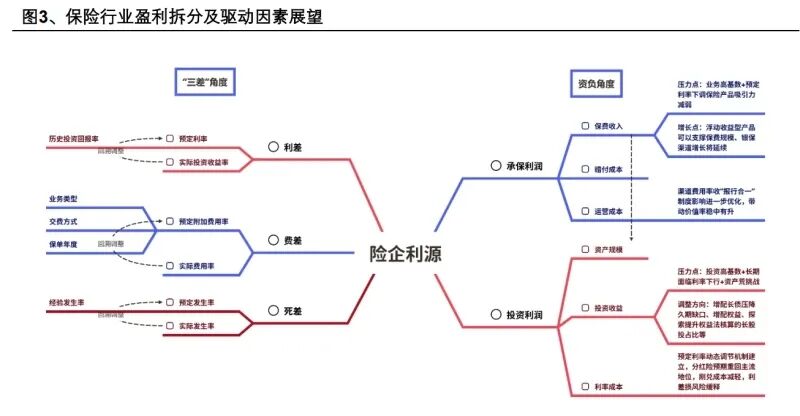
Overall Review - The insurance sector has experienced an overall increase, with A-shares and H-shares showing differentiated performance [1][7] - The fundamental performance indicates high value growth, with investment driving continued net profit growth [1][7] Financial Performance - For Q1-Q3 2025, the net profit growth year-on-year shows significant increases: China Life +60.5%, New China Life +58.9%, China Pacific Insurance +50.5%, PICC +28.9%, Taikang +19.3%, and Ping An +11.5% [2][9] - In Q3 2025 alone, the net profit growth year-on-year is led by China Life +91.5%, China Pacific Insurance +91.4%, and New China Life +88.2% [2][9] - The net asset changes from the beginning of the year show China Life +22.8%, PICC +16.9%, and China Pacific Insurance +12.3%, while Taikang saw a decline of -2.5% [2][9] Investment Logic - Insurance company profits are derived from underwriting profits and investment profits, with underwriting profits influenced by premium income and operational costs [3][10] - The investment profit is primarily affected by investment yield and liability cost rate, with the former being more variable due to market conditions [3][10] - The improvement in underwriting profits is driven by better product structures, channel efficiency, and cost control [3][10] Historical Stock Selection Logic - The stock selection logic for insurance companies has evolved through four phases over the past decade, with a focus on value growth from 2015-2019, short-term catalysts from 2020-2023, and a systemic revaluation of value in 2024 [5][13][14] - Since 2025, the systemic revaluation of value has continued, with H-shares of New China Life, PICC, and China Life leading the market [5][14] Future Outlook - The macroeconomic and capital market environment is expected to transition from a downward economic cycle with improving capital market conditions to a favorable economic cycle with a recovering capital market [6][15] - The focus will remain on net profit as a key indicator, with the importance of liability indicators represented by NBV expected to increase [6][15]



港股公告精选|中煤能源11月煤炭销量同比降约15% 中国太保年内原保费收入近4400亿元
Xin Lang Cai Jing· 2025-12-16 12:32
Company News - China Energy Construction (03996.HK) has officially put into operation the first phase of the Zhongnengjian Songyuan Hydrogen Energy Industrial Park (integrated green hydrogen and ammonia project) [1] - China Coal Energy (01898.HK) reported a total coal sales volume of approximately 234 million tons for the first 11 months, a year-on-year decrease of 8.7%. In November, coal sales were 21.74 million tons, down 15.7% year-on-year [1] - China Pacific Insurance (02601.HK) reported that for the first 11 months, Pacific Life's cumulative original insurance premium income was RMB 250.322 billion, an increase of 9.4% year-on-year, while Pacific Property's cumulative original insurance premium income was RMB 187.682 billion, a slight increase of 0.3% year-on-year [1] - Hansoh Pharmaceutical (03692.HK) has entered into a licensing agreement with GLENMARK for Amivantamab, which includes an upfront payment and potential cumulative payments exceeding USD 1 billion, along with tiered royalties based on net sales in the licensed territory [1] - Yuexiu Property (00123.HK) has secured a term loan financing of HKD 500 million [1] - China Railway Construction (01186.HK) plans to issue corporate bonds with a total amount not exceeding RMB 4 billion [1] Buyback Activities - Genscript Biotech (01672.HK) has increased its share buyback fund from a maximum of HKD 300 million to HKD 500 million [1] - Tencent Holdings (00700.HK) repurchased approximately 1.067 million shares for about HKD 636 million, with buyback prices ranging from HKD 592.5 to HKD 602.5 [2] - Xiaomi Group (01810.HK) repurchased 7.2 million shares for approximately HKD 294 million, with buyback prices between HKD 40.36 and HKD 41.00 [2] - Kuaishou Technology (01024.HK) repurchased 1.8231 million shares for about HKD 116 million, with buyback prices ranging from HKD 63.05 to HKD 64.4 [2] - Geely Automobile (00175.HK) repurchased 299,900 shares for approximately HKD 50.5444 million, with buyback prices between HKD 16.72 and HKD 17.2 [3]


A股公告精选 | 4连板百大集团(600865.SH):公司股票价格短期涨幅较大 存在后续下跌风险
智通财经网· 2025-12-16 12:15
Group 1 - Company Chuangxin Data plans to purchase servers not exceeding 9 billion yuan to provide cloud computing services for clients [1] - Company CaiXun plans to jointly invest in a fund specifically for a humanoid robot company, contributing 5 million yuan [2] - Company JiuZhiYang confirms normal operations and no undisclosed significant matters [3] Group 2 - Company Aerospace Changfeng states it does not engage in commercial aerospace business [4] - Company Aerospace Engineering clarifies its main business does not involve commercial aerospace [5] - Company Aerospace Information reports its main products do not include commercial aerospace [6] Group 3 - Company Tianpu shares have increased by 486.07% since August 22, indicating significant trading risks [7] - Company BaiDa Group's stock price has risen by 46.44% in a short period, posing potential risks of decline [10] Group 4 - Company Haiyou New Materials plans to invest approximately 300 million yuan in a polymer special film production project in Chengdu [8] - Company Huasheng Technology intends to transfer production technology for 18 million yuan and invest in a related company [11] Group 5 - Company Wolong Nuclear Materials plans to invest up to 1.5 billion yuan to expand its production base [12] - Company Jidian plans to invest in a 100MW wind power project in Guangxi with a total investment of 564 million yuan [13] Group 6 - Company China Energy Construction announces the official operation of the first phase of the world's largest green hydrogen and ammonia project [15] - Company Silan Microelectronics has received approval for a 12-inch high-end analog integrated circuit chip production line project with an investment of 10 billion yuan [16] Group 7 - Company Jiangte Electric plans to contest the cancellation of mining rights for a lithium-containing mineral [17] - Company China General Nuclear Power has begun construction of the Ningde Unit 6 nuclear power project [19] Group 8 - Company China Pacific Insurance reports a 9.4% increase in premium income for its life insurance subsidiary [20] - Company Bozhong Precision Engineering sees a significant increase in orders for electric vehicle battery swap stations [21] Group 9 - Company Dekeli plans to reduce its holdings by up to 100,000 shares [22] - Company Action Education intends to repurchase shares worth 20 to 25 million yuan [23] Group 10 - Company Gansu Energy Chemical wins a 359 million yuan engineering project [26] - Company Huayou Cobalt signs a memorandum for the supply of 79,600 tons of ternary precursor products [28] - Company Zhongneng Electric and its subsidiaries win multiple projects totaling approximately 423 million yuan [29]



12月16日晚间重要公告一览
Xi Niu Cai Jing· 2025-12-16 10:31
Group 1 - Action Education plans to repurchase shares worth between 20 million to 25 million yuan at a price not exceeding 45 yuan per share for employee stock ownership plans or equity incentives [1] - Fulin Technology's shareholders plan to reduce their holdings by up to 2% of the company's total shares, amounting to a maximum of 24.44 million shares starting from December 22, 2025 [2] - Huashu shares' shareholders intend to reduce their holdings by up to 1% of the company's total shares, which is a maximum of 35.94 million shares [3] Group 2 - Silan Microelectronics has obtained a filing certificate for its 12-inch high-end analog integrated circuit chip manufacturing production line project, with an investment of 10 billion yuan and a monthly production capacity of 20,000 wafers [4] - Aerospace Information confirms that its main business does not involve commercial aerospace and that its operations are normal without significant changes [5] - Qinglong Pipe Industry signed a supply contract worth 294 million yuan for PCCP and pressure steel pipes, accounting for 10.43% of its 2024 revenue [6] Group 3 - Huaxin Precision plans to invest up to 1 billion yuan of idle funds in low-risk financial products [7] - Hainan Rubber received insurance compensation totaling approximately 26.65 million yuan for rubber income and tree insurance [8] - Lianmei Holdings announced the suspension of its subsidiary Fulin Thermal Power due to economic slowdown and reduced customer demand [9] Group 4 - Ruifeng Bank has been approved to issue up to 2.5 billion yuan in secondary capital bonds to enhance its capital and risk resistance [11] - China Pacific Insurance reported a 9.4% year-on-year increase in premium income for its life insurance subsidiary, totaling 250.32 billion yuan [12] - Sunshine Nuohuo signed an agreement with Peking University to establish a joint laboratory for innovative drug development [13] Group 5 - Century Huatong completed the cancellation of 56.12 million repurchased shares, reducing its total share capital from 7.428 billion to 7.372 billion shares [14] - Yaxin Security received a government subsidy of 3 million yuan [15] - Haili Biology's subsidiary received registration certification for a bone repair material in Indonesia [16] Group 6 - Yian Technology's subsidiary secured a major project for magnesium alloy components worth 430 million yuan, expected to start production by the end of March 2026 [17] - Jiangte Electric plans to contest the proposed cancellation of its lithium-containing mining rights [18] - COFCO Technology announced the resignation of its deputy general manager due to work changes [19] Group 7 - Fangsheng Pharmaceutical passed the GMP compliance inspection for its raw material production lines [21] - Bohai Ferry announced the resignation of two deputy general managers for personal and age-related reasons [22] - ST Fuhua appointed a new general manager [23] Group 8 - Huazhong CNC received project funding of 17.7 million yuan, accounting for 31.97% of its audited net profit for 2024 [24] - Oppein Home used 15 million yuan of idle funds to purchase a large time deposit with a 0.9% annual yield [25] - China General Nuclear Power's Ningde Unit 6 has begun full construction, utilizing Hualong One technology with a capacity of 1210 MW [26] Group 9 - Jiayuan Technology's chairman has had the investigation order lifted, and the company is operating normally [27] - Fulaixin Materials' application for a specific stock issuance has been approved by the Shanghai Stock Exchange [28] - Shuhua Sports plans to invest up to 500 million yuan in a health industry park project [29] Group 10 - Rhine Biology's stock will continue to be suspended due to ongoing control change and asset acquisition plans [30] - Haishi Science received approval for clinical trials for four innovative drugs targeting various diseases [31] - Hangcai Co. plans to repurchase shares worth between 50 million to 100 million yuan at a price not exceeding 80 yuan per share [32] Group 11 - Yinxin Technology received a cash dividend of 18 million yuan from its subsidiary [33] - Tianfulong plans to increase its wholly-owned subsidiary's capital by 580 million yuan [34] - Poly United's subsidiary won a bid for a stripping project worth 1.528 billion yuan [35] Group 12 - Minglida's deputy general manager resigned due to health reasons [36] - ST Guohua appointed a new deputy general manager [37] - China Xidian's subsidiaries won contracts totaling 1.005 billion yuan for Southern Power Grid projects [38]




迪庆金融监管分局同意太平洋产险维西支公司营业场所变更
Jin Tou Wang· 2025-12-16 10:27
Core Points - The Yunnan branch of China Pacific Property Insurance Co., Ltd. has received approval for the relocation of its Weixi branch's business premises [1] Group 1 - The new business location for the Weixi branch is specified as: Building E09, Yunli Century City Commercial Complex, Lanyong Village Committee, Baohe Town, Weixi County, Diqing Prefecture, Yunnan Province [1] - The company is required to handle the change and obtain the necessary permits in accordance with relevant regulations [1]

中国太保:太平洋人寿保险前11个月原保险保费收入为2503.22亿元 同比增长9.4%
Zhi Tong Cai Jing· 2025-12-16 09:52
Core Insights - China Pacific Insurance (601601) reported a cumulative original insurance premium income of RMB 250.32 billion from January 1, 2025, to November 30, 2025, representing a year-on-year growth of 9.4% [1] - The company's subsidiary, China Pacific Property Insurance Co., Ltd., recorded a cumulative original insurance premium income of RMB 187.68 billion during the same period, showing a slight year-on-year increase of 0.3% [1] Group 1 - The life insurance segment of the company demonstrated strong growth with a significant increase in premium income [1] - The property insurance segment experienced modest growth, indicating a stable but slower performance compared to the life insurance segment [1]
中国太保(02601) - 保费收入公告
2025-12-16 09:47
(於中華人民共和國註冊成立的股份有限公司) 香港交易及結算所有限公司及香港聯合交易所有限公司對本公告的內 容 概 不 負 責,對 其 準 確 性 或 完 整 性 亦 不 發 表 任 何 聲 明,並 明 確 表 示,概 不對因本公告全部或任何部分內容而產生或因倚賴該等內容而引致的 任 何 損 失 承 擔 任 何 責 任。 中國太平洋保險(集團)股份有限公司 CHINA PACIFIC INSURANCE (GROUP) CO., LTD. 承董事會命 中 國 太 平 洋 保 險(集 團)股 份 有 限 公 司 傅 帆 董事長 (股份代號:02601) 保費收入公告 於2025年1月1日 至2025年11月30日 期 間,中 國 太 平 洋 保 險(集 團)股 份 有 限 公 司(「本公司」)子 公 司 中 國 太 平 洋 人 壽 保 險 股 份 有 限 公 司 累 計 原 保 險保費收入為人民幣2,503.22億 元,同 比 增 長9.4%,本 公 司 子 公 司 中 國 太 平洋財產保險股份有限公司累計原保險保費收入為人民幣1,876.82億 元, 同比增長0.3%。 上 述 累 計 原 保 險 保 費 收 ...
寿险公司权益投资的"拉平收益率"
13个精算师· 2025-12-16 09:32
到今年二季度末,已经有32家寿险公司将HTM债券都转成了AFS债券,其中有28家公 司今年公布的投资收益率仍然是I 3 9下的口径,这包括老七家中的五家公司(只有国寿 和太保寿还没有转)。另外国华和合众今年已经不再公布偿付能力报告了。 今年三季度是债券市场的熊市,10年期到30年期国债和地方债收益率大约上升了2 0到3 6 b p。绝大多数公司的债券久期(不含久期很短的非标投资)都在10年到20年之间,债 券投资的仓位占可投资资产的比例通常在45%到75%之间,对于已经没有HTM债券的公 司来说,三季度债券价格下跌将给公司整体带来- 1. 4%到- 3.0%的投资收益率,公司的 净投资收益率通常在0 . 7%左右,二者相加在一起的贡献在- 0 . 6%到- 2 . 4%之间,那么公 司权益投资带来的收益率贡献(不含已经归属于净资产收益率中的股票和基金分红)等 于 三 季 度 的 综 合 收 益 率 减 去 0.6% 到 2.4% 之 间 的 某 个 数 , 通 常 我 们 会 选 1 . 5% 为 最 佳 估 计,然后再参考20 24年综合收益率及其他相关信息加以微调,最后的误差应该在0 . 5% 之内。当然 ...

中国太保(601601) - 中国太保保费收入公告
2025-12-16 09:31
证券代码:601601 证券简称:中国太保 公告编号:2025-066 重要提示 上述累计原保险保费收入数据未经审计,提请投资者注意。 特此公告。 中国太平洋保险(集团)股份有限公司董事会 2025 年 12 月 17 日 注: 1、原保险保费收入数据根据中华人民共和国财政部《企业会计准则第 25 号—原保险合同》(财会〔2006〕 3 号)及《保险合同相关会计处理规定》(财会〔2009〕15 号)编制。 本公司董事会及全体董事保证本公告内容不存在任何虚假记载、误导性陈述 或者重大遗漏,并对其内容的真实性、准确性和完整性承担法律责任。 中国太平洋保险(集团)股份有限公司 保费收入公告 于 2025 年 1 月 1 日至 2025 年 11 月 30 日期间,本公司子公司中 国太平洋人寿保险股份有限公司累计原保险保费收入为人民币 2,503.22 亿元,同比增长 9.4%,本公司子公司中国太平洋财产保险股 份有限公司累计原保险保费收入为人民币 1,876.82 亿元,同比增长 0.3%。 2、中国太平洋财产保险股份有限公司累计原保险保费收入为包含其子公司太平洋安信农业保险股份有限公 司的合并数据。 ...
中国太保:前11月太保寿险原保费收入2503.22亿元,同比增长9.4%
Jin Rong Jie· 2025-12-16 09:27
关键词阅读:中国太保 保费收入 责任编辑:山上 12月16日,中国太保发布公告称,2025年1月1日至2025年11月30日期间,公司子公司太保寿险累计原保 费收入为2503.22亿元,同比增长9.4%;公司子公司太保产险累计原保费收入为1876.82亿元,同比增长 0.3%。 ...