GWMOTOR(601633)

Search documents
车展流量营销降温
Jing Ji Guan Cha Wang· 2025-11-29 08:29
Core Insights - The phenomenon of executives becoming internet celebrities at auto shows is declining, with a shift towards professional athletes and entertainers promoting products, indicating a return to the essence of business in the Chinese automotive industry [1][2][3] Group 1: Changes in Marketing Strategies - The previous trend of executives as marketing figures has cooled down, with fewer high-profile appearances at the 2025 Guangzhou Auto Show compared to previous years [2][3] - Companies are now focusing on the value of their products rather than just marketing gimmicks, emphasizing the importance of product quality and safety [6][8] - The presence of professional athletes as brand ambassadors is becoming more prominent, aligning their positive public image with the values of automotive brands [3][5] Group 2: Consumer Behavior and Market Dynamics - Consumers are becoming more rational and informed, moving away from impulsive buying based on brand names or celebrity endorsements [9] - The automotive industry is facing a "profitless growth" dilemma, prompting a reevaluation of competitive strategies and a focus on quality over quantity [8] - Regulatory changes and industry self-discipline are influencing a more cautious approach to marketing and product claims [7][8]


长城汽车澄清欧洲建厂传闻:暂无明确规划
Ju Chao Zi Xun· 2025-11-29 03:33
Group 1 - The core viewpoint of the news is that Great Wall Motors has clarified that there are currently no specific plans for building a factory in Europe, despite earlier comments suggesting a potential expansion into the European market [2] - Great Wall Motors aims to achieve an annual production target of 300,000 vehicles in Europe by 2029 and is actively searching for potential factory locations, including Spain and Hungary [2] - The company is facing multiple complex factors in its decision-making process, including labor and logistics costs, EU industrial policies, investment environment, and tariff changes, all of which will influence the final site selection [2] Group 2 - In terms of production and sales, Great Wall Motors has shown steady growth, with a total production of 140,500 units in October, representing a year-on-year increase of 22.01% compared to 115,153 units in the same month last year [3] - For the period from January to October 2025, the cumulative production reached 1,060,316 units, a 9.7% increase from 966,579 units in the same period last year [3] - The total sales in October were 143,078 units, reflecting a year-on-year growth of 22.5% compared to 116,799 units in October of the previous year [3] - Cumulatively, sales from January to October 2025 reached 1,066,436 units, marking a 9.87% increase from 970,612 units in the same period last year [3]

蔚来每卖一辆车亏超6万,奔驰赚2.3万
Di Yi Cai Jing· 2025-11-28 12:00
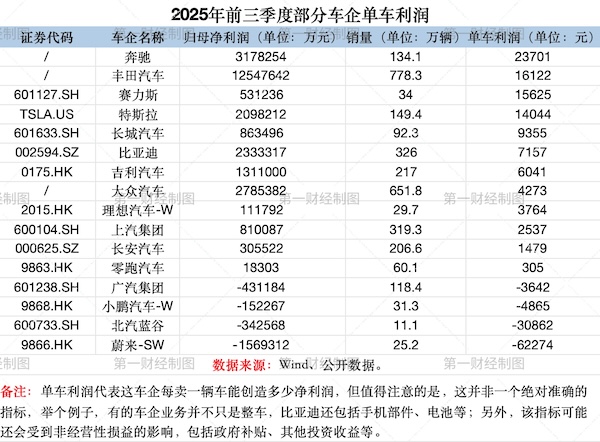
Core Insights - The profitability of major automotive companies is a focal point, particularly the per-vehicle profit, with luxury brands like Mercedes-Benz and Toyota leading the rankings [1][2] - The data indicates a shift in the narrative around electric vehicles, with companies like Seres and Tesla showing significant per-vehicle profits, challenging the notion that electric vehicles are unprofitable [1] Group 1: Profitability Rankings - Mercedes-Benz has the highest per-vehicle profit at approximately 24,000 yuan, followed by Toyota at 16,000 yuan, and Seres, a Chinese brand, at over 15,000 yuan, surpassing Tesla's profit of 14,000 yuan [1] - Among the 16 companies analyzed, only four have a per-vehicle profit exceeding 10,000 yuan, representing 25% of the sample [1] Group 2: Performance of Domestic and Foreign Brands - The "Big Three" private Chinese automakers, Great Wall, BYD, and Geely, have per-vehicle profits of 9,355 yuan, 7,157 yuan, and 6,041 yuan, respectively [2] - Xiaomi's automotive division reported a third-quarter operating profit of 700 million yuan with a delivery volume of 108,000 vehicles, showing significant improvement from a previous loss of 60,000 yuan per vehicle [2] Group 3: Challenges Faced by Multinational Companies - Volkswagen's net profit dropped by 61.5% year-on-year to 3.4 billion euros, with per-vehicle profit falling to around 4,000 euros due to various challenges including tariffs and restructuring [2] - Mercedes-Benz's net profit for the first three quarters was 3.878 billion euros, down from 7.806 billion euros the previous year, with a per-vehicle profit decline from 44,000 yuan to 24,000 yuan [2] Group 4: Losses in Certain Companies - NIO reported a cumulative loss of nearly 15.7 billion yuan in the first three quarters, with a per-vehicle loss exceeding 60,000 yuan, although there is an improvement trend compared to the previous year [3] - BAIC Blue Valley incurred a cumulative loss of over 3.4 billion yuan, with a per-vehicle loss exceeding 30,000 yuan, also showing signs of improvement [3]




将在欧洲建厂?长城汽车回应
2 1 Shi Ji Jing Ji Bao Dao· 2025-11-28 10:45
Core Viewpoint - Great Wall Motors has denied rumors regarding the establishment of a manufacturing plant in Europe, stating that there are currently no plans for such an investment [1][3]. Group 1: European Expansion Plans - Great Wall Motors' international president, Shi Qingke, clarified that the company is evaluating investment opportunities in Europe but has not conducted any site assessments in the region [1]. - The company has established Great Wall Motors Europe Technology Center in Germany, focusing on research and design of vehicles and automotive parts [1]. - Previous reports about Great Wall Motors exploring multiple European countries for potential factory sites are based on information prior to 2025 [1]. Group 2: Financial Performance - In the third quarter of 2025, Great Wall Motors reported a revenue of 612.47 billion yuan, a year-on-year increase of 20.51%, but the net profit attributable to shareholders decreased by 31.23% to 22.98 billion yuan [2]. - For the first three quarters of 2025, the company achieved a revenue of 1,535.82 billion yuan, up 7.96% year-on-year, while the net profit fell by 16.97% to 86.35 billion yuan [2]. - The decline in profit is attributed to increased investments in new user channels, new model launches, and brand promotion efforts [2]. Group 3: Stock Performance - As of the market close, Great Wall Motors' A-shares were priced at 21.90 yuan per share, reflecting a 0.64% increase, with a total market capitalization of 1,874 billion yuan [4]. - The company's stock has experienced a decline of over 15% year-to-date [4].

长城汽车:九州超算中心总算力规模达5EFLOPS,硬件扩容至超万卡级别且持续升级
Di Yi Cai Jing· 2025-11-28 09:40
Core Viewpoint - Great Wall Motors has achieved a total computing power of 5 EFLOPS at the Jiuzhou Supercomputing Center, with hardware expansion exceeding 10,000 units, and is continuously upgrading to support larger model training in the future [1] Group 1: Computing Power and Infrastructure - The Jiuzhou Supercomputing Center's advantages include not only scale but also efficiency, utilizing high-speed RDMA networks and high-performance storage systems to provide significant linear acceleration for large-scale model training [1] - The infrastructure is designed to avoid computational waste caused by data transmission and storage delays, significantly shortening the training cycle for complex AI models [1] Group 2: Future Strategy - Great Wall Motors plans to adhere to a "forest ecosystem" system, focusing on precise investment in research and development to maintain technological leadership and competitiveness amid industry transformation [1]
乘用车板块11月28日涨1.57%,广汽集团领涨,主力资金净流入11.25亿元
Zheng Xing Xing Ye Ri Bao· 2025-11-28 09:08
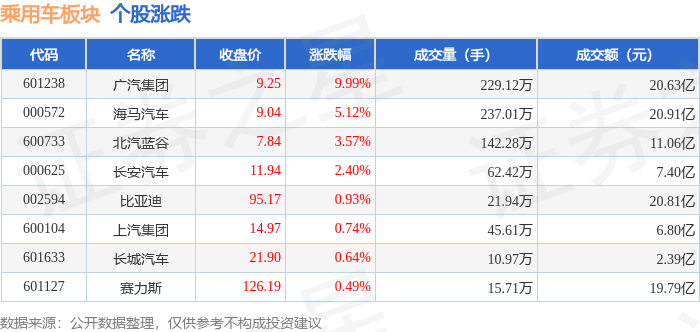
Core Points - The passenger car sector experienced a rise of 1.57% on November 28, with GAC Group leading the gains [1] - The Shanghai Composite Index closed at 3888.6, up 0.34%, while the Shenzhen Component Index closed at 12984.08, up 0.85% [1] Passenger Car Sector Summary - GAC Group's stock closed at 9.25, with a significant increase of 9.99%, and a trading volume of 2.29 million shares, amounting to a transaction value of 2.063 billion yuan [1] - Other notable performers included: - BAW Blue Valley, which rose by 3.57% to close at 7.84, with a transaction value of 1.106 billion yuan [1] - Changan Automobile, which increased by 2.40% to close at 11.94, with a transaction value of 740 million yuan [1] - BYD, which saw a modest increase of 0.93% to close at 95.17, with a transaction value of 2.081 billion yuan [1] Fund Flow Analysis - The passenger car sector saw a net inflow of 1.125 billion yuan from main funds, while retail investors experienced a net outflow of 643 million yuan [1] - The overall fund flow indicates a mixed sentiment, with institutional investors showing confidence while retail investors withdrew [1]



哪些A股上市公司拿政府补助当“遮羞布”?
Sou Hu Cai Jing· 2025-11-28 08:34
Core Insights - Government subsidies are a common and significant financial indicator for A-share listed companies, with a total of 890 companies receiving subsidies amounting to 3.354 billion yuan, covering 31 industries as of the first half of this year [1][12][14] Summary by Sections Government Subsidy Overview - Government subsidies can either serve as "lifelines" for companies to turn losses into profits or as "cover-ups" for operational difficulties [1] - The total amount of government subsidies received by listed companies reached 3.354 billion yuan, with 890 companies benefiting [1][12] Companies with Significant Subsidies - Eight companies received over 100 million yuan in subsidies, including China Petroleum (360 million yuan), Conch Cement (196.96 million yuan), and Gujia Home (139.35 million yuan) [3][4] - China Petroleum leads with a subsidy amount that is 1.8 times the average of the other seven companies, reflecting its status as a central enterprise in the energy sector [5] Industry Impact - The companies receiving substantial subsidies are primarily industry leaders or regional pillars, aligning with government goals to stabilize supply chains and promote industrial upgrades [4][9] - The medical device company Sainuo Medical received 2 million yuan in subsidies, which accounted for 133.53% of its net profit, indicating a heavy reliance on government support [6][8] Sector Analysis - The pharmaceutical and biological sector has the highest number of companies receiving subsidies, totaling 77, followed by machinery equipment (74) and basic chemicals (71) [13] - Traditional industries like textiles and retail have fewer companies receiving subsidies, indicating a policy focus on high-value-added and strategic emerging industries [14] ST Companies and Subsidy Reliance - Among 25 ST companies, only ST Juewei remains profitable, while others are in loss, highlighting the critical role of subsidies in avoiding delisting [10][11] - ST Yingfeitou received the highest subsidy of 6.9004 million yuan, while ST Saiwei received the lowest at 0.01 million yuan [11][10]






长城汽车回应欧洲建厂传闻:暂无规划
Xin Lang Cai Jing· 2025-11-28 07:35
Core Viewpoint - Great Wall Motors has denied rumors regarding plans to build a factory in Europe, stating that there are currently no such plans in place [1] Group 1 - Great Wall Motors' International President, Shi Qingke, clarified in a media interview on November 26 that the company is evaluating investment and site selection for a factory in Europe, but no plans have been finalized [1] - The rumors about Great Wall Motors conducting assessments in multiple European countries are based on information prior to 2025, and the company has not conducted any related assessments in any European countries [1]
中国银河证券:双轮驱动下的行业变革 2026年Robotaxi迈入规模化商用拐点 @李程
Zhi Tong Cai Jing· 2025-11-28 05:41
Core Insights - The report from China Galaxy Securities highlights that by 2026, the Robotaxi sector is expected to reach a commercialization turning point driven by policy support, technological advancements, and cost reductions [1][3] - The automotive industry in China is projected to experience stable volume and gradual price increases in 2025, with a dual drive from exports and new energy vehicles [1][2] Group 1: 2025 Overview - In 2025, the Chinese automotive industry is expected to achieve a pattern of "stable volume and gradual price increase," supported by the effective recovery of domestic demand due to vehicle replacement policies [1] - Both wholesale and retail sales are anticipated to grow year-on-year, with an increasing penetration rate of new energy vehicles [1] - The industry is facing continued price wars, leading to further pressure on profitability, with revenue growth outpacing profit growth [1] Group 2: 2026 Outlook - The exemption of the new energy vehicle purchase tax is expected to continue until the end of 2025, with a reduction to half in 2026-2027, potentially impacting sales significantly, especially for vehicles priced below 300,000 yuan [2] - Major automakers like Hongmeng Zhixing, Leap Motor, Geely, and JAC are entering a period of intensive new product launches, which may enhance their sales and market share [2] - The mainstream automakers' pure electric platforms are expected to be validated by 2025, with new models being launched at scale in 2026 [2] - The rollout of L3-level intelligent driving technology is imminent, becoming a key driver for new model launches in 2026 [2] Group 3: Emerging Business Opportunities - The Robotaxi sector is benefiting from policy support, technological progress, and cost reductions, leading to a commercial breakthrough, with major manufacturers and tech giants expanding their operations [3] - Low-speed unmanned logistics vehicles and mining trucks are moving towards scale due to policy support and economic advantages [3] - The integration of the intelligent automotive supply chain with the robotics industry is creating multiple advantages, including technological migration and resource consolidation [3] Group 4: Investment Recommendations - The report recommends focusing on leading passenger vehicle manufacturers, the intelligent industry chain, and humanoid robotics industry, highlighting companies like Geely and Great Wall Motors as key players [3] - Beneficiary stocks include JAC Motors and Leap Motor in the passenger vehicle sector, and companies like SUTENG and Desay SV in the intelligent sector [3] - In the humanoid robotics sector, companies such as Top Group and Aikodi are identified as beneficiaries [3]




观车 · 论势 || 越野大众化:别让自由探索失了“指南针”
Zhong Guo Qi Che Bao Wang· 2025-11-28 03:19
Core Viewpoint - The Chinese off-road market is undergoing a significant transformation, evolving from a niche hobby for enthusiasts to a mainstream choice for millions of families, with total sales of off-road vehicles expected to exceed 1.1 million units in 2024, representing a 63% year-on-year growth [1][2]. Group 1: Market Dynamics - The demand for off-road vehicles is driven by multiple social needs, including the upgrading of automotive consumption, the introduction of intelligent technologies that lower the entry barrier for new drivers, and a post-pandemic desire for adventure and exploration [2][3]. - The industry faces challenges due to a lack of standardized performance evaluation, leading to consumer confusion between different vehicle types and their capabilities, particularly in extreme conditions [3][4]. Group 2: Safety Concerns - There is a significant gap in drivers' understanding of their driving abilities, vehicle performance limits, and terrain assessment, contributing to safety risks in off-road driving [3][4]. - The absence of graded and managed off-road environments has resulted in dangerous situations, as seen in recent accidents where inexperienced drivers ventured into high-risk areas without proper guidance [3][4]. Group 3: Industry Standards and Initiatives - Great Wall Motors is attempting to establish a systematic understanding of off-road driving through three grading standards: off-road skills, off-road scenarios, and off-road products, but this alone is insufficient to change market perceptions [4][5]. - The launch of the "Off-Road Travel Compass" brand by Xiangyang Daan Automotive Testing Center aims to provide a structured evaluation system for vehicles, terrains, and driver skills, addressing key industry pain points and promoting safety [4][5]. Group 4: Cultural Shift - The standardization efforts are not meant to restrict freedom but to ensure safety and respect for life, emphasizing that true off-road enthusiasts prioritize preparation and safety over recklessness [5]. - The industry is at a critical juncture, transitioning from a focus on speed to quality, with the "Off-Road Travel Compass" representing a collective industry consensus on the importance of balancing adventure with safety [5].