
EBSCN(601788)

Search documents
光大证券遭易方达基金减持272.12万股
Ge Long Hui· 2025-12-17 00:03
| 股份代號: | 06178 | | --- | --- | | 上市法國名稱: | 光大證券股份有限公司 - H股 | | 日期 (日 / 月 / 年): | 17/11/2025 - 17/12/2025 | 格隆汇12月17日丨根据联交所最新权益披露资料显示,2025年12月11日,光大证券(06178.HK)遭易方达基金管理有限公司在场内以每股均价8.7778港元减持 272.12万股,涉资约2388.61万港元。 减持后,易方达基金管理有限公司最新持股数目为6163.82万股,持股比例由9.14%下降至8.75%。 追加内容 本文作者可以追加内容哦 ! | 表格序號 | 大股東/董事/最高行政人員名 作出披露的 買入 / 賣出或涉及的 每股的平均價 | | | | 持有權益的股份數目 佔已發行的有關事件的日 相關法國 | | --- | --- | --- | --- | --- | --- | | | 股份數目 | 原因 | | | ( 請參閱上述 * 註 有投票權股 期 (日 / 月 / | | | | | | | at 份百分比 年) | | | | | | | ( % ) | | CS20 ...



光大证券(06178.HK)遭易方达基金减持272.12万股
Ge Long Hui A P P· 2025-12-16 23:19
减持后,易方达基金管理有限公司最新持股数目为6163.82万股,持股比例由9.14%下降至8.75%。 格隆汇12月17日丨根据联交所最新权益披露资料显示,2025年12月11日,光大证券(06178.HK)遭易方达基金管理有限公司在场内以每股均价8.7778港元减持 272.12万股,涉资约2388.61万港元。 | 股份代號: | 06178 | | --- | --- | | 上市法國名稱: | 光大證券股份有限公司 - H股 | | 日期 (日 / 月 / 年): | 17/11/2025 - 17/12/2025 | | 表格序號 | 大股東/董事/最高行政人員名 作出披露的 買入 / 賣出或涉及的 每股的平均價 | | | | 持有權益的股份數目 佔已發行的有關事件的日 相關法國 | | --- | --- | --- | --- | --- | --- | | | 股份數目 | 原因 | | | ( 請參閱上述 * 註 有投票權股期 (日 / 月 / | | | | | | | 份自分比 年) | | | | | | | ( % ) | | CS20251216E00263 | 易方达基金管理有 ...

【固收】主要指标进一步回落——2025年11月经济数据点评兼债市观点(张旭/李枢川)
光大证券研究· 2025-12-16 23:03
Core Viewpoint - The economic data released by the National Bureau of Statistics indicates a mixed performance in industrial production, fixed asset investment, and retail sales for November 2025, suggesting underlying economic challenges and a need for cautious optimism in investment strategies [4][5][6][7]. Industrial Production - In November 2025, the industrial added value for large-scale enterprises grew by 4.8% year-on-year, a slight decrease from 4.9% in October. However, the month-on-month growth rate improved to +0.44%, indicating a positive trend in short-term production [5]. - Among the three major sectors, the mining industry saw an increase in year-on-year growth, while the manufacturing and utilities sectors experienced a decline [5]. Fixed Asset Investment - From January to November 2025, the cumulative year-on-year growth rate of fixed asset investment decreased by 2.6%, marking a widening decline. However, the month-on-month growth rate for November showed a smaller decline of -1.03% [6]. - Investment in real estate, manufacturing, and broad infrastructure remained weak, contributing to the overall decline in fixed asset investment [6]. Retail Sales - The year-on-year growth rate of social consumer goods retail sales in November was 1.3%, down from 2.9% in the previous month. The month-on-month growth rate was -0.42%, which was weaker than seasonal expectations [7]. - Sales growth across different types of consumer goods also showed a decline compared to the previous month [7]. Bond Market Insights - Since August 2025, the yield on government bonds has shown a clear divergence, with short-term yields remaining stable and declining, while long-term yields, particularly the 30-year yield, have been on an upward trend, resulting in a steeper yield curve [8]. - The current liquidity in the market is relatively loose, and despite weak fundamentals, there is a growing optimism among investors regarding the bond market, with expectations for the 10-year government bond yield to stabilize around 1.75% [8]. - In the convertible bond market, as of December 12, 2025, the performance of convertible bonds has lagged behind the equity market, with a year-to-date increase of 16.5% compared to 21.8% for the broader index. However, convertible bonds are still considered relatively high-quality assets in the long term [8].

纳芯微跌2.54% 2022年上市超募48亿元光大证券保荐
Zhong Guo Jing Ji Wang· 2025-12-16 08:58
Group 1 - The stock price of Naxin Micro (688052.SH) fell by 2.54%, closing at 148.16 yuan [1] - Naxin Micro was listed on the Shanghai Stock Exchange's Sci-Tech Innovation Board on April 22, 2022, with an initial public offering (IPO) of 25.266 million shares at a price of 230.00 yuan per share [1] - The company is currently in a state of share price decline, having broken its initial offering price [1] Group 2 - The total amount raised from the IPO was 5.811 billion yuan, with a net amount of 5.581 billion yuan, exceeding the originally planned fundraising by 4.831 billion yuan [1] - The original fundraising target was 750 million yuan, intended for signal chain chip development, R&D center construction, and working capital [1] - The total issuance costs for the IPO were 230 million yuan (excluding VAT), with underwriting fees amounting to 203 million yuan [1] Group 3 - On May 24, 2023, Naxin Micro announced a profit distribution plan, distributing a cash dividend of 0.8 yuan per share (tax included) and a capital reserve increase of 0.4 shares per share [1] - The total cash dividend distributed amounted to 80.8512 million yuan, with a total of 40.4256 million shares being increased [1] - Following this distribution, the total share capital of the company increased to 141.4896 million shares [1]

上交所:光大证券股份有限公司债券12月17日上市,代码244286
Sou Hu Cai Jing· 2025-12-16 02:39
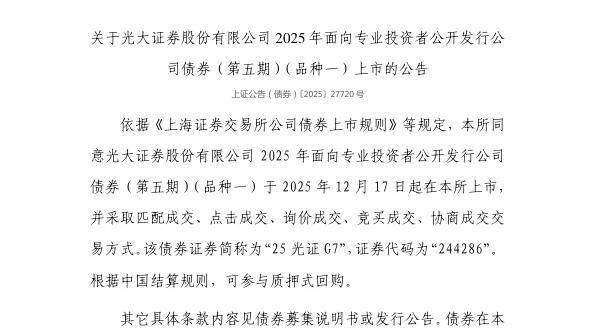
12月16日,上交所发布关于光大证券股份有限公司2025年面向专业投资者公开发行公司债券(第五期) (品种一)上市的公告。 依据《上海证券交易所公司债券上市规则》等规定,上交所同意光大证券股份有限公司2025年面向专业 投资者公开发行公司债券(第五期)(品种一)于2025年12月17日起在上交所上市,并采取匹配成交、 点击成交、询价成交、竞买成交、协商成交交易方式。该债券证券简称为"25光证G7",证券代码 为"244286"。根据中国结算规则,可参与质押式回购。 来源:市场资讯 ...
A股开盘速递 | 指数弱势震荡!零售板块反复活跃 乳业概念再度走强
智通财经网· 2025-12-16 02:03
Group 1: Market Overview - The market showed weakness with the Shanghai Composite Index down 0.51%, Shenzhen Component down 0.58%, and ChiNext down 0.66% as of 9:38 AM on December 16 [1] - Retail concepts were active, with Baida Group achieving four consecutive trading limits, and other companies like Hongqi Chain and Dongbai Group also seeing gains [1] - The dairy industry saw a resurgence, with Huangshi Group hitting a trading limit and achieving two consecutive trading limits, while companies like Huanlejia and Sunshine Dairy also rose [1] Group 2: Institutional Perspectives - Everbright Securities anticipates a favorable cross-year market for A-shares due to new policy deployments, which are expected to support economic growth and attract capital inflows [2] - Huaxi Securities notes that recent meetings have supported market risk appetite, with expectations for increased trading activity and investment in growth sectors like domestic substitution and innovative pharmaceuticals [3] - Oriental Securities emphasizes the importance of core technology sectors that are trending upwards, while also noting the market's structural volatility as it approaches the end of the year [4]


——2025年11月经济数据点评:经济内生动能回落,政策窗口期逐步临近
EBSCN· 2025-12-15 14:50
Consumption - In November 2025, the year-on-year growth rate of social retail sales was 1.3%, below the expected 2.9%, marking the lowest point since February 2023[3] - The decline in consumption is attributed to last year's "trade-in" policy raising the base, and a decrease in service consumption after the long holiday[2] - The retail sales of five categories involved in the "trade-in" policy saw a decline, with home appliances and furniture experiencing negative year-on-year growth[4] Investment - From January to November 2025, fixed asset investment showed a cumulative year-on-year decrease of 2.6%, worse than the expected decrease of 2.2%[5] - In November, the year-on-year decline in fixed asset investment was -11.1%, with manufacturing investment improving slightly to -4.4%[13] - Infrastructure investment continued to decline, with narrow and broad infrastructure showing year-on-year decreases of -9.7% and -12.0%, respectively[19] Real Estate - In November 2025, the year-on-year growth rate of national commodity housing sales fell to -26.1%, down from -25.1% in October[23] - Real estate development investment saw a significant decline, with a year-on-year decrease of -31.4% in November, reaching a low level[23] - The two-year compound growth rate for commodity housing sales area improved slightly, from -11.1% in October to -7.9% in November[23]
——量化学习笔记之一:基于堆叠LSTM模型的十年期国债收益率预测
EBSCN· 2025-12-15 07:56
1. Report Industry Investment Rating No relevant content provided. 2. Core View of the Report The report systematically reviews the evolution of financial time - series forecasting models and constructs a prediction model for China's 10 - year treasury bond yield using a long - short - term memory (LSTM) neural network with historical time series as the single input variable, initially exploring the application of this deep - learning model in the fixed - income quantitative field [10]. 3. Summary by Relevant Catalog 3.1 Financial Time - Series Forecasting and Neural Network Models 3.1.1 Evolution of Financial Time - Series Forecasting Models Financial time - series forecasting has gone through three main development stages: traditional econometric models, traditional machine - learning models, and deep - learning models. Traditional econometric models have clear forms and strong interpretability but struggle to depict nonlinear and complex dynamic relationships. Traditional machine - learning models can perform nonlinear fitting and automatic feature screening but need manual feature extraction. Deep - learning models can automatically extract features from raw data and capture complex long - term time - series patterns, adapting well to the complex characteristics of financial time series [11][12]. 3.1.2 Neural Network Models and LSTM Models Neural network models are machine - learning models imitating the connection structure of human brain neurons. Recurrent neural networks (RNN) and their variants, such as LSTM, are designed for processing sequence data. LSTM solves the long - term dependence problem of traditional RNN through a "gating mechanism" and memory units, enhancing robustness to irregular data and being suitable for bond yield prediction [13][18]. 3.2 Treasury Bond Yield Prediction Based on Stacked LSTM Model 3.2.1 Stacked LSTM Model Stacked LSTM connects multiple LSTM layers in sequence, having advantages in long - sequence processing and multi - dimensional feature extraction, more suitable for complex time - series forecasting in financial scenarios [23]. 3.2.2 Construction of Treasury Bond Yield Prediction Model The report uses a classic and robust architecture of three - layer stacked LSTM + Dropout regularization to build a neural network model for predicting the 10 - year treasury bond yield. It only uses the historical time series of the 10 - year treasury bond yield as a single variable for prediction. The data is from the beginning of 2021 to December 12, 2025. After data processing and sample construction, a medium - complexity LSTM neural network model with about 130,000 adjustable parameters is built. The optimal model is obtained at the 27th training iteration, with an average absolute error of 1.43BP for the test set. The predicted yield on December 19, 2025, is 1.8330%, slightly lower than 1.8396% on December 12, 2025 [2][24][30]. 3.3 Follow - up Optimization Directions - Optimize model design: Adjust and optimize the design related to time windows, data processing, network architecture, and training strategies [3][36]. - Input multi - dimensional variables: Expand input variables from a single yield sequence to multi - dimensional variables such as macro, market, and sentiment to make the model more in line with economic logic and capture more comprehensive information [3][36]. - Build hybrid models: Combine the LSTM model with traditional econometric models or other machine - learning models to build hybrid models like ARIMAX - LSTM and CNN - LSTM - ATT, enhancing prediction accuracy [3][36]. - Introduce a rolling back - testing mechanism: Use a rolling time - window back - testing mechanism to update the model dynamically and make continuous predictions, improving the model's adaptability to market changes [3][36].
光期研究2026年度黑色策略报告-20251215
Guang Da Qi Huo· 2025-12-15 05:35
1. Report Industry Investment Rating No relevant content provided. 2. Core Views of the Report - In 2026, the supply - demand situation of steel products is expected to improve, and the center of steel prices may move up. The production of crude steel will continue to decline slightly, while demand from infrastructure and manufacturing will pick up, and exports will remain at a high level. The cost of raw materials such as iron ore and coking coal is expected to be relatively loose, and the profits of the steel industry may be repaired [6][7][11][12]. - The supply - demand balance of iron ore will remain loose in 2026. Overseas mines (excluding India) are expected to increase production by 62 million tons, and domestic iron ore supply will also increase. However, the release of incremental supply from small and medium - sized mines depends on ore prices and project progress. Domestic pig iron production is expected to decline, and overseas demand will increase slightly. The operating range of ore prices is expected to be around $85 - 110 per ton [121][122][123]. - The supply - demand pattern of coking coal and coke will remain relatively loose in 2026. For coking coal, domestic production and imports are expected to increase, while demand may decrease. The operating range of coking coal futures prices is expected to be between 900 - 1400 yuan per ton. For coke, production is expected to decrease, exports may fall, and imports may rise. The operating range of coke futures prices is expected to be between 1300 - 1900 yuan per ton [228][229]. - In 2026, the oversupply situation of ferroalloys is difficult to change. For ferromanganese silicon, new production capacity is to be put into operation, but production may decline slightly, and demand will remain stable. For ferrosilicon, production capacity will remain in excess, costs will provide support, and upward drivers will be limited [322]. 3. Summary According to the Directory 3.1 Steel Products 2025 Market Review - The domestic steel market in 2025 showed a trend of "lower price center and significantly narrowed volatility". Steel prices mainly fluctuated and declined throughout the year, except for a significant rebound from June to July. The overall demand was weak, with real estate being the main drag, while plate demand was stronger than long - product demand. Overseas demand was strong, and steel and billet exports reached new highs [14][23][38][40]. - Long - process steel mills had relatively good profits in 2025, mainly due to the sharp decline in coking coal and coke prices and the adjustment of product structure by steel mills. Short - process steel mills continued to suffer losses [55][56]. 2026 Market Analysis - **Demand**: In 2026, policy guidance for steel demand will be positive. Real estate investment and sales are expected to decline at a slower pace, infrastructure investment is expected to increase slightly, and manufacturing investment is expected to recover moderately [7][62][72]. - **Supply**: The policy of reducing crude steel production will continue in 2026, and it is expected that crude steel production will decline slightly, and the supply of steel products will better match demand [6][94][96]. - **Import and Export**: In 2026, steel exports are expected to remain at a high level but will decline from the peak. The net export of crude steel may decrease compared to 2024 [10][101][118]. - **Cost**: In 2026, the supply of iron ore and coking coal will be relatively loose, and the profits of the steel industry may be repaired [11][110][114]. 3.2 Iron Ore 2025 Market Review - In 2025, the supply - demand of iron ore was marginally loose, and the price fluctuations throughout the year were significantly narrowed. There were two obvious price increases, and the basis was at a low level in the past five years. The prices of different iron ore varieties showed different trends [124][129][132]. - The supply increment mainly came from Brazil and non - mainstream countries, and the production of domestic mines increased less than expected. Overseas demand decreased slightly, while domestic iron ore demand was better than expected [142][158][179]. 2026 Market Outlook - **Supply**: In 2026, overseas mines (excluding India) are expected to increase production by 62 million tons, with the main increments coming from Australia, Guinea, and Brazil. The supply of domestic iron ore is also expected to increase, but the release of incremental supply from small and medium - sized mines depends on ore prices and project progress [121][161][177]. - **Demand**: Overseas demand is expected to increase slightly, while domestic pig iron production is expected to decline. Overall, the supply - demand of iron ore will remain loose, and the operating range of ore prices is expected to be around $85 - 110 per ton [122][123][203]. - **Inventory**: Port inventory first decreased and then increased, and steel mills maintained low - inventory management [209][215]. 3.3 Coking Coal and Coke 2025 Market Review - In 2025, the prices of coking coal and coke fluctuated greatly. The price of coking coal was mainly driven by the supply side, with a sharp decline from January to May, a sharp increase from June to August, wide - range fluctuations from August to October, and another significant decline in November [231][232][235]. - The production of coking coal showed a pattern of "loose in the first half of the year and tight in the second half". The production of coke was adjusted periodically according to coking profits [246][277]. 2026 Market Outlook - **Coking Coal**: In 2026, domestic coking coal production is expected to reach 483 million tons, and imports are expected to increase to 120 million tons. Demand is expected to decrease by 8 million tons to about 585 million tons. The overall supply - demand of coking coal will face certain pressure, and the operating range of futures prices is expected to be between 900 - 1400 yuan per ton [228][314][317]. - **Coke**: In 2026, coke production is expected to decrease to 495 million tons, exports may fall to 7.2 million tons, and imports may rise to 0.8 million tons. Demand is expected to decrease by about 2.8 million tons. The operating range of coke futures prices is expected to be between 1300 - 1900 yuan per ton [229][314][318]. 3.4 Ferroalloys 2025 Market Review - In 2025, the futures prices of ferromanganese silicon and ferrosilicon showed similar trends, with the amplitude of ferromanganese silicon being slightly larger. The prices were mainly affected by factors such as manganese ore inventory, terminal demand, and the "anti - involution" policy [326][327]. 2026 Market Outlook - **Ferromanganese Silicon**: In 2026, the supply - demand pattern of ferromanganese silicon will remain relatively loose, and prices will mainly fluctuate. New production capacity is to be put into operation, but production may decline slightly. Demand is expected to remain basically the same [322][397]. - **Ferrosilicon**: In 2026, the over - capacity situation of ferrosilicon will continue, with cost support and limited upward drivers. Production capacity will remain in excess, and demand will change little year - on - year [322][399].
东海证券晨会纪要-20251215
Donghai Securities· 2025-12-15 03:38
Core Insights - The report emphasizes the importance of focusing on equity sectors with clear directions during the central bank's interest rate decision week, highlighting the mixed performance of global markets and the need for strategic asset allocation [5][7][10]. Economic Policy Insights - The 2025 Central Economic Work Conference outlined five essential strategies to stabilize economic growth, maintaining a target growth rate of around 5% and emphasizing the need for effective macroeconomic governance [10][11][12]. - The report indicates a shift towards more proactive fiscal policies, with a projected narrow deficit rate of around 4% and an increase in special bonds to support economic recovery [12][13]. - Monetary policy is expected to remain moderately loose, with room for further interest rate cuts and reserve requirement ratio reductions to support economic growth and price stability [12][13]. Market Performance - The report notes that during the week of December 12, 2025, the A-share market showed varied performance across sectors, with growth sectors outperforming financial and cyclical sectors [6][22]. - The average daily trading volume in the domestic equity market increased to 19,359 billion yuan, up from 16,843 billion yuan previously, indicating heightened market activity [6][22]. Sector Analysis - The report highlights that the semiconductor sector is expected to perform well, with global semiconductor sales increasing by 4.7% month-on-month in October 2025, reaching 72.7 billion USD, and a year-on-year growth of 27.2% [7][10]. - In the A-share market, the telecommunications, defense, and electronics sectors showed significant gains, while coal, oil, and steel sectors experienced declines [6][22]. Financial Statistics - The report provides key financial statistics, including a total social financing increment of 33.39 trillion yuan for the first ten months of 2025, which is 3.99 trillion yuan more than the previous year [16]. - The broad money supply (M2) reached 336.99 trillion yuan, reflecting an 8% year-on-year growth, while the narrow money supply (M1) increased by 4.9% [16].