
Bank of Chengdu(601838)

Search documents
真金白银出手!上市银行,增持潮起!
券商中国· 2025-11-23 02:32
Core Viewpoint - The recent trend of share buybacks by major shareholders and executives in A-share listed banks, particularly city commercial banks and rural commercial banks, indicates strong confidence in the long-term development prospects of these institutions [1][4]. Group 1: Shareholder and Executive Buybacks - Multiple listed banks, including Nanjing Bank and Chengdu Bank, have announced significant share buybacks by major shareholders and executives, reflecting a growing trend since October [2][3]. - Chengdu Bank's major shareholders invested approximately 611 million yuan to buy back nearly 34.247 million shares, with plans for further purchases totaling between 700 million and 1.4 billion yuan [2]. - Nanjing Bank's largest shareholder, BNP Paribas, increased its stake by approximately 12.8 million shares, raising its total holding to 18.06%, marking a new high [3]. Group 2: Market Performance and Investor Sentiment - Despite overall market volatility, the A-share banking sector has shown resilience, with major banks like Bank of China and Industrial and Commercial Bank of China reaching new historical highs [1][6]. - In the past month, 17 banking stocks have recorded positive cumulative gains, with Bank of China leading at a 13.74% increase [6]. - The overall valuation of A-share listed banks remains low, with a median price-to-book ratio of approximately 0.6, indicating potential for further appreciation [6]. Group 3: Analyst Insights and Future Outlook - Analysts from various brokerage firms have reiterated investment opportunities in the banking sector, highlighting the sector's high dividend yield and low valuation as attractive features [7]. - The shift in investment logic from "pro-cyclical" to "weak-cyclical" suggests that during periods of economic stagnation, banking stocks will remain appealing due to their consistent high dividends [7]. - There is an expectation that medium-sized insurance companies will increasingly seek long-term equity investments in smaller banks, further supporting the sector's growth [7].




沪市公司单日披露超30份增持回购公告
Zheng Quan Ri Bao Zhi Sheng· 2025-11-22 01:37
Group 1 - As of November 21, nearly 40 companies in the Shanghai market announced share buybacks and positive operational news, with 32 of these being buyback announcements [1] - Huida Technology announced a new buyback plan of 200 million to 400 million yuan, with a buyback price ceiling of 124.15 yuan per share, representing approximately 0.35% to 0.69% of its total share capital [1] - Other companies like Yongyuan Tourism and Xiangyuan Cultural Tourism also initiated their first buybacks, with significant amounts being allocated for these plans [2] Group 2 - Xiangyuan Cultural Tourism plans to buy back between 80 million to 120 million yuan from November 18, 2025, to May 15, 2026, and has already repurchased 2.095 million shares for 15.63 million yuan [2] - Yongyuan Tourism began its buyback on November 10, 2025, repurchasing 1 million shares for 5.39 million yuan, while Xingdesheng repurchased 200,000 shares for 4.93 million yuan on the same day [2] - China National Shipping Holdings announced a buyback plan of 749 million to 1.498 billion yuan, having repurchased 40.53 million shares for a total of 607 million yuan by November 21 [2] Group 3 - China Jushi disclosed a buyback plan of up to 880 million yuan, having repurchased 34.18 million shares, which is 0.85% of its total share capital, with over 534 million yuan spent in one month [3] - Jiangsu Hengrui Medicine and Zhuzhou Qibin Group also reported their buyback activities, with Hengrui repurchasing 979,900 shares for 59.79 million yuan, totaling 889.87 million yuan in buybacks [3] - Zhuzhou Qibin Group repurchased 15.95 million shares for 112.36 million yuan, with total buybacks reaching 27.96 million shares and 195.96 million yuan spent [3] Group 4 - Seven companies, including Chengdu Bank and China Railway High-tech Industry, reported shareholder buyback progress, with Longi Green Energy's chairman completing a buyback of 6.13 million shares for 100.69 million yuan [4] - Sinopec announced that its controlling shareholder and related parties have increased their holdings by 34.56 million shares for approximately 194 million yuan since April 9, 2025, totaling over 294 million yuan in buybacks [4]






越跌越买?成都银行两大股东再出手增持,下半年银行板块回调显著,股东管理层“买单”频现
Xin Lang Cai Jing· 2025-11-21 15:33
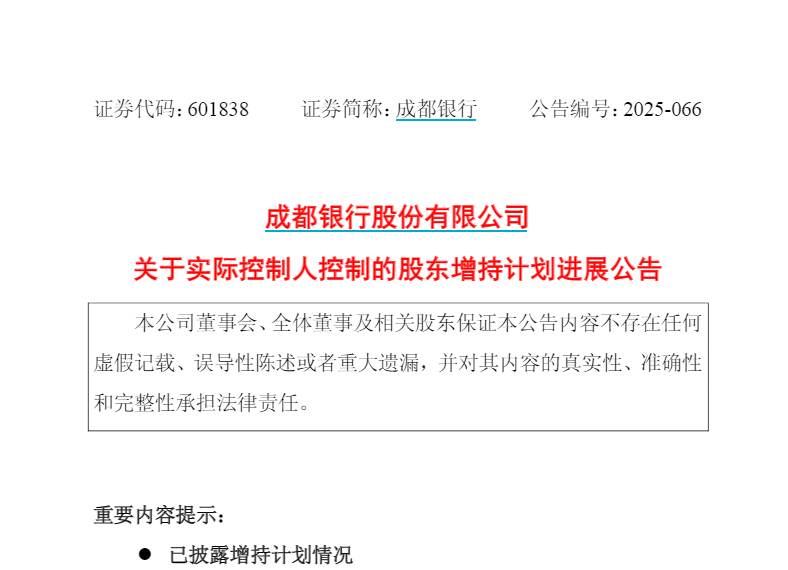
智通财经11月21日讯(记者 邹俊涛)11月21日晚,成都银行发布公告,公司两大股东成都产业资本集团、成都欣天颐近期联手斥资6.11亿元增持该行股份近 3424.7万股。 Wind数据显示,截止11月21日收盘,成都银行股价报收16.72元每股,较今年年中的股价高峰时期已跌去41%。其中在今年8月下旬以来的股价跌幅达到35% 左右。 今日晚间,成都银行公告称,该行于2025年11月21日收到成都产业资本控股集团有限公司(以下简称"成都产业资本集团")、成都欣天颐投资有限责任公司 (以下简称"成都欣天颐")关于增持计划实施进展的告知函。 公告显示,2025年8月27日至2025年11月21日期间,成都产业资本集团和成都欣天颐通过集中竞价的方式分别累计增持成都银行股份14,044,750股和 20,202,237股,占成都银行股份总数比例的0.3314%和0.4766%,分别累计增持金额为25,265.94万元和35,834.97万元。 增持后,成都产业资本集团持股数量为256,926,336股,持股比例为6.0618%;成都欣天颐持股数量为181,136,235股,持股比例为4.2737%。 公告称,本次增持计 ...
成都银行:获股东成都产业资本集团、成都欣天颐合计增持3424.7万股
Bei Jing Shang Bao· 2025-11-21 13:11
成都银行表示,本次增持计划实施可能存在因资本市场情况发生变化或目前尚无法预判的因素,导致增 持计划无法继续实施的风险。敬请广大投资者谨慎决策,注意防范投资风险。 2025年8月27日至2025年11月21日期间,成都产业资本集团通过上海证券交易所交易系统以集中竞价的 方式累计增持成都银行股份1404.48万股,占成都银行股份总数的比例为0.3314%,累计增持金额为2.53 亿元。目前成都产业资本集团的持股数量为2.57亿股,持股比例为6.0618%。2025年8月27日至2025年11 月21日期间,成都欣天颐通过上海证券交易所交易系统以集中竞价的方式累计增持成都银行股份 2020.22万股,占成都银行股份总数的比例为0.4766%,累计增持金额为3.58亿元。目前成都欣天颐的持 股数量为1.81亿股,持股比例为4.2737%。本次增持计划尚未实施完毕,成都产业资本集团、成都欣天 颐将按照增持计划以自有资金继续增持成都银行股份。 北京商报讯(记者 孟凡霞 周义力)11月21日,成都银行发布公告称,该行今日收到成都产业资本控股 集团有限公司(以下简称"成都产业资本集团")、成都欣天颐投资有限责任公司(以下简称 ...
成都银行(601838.SH):股东成都产业资本集团增持1404.48万股公司股份
Ge Long Hui A P P· 2025-11-21 11:28
格隆汇11月21日丨成都银行(601838.SH)公布,成都银行于2025年11月21日收到成都产业资本控股集团 有限公司、成都欣天颐投资有限责任公司关于增持计划实施进展的告知函。2025年8月27日至2025年11 月21日期间,成都产业资本集团通过上海证券交易所交易系统以集中竞价的方式累计增持成都银行股份 1404.48万股,占成都银行股份总数的比例为0.3314%,累计增持金额为2.53亿元。目前成都产业资本集 团的持股数量为2.57万股,持股比例为6.0618%。2025年8月27日至2025年11月21日期间,成都欣天颐通 过上海证券交易所交易系统以集中竞价的方式累计增持成都银行股份2020.22万股,占成都银行股份总 数的比例为0.4766%,累计增持金额为3.58亿元。目前成都欣天颐的持股数量为1.81亿股,持股比例为 4.2737%。本次增持计划尚未实施完毕,成都产业资本集团、成都欣天颐将按照增持计划以自有资金继 续增持成都银行股份。 ...
成都银行(601838) - 成都银行股份有限公司关于实际控制人控制的股东增持计划进展公告
2025-11-21 11:15
成都银行股份有限公司 关于实际控制人控制的股东增持计划进展公告 证券代码:601838 证券简称:成都银行 公告编号:2025-066 本公司董事会、全体董事及相关股东保证本公告内容不存在任何 虚假记载、误导性陈述或者重大遗漏,并对其内容的真实性、准确性 和完整性承担法律责任。 重要内容提示: 已披露增持计划情况 成都银行股份有限公司(以下简称"成都银行")于 2025 年 4 月 9 日披露了《成都银行股份有限公司关于实际控制人控制的股东增持计 划公告》,于 2025 年 8 月 9 日披露了《成都银行股份有限公司关于实 际控制人控制的股东增持计划进展暨增持计划调整的公告》,对原增 持计划进行合理调整和变更,相关调整和变更事项已于 2025 年 8 月 26 日经成都银行 2025 年第一次临时股东大会审议通过。 增持计划的实施进展 成都银行于 2025 年 11 月 21 日收到成都产业资本控股集团有限 公司(以下简称"成都产业资本集团")、成都欣天颐投资有限责任公 司(以下简称"成都欣天颐")关于增持计划实施进展的告知函。2025 年 8 月 27 日至 2025 年 11 月 21 日期间,成都产业资 ...
金融行业双周报(2025、11、07-2025、11、20):银行:超配(维持)-20251121
Dongguan Securities· 2025-11-21 10:43
Investment Ratings - Banking: Overweight (Maintain) [1] - Securities: Market Weight (Maintain) [1] - Insurance: Overweight (Maintain) [1] Core Insights - The report highlights the emergence of a trillion-yuan brokerage firm through mergers, accelerating supply-side reforms in the securities industry [3] - The total assets of the new company formed by the merger of CICC, Dongxing Securities, and Xinda Securities are expected to reach 1009.583 billion yuan, making it the fourth largest securities company in A-shares [3] - The report indicates that the insurance sector is seeing a steady increase in stock investments, with a total balance of 3.62 trillion yuan, reflecting a shift towards equity investments to mitigate potential risks [4][46] Summary by Sections Market Review - As of November 20, 2025, the banking, securities, and insurance indices have changed by +1.69%, -3.36%, and +1.76% respectively, while the CSI 300 index decreased by -2.74% [12] - Among the sub-sectors, China Bank (+10.25%), Dongxing Securities (+5.38%), and China Life Insurance (+2.32%) performed the best [12] Valuation Situation - As of November 20, 2025, the PB ratio for the banking sector is 0.77, with state-owned banks, joint-stock banks, city commercial banks, and rural commercial banks having PB ratios of 0.83, 0.62, 0.73, and 0.65 respectively [22] - The securities sector's PB ratio is 1.49, indicating potential for valuation recovery [25] Recent Market Indicators - The average daily trading volume in A-shares was 1819.419 billion yuan, a decrease of 10.14% week-on-week [35] - The average margin balance was 2493.753 billion yuan, showing a slight decrease of 0.05% [35] Industry News - The report notes that the financial regulatory authority has implemented measures to enhance the supervision of pension institutions, which may impact banking operations [39] - The report also highlights a significant increase in bond underwriting by securities firms, particularly in technology and rural revitalization bonds [39] Company Announcements - CICC announced plans to merge with Dongxing Securities and Xinda Securities, with the merger expected to enhance its market position significantly [45] - Nanjing Securities plans to raise up to 5 billion yuan through a private placement to strengthen its capital base and enhance competitiveness [42] Weekly Perspectives - The banking sector is expected to benefit from a shift in funds towards safer investments, particularly in high-dividend, low-valuation bank stocks [44] - The insurance sector is encouraged to increase equity investment ratios, with a focus on returning to core protection functions [46]





华西中债1-5年政策性金融债成立 规模30亿元
Zhong Guo Jing Ji Wang· 2025-11-21 03:01
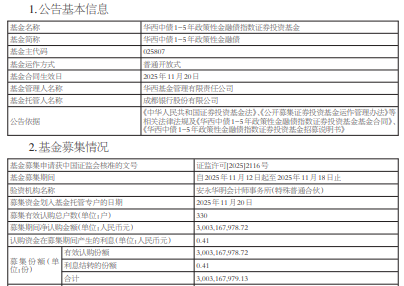
| 甚金名称 | 华西中债1-5年政策性金融情指数证券投资基金 | | --- | --- | | 甚全间标 | 华西中债1-5年政策性金融情 | | 甚金主代码 | (025807 | | 基金运作方式 | 督通开放式 | | 蒸会合同生效日 | 2025年11月20日 | | 甚金管理人名称 | 华西基金管理有限责任公司 | | 蒸会托管人名称 | 成都银行股份有限公司 | | 公告依据 | 《中华人民共和国正券投资基金法》,《公开总集证券投资基金运作管理办法》等 相关注律法规及《华西中债1-5年政策性金融债指数证券投资基金基金合同》、 | | | 《华西中情 1-5年政策性金融情指数正券投资基金招赋说明书》 | 中国经济网北京11月21日讯今日,华西基金发布华西中债1-5年政策性金融债指数证券投资基金合同生 效公告。 募集期间净认购金额3,003,167,978.72元,认购资金在募集期间产生的利息0.41元,募集份额合计 3,003,167,979.13份。 基金经理钟青松曾任前海人寿保险股份有限公司信用产品投资岗,现任华西基金管理有限责任公司投资 管理部基金经理。这也是其首次管理公募基金。 | 基金 ...
中国银行创新高,保险资金为何偏爱银行股?
Jiang Nan Shi Bao· 2025-11-20 09:24
Core Viewpoint - The banking sector is gaining attention in the capital market due to a combination of declining interest rates, policy support, and low valuations, leading to increased investment from long-term funds like insurance capital [1][2]. Group 1: Reasons for Insurance Capital Favoring Bank Stocks - Insurance capital seeks stable and reliable assets due to a mismatch in the average duration of liabilities (over 12 years) and assets (approximately 6 years), resulting in over 2 trillion yuan needing investment annually [1]. - Bank stocks are attractive due to their high dividend yields, low valuations, and low volatility, with an average dividend yield of 3.86%, significantly higher than the 10-year government bond yield of 1.82% as of November 19, 2025 [1][2]. Group 2: Valuation and Stability of the Banking Sector - The banking sector's price-to-book ratio is at 0.63, indicating extreme low valuation and providing a safety cushion [2]. - The banking sector has shown a volatility of only 14.90% over the past three years, which is significantly lower than the 24.80% volatility of the CSI 300 index, making it suitable for long-term holding as a core asset [2]. Group 3: Impact of IFRS 9 on Insurance Companies - The implementation of IFRS 9 accounting standards requires insurance companies to estimate and recognize expected credit losses at the initial recognition of assets, affecting profits even before actual losses occur [2]. - This new standard encourages insurance companies to classify more equity investments as FVOCI (Fair Value Through Other Comprehensive Income), which helps to isolate short-term market fluctuations from profit statements, making bank stocks a suitable choice for long-term holding [2]. Group 4: Preferred Bank Stocks Among Insurance Capital - Insurance capital shows a preference for state-owned banks like Industrial and Commercial Bank of China and China Construction Bank due to their stable dividends and strong liquidity [3]. - Quality joint-stock banks such as China Merchants Bank and Industrial Bank are favored for their robust profitability and potential for valuation recovery [3]. - High-growth regional banks like Chengdu Bank and Suzhou Bank are also attractive due to their high ROE and asset quality, indicating potential for price appreciation [3]. - Hong Kong-listed bank stocks, such as CITIC Bank and Chongqing Bank, are appealing due to higher dividend yields and more attractive valuations [3]. Group 5: Implications for Ordinary Investors - For ordinary investors, bank stocks offer a combination of high dividends and low valuations, providing defensive characteristics and cash flow returns in the current market environment [5]. - As market trends shift towards stable returns, bank stocks can play a crucial role in balancing risk and securing stable dividends within an investment portfolio [5].



中国银行股价创新高!红利低波ETF(512890)近60个交易日资金狂揽47亿元,机构持续看好红利资产配置价值
Xin Lang Ji Jin· 2025-11-20 03:13
Core Viewpoint - The article highlights the performance and investment appeal of the Dividend Low Volatility ETF (512890), which has shown significant capital inflows and strong market recognition. Group 1: ETF Performance - The Dividend Low Volatility ETF (512890) rose by 1.15% to 1.233 CNY, with a trading volume of 4.18 billion CNY, leading its category in terms of transaction scale [1][3] - Over the past five trading days, the ETF has seen a net inflow of 180 million CNY, and over the last 20 trading days, the net inflow reached 1.15 billion CNY, indicating strong investor interest [2][3] - As of November 19, 2025, the ETF's total circulation scale was 21.431 billion CNY, ranking first among similar products, reflecting market confidence in the dividend low volatility strategy [2][3] Group 2: Investment Strategy and Holdings - The ETF's top holdings include major banks and transportation sectors, such as China Grain Reserves Corporation, Nanjing Bank, and Agricultural Bank of China, showcasing a focus on stable dividend-paying stocks [2][6] - The ETF has achieved a cumulative return of 143.68% since its inception in December 2018, outperforming its benchmark, making it a viable option for investors seeking stable returns amid market volatility [6] Group 3: Market Outlook - Analysts from Zheshang Securities express optimism about the value of dividend assets, predicting a balanced market style in 2026, with cyclical and technology growth sectors performing well [5] - The banking sector is highlighted as having significant investment potential due to its low historical valuations and strong dividend policies, making it an attractive choice for long-term investors [5]



