
CHINA COAL ENERGY(601898)

Search documents
学大教育目标价超70% 中煤能源等6股评级被调低|券商评级观察
2 1 Shi Ji Jing Ji Bao Dao· 2025-10-29 01:36
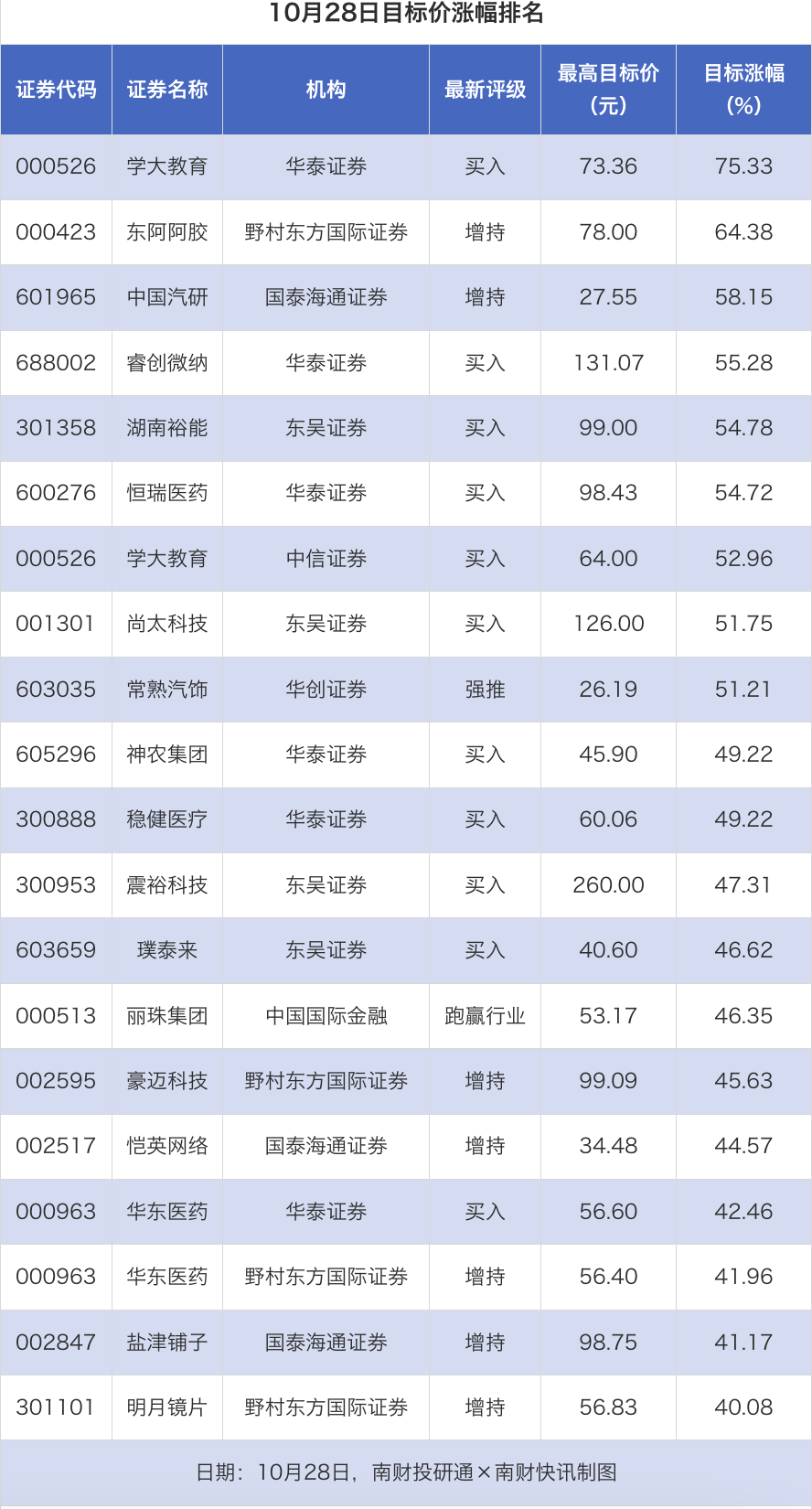
Group 1: Target Price Increases - The companies with the highest target price increases on October 28 include Xueda Education, Dong'e Ejiao, and China Automotive Technology Research Center, with target price increases of 75.33%, 64.38%, and 58.15% respectively [1][3] - Xueda Education received a "Buy" rating from Huatai Securities with a target price of 73.36 yuan [3] - Dong'e Ejiao was rated "Hold" by Nomura Orient International Securities with a target price of 78.00 yuan [3] - China Automotive Technology Research Center was rated "Increase" by Guotai Haitong Securities with a target price of 27.55 yuan [3] Group 2: Broker Recommendations - On October 28, a total of 262 listed companies received broker recommendations, with Qingdao Beer receiving the highest number of recommendations at 13 [4][5] - Ningbo Bank and Yanjinpuzi both received 11 recommendations [4] - The companies with the most broker recommendations include Qingdao Beer (13), Ningbo Bank (11), and Yanjinpuzi (11) [5] Group 3: Rating Adjustments - On October 28, Guotou Securities upgraded Yiling Pharmaceutical's rating from "Increase" to "Buy" [6] - Six companies had their ratings downgraded, including Baoxiniang, which was downgraded from "Buy" to "Increase" by Everbright Securities [7] - Other companies with downgraded ratings include Waifu Holdings and Fuanna, with ratings adjusted to "Cautious Recommendation" and "Increase" respectively [7] Group 4: First Coverage - Five companies received first coverage on October 28, including Qianyan Biology, which was rated "Increase" by Caitong Securities [8] - Other companies receiving first coverage include Dazhong Mining, Songyuan Safety, Daotong Technology, and Hehe Information, all rated "Buy" or "Increase" by various securities firms [8]


学大教育目标价超70%,中煤能源等6股评级被调低|券商评级观察
2 1 Shi Ji Jing Ji Bao Dao· 2025-10-29 01:33
Core Insights - On October 28, a total of 182 target price adjustments were made by brokerages for listed companies, with notable increases in target prices for Xueda Education, Dong'e Ejiao, and China Automotive Technology, showing increases of 75.33%, 64.38%, and 58.15% respectively, across the education, traditional Chinese medicine, and automotive service sectors [1][3]. Group 1: Target Price Increases - Xueda Education received a target price of 73.36 yuan with a target increase of 75.33% from Huatai Securities [3]. - Dong'e Ejiao's target price was set at 78.00 yuan, reflecting a 64.38% increase from Nomura Orient International Securities [3]. - China Automotive Technology's target price is 27.55 yuan, indicating a 58.15% increase from Guotai Junan Securities [3]. Group 2: Brokerage Recommendations - A total of 262 listed companies received brokerage recommendations on October 28, with Qingdao Beer receiving the highest number of recommendations at 13 [4][5]. - Ningbo Bank and Yanjinpuzi both received 11 recommendations each [4]. Group 3: Rating Adjustments - Yiling Pharmaceutical's rating was upgraded from "Hold" to "Buy" by Guotou Securities on October 28 [6]. - Six companies had their ratings downgraded, including Baoxiniang, which was downgraded from "Buy" to "Hold" by Everbright Securities [7]. Group 4: First Coverage - Five companies received initial coverage on October 28, including Qianyan Biology with a rating of "Hold" from Caitong Securities [8]. - Other companies receiving initial ratings include Dazhong Mining, Songyuan Safety, Daotong Technology, and Hehe Information, all rated "Buy" or "Hold" by various brokerages [8].

二永债如何配




GOLDEN SUN SECURITIES· 2025-10-29 00:12
Group 1: Macro Insights - The "14th Five-Year Plan" has established a clear direction for the "15th Five-Year Plan," emphasizing foundational consolidation and comprehensive efforts, with a focus on "common prosperity" and strengthening "internal circulation" [6] - The plan identifies four strategic emerging industries and six future industries, aiming to promote key core technology breakthroughs in six priority areas through extraordinary measures [6] Group 2: Fixed Income - Er Yong Bonds - Recent market conditions have led to a decline in risk appetite, benefiting Er Yong bonds with both interest rate and spread reductions [7] - The supply of Er Yong bonds remains weak, continuing the trend of asset scarcity, while the monthly turnover rate has remained stable [7] - The pricing model suggests that the yield of 5-year AAA-rated secondary capital bonds may decline to approximately 2.07% next year [7] Group 3: Banking Sector - Precious Metals - The banking sector is expected to see growth in precious metals business despite challenges from high volatility in the gold market [8] - As of September 2025, China's official gold reserves reached 74.06 million ounces, marking an increase for 11 consecutive months, with a global trend of central banks increasing gold reserves [8] - The introduction of pilot programs for insurance funds to invest in gold is creating new opportunities for banks to provide services and increase intermediary income [8] Group 4: Textile and Apparel - Baoxini - Baoxini's revenue is expected to stabilize, with a projected decline in net profit due to ongoing adjustments in its main brand [12] - The company is anticipated to achieve a net profit of 2.95 billion, 3.74 billion, and 4.49 billion yuan from 2025 to 2027, maintaining a "buy" rating [12] Group 5: Food and Beverage - Haitian Flavoring - Haitian Flavoring reported a revenue of 21.628 billion yuan for the first three quarters of 2025, reflecting a year-on-year increase of 6.02% [13] - The company is expected to benefit from its leadership position in the industry and aims for significant growth in overseas markets [13] Group 6: Computer Industry - Zhongke Chuangda - Zhongke Chuangda's revenue for Q3 2025 reached 1.848 billion yuan, a year-on-year increase of 42.87% [15] - The company is projected to achieve net profits of 606 million, 695 million, and 782 million yuan from 2025 to 2027, maintaining a "buy" rating [15] Group 7: Home Appliances - Hisense - Hisense's profitability has slightly declined, but the company remains optimistic about its long-term globalization strategy [16] - The projected net profits for 2025 to 2027 are 3.398 billion, 3.771 billion, and 4.154 billion yuan, with a "hold" rating [16] Group 8: Coal Industry - China Coal Energy - China Coal Energy reported a revenue of 110.584 billion yuan for the first three quarters of 2025, a year-on-year decrease of 21.24% [27] - The company is expected to achieve net profits of 16 billion, 17.1 billion, and 18.5 billion yuan from 2025 to 2027, maintaining a "buy" rating [27] Group 9: Automotive - Huguang - Huguang's revenue for the first three quarters of 2025 was 5.84 billion yuan, reflecting a year-on-year increase of 6% [34] - The company is expanding its customer base and enhancing its overseas market presence, which is expected to drive future growth [34]
中煤能源(601898):2025年三季报点评:成本管控显效,三季度业绩超市场预期
Shenwan Hongyuan Securities· 2025-10-28 13:15
Investment Rating - The investment rating for the company is "Buy" (maintained) [6] Core Views - The company reported better-than-expected performance in Q3 2025, with total revenue of 110.58 billion yuan, a year-on-year decrease of 21.24%, and a net profit attributable to shareholders of 12.485 billion yuan, down 14.57% year-on-year [6] - Effective cost control has been noted, with a slight decrease in gross margin for self-produced coal [6] - The company is progressing steadily with its construction projects, aiming to build a "coal-electricity-chemical-new" integrated industrial chain [6] - Due to rising coal prices, the profit forecasts for 2025-2027 have been adjusted upwards [6] Financial Data and Profit Forecast - Total revenue (million yuan) for 2025 is projected at 155,378, with a year-on-year growth rate of -18.0% [2] - Net profit attributable to shareholders (million yuan) for 2025 is estimated at 16,928, with a year-on-year growth rate of -12.4% [2] - Earnings per share (yuan/share) for 2025 is expected to be 1.28 [2] - Gross margin (%) for 2025 is projected at 26.5% [2] - Return on equity (ROE) for 2025 is estimated at 11.0% [2] Market Data - Closing price as of October 27, 2025, is 13.75 yuan [3] - The one-year high/low price range is 14.09/9.42 yuan [3] - The market capitalization of circulating A shares is 125.84 billion yuan [3] - The price-to-earnings ratio (PE) for 2025 is projected at 11 [2][3] Operational Highlights - The company produced 102 million tons of commodity coal in the first three quarters of 2025, a decrease of 0.7% year-on-year [6] - The average selling price of self-produced coal was 474 yuan/ton, down 17.0% year-on-year [6] - The company achieved a gross margin of 216 yuan/ton for self-produced coal, a decrease of 23.9% year-on-year [6] - Management and financial expenses have decreased, contributing to a reduction in total expenses [6]
中煤能源(601898):煤价回升带动盈利修复,Q3业绩超预期
ZHONGTAI SECURITIES· 2025-10-28 13:02
Investment Rating - The report maintains a "Buy" rating for the company, indicating an expected relative performance increase of over 15% against the benchmark index in the next 6 to 12 months [4][10]. Core Views - The recovery in coal prices has led to a significant improvement in profitability, with Q3 performance exceeding expectations [1][5]. - The company has shown stable production and sales in its coal business, with a notable improvement in profitability on a quarter-over-quarter basis [5][6]. - The report forecasts a decline in revenue and net profit for 2024, with a gradual recovery expected in subsequent years [4][7]. Financial Performance Summary - For the first three quarters of 2025, the company reported revenue of 110.58 billion yuan, a year-on-year decrease of 21.24%, and a net profit of 12.485 billion yuan, down 14.57% year-on-year [6]. - In Q3 2025, the company achieved revenue of 36.148 billion yuan, a year-on-year decline of 23.78%, but a quarter-over-quarter increase of 0.29% [6]. - The coal production for the first three quarters was 101.58 million tons, a slight decrease of 0.7% year-on-year, while sales increased by 1.1% [6][7]. Profitability Metrics - The report indicates a weighted average ROE of 8.07%, down 1.88 percentage points year-on-year [6]. - The company’s unit cost of coal decreased by 10.1% year-on-year, while the unit price fell by 17.0% [6]. - The report projects net profits for 2025-2027 to be 15.917 billion yuan, 16.942 billion yuan, and 18.892 billion yuan respectively, with corresponding PE ratios of 10.0X, 9.4X, and 8.4X [7][8]. Business Segment Performance - In the coal chemical segment, the report highlights a significant recovery in profitability for polyolefins, while methanol and ammonium nitrate face profitability pressures [6][7]. - The company’s methanol production increased by 21.8% year-on-year in the first three quarters, with a notable increase in unit gross profit [6][7]. - The report also notes a strategic acquisition in the renewable energy sector, enhancing the company's overall asset management [7].
中煤能源(601898):降本增效+煤价触底上行 Q3业绩超预期
Xin Lang Cai Jing· 2025-10-28 12:27
Core Insights - The company reported a decline in revenue and net profit for the first three quarters of 2025, with total revenue at 110.58 billion yuan, down 21.24% year-on-year, and net profit attributable to shareholders at 12.485 billion yuan, down 14.57% year-on-year [1] Group 1: Financial Performance - For Q3 2025, the company achieved revenue of 36.148 billion yuan, a decrease of 23.78% year-on-year but a slight increase of 0.29% quarter-on-quarter [1] - The net profit for Q3 2025 was 4.780 billion yuan, down 0.96% year-on-year but up 28.26% quarter-on-quarter [1] Group 2: Coal Business Performance - In the first three quarters of 2025, the company produced and sold 101.58 million tons and 190.36 million tons of coal, respectively, down 0.73 million tons and 15.15 million tons year-on-year [2] - For Q3 2025, production and sales were 34.24 million tons and 61.68 million tons, respectively, with year-on-year decreases of 1.57 million tons and 10.28 million tons, but a quarter-on-quarter increase in production of 0.25 million tons [2] Group 3: Pricing and Cost Management - The average selling price of self-produced coal for the first three quarters of 2025 was 474 yuan per ton, down 97 yuan per ton year-on-year [2] - The unit sales cost of self-produced coal for the first three quarters of 2025 was 258 yuan per ton, a decrease of 28.9 yuan per ton year-on-year [3] - The company has implemented cost management measures, resulting in a reduction of material costs and other costs associated with coal production [3] Group 4: Strategic Acquisitions - The company announced plans to acquire a 30% stake in a renewable energy company for 115 million yuan, which is expected to enhance profitability and support the development of a "coal-electricity-chemical-new" industry chain [3] Group 5: Investment Outlook - The company forecasts net profits attributable to shareholders for 2025-2027 to be 16 billion, 17.1 billion, and 18.5 billion yuan, corresponding to P/E ratios of 11.4, 10.7, and 9.9 times, respectively, maintaining a "buy" rating [3]
第二十一届中国国际煤炭采矿技术交流及设备展览会开幕
Zheng Quan Ri Bao Wang· 2025-10-28 10:40
Core Viewpoint - The 21st China International Coal Mining Technology Exchange and Equipment Exhibition highlights the coal industry's commitment to high-quality development, energy security, and technological innovation, showcasing significant advancements in coal mining technology and equipment [1][2][3][4][5] Industry Developments - The coal industry has made substantial progress in high-quality development since the 14th Five-Year Plan, focusing on energy security and green low-carbon development [1] - Innovations such as intelligent mining equipment and advanced coal processing technologies have been successfully implemented, contributing to safer and more efficient coal production [1][3] - The industry aims to deepen the integration of technological and industrial innovation, promoting a shift towards high-end, intelligent, and green development [1][2][4] Exhibition Highlights - The exhibition features over 1,200 domestic and international coal machinery manufacturers from 17 countries, with an expected attendance of over 150,000 visitors [5] - The theme "New Quality Empowerment, Intelligent Future" emphasizes the latest technologies in intelligent mining, green low-carbon transformation, and clean energy utilization [5] - The event utilizes both the China International Exhibition Center and the Capital International Convention Center, enhancing the visitor experience through a dual-venue operation [5]
中煤能源(601898):成本管控、价格回升,煤炭业绩保持稳健
Xinda Securities· 2025-10-28 10:34
Investment Rating - The investment rating for the company is "Buy" [1] Core Insights - The report highlights that the coal business maintains resilience in profitability due to effective cost control and price recovery, despite a decline in revenue and net profit year-on-year [3][4] - The company is expected to see stable performance and growth driven by ongoing projects and an increase in shareholder returns in the future [3][4] Financial Performance Summary - For the first three quarters of 2025, the company achieved operating revenue of 110.58 billion yuan, a year-on-year decrease of 21.2%, and a net profit attributable to shareholders of 12.485 billion yuan, down 14.6% [1] - In Q3 2025, the company reported a single-quarter operating revenue of 36.148 billion yuan, a year-on-year decline of 23.8%, but a quarter-on-quarter increase of 0.3% [2] - The average selling price of self-produced coal was 474 yuan/ton, down 17.0% year-on-year, while the unit sales cost decreased by 10.1% to 257.67 yuan/ton [3] Production and Sales Overview - The company produced 101.58 million tons of self-produced coal in the first three quarters of 2025, a decrease of 0.7% year-on-year, while sales increased by 1.1% to 101.45 million tons [3] - The report indicates that the company is expected to increase production capacity with new mines coming online in 2026, contributing to future growth [3] Profitability and Cost Management - The report emphasizes successful cost management strategies that have mitigated the impact of falling prices, allowing the coal business to maintain profitability [3] - The company’s gross profit margin is projected to improve, with estimates of 26.8%, 27.6%, and 28.3% for 2025, 2026, and 2027 respectively [5] Earnings Forecast - The forecast for net profit attributable to shareholders is 17.3 billion yuan for 2025, with expected growth to 18.4 billion yuan in 2026 and 19.4 billion yuan in 2027 [4][5]
在牛市中玩红利资产是浪费行情?黄海业绩失速,仍重仓煤炭,他的基金还能买吗?
市值风云· 2025-10-28 10:08
Core Viewpoint - The article discusses the performance and strategy of fund manager Huang Hai, emphasizing his continued focus on the coal industry despite recent underperformance compared to the market index [3][6][18]. Fund Performance - In 2025, Huang Hai's flagship fund, Wan Jia Xin Li Flexible Allocation Mixed Fund, reported a year-to-date return of 9.14%, lagging behind the CSI 300 index by 9 percentage points [3][7]. - Huang Hai's management scale has decreased to just over 3 billion yuan, reflecting investor dissatisfaction due to underperformance [3][6]. Industry Analysis - The coal industry faced significant challenges in early 2025 due to high inventory levels and declining prices, but began to recover in the summer with increased demand during peak electricity usage [6][7]. - By the third quarter of 2025, coal companies showed signs of recovery, with major firms like China Shenhua and New Energy showing improved net profits [7][8]. Investment Strategy - Huang Hai maintains a high concentration in coal stocks, with 73% of his fund's net value invested in this sector as of the third quarter [7][8]. - Despite criticism, Huang Hai's investment style remains consistent, focusing heavily on coal and showing little diversification [8][12]. Portfolio Adjustments - In the third quarter, Huang Hai made minor adjustments to his portfolio, reducing holdings in certain coal stocks while increasing positions in gold mining companies, which performed well [14][15]. - The top ten holdings in his flagship fund include several coal companies, with notable increases in gold stocks like Zhongjin Gold and Chifeng Gold [15][14]. Future Outlook - Huang Hai believes that traditional dividend-paying cyclical sectors, such as coal, steel, and non-ferrous metals, will not be absent in future bull markets and will provide substantial absolute returns [16][17]. - The article suggests that long-term capital will likely increase allocations to dividend-generating cyclical assets as manufacturing capacity cycles clear [17][18].



中煤能源(601898):降本增效+煤价触底上行,Q3业绩超预期
GOLDEN SUN SECURITIES· 2025-10-28 09:30
Investment Rating - The investment rating for the company is "Buy" [5] Core Views - The company has reported a decrease in revenue and net profit for the first three quarters of 2025, with revenue at 110.58 billion yuan, down 21.24% year-on-year, and net profit at 12.485 billion yuan, down 14.57% year-on-year. However, the Q3 performance exceeded expectations with a slight revenue increase of 0.29% quarter-on-quarter [1][2] - The company is focusing on cost reduction and efficiency improvement, with a significant decrease in unit sales costs for self-produced coal, which was 258 yuan/ton for the first three quarters, down 28.9 yuan/ton year-on-year [3] - The acquisition of a 30% stake in a renewable energy company is expected to enhance profitability and accelerate the development of a "coal-electricity-chemical-new" industry chain [3] Summary by Sections Financial Performance - For the first three quarters of 2025, the company achieved a production and sales volume of 101.58 million tons and 190.36 million tons, respectively, showing a year-on-year decrease of 7.3 million tons and 15.15 million tons [2] - The average selling price of self-produced coal for the first three quarters was 474 yuan/ton, down 97 yuan/ton year-on-year [2] - The company expects net profits for 2025-2027 to be 16 billion, 17.1 billion, and 18.5 billion yuan, corresponding to P/E ratios of 11.4, 10.7, and 9.9 times [3] Cost Management - The unit sales cost of self-produced coal in Q3 was 247 yuan/ton, reflecting a reduction due to improved procurement management and cost control measures [3] - The company has implemented measures to reduce safety and maintenance costs, contributing to lower overall costs [3] Strategic Initiatives - The acquisition of a renewable energy company is seen as a strategic move to diversify and strengthen the company's portfolio, potentially leading to increased profitability [3]