
CCB(601939)

Search documents
太豪爽!中期分红近2300亿元,A股半数上市银行发“红包”
券商中国· 2025-12-27 07:17
Core Viewpoint - The article discusses the recent trend of mid-term dividends among listed banks in China, highlighting the significant cash distributions made by state-owned banks and the increasing participation of smaller banks in dividend payouts [1][2][3]. Group 1: Mid-term Dividends Overview - As of December 26, 21 A-share listed banks have implemented mid-term dividends, totaling nearly 230 billion yuan, with an observed trend of earlier dividend announcements and increased payout ratios [2]. - State-owned banks are the primary contributors to mid-term dividends, with five major banks distributing a total of approximately 189.89 billion yuan in cash dividends [3]. - The Agricultural Bank of China and Industrial and Commercial Bank of China led the mid-term dividend payouts, with 41.82 billion yuan and 50.40 billion yuan respectively [3]. Group 2: Participation of Smaller Banks - More small and medium-sized banks are joining the mid-term dividend trend, with 13 local listed banks announcing their plans, collectively distributing over 18.5 billion yuan [6]. - Qilu Bank and Zijin Bank have recently disclosed their mid-term dividend plans, with Qilu Bank proposing a payout of 0.121 yuan per share, totaling 745 million yuan [6]. - The trend indicates that many banks are maintaining or increasing their dividend payout ratios compared to the previous year, with some banks showing increases of 0.9% to 4.5% [6]. Group 3: Future Dividend Plans - Postal Savings Bank has outlined a clear plan for mid-term dividends, proposing a payout of 1.23 yuan per 10 shares, amounting to approximately 14.8 billion yuan, which represents 30% of its net profit [4]. - China Merchants Bank has indicated that its mid-term cash dividend distribution will occur between January and February 2026, with a proposed payout ratio of 35% [6]. - Several other banks, including Industrial Bank and Everbright Bank, have also announced their mid-term dividend plans, with payout ratios exceeding 25% [5].





二级资本债周度数据跟踪(20251222-20251226)-20251227
Soochow Securities· 2025-12-27 07:03
1. Report Industry Investment Rating - No information provided regarding the industry investment rating in the report 2. Core View of the Report - The report presents a weekly data tracking of secondary - capital bonds from December 22, 2025, to December 26, 2025, covering primary - market issuance, secondary - market trading, and valuation deviation of individual bonds [1] 3. Summary by Relevant Catalogs 3.1 Primary - Market Issuance - During the week from December 22, 2025, to December 26, 2025, 8 new secondary - capital bonds were issued in the inter - bank and exchange markets, with a total issuance scale of 53.15 billion yuan. The issuance term was 10 years, and the issuers included local state - owned enterprises, private enterprises, other enterprises, and central financial enterprises. The issuer regions were Sichuan, Zhejiang, Jiangsu, Beijing, and Hunan, and the subject ratings were AA +, AA -, A +, and AAA [1] 3.2 Secondary - Market Trading - **Trading Volume**: The total weekly trading volume of secondary - capital bonds was approximately 272.9 billion yuan, a decrease of 1 billion yuan compared to the previous week. The top three bonds in terms of trading volume were 25 Bank of China Secondary Capital Bond 03A(BC) (19.41 billion yuan), 25 China Construction Bank Secondary Capital Bond 03BC (9.691 billion yuan), and 25 Bank of China Secondary Capital Bond 01BC (8.304 billion yuan). By issuer region, the top three in trading volume were Beijing (about 217.1 billion yuan), Shanghai (about 19.3 billion yuan), and Guangdong (about 10 billion yuan) [2] - **Yield to Maturity**: As of December 26, for 5Y secondary - capital bonds, the yield - to - maturity changes of AAA -, AA +, and AA - rated bonds compared to the previous week were 1.19BP, 0.00BP, and 0.00BP respectively; for 7Y bonds, the changes were - 1.05BP, - 1.52BP, and - 1.52BP; for 10Y bonds, the changes were - 1.92BP, - 0.95BP, and - 0.95BP [2] 3.3 Valuation Deviation of Top 30 Individual Bonds - **Overall Situation**: The overall valuation deviation of the weekly average trading price of secondary - capital bonds was not significant. The proportion of discount transactions was less than that of premium transactions, but the discount magnitude was greater than the premium magnitude [3] - **Discount Bonds**: The top three bonds with the highest discount rates were 22 Shengjing Bank Secondary Capital Bond 01 (- 0.5385%), 24 Chang'an Bank Secondary Capital Bond 01 (- 0.4596%), and 25 Jilin Bank Secondary Capital Bond 01 (- 0.3868%). The Zhongzheng implied ratings were mainly AAA -, AA, and AA +, and the regions were mainly Beijing, Tianjin, and Guangdong [3] - **Premium Bonds**: The top three bonds with the highest premium rates were 23 Huaxing Bank Secondary Capital Bond 01 (0.3868%), 22 China Construction Bank Secondary Capital Bond 02B (0.2792%), and 23 Bank of China Secondary Capital Bond 01B (0.2319%). The Zhongzheng implied ratings were mainly AAA -, AA, and AA -, and the regions were mainly Beijing, Shanghai, and Sichuan [3]

金融赋能双极 共筑湾区繁荣 建行广东省分行助力粤港澳大湾区高质量发展
2 1 Shi Ji Jing Ji Bao Dao· 2025-12-26 23:16
Core Insights - The Guangdong-Hong Kong-Macao Greater Bay Area is rapidly advancing towards becoming a world-class bay area and city cluster, with Nansha and Hengqin as key platforms for reform and cooperation [1] - China Construction Bank Guangdong Branch is deeply integrated into national development, providing diversified financial support to facilitate the construction of the Greater Bay Area [1][3] Group 1: Financial Services in Nansha - Nansha has become a strategic hub for financial innovation and enterprise expansion, supported by policies like the "Nansha Financial 30 Measures" [3] - The bank has tailored its services to meet the needs of Hong Kong and Macao enterprises, local businesses, and domestic companies going abroad, creating a new financial ecosystem [3][4] - A case study of a Hong Kong tech company illustrates how the bank optimized processes to enhance capital inflow efficiency by over 50%, facilitating rapid project development [4][5] Group 2: Support for Enterprises Going Abroad - The bank provides comprehensive financial services for enterprises facing complex cross-border financing and risk management needs, including customized foreign exchange services and financing solutions [5][6] - A notable example includes the bank's rapid issuance of bid guarantees for engineering companies, demonstrating its ability to support overseas project bids efficiently [5] - The bank's collaboration with a national "going out" service base enhances support for enterprises' cross-border investment operations [4][5] Group 3: Financial Innovation in Hengqin - Hengqin focuses on financial system innovation to facilitate deeper integration between Macau and Hengqin, with the establishment of the multi-functional EF account system [7][8] - The EF account has significantly improved cross-border payment efficiency for companies, reducing transaction times from days to hours [7][8] - The bank has launched a 2 billion yuan fund to support long-term capital needs for high-tech industries, emphasizing investment in technology potential rather than traditional collateral [8][9] Group 4: Overall Impact and Future Directions - The bank's practices in Nansha and Hengqin, while differing in focus, share a common goal of aligning with national strategies and addressing the real needs of the economy [10] - The bank aims to continue evolving its service models and financial innovations to better support the growth of enterprises in the Greater Bay Area [10]
建设银行取得数据信息确定方法专利
Sou Hu Cai Jing· 2025-12-26 22:16
Group 1 - China Construction Bank Corporation and Jianxin Financial Technology Co., Ltd. have obtained a patent for "Method, Device, Equipment, Medium, and Program Product for Determining Data Information," with authorization announcement number CN119382961B, applied on October 2024 [1] - China Construction Bank Corporation was established in 2004, located in Beijing, with a registered capital of 26,160,038.1459 thousand RMB [1] - The bank has invested in 36 companies, participated in 5,000 bidding projects, and holds 1,908 trademark records and 5,000 patent records, along with 149 administrative licenses [1] Group 2 - Jianxin Financial Technology Co., Ltd. was established in 2018, located in Shanghai, with a registered capital of 172,972.9729 thousand RMB [1] - The company has invested in 6 enterprises, participated in 4,222 bidding projects, and holds 297 trademark records and 5,000 patent records, along with 10 administrative licenses [1]
年终奖怎么投资?多家银行放出专属理财“大招”
Guo Ji Jin Rong Bao· 2025-12-26 15:25
Group 1 - The core viewpoint of the articles highlights that banks are launching "year-end bonus wealth management" plans to cater to the needs of employees receiving year-end bonuses, focusing on stable and low-risk investment products [1][2][3] - Several banks, including Postal Savings Bank, China Construction Bank, and Bank of Communications, are offering "one-stop" wealth management solutions that include deposits, investments, and insurance products [1][2] - The recommended investment products are primarily low-risk (PR1) or medium-low risk (PR2), with a focus on meeting customer needs and enhancing customer loyalty in a competitive market [2][3] Group 2 - This year, banks are incorporating various insurance products into their year-end wealth management plans, with some banks prioritizing conservative and stable insurance options alongside traditional investment products [3][4] - The overall trend in year-end wealth management plans is towards low volatility and stability, with higher risk products being less common [4] - Experts suggest that investors should analyze their financial situation, risk tolerance, and future funding needs to create a tailored investment plan that balances risk and return [4][5] Group 3 - For short-term funds, it is recommended to choose highly liquid cash management products, while medium-term funds can be allocated to low-risk fixed income products [5] - Long-term investments may include rights-based financial products, with diversification through funds being encouraged to achieve long-term return goals [5][6] - The global economic uncertainty is expected to persist, and the wealth management market is projected to continue expanding, necessitating investor education on asset allocation and investment strategies [6]


建行上海市分行与浦东美术馆战略合作暨“遇‘建’美”品牌发布
Zhong Guo Jin Rong Xin Xi Wang· 2025-12-26 12:40
转自:新华财经 据介绍,"遇'建'美"品牌将从三个维度深化艺术与金融融合:一是以艺为媒,整合浦东美术馆展览、票 务、文创等资源,双方计划于2026年推出"浦美信用卡",提供门票折扣、VIP通道、文创优惠等专属权 益;二是以美育人,建行上海市分行将融入浦东美术馆"美普绘——少儿艺术家培养计划"等公益项目, 通过金融产品与专业咨询服务,推动艺术传承与财富传承相结合;三是以文润心,双方携手为客户打 造"月月有大师课、季季有主题沙龙、年年有建行专属大型活动"的立体化艺术体验体系。 建行上海市分行相关负责人表示,此次与浦东美术馆的合作,是该行继携手上海科技馆、上海博物馆之 后,在文博艺术领域的又一重要布局,进一步拓展文化服务版图,实现金融与艺术的"双向奔赴"。未 来,该行还将继续深化与各类文化机构合作,为推动上海提升城市软实力贡献更多金融力量。 编辑:葛佳明 作为服务上海国际消费中心建设的金融主力军,建行上海市分行持续聚焦"房子、车子、筷子、杯子、 票子"五大消费领域,构建全方位消费金融生态。此前,该行已推出《促进上海文化消费的若干举 措》,创新"文创贷""票艺融"等融资产品,落地"艺术外滩""天天有戏"等系列文化活动 ...
关于2025深圳金融创新大赛拟获奖项目的公示
Xin Lang Cai Jing· 2025-12-26 12:21
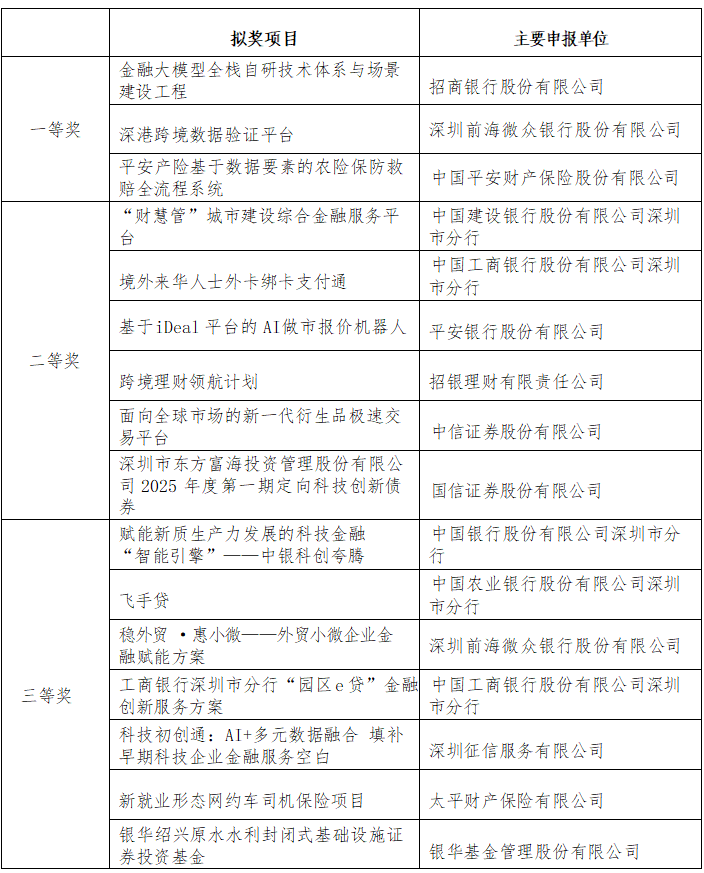
Core Viewpoint - The 2025 Shenzhen Financial Innovation Competition aims to enhance the financial services of local institutions and promote Shenzhen as a globally influential financial center, showcasing the innovation level of the financial industry in Shenzhen [1][4]. Summary by Category Competition Overview - The competition was announced in September 2025, receiving submissions from 113 units with a total of 173 projects [4]. - After various evaluation stages, 30 projects were selected for awards, including 3 first prizes, 6 second prizes, 12 third prizes, 3 most potential awards, 3 best growth awards, and 3 innovation breakthrough awards [4]. Awarded Projects - **First Prize Projects**: - Financial model full-stack self-research technology system and scenario construction project by China Merchants Bank and WeBank [6]. - Hong Kong-Shenzhen cross-border data verification platform [6]. - Agricultural insurance prevention and rescue system based on data elements by Ping An Property & Casualty Insurance [6]. - **Second Prize Projects**: - Cross-border wealth management navigation plan by China Merchants Bank Wealth Management [6]. - New generation derivative rapid trading platform for global markets by CITIC Securities [6]. - Technology financial empowerment plan for new quality productivity development by Bank of China Shenzhen Branch [6]. - **Third Prize Projects**: - AI and multi-data integration service for early-stage technology enterprises by Shenzhen Credit Service [6]. - New employment form ride-hailing driver insurance project by Taiping Property Insurance [6]. - **Most Potential Award Projects**: - "Housing Dream" project for large-scale urban village renovation by the National Development Bank Shenzhen Branch [7]. - New energy "technology + insurance" model construction by Ping An Property & Casualty Insurance Shenzhen Branch [7]. - **Best Growth Award Projects**: - New model for marine pastoral + insurance + N by Taiping Property Insurance [7]. - **Innovation Breakthrough Award Projects**: - "WeChat Quick Compensation" proactive claim model by Weimin Insurance Agency [7]. - Online self-service tax refund mini-program "Xing Shui Tong" by Guangdong Huaxing Bank Shenzhen Branch [7].


如何看待银行承接长债指标压力,如何缓解?
GOLDEN SUN SECURITIES· 2025-12-26 12:14
1. Report Industry Investment Rating No relevant content provided. 2. Core View of the Report Since mid - to late November, long - term bonds, especially ultra - long bonds, have undergone significant adjustments, possibly due to banks' selling under year - end duration indicator constraints. The mismatch between banks' asset and liability durations has intensified, with some state - owned banks' bank book interest rate risk indicators approaching regulatory limits. In 2026, the regulatory standards for bank book interest rate risk are likely to be adjusted. Possible adjustment methods include lowering the interest rate shock amplitude, relaxing regulatory indicator upper limits, and using special treasury bonds to supplement primary capital. It is expected that the probability of lowering the shock amplitude and issuing special treasury bonds to supplement capital next year is relatively high, and the indicator pressure will be alleviated compared to this year [1][2][4]. 3. Summary by Directory 3.1 Bank Book Interest Rate Indicator Regulatory Policy Evolution After the 2008 international financial crisis, the importance of bank account interest rate risk management became prominent. In 2009, the CBRC issued the "Guidelines for the Management of Commercial Bank Account Interest Rate Risk". In 2016, the Basel Committee on Banking Supervision released standards for bank book interest rate risk. In 2017, China comprehensively revised the 2009 guidelines. In July 2024, the Basel Committee revised the bank book interest rate shock scenario, to be officially implemented on January 1, 2026, with the "parallel upward" shock amplitude for interest rates adjusted from 250BP to 225BP [8][9]. 3.2 State - owned Banks' ΔEVE/Net Primary Capital Approaching the Upper Limit Banks divide financial assets into TPL, AC, and OCI accounts. AC and OCI accounts, mainly for allocation, face bank book interest rate risk management indicators. Due to the shortening of liability duration and the lengthening of asset duration, the mismatch between banks' asset and liability durations has intensified. In 2024, the ΔEVE/Net Primary Capital of Agricultural Bank of China (-14.31%), Industrial and Commercial Bank of China (-14.71%), and China Construction Bank (-14.73%) was close to the - 15% regulatory limit [10][19]. 3.3 How to Alleviate Bank Book Interest Rate Risk? - **2025 Risk Calculation**: Calculate the 2025 year - end ΔEVE based on the increment of AC and OCI financial investments and their growth rate; calculate the 2025 year - end estimated value of primary capital based on the cumulative year - on - year growth rate from Q3 2025 to Q3 2024; then calculate the theoretical value of ΔEVE/primary capital for each major bank. It is expected that the indicators of Agricultural Bank, Industrial and Commercial Bank, and China Construction Bank will exceed the 15% regulatory red line, and the indicators of Agricultural Bank, Industrial and Commercial Bank, China Construction Bank, and Bank of China will deteriorate marginally in 2025 [22]. - **2026 Possible Measures**: - **Lowering Interest Rate Shock Amplitude**: Lower the parallel upward shock amplitude of RMB in the IRRBB standard by 25BP from January 1, 2026. Static calculations based on 2025 forecast data show that the regulatory buffer space of △EVE/Net Primary Capital increases by 1.3%, and it can support large - scale banks to undertake 30 - year government bonds worth 649 billion yuan. For 5 - year and 10 - year bonds, the supportable scales are 2.8 trillion yuan and 1.3 trillion yuan respectively [2][23]. - **Relaxing Regulatory Indicator Upper Limits**: Static calculations based on 2025 forecast data show that when the regulatory indicator is raised by 1%, the regulatory buffer space of △EVE/Net Primary Capital can support large - scale banks to undertake 30 - year government bonds worth 484 billion yuan. For 5 - year and 10 - year bonds, the supportable scales are 2.0612 trillion yuan and 968.9 billion yuan respectively. If the regulatory indicator is raised by 2%, the supportable incremental scales for 5 - year, 10 - year, and 30 - year government bonds are 4.1225 trillion yuan, 1.9379 trillion yuan, and 968 billion yuan respectively [3][24][26]. - **Supplementing Primary Capital with Special Treasury Bonds**: This year, 50 billion yuan of special treasury bonds have been issued to support state - owned large - scale banks to supplement capital. If Agricultural Bank and Industrial and Commercial Bank each have 25 billion yuan of primary capital increase next year, based on the △EVE/primary capital regulatory requirement of 15%, the △EVE released by the 50 billion yuan of supplementary primary capital can support large - scale banks to undertake incremental scales of 5 - year, 10 - year, and 30 - year government bonds of 1.0166 trillion yuan, 477.9 billion yuan, and 238.7 billion yuan respectively. It is less likely to raise the regulatory threshold of "ΔEVE/primary capital" in IRRBB, while it is more likely to lower the interest rate shock amplitude and issue additional special treasury bonds to supplement capital. After these measures, the pressure on IRRBB in 2026 is expected to be alleviated compared to this year [3][4][28].
2025回顾| 猛涨450%,逼近万亿,定增大爆发!
Guo Ji Jin Rong Bao· 2025-12-26 12:02
Core Viewpoint - The A-share market has seen a significant increase in the scale and performance of private placements in 2025, with a total fundraising amount of 959.38 billion yuan, marking a 454.4% increase compared to the entire year of 2024 [2][6]. Group 1: Fundraising Activity - As of December 25, 2025, 164 A-share companies have implemented private placements, raising a total of 959.38 billion yuan, which is a substantial increase from the previous year [2][6]. - The approval rate for private placement projects has reached 100%, with nearly 90% of projects currently showing profits [2][12]. - The fundraising scale in 2025 is approaching the 1 trillion yuan mark, with the total exceeding 950 billion yuan, a significant recovery from the low of 173.05 billion yuan in 2024 [5][6]. Group 2: Sector and Company Distribution - The financial sector leads in fundraising, with 11 companies raising a total of 659.47 billion yuan, including major banks like China Bank and Postal Savings Bank [7][8]. - Among the 164 companies that have completed private placements, 118 are from the manufacturing sector, raising 189.66 billion yuan, indicating a strong demand for long-term funding in this industry [6][19]. - The top four state-owned banks have collectively raised 520 billion yuan, accounting for 52.5% of the total private placement fundraising this year [8][10]. Group 3: Market Performance - Approximately 88% of the private placement projects this year have shown profits, with 33 projects experiencing price increases exceeding 100% [12][16]. - Notable performers include companies like AVIC Chengfei, which has a premium rate of 820.23% [13]. - The overall enthusiasm for private placements is high, with public funds participating significantly, leading to a floating profit amount of 10.74 billion yuan for public funds [16]. Group 4: Approval and Regulatory Environment - The approval process for private placements has accelerated, with 133 projects approved by the end of 2025, reflecting a significant increase in efficiency compared to previous years [17][18]. - The "Six Merger Policies" have notably increased the proportion of financing for mergers and acquisitions, with 45 cases related to asset acquisitions [19]. - The reduction in the average review cycle for private placements has improved the responsiveness of the capital market to the needs of the real economy [18][19].

建行取得数据清理方法专利
Sou Hu Cai Jing· 2025-12-26 11:13
Group 1 - The core point of the article is that China Construction Bank has obtained a patent for a "data cleaning method and its device, equipment, medium, and product," with the authorization announcement number CN117194402B and an application date of September 2023 [1] Group 2 - China Construction Bank, established in 2004 and located in Beijing, primarily engages in monetary financial services, with a registered capital of 26,160,038.1459 thousand RMB [1] - The bank has made investments in 36 companies, participated in 5,000 bidding projects, and holds 1,908 trademark records and 5,000 patent records, along with 149 administrative licenses [1] Group 3 - Jianxin Financial Technology Co., Ltd., established in 2018 and located in Shanghai, focuses on software and information technology services, with a registered capital of 1,729.729729 million RMB [1] - The company has invested in 6 enterprises, participated in 4,225 bidding projects, and holds 297 trademark records and 5,000 patent records, along with 10 administrative licenses [1]