
CICC(601995)

Search documents
机构研究周报:重视业绩与性价比,A股或优于港股
Wind万得· 2026-01-18 23:55
Focus Review - The People's Bank of China has lowered the interest rates of various structural monetary policy tools by 0.25 percentage points, with the one-year re-lending rate now at 1.25% [3] - This policy is seen as the start of a monetary easing process, with potential for further adjustments if economic conditions worsen [3] Equity Market - Huatai Securities emphasizes the importance of focusing on performance and cost-effectiveness as the earnings forecast period approaches, suggesting two main categories for investment: themes with catalysts and relatively low crowding, such as media (gaming) and service consumption (duty-free), and sectors benefiting from external demand recovery, like batteries and engineering machinery [5] - Fuguo Fund highlights that in a low-interest-rate environment, dividend assets are gaining attention due to their stable cash flow and high dividend yield, making them a mature investment strategy globally [6] - CICC predicts that A-shares are likely to outperform Hong Kong stocks in 2026, while investors should focus on unique structural opportunities in Hong Kong, particularly in sectors like dividends, internet, innovative pharmaceuticals, and new consumption [7] Industry Research - GF Fund suggests that resource products may become a key investment theme in 2026, driven by macroeconomic conditions and AI demand, with a focus on non-ferrous metals and certain chemicals [11] - Huatai Securities notes a significant recovery in the liquidity of the Hong Kong innovative pharmaceutical sector, driven by unexpected BD transactions and overseas interest rate cuts, recommending increased allocation to this sector [12] - Fuguo Fund reports that surging AI demand is causing a supply-demand imbalance in the memory industry, leading to significant price increases, with expectations of a strong cycle lasting until the second half of 2026 [13] Macro and Fixed Income - Guohai Franklin Fund indicates that the bond market may experience volatility in 2025, with a focus on stable growth and price recovery policies, while remaining cautious of potential upward risks from stimulus measures [18] - Guotai Fund believes that the recent interest rate cuts by the central bank have boosted market sentiment, although the direct impact on credit and the bond market is limited [19] -招商基金 suggests a defensive approach in the first quarter, anticipating stabilization in the bond market as supply shocks are absorbed [19] Asset Allocation - HSBC Jintrust Fund highlights that global liquidity easing will create diverse asset allocation opportunities, with A-shares expected to show a low valuation and technology-driven market [21]




从技术概念跃入商业现实 科技大厂加码人工智能体
Zheng Quan Shi Bao· 2026-01-18 18:06
Core Insights - The emergence of AI Agents marks a significant shift from AI as an auxiliary tool to a core productivity driver, reshaping industry logic and unlocking trillion-dollar market potential [1][5] Group 1: AI Agent Development - Major tech companies are actively developing AI Agents, which are defined as systems that utilize large language models (LLMs) to autonomously manage workflows and tools, moving beyond traditional AI capabilities [2][3] - AI Agents can perform complex tasks such as online ordering and investment decision-making, demonstrating their ability to replace certain human functions rather than merely assist [2][4] Group 2: Market Potential and Commercialization - The global AI programming market is currently valued at approximately $3 billion, with projections to reach $23 billion by 2030 and a long-term potential nearing $700 billion [5] - AI Agents are penetrating various industries, with finance, programming, and government sectors leading the way as benchmark scenarios for technology empowerment [5][6] Group 3: Future Outlook and Challenges - The Chinese AI Agent market is expected to reach ¥147.3 billion by 2024, with a projected growth to over ¥3.3 trillion by 2028, indicating significant enterprise adoption potential [6] - Despite the optimistic outlook, challenges such as high entry barriers, safety concerns, and reliability issues remain, as the industry is still in its early stages [6]


保荐机构扩容 中小券商强化投行服务谋突围
Zheng Quan Ri Bao· 2026-01-18 16:54
Core Viewpoint - The approval of Shanghai Securities' sponsorship business license by the China Securities Regulatory Commission is expected to enhance the firm's investment banking service system and open new avenues for business development [1]. Group 1: Business Development - Shanghai Securities, established in 2001 with a registered capital of 5.327 billion yuan, has a total asset of 75.539 billion yuan as of mid-2025, reflecting a 3.63% increase year-on-year [2]. - In the first half of 2025, Shanghai Securities achieved an operating income of 1.526 billion yuan, a year-on-year growth of 53.73%, and a net profit of 706 million yuan, up 70.03% year-on-year [2]. - The newly acquired sponsorship business qualification is anticipated to inject new momentum into Shanghai Securities' investment banking operations, enhancing revenue sources and improving income structure [2]. Group 2: Competitive Landscape - The competitive landscape shows that leading brokers have significant advantages, with industry concentration continuing to rise. In 2025, CITIC Securities led with 43 sponsored projects, followed by Guotai Junan with 41 projects [3]. - The underwriting fees indicate a stark performance disparity among brokers, with CITIC Securities and Guotai Junan exceeding 1 billion yuan in fees, while many others earned less than 200 million yuan [3]. Group 3: Market Trends - The overall development of the investment banking sector is supported by a favorable market and active trading, with total net income from investment banking services for A-share listed brokers reaching 15.53 billion yuan in the first half of 2025, a year-on-year increase of 18.11% [4]. - Despite the positive market conditions, competition remains fierce, with 17 listed brokers experiencing over 30% growth in investment banking income, while 14 brokers saw a decline [4]. Group 4: Differentiation Strategies - In response to intensified competition, smaller brokers are accelerating the exploration of differentiated development paths, focusing on regional markets and specific client groups [4]. - For instance, First Capital aims to leverage shareholder resources to expand its coverage in Beijing and capitalize on opportunities in the bond market, while Northeast Securities focuses on high-growth SMEs [4][5]. - The industry is transitioning from a "channel-driven" model to a "professional-driven" model, emphasizing the importance of specialization and functionality in investment banking services [5].



非银金融周报:融资保证金比例上调,金监总局部署2026年监管工作-20260118
HUAXI Securities· 2026-01-18 14:52
Investment Rating - The industry rating is "Recommended" [5] Core Insights - The adjustment of the financing margin ratio from 80% to 100% aims to cool down excessive leverage and maintain market stability. This change will take effect on January 19, 2026, and applies only to new financing contracts [3][4][15][7] - As of January 14, 2026, the total market financing balance reached a historical high of 2.68 trillion yuan, with the margin balance accounting for 2.59% of the A-share market capitalization, indicating an increase from the average level of 2.40% in 2025 [4][15] - The non-bank financial sector index fell by 2.63%, underperforming the CSI 300 index by 2.06 percentage points, ranking 26th among all primary industries. The securities sector decreased by 2.21%, while the financial technology sector increased by 1.34% [2][13] Summary by Sections Market and Sector Performance - The average daily trading volume of A-shares for the week of January 11-17, 2026, was 34.651 billion yuan, a 21.5% increase week-on-week and a 189.4% increase year-on-year. The average trading volume for the first quarter of 2026 is 31.585 billion yuan, up 107.7% from the same period in 2025 [19] - In the same week, three new stocks were issued, raising 2.025 billion yuan, while two new stocks were listed, raising 1.484 billion yuan. Year-to-date, three A-share IPOs have raised 3.039 billion yuan [19] Financing Margin Ratio Adjustment - The financing margin ratio adjustment is a regulatory measure to prevent systemic risks and protect investors' rights. The increase in the minimum margin requirement is intended to curb market overheating and ensure a smooth market transition [4][7][15] Regulatory Developments - The National Financial Supervision Administration held a regulatory work meeting on January 15, 2026, outlining five key tasks for the year, including risk resolution for small and medium-sized financial institutions and enhancing regulatory quality. The focus for 2026 is on preventing systemic risks and ensuring high-quality industry development [8][16][17]





金融行业周报(2026、01、18):央行宣布结构性降息,衍生品交易监管更规范-20260118
Western Securities· 2026-01-18 11:43
Investment Rating - The report does not explicitly state an overall investment rating for the financial industry, but it provides specific recommendations for various sectors and companies within the industry [3][21]. Core Insights - The financial industry experienced a decline this week, with the non-bank financial index down by 2.63%, underperforming the CSI 300 index by 2.06 percentage points. The banking sector saw a decline of 3.03%, also underperforming the CSI 300 index by 2.46 percentage points [1][9]. - The report highlights a structural interest rate cut by the central bank, which is expected to impact various financial sectors, particularly banks and insurance companies. The insurance sector is viewed as being in a critical window for performance and valuation recovery [3][21]. - Regulatory measures have been introduced to stabilize the derivatives market, which is expected to benefit well-capitalized and compliant brokerage firms [2][17]. Summary by Sections 1. Weekly Performance and Sector Insights - The non-bank financial index decreased by 2.63%, with the securities, insurance, and diversified financial indices down by 2.21%, 3.59%, and 1.83% respectively [1][9]. - The banking sector's performance was notably poor, with state-owned banks, joint-stock banks, city commercial banks, and rural commercial banks experiencing declines of 2.20%, 4.08%, 2.40%, and 2.20% respectively [1][9]. 2. Insurance Sector Insights - The insurance sector's index fell by 3.59%, underperforming the CSI 300 index by 3.02 percentage points. The report indicates that regulatory cooling measures have created short-term pressure on the insurance sector, but the long-term outlook remains positive due to asset growth and interest margin recovery [1][13][15]. - Key companies such as China Pacific Insurance, China Life, and New China Life are recommended for investment due to their strong fundamentals and recovery potential [3][16]. 3. Brokerage Sector Insights - The brokerage sector saw a decline of 2.21%, with the report emphasizing the potential benefits of new regulatory measures aimed at enhancing the derivatives market. The focus is on larger, well-capitalized firms that can navigate the evolving regulatory landscape [2][17]. - Recommendations include major brokerages like Guotai Junan and Huatai Securities, which are expected to benefit from the anticipated recovery in profitability and valuation [2][18]. 4. Banking Sector Insights - The banking sector's index fell by 3.03%, with the central bank's recent interest rate cut expected to support the sector's performance in the long run. The report suggests that banks may see a gradual recovery in net interest income and profitability [3][21][22]. - Specific banks such as Hangzhou Bank and Ningbo Bank are highlighted as potential investment opportunities, particularly those with previously undervalued positions [3][22].


诚邀体验 | 中金点睛数字化投研平台
中金点睛· 2026-01-18 01:07
Core Viewpoint - The article emphasizes the establishment of a digital research platform by CICC, aimed at providing efficient, professional, and accurate research services by integrating insights from over 30 specialized teams and covering more than 1800 individual stocks [1]. Group 1: Research Services - CICC's digital research platform, "CICC Insight," offers a one-stop service that includes research reports, conference activities, fundamental databases, and research frameworks [1]. - The platform utilizes advanced model technology to enhance the research experience for clients [1]. Group 2: Research Content - Daily updates on research focus and timely article selections are provided through the "CICC Morning Report" [4]. - The platform features live broadcasts where senior analysts interpret market hotspots [4]. Group 3: Data and Frameworks - CICC Insight includes over 160 industry research frameworks and more than 40 premium databases, offering comprehensive industry data [10]. - The platform also features an AI search function for efficient information retrieval and analysis [10].

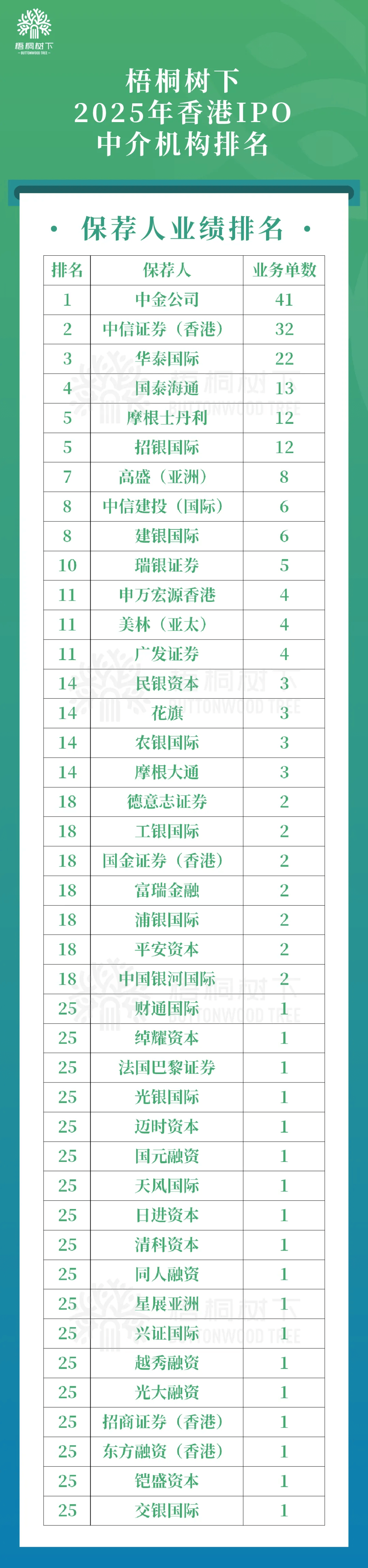
2025年香港IPO中介机构排行榜
Sou Hu Cai Jing· 2026-01-17 14:33
Group 1: IPO Overview - In 2025, a total of 119 companies listed on the Hong Kong Stock Exchange, with 114 through IPOs and 5 through other methods [1] - The IPO intermediaries included 42 brokerage firms, 39 Hong Kong legal advisors, 33 Chinese legal advisors, and 9 accounting firms [1] Group 2: Sponsor Performance Rankings - The top five sponsors for the 114 Hong Kong IPOs were: 1. CICC with 41 deals 2. CITIC Securities (Hong Kong) with 32 deals 3. Huatai International with 22 deals 4. Guotai Junan with 13 deals 5. Morgan Stanley and China Merchants International, both with 12 deals [2][3] Group 3: Hong Kong Legal Advisors Rankings - The leading Hong Kong legal advisors for the IPOs were: 1. Davis Polk and Highbury with 16 deals each 2. K&L Gates with 9 deals 3. Several firms including Farrer & Co, King & Wood Mallesons, and others with 5 deals each [7][8] Group 4: Chinese Legal Advisors Rankings - The top Chinese legal advisors for the IPOs were: 1. Tongshang with 19 deals 2. Jingtian & Gongcheng with 17 deals 3. Zhong Lun with 10 deals [10][11] Group 5: Accounting Firms Rankings - The leading accounting firms for the IPOs were: 1. Ernst & Young with 41 deals 2. KPMG with 25 deals 3. Deloitte with 21 deals 4. PwC with 13 deals [14][15]

中金公司党委书记、董事长陈亮:奋力打造一流投资银行 积极服务金融强国建设
Zhong Guo Zheng Quan Bao· 2026-01-17 03:01
Core Viewpoint - The company aims to become a world-class investment bank by focusing on high-quality development, serving the real economy, and promoting wealth preservation and growth for residents, while contributing to the construction of a financial powerhouse and Chinese-style modernization [1][11]. Group 1: Service to the Real Economy - The company emphasizes its core responsibility to serve the real economy, particularly through technology-driven innovation, as a key aspect of its mission as a state-owned financial institution [2]. - The company has facilitated over 3.2 trillion yuan in technology finance-related equity, bond, and merger transactions, including significant IPOs like CATL and Han's Laser [2][4]. - The company aims to be a partner in industrial innovation, providing continuous support from value discovery to resource integration for technology enterprises [2]. Group 2: Wealth Management and Resident Wealth Growth - The company recognizes the importance of the securities industry in facilitating the interaction between resident wealth and capital markets, which is crucial for promoting consumption and expanding domestic demand [5][6]. - The company has seen a significant increase in its wealth management capabilities, with its buy-side advisory assets exceeding 120 billion yuan, positioning it as a leader in the industry [7]. - The company is committed to enhancing its digital capabilities and providing tailored wealth management services to help residents achieve stable wealth growth in a low-interest-rate environment [7]. Group 3: Internationalization and High-Level Opening - The company is focused on becoming a financial institution that understands the Chinese market and connects with international rules, providing cross-border investment and financing services [8][9]. - The company has completed over 80 billion USD in transactions related to the Belt and Road Initiative, showcasing its role in cross-border capital flows [9]. - The company aims to contribute to international rule-making and enhance China's influence in green finance and sustainable investment [10]. Group 4: Future Strategy and Development - The company plans to leverage the spirit of the 20th National Congress to formulate a new strategic plan, aiming for comprehensive upgrades in capabilities and organizational transformation [12]. - The company will focus on mergers and acquisitions, such as the integration with Dongxing Securities and Xinda Securities, to enhance its operational efficiency and service capabilities [12].

中国国际金融股份有限公司 关于深圳中电港技术股份有限公司 2025年度持续督导定期现场检查报告
Zhong Guo Zheng Quan Bao - Zhong Zheng Wang· 2026-01-17 02:05
登录新浪财经APP 搜索【信披】查看更多考评等级 ■ 保荐代表人: ________________ ________________ 一、本次持续督导培训的基本情况 实施本次现场培训前,中金公司编制了培训材料,并提前要求中电港参与培训的相关人员了解培训相关 内容。 本次现场培训于2026年1月12日在公司办公地(深圳市南山区桃源街道留仙大道3333号塘朗城广场(西 区)A座)进行,对未能现场参与培训的人员采取电子邮件发送培训资料的方式进行培训。本次培训对 象包括公司控股股东、实际控制人、董事、高级管理人员及关键岗位人员等。 李邦新 王申晨 中国国际金融股份有限公司 年 月 日 中国国际金融股份有限公司 关于深圳中电港技术股份有限公司 2025年度持续督导培训情况的报告 深圳证券交易所: 中国国际金融股份有限公司(以下简称"中金公司"或"保荐机构")根据《深圳证券交易所上市公司自律 监管指引第13号一一保荐业务》等相关法律法规的要求,对深圳中电港技术股份有限公司(以下简 称"中电港"、"公司")的控股股东、实际控制人、董事、高级管理人员及关键岗位人员等进行了2025年 度持续督导培训,报告如下: 二、现场培训 ...
中国国际金融股份有限公司 关于深圳中电港技术股份有限公司 2025年度持续督导培训情况的报告
Zheng Quan Ri Bao· 2026-01-16 23:10
登录新浪财经APP 搜索【信披】查看更多考评等级 深圳证券交易所: 中国国际金融股份有限公司 一、本次持续督导培训的基本情况 实施本次现场培训前,中金公司编制了培训材料,并提前要求中电港参与培训的相关人员了解培训相关 内容。 本次现场培训于2026年1月12日在公司办公地(深圳市南山区桃源街道留仙大道3333号塘朗城广场(西 区)A座)进行,对未能现场参与培训的人员采取电子邮件发送培训资料的方式进行培训。本次培训对 象包括公司控股股东、实际控制人、董事、高级管理人员及关键岗位人员等。 二、现场培训的主要内容 本次培训根据《证券发行上市保荐业务管理办法》《深圳证券交易所股票上市规则》《深圳证券交易所 上市公司自律监管指引第13号——保荐业务》等规则要求,由培训人员对上市公司信息披露、股权变 动、董事及高级管理人员任职行为规范、投资者保护等要求进行培训。在现场培训过程中,与会人员就 部分问题向中金公司授课人员进行了咨询提问,授课人员对与会人员的问题做了相应解答。 三、本次持续督导培训的结论 在保荐机构本次持续督导培训的工作过程中,公司在人员、场地、组织等方面予以积极配合,保证了培 训工作的有序进行。保荐机构通过本 ...