
LBX(603883)

Search documents
阳光人寿山东分公司推出《以案说险 廿四图鉴》系列, 打造老百姓“看得懂、记得住、用得上”的保险知识手册
Qi Lu Wan Bao· 2025-09-18 07:22
在2025年金融教育宣传周活动期间,阳光人寿山东分公司精心策划并推出了《以案说险 廿四图鉴》专 题汇编线上系列。该图鉴汇聚全辖机构的智慧与实践,以生动直观的"一图读懂"形式,将复杂的保险知 识转化为通俗易懂的"故事"语言,成为本次宣传周的一大亮点。 亮点三:文化赋能,借"廿四"概念寓意全天候守护 亮点一:内容覆盖广,聚焦消费全周期风险防范 创意借鉴中国传统的"二十四节气"智慧,以"廿四图鉴"为名,寓意阳光人寿山东分公司的消费者权益保 护工作如节气般循时而动,与时俱进,为消费者的金融生活提供全年无断点、全方位的智慧守护与风险 提示,体现了品牌的文化底蕴与人文关怀。 《图鉴》内容极具系统性与实用性,覆盖保险消费全流程中的关键风险点。从投保前的"如实告知"重要 性、"代签名"合同效力解析,到投保中的"看清保险责任"、"读懂条款关键词",再到理赔时的"及时报 案指引"、"指定受益人意义",最后延伸至日常生活中需高度警惕的"代理退保骗局"、"高收益理财陷 阱"、"电信诈骗"、"养老投资陷阱"及"销售误导"等热点问题,堪称一本"保险防坑百科全书"。 亮点二:全域共创,凝聚基层智慧凸显服务温度 《图鉴》的24个案例均由基层 ...

老百姓涨2.04%,成交额2.00亿元,主力资金净流出2328.15万元
Xin Lang Zheng Quan· 2025-09-18 05:20
Core Viewpoint - The stock price of Lao Bai Xing has shown fluctuations, with a year-to-date increase of 7.24% but a significant decline over the past 60 days, indicating potential volatility in the market [2]. Company Overview - Lao Bai Xing Pharmacy Chain Co., Ltd. is located in Changsha, Hunan Province, established on December 1, 2005, and listed on April 23, 2015. The company primarily engages in the retail chain business of pharmaceuticals and health-related products [2]. - The revenue composition of the company includes 80.95% from Western and Chinese medicines, 12.11% from non-pharmaceutical products, and 6.94% from traditional Chinese medicine [2]. - As of June 30, 2025, the number of shareholders is 43,600, a decrease of 9.16% from the previous period, with an average of 17,396 circulating shares per shareholder, an increase of 10.08% [2]. Financial Performance - For the first half of 2025, Lao Bai Xing reported a revenue of 10.774 billion yuan, a year-on-year decrease of 1.51%, and a net profit attributable to shareholders of 398 million yuan, down 20.86% year-on-year [2]. - Since its A-share listing, the company has distributed a total of 2.069 billion yuan in dividends, with 991 million yuan distributed over the past three years [3]. Shareholding Structure - As of June 30, 2025, the top ten circulating shareholders include Hong Kong Central Clearing Limited as the third-largest shareholder with 15.0804 million shares, a decrease of 3.0999 million shares from the previous period. New entrants include Southern CSI 1000 ETF and Guotai Medical Health Stock A [3].
风向大变?9月起“4大降价潮”或将席卷中国,老百姓应早做准备
Sou Hu Cai Jing· 2025-09-18 00:41
Group 1: Real Estate Market - The domestic real estate market continues to face downward pressure, with second-hand housing prices having declined for over 30 months, showing a year-on-year drop of 7.34% in August 2025 [3][4] - Developers are expected to adopt aggressive pricing strategies to stimulate sales during the traditional "golden September and silver October" period, leading to significant discounts on new homes [4][6] - The increase in second-hand housing listings is forcing sellers to lower their asking prices, creating a favorable negotiation environment for buyers [6][8] Group 2: Automotive Market - The automotive market in China is experiencing a significant price war, with price reductions of 20,000 to 90,000 yuan across various brands, including both domestic and international manufacturers [7][9] - The shift towards electric vehicles has led to overcapacity in the traditional fuel vehicle market, prompting manufacturers to lower prices to clear inventory [8][9] - Middle-class consumers are delaying vehicle purchases due to stagnant income growth, contributing to reduced overall market demand [9] Group 3: Small Appliances Market - Prices of small appliances such as air fryers and vacuum cleaners have dropped by 10-30%, with expectations for further reductions as brands compete aggressively [10][12] - Rapid technological advancements and inventory buildup of older models are driving retailers to offer discounts to stimulate sales [11][12] - Consumer purchasing power has decreased, leading to a shift in demand for more affordable options [13] Group 4: Pork Market - Pork prices have significantly decreased from 35-40 yuan per jin in 2020 to around 20-22 yuan, with expectations to drop below 20 yuan in September [14][15] - The oversupply in the market, driven by increased production, has led to a decline in prices [15] - Changing consumer preferences and reduced purchasing power are contributing to the decline in pork demand [15][16]


新华社权威速览·非凡“十四五”丨老百姓的餐桌:供给越来越多样 品类越来越丰富
Xin Hua Wang· 2025-09-16 09:27
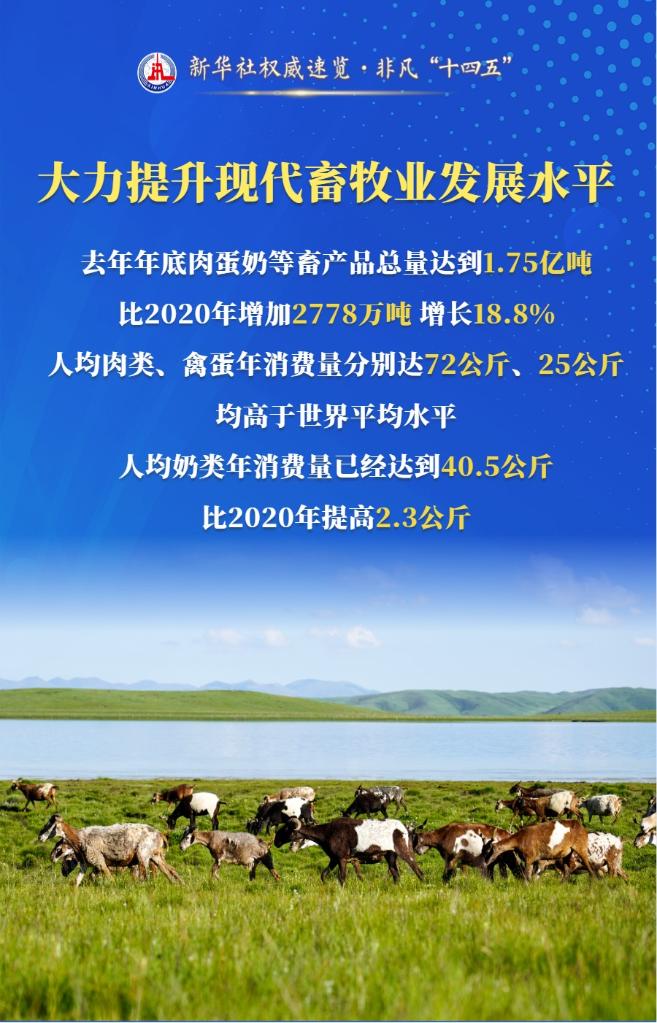
Group 1: Agricultural Development - The agricultural sector is promoting a diversified food supply system by sourcing food from forests, grasslands, rivers, lakes, seas, and through facility agriculture, leading to a richer variety of food on consumers' tables [1] - The total output of meat, eggs, and dairy products reached 175 million tons by the end of last year, an increase of 27.78 million tons or 18.8% compared to 2020 [2] - Per capita consumption of meat and poultry eggs reached 72 kg and 25 kg respectively, both exceeding the global average [2] Group 2: Aquaculture and Fisheries - In 2024, the total output of aquatic products reached 73.58 million tons, representing a 12.3% increase since 2020 [4] - China has maintained its position as the world's largest producer of aquatic products for 36 consecutive years, with abundant supplies of fish, shrimp, crab, and shellfish [4] Group 3: Facility Agriculture - The area of facility agriculture has reached 40 million acres, with annual vegetable production exceeding 20 million tons [6] - The annual output of edible fungi has surpassed 42 million tons, accounting for 85% of global production [6] Group 4: Biotechnology in Agriculture - The agricultural sector is accelerating the development of biotechnology and bio-industries, leading to the emergence of new food products [8] - China is at the forefront of algae cultivation technology [8]
老百姓餐桌越来越丰富 四个方面表现“舌尖”上的幸福感
Zhong Guo Xin Wen Wang· 2025-09-16 05:24
Core Viewpoint - The Chinese government has made significant progress in diversifying food supply systems during the "14th Five-Year Plan" period, focusing on enhancing agricultural productivity and food security through various initiatives and technological advancements [1][2][3] Group 1: Modern Livestock Development - The level of modern livestock development has been significantly improved, with the total output of meat, eggs, and milk reaching 175 million tons by the end of last year, an increase of 27.78 million tons or 18.8% compared to 2020 [1] - Per capita consumption of meat and eggs in China reached 72 kg and 25 kg respectively, both exceeding the global average, while per capita milk consumption increased to 40.5 kg, up by 2.3 kg from 2020 [1] Group 2: Modern Fisheries Development - The total output of aquatic products in China reached 73.58 million tons in 2024, marking a 12.3% increase from 2020, maintaining the country's position as the world's largest producer of aquatic products for 36 consecutive years [2] - The variety and supply of aquatic products, including fish, shrimp, crab, and shellfish, have become increasingly abundant [2] Group 3: Facility Agriculture Development - During the "14th Five-Year Plan" period, facility agriculture has rapidly developed, with the area of agricultural facilities reaching 40 million acres and annual vegetable production exceeding 20 million tons, achieving year-round balanced supply [2] - The production of edible mushrooms from facility agriculture has reached over 42 million tons, accounting for 85% of global production, while the availability of facility-grown fruits like strawberries and cherries has extended their market season [2] Group 4: Expansion of Agricultural Development Space - The agricultural sector is expanding from traditional crops and livestock to a wider range of biological resources, accelerating the development of biotechnology and new food products [2] - China has achieved breakthroughs in key core technologies related to algae cultivation, with various species now available on the dining tables of the public [2] Group 5: Nutritional Improvement - The nutritional health levels of food consumed by urban and rural residents in China are approaching those of developed countries, with balanced intake of protein, fat, and carbohydrates [3] - The overall food supply not only meets the caloric needs but also enhances the quality and nutritional value of the diet for the population [3]
现在老百姓能吃得更好、更健康营养
Xin Hua She· 2025-09-16 04:27
Core Viewpoint - The press conference highlighted the achievements in agricultural and rural development during the "14th Five-Year Plan" period, emphasizing improved food quality and nutrition for the public [2] Group 1: Agricultural Development Achievements - The agricultural sector has made significant progress in enhancing food quality and nutrition for the population [2] - The government aims to ensure that citizens have access to better and healthier food options [2]
农业农村部:让老百姓不仅能吃饱,还能吃得更好、更营养健康
2 1 Shi Ji Jing Ji Bao Dao· 2025-09-16 04:26
Core Viewpoint - The Ministry of Agriculture and Rural Affairs emphasizes the importance of not only ensuring food security but also improving the nutritional quality of food for the public [1] Group 1: Agricultural Development - The ministry is promoting the transition from traditional crops and livestock to a wider range of biological resources [1] - There is a focus on accelerating the development of biotechnology and the bio-industry, with successful breakthroughs in key core technologies [1] - New types of food are continuously emerging, with algae farming technology being at the forefront globally [1] Group 2: Nutritional Improvement - The nutritional health levels of food consumed by urban and rural residents are becoming more balanced and are approaching those of developed countries [1] - Residents are now not only able to eat enough but also enjoy better and more nutritious food [1]
老百姓大药房连锁股份有限公司关于参加2025年湖南辖区上市公司投资者网上集体接待日暨半年度业绩说明会活动的公告
Zhong Guo Zheng Quan Bao - Zhong Zheng Wang· 2025-09-16 02:14
Group 1 - The company will participate in the "2025 Hunan Listed Companies Investor Online Reception Day and Semi-Annual Performance Briefing" to enhance interaction with investors [1] - The event will be held online on September 19, 2025, from 14:00 to 17:00, allowing investors to engage through various platforms [1] - Company executives will discuss the company's performance from 2024 to the first half of 2025, governance, development strategy, operational status, and sustainable development during the event [1]
老百姓(603883) - 关于参加2025年湖南辖区上市公司投资者网上集体接待日暨半年度业绩说明会活动的公告
2025-09-15 09:00
证券代码:603883 证券简称:老百姓 公告编号:2025-049 老百姓大药房连锁股份有限公司关于参加 2025 年湖南辖区上市公司投资者网上集体接待日 本公司董事会及全体董事保证本公告内容不存在任何虚假 记载、误导性陈述或者重大遗漏,并对其内容的真实性、准确 性和完整性承担法律责任。 为进一步加强与投资者的互动交流,老百姓大药房连锁股份有限公司(以 下简称"公司")将参加由湖南证监局、湖南省上市公司协会与深圳市全景网 络有限公司联合举办的"资本聚三湘 楚光耀新程——2025年湖南辖区上市公司 投资者网上集体接待日暨半年度业绩说明会"活动,现将相关事项公告如下: 本次活动将采用网络远程的方式举行,投资者可登录"全景路演"网站 (https://rs.p5w.net),或关注微信公众号:全景财经,或下载全景路演APP, 参与本次互动交流,活动时间为2025年9月19日(星期五)14:00-17:00。届时 公司高管将在线就公司2024年至2025半年度业绩、公司治理、发展战略、经营 状况和可持续发展等投资者关心的问题,与投资者进行沟通与交流,欢迎广大 投资者踊跃参与! 特此公告。 老百姓大药房连锁股份有限公 ...
“老百姓盼的,就是我们要干的”
Ren Min Ri Bao· 2025-09-14 22:03
Core Points - The article highlights the successful implementation of natural gas access for residents in the Beidaying community of Shenyang, marking a significant improvement in their living conditions [1][2][4] - The initiative is part of a broader municipal effort to address historical issues in old residential areas, focusing on enhancing service efficiency and ensuring safety [2][3] Group 1: Community Impact - Residents in the Beidaying community have transitioned from using liquefied gas tanks to natural gas, significantly improving convenience and safety [1][2] - The project has resolved a long-standing issue for 98 households, allowing them to cook more easily and safely [2][4] Group 2: Implementation Strategy - The Shenyang municipal government has launched a special action plan aimed at addressing residents' concerns and improving living conditions in old neighborhoods [2][3] - The project involved extensive community engagement, including pre-construction surveys and feedback collection to ensure the needs of residents were met [3] Group 3: Technical Execution - The construction approach prioritized minimal disruption to existing home interiors, opting for external piping solutions where necessary [3] - Safety measures were emphasized, including professional corrosion treatment of pipes and regular maintenance checks to prevent gas leaks [3] Group 4: Future Plans - The Shenyang government plans to complete 160 kilometers of gas pipeline installation within the year, benefiting over 30,000 households in old residential areas [4]