
CMOC(603993)

Search documents
无惧国际金属市场扰动!有色ETF华宝(159876)拔地而起!获资金净申购2880万份!机构:新质牛是行情推手
Xin Lang Cai Jing· 2025-12-30 02:31
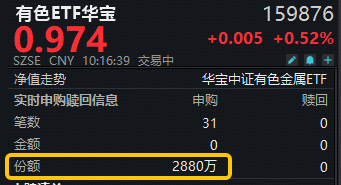
Core Viewpoint - The performance of the Huabao ETF (159876), which encompasses leading companies in the non-ferrous metals industry, shows resilience with a recent price increase of 0.52% after an initial drop of 2%, indicating strong investor interest in the sector [1][7]. Fund Performance - As of the latest report, the Huabao ETF has seen a net subscription of 28.8 million shares, with an additional inflow of 15.36 million yuan the previous day, reflecting positive market sentiment towards the non-ferrous metals sector [1][7]. - The current trading price of the Huabao ETF is 0.974, with a gain of 0.005, representing a 0.52% increase [1][7]. Leading Stocks - Key stocks within the ETF include Tianshan Aluminum, which rose by 4.41%, and Yun Aluminum, which increased by 4.22%. Other notable performers include Jiangxi Copper, China Aluminum, and Luoyang Molybdenum, all of which saw gains exceeding 2% [2][8]. Market Trends - The overall metal market has been on an upward trend, particularly in precious metals, energy metals, and industrial metals, with significant price increases observed [9]. - The recent announcement by the CME Group to raise margin requirements for various metal futures, including gold and silver, has led to a decline in international metal futures prices [9]. Future Outlook - Analysts predict that the non-ferrous metals sector is entering a new bull market driven by strong demand from "new productive forces," with supply constraints and diverse driving factors [3][9]. - The current bull market is characterized by a shift from traditional infrastructure-driven demand to one that integrates global energy transitions, technological revolutions, and industrial upgrades, with emerging fields such as new energy, new materials, AI, and aerospace being key growth drivers [3][9]. Investment Strategy - A diversified investment approach through the Huabao ETF and its associated funds is recommended to capture the overall beta performance of the non-ferrous metals sector, as it covers a wide range of metals including copper, aluminum, gold, rare earths, and lithium [4][10].




资金风向标 | 两融余额较上一日增加84.04亿元 有色金属行业获融资净买入额居首
Sou Hu Cai Jing· 2025-12-30 02:05
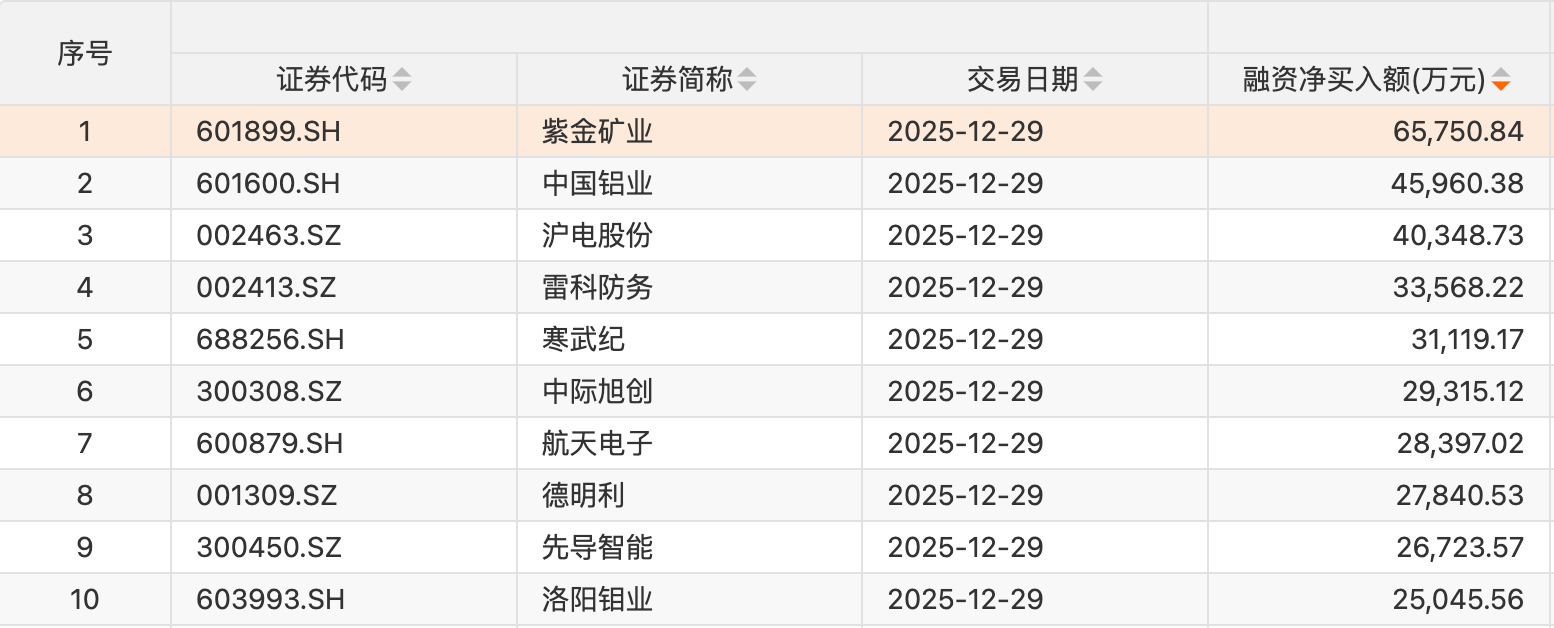
Group 1 - As of December 29, the A-share margin balance reached 25,517.34 billion yuan, an increase of 8.404 billion yuan from the previous trading day, accounting for 2.59% of the A-share circulating market value [1] - The margin trading volume on the same day was 230.053 billion yuan, a decrease of 9.696 billion yuan from the previous trading day, representing 10.65% of the A-share transaction volume [1] - Among the 31 primary industries, 18 experienced net financing inflows, with the non-ferrous metals industry leading with a net inflow of 2.449 billion yuan [1] Group 2 - A total of 53 stocks had net financing inflows exceeding 100 million yuan, with Zijin Mining leading at 658 million yuan [1] - Other notable stocks with significant net financing inflows included China Aluminum, Huadian Technology, and Aerospace Electronics [1] - Citic Securities' analysis indicates that compared to the hot copper futures market, related stocks have shown relatively calm performance due to market doubts about the sustainability of current commodity strength [2]



洛阳钼业:预计2026年3月28日公布年报,预测Q4一致预期营收1817.34~2641.20亿元
Xin Lang Cai Jing· 2025-12-29 13:45
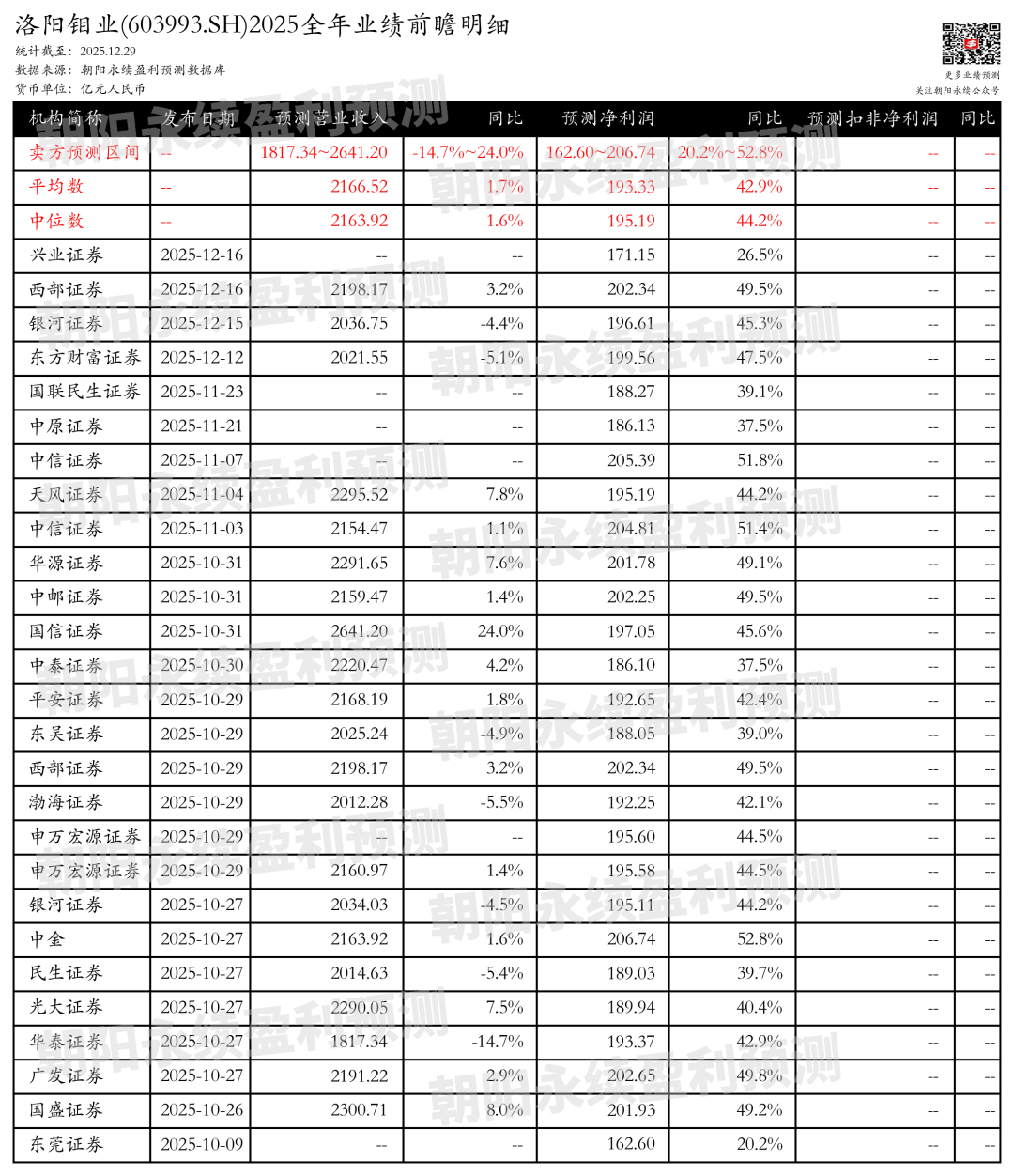
Group 1 - Company Luoyang Molybdenum (603993.SH) is scheduled to release its 2025 annual report on March 28, 2026 [1][6] - For Q4 2025, the expected revenue is projected to be between 181.73 billion to 264.12 billion yuan, with a year-on-year change of -14.7% to 24.0% [2][6] - The expected net profit for Q4 2025 is forecasted to be between 16.26 billion to 20.67 billion yuan, representing a year-on-year growth of 20.2% to 52.8% [2][6] Group 2 - According to Minsheng Securities, Luoyang Molybdenum's production in 2024 is expected to exceed forecasts, with copper and cobalt production increasing significantly by 55% and 106% year-on-year, respectively [4][8] - The company’s production capacity for copper and cobalt has surpassed annual production targets, achieving completion rates of 114.1% and 163.1% [4][8] - The company aims for a copper production target of 800,000 to 1,000,000 tons and cobalt production of 90,000 to 100,000 tons over the next five years [4][9] Group 3 - Guosheng Securities anticipates a significant increase in Luoyang Molybdenum's net profit for 2024, estimating it to reach between 12.8 billion to 14.2 billion yuan, a year-on-year increase of 55.2% to 72.1% [5][9] - The company is expected to see a quarter-on-quarter net profit growth of 58.6% to 107.6% in Q4 2024 [5][9] - The company has signed a cooperation agreement for the Nzilo_II hydropower station to ensure power supply, and projects TFM and KFM are progressing smoothly [10]

1月十大金股推荐
Ping An Securities· 2025-12-29 11:53
Group 1: Market Outlook - The equity market is expected to continue its upward trend due to clear domestic policy, strong economic growth momentum, and relatively loose market liquidity[3] - Investors are advised to actively position for the spring market, focusing on sectors with improving performance and benefiting from policies[3] Group 2: Recommended Stocks - BeiGene (688235.SH): Global sales of its core product, Zanubrutinib, reached $2.78 billion in the first three quarters of 2025, a year-on-year increase of 53.2%[4] - Beijing Junzheng (300223.SZ): The storage cycle is on the rise, and the company is expected to benefit from the L3 autonomous driving market[11] - Haiguang Information (688041.SH): The company is a leading domestic computing power provider, with revenue maintaining rapid growth in the first three quarters of 2025[18] - Daotong Technology (688208.SH): The company has seen rapid revenue growth and is advancing its AI strategy[26] - Penghui Energy (300438.SZ): The company ranks among the top three globally in household storage cell shipments in the first three quarters of 2025[32] - Goldwind Technology (002202.SZ): The gross margin for wind turbine and component business reached 7.97% in the first half of 2025, showing significant improvement[39] - Chifeng Gold (600988.SH): The company is expected to benefit from rising gold prices and increased production from new mining projects[46] - Luoyang Molybdenum (603993.SH): The company is positioned to benefit from rising copper prices and increased production[52] - Huaxin Cement (600801.SH): The company reported a 120.7% year-on-year increase in net profit attributable to shareholders in Q3 2025[57] - China Pacific Insurance (601601.SH): The company has maintained a high dividend yield, exceeding 3% since 2018[65]



盐湖提锂概念下跌1.89%,11股主力资金净流出超亿元
Zheng Quan Shi Bao Wang· 2025-12-29 09:33
Group 1 - The lithium extraction concept from salt lakes experienced a decline of 1.89%, ranking among the top losers in the concept sector, with Hualian Holdings hitting the daily limit down [1] - Major stocks within the salt lake lithium extraction sector that saw significant declines include Hualian Holdings, Xinhua Lithium Energy, and China Aluminum International, with respective drops of 9.99%, 6.19%, and 7.17% [1][2] - Conversely, stocks that gained in this sector included Fumiao Technology, ST Zhengping, and Longhua Technology, with increases of 6.96%, 5.03%, and 4.53% respectively [1][3] Group 2 - The salt lake lithium extraction sector faced a net outflow of 4.73 billion yuan, with 39 stocks experiencing net outflows, and 11 stocks seeing outflows exceeding 100 million yuan [1] - The stock with the highest net outflow was Luoyang Molybdenum, with a net outflow of 1.10 billion yuan, followed by Tianqi Lithium and Ganfeng Lithium with outflows of 689 million yuan and 603 million yuan respectively [1] - Stocks with the highest net inflows included BYD, Longhua Technology, and Chuanheng Shares, with inflows of 109 million yuan, 35 million yuan, and 30 million yuan respectively [1][3]



有色金属行业今日净流出资金81.37亿元,洛阳钼业等25股净流出资金超亿元
Zheng Quan Shi Bao Wang· 2025-12-29 09:23
沪指12月29日上涨0.04%,申万所属行业中,今日上涨的有10个,涨幅居前的行业为石油石化、国防军 工,涨幅分别为1.48%、1.43%。跌幅居前的行业为有色金属、公用事业,跌幅分别为1.95%、1.24%。 有色金属行业位居今日跌幅榜首位。 605376 博迁新材 5.56 3.26 1379.20 有色金属行业资金流出榜 | 代码 | 简称 | 今日涨跌幅(%) | 今日换手率(%) | 主力资金流量(万元) | | --- | --- | --- | --- | --- | | 603993 | 洛阳钼业 | -4.41 | 1.94 | -109862.42 | | 600362 | 江西铜业 | 1.41 | 6.56 | -104962.10 | | 002466 | 天齐锂业 | -4.54 | 5.05 | -68899.68 | | 002460 | 赣锋锂业 | -4.74 | 5.67 | -60331.70 | | 002240 | 盛新锂能 | -6.19 | 7.96 | -39038.27 | | 601600 | 中国铝业 | -3.29 | 3.23 | -37509.87 ...
贝莱德(BlackRock)对洛阳钼业H股的多头持仓比例降至7.96%
Xin Lang Cai Jing· 2025-12-29 09:16
据香港交易所披露,贝莱德(BlackRock)对洛阳栾川钼业集团股份有限公司 - H股的多头持仓比例于 2025年12月24日从8.28%降至7.96%。 ...
大摩:铝行业产能整合有利于行业龙头中国铝业和中国宏桥
Zhi Tong Cai Jing· 2025-12-29 08:24
Group 1 - The article highlights the National Development and Reform Commission's recent emphasis on optimizing the management and layout of the alumina and copper smelting industries, encouraging mergers and acquisitions among major enterprises in these sectors [1] - Morgan Stanley notes that alumina prices are under pressure due to increased supply, with current production capacity reaching 110 million tons and an utilization rate of 84%, while domestic demand in China has nearly reached its limit [1] - The new policy may restrict the planning of additional alumina production capacity, and capacity consolidation is expected to benefit industry leaders such as China Aluminum (601600) and China Hongqiao (01378) [1] Group 2 - The report indicates that lower annual copper concentrate processing and refining fees, along with long-term contract concentrate volumes, may lead to a reduction in refined copper production by 2026 [1] - Despite these factors, stable demand is expected to support copper prices at high levels, benefiting companies like Zijin Mining (601899), Luoyang Molybdenum (603993), Minmetals Resources (01208), and Jiangxi Copper (600362) [1]
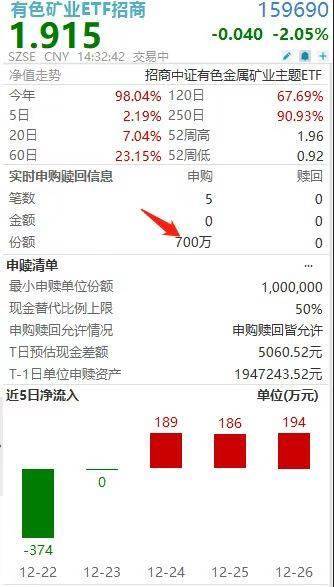
超千万资金逆市抢筹!有色矿业ETF招商(159690)盘中放量净流入,洛阳钼业、赣锋锂业跌幅居前
Sou Hu Cai Jing· 2025-12-29 06:56
华泰证券表示,近期商品市场表现强势,背后驱动主要来自双重逻辑:一是货币属性重估,美元信用趋 弱推动黄金的长叙事逻辑向其他商品扩散,多数商品黄金比价仍处于低位,存在比价修复空间;二是商 品属性支撑,明年全球经济或仍具有韧性,有利于需求实际改善。展望后市,部分品种因地缘、资金拥 挤等短期逻辑上涨过快,建议逢低增配而非逢高追涨;权益方面,全球比较下A股与港股周期板块总体 估值相对偏高,但煤炭、石油、化工等仍具相对性价比。 | 色矿业ETF招商 | | | 159690 | | --- | --- | --- | --- | | | | -0.040 -2.05% | | | SZSE CNY 14:32:42 交易中 | | F @ + | | | 净值走势 | | 招商中证有色金属矿业主题ETF | | | 文年 | 98.04% 120日 | 67.69% | | | 5日 | 2.19% 250日 | 90.93% | | | 20日 | 7.04% 52周高 | 1.96 | | | 60日 | 23.15% 52周低 | 0.92 | | | 实时申购陵回信息 | 申购 | 使回 | | | 等数 | 5 ...
银铜续创历史新高,有色ETF基金(159880)盘中净申购1100万份,盘中价格再创年内新高
Sou Hu Cai Jing· 2025-12-29 03:48
Group 1 - The core viewpoint of the news highlights the significant rise in the non-ferrous metal sector, with the index and various stocks experiencing notable gains, particularly in silver and copper prices reaching historical highs [1][2]. - The non-ferrous metal industry index (399395) increased by 0.56%, with key stocks such as Silver Holdings (601212) up by 10.05% and Jiangxi Copper (600362) up by 4.68% [1]. - The surge in precious metals, especially silver, is attributed to lower-than-expected inflation data, which has fueled expectations for interest rate cuts by the Federal Reserve, leading to a decline in U.S. Treasury yields [2]. Group 2 - The top ten weighted stocks in the non-ferrous metal industry index account for 52.34% of the index, with major players including Zijin Mining (601899) and China Aluminum (601600) [3]. - The non-ferrous ETF fund (159880) closely tracks the non-ferrous metal industry index and includes 50 prominent securities from the sector, reflecting the overall performance of listed companies in the non-ferrous metal industry [2][4].


