Hygon Information Technology (688041)

Search documents
最新规模突破330亿元,科创芯片ETF(588200)红盘蓄势,东芯股份领涨成分股
Sou Hu Cai Jing· 2025-07-30 03:15
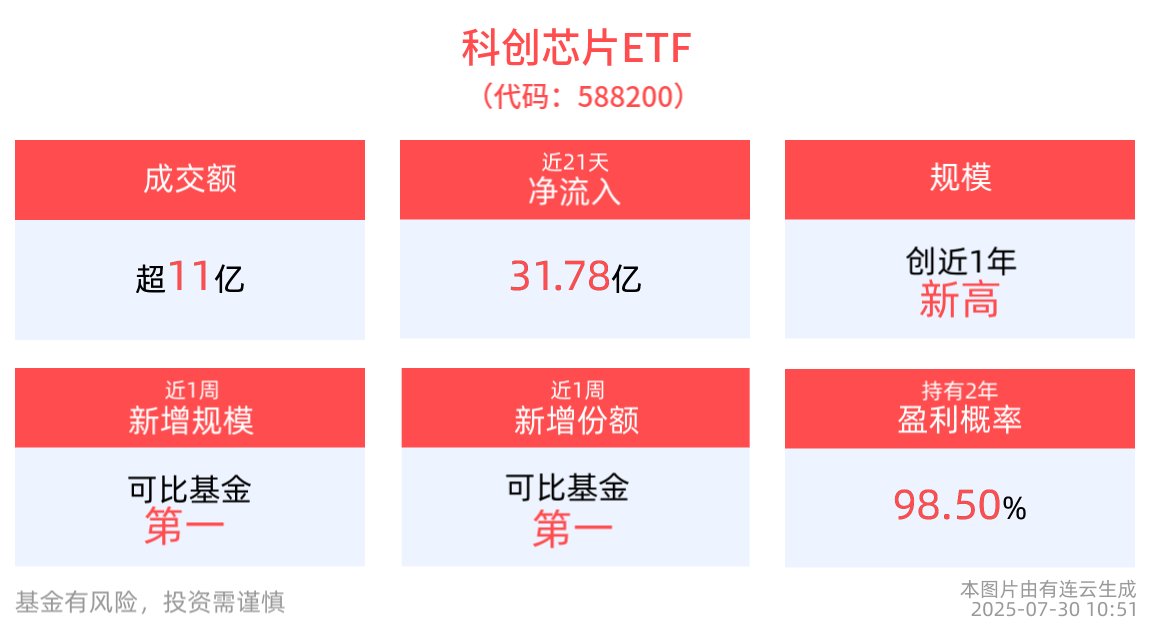
Group 1: ETF Performance and Liquidity - The Sci-Tech Chip ETF has a turnover rate of 3.52% during trading, with a transaction volume of 1.157 billion yuan [3] - As of July 29, the ETF's latest scale reached 33 billion yuan, marking a one-year high and ranking first among comparable funds [3] - Over the past week, the ETF's share increased by 30 million shares, also ranking first among comparable funds [3] - In the last 21 trading days, the ETF experienced net inflows on 15 days, totaling 3.178 billion yuan [3] - The ETF's financing net purchase amount reached 10.0419 million yuan this month, with a latest financing balance of 1.702 billion yuan [3] - The ETF's net value increased by 74.24% over the past year, ranking first among comparable funds [3] Group 2: Industry Insights and Market Trends - The resurgence of H20 is providing more computing power options for AI application companies, alleviating the shortage of high-end chips and accelerating the commercialization of AI applications [4] - This shift is expected to encourage domestic manufacturers to accelerate product iteration and strengthen the move towards full-stack autonomy, supporting the trend of domestic substitution [4] - As of June 30, 2025, the top ten weighted stocks in the Sci-Tech Chip Index accounted for 57.76% of the index, including major players like SMIC and Cambrian [4] Group 3: Stock Performance - The performance of key stocks in the Sci-Tech Chip Index shows varied results, with SMIC down by 0.87% and Cambrian down by 1.38%, while companies like Langchao Technology saw an increase of 1.37% [6] Group 4: Investment Opportunities - Investors without stock accounts can access domestic chip investment opportunities through the Sci-Tech Chip ETF linked fund (017470) [7]




多项成果亮相2025世界人工智能大会 国产算力从“单点突破”迈向“全场景攻坚”
Zhong Guo Jin Rong Xin Xi Wang· 2025-07-29 23:09
Core Insights - The 2025 World Artificial Intelligence Conference showcased significant advancements in domestic computing power, highlighting the importance of these innovations for accelerating AI applications [1][2] - Industry experts believe that 2023 is a pivotal year for the comprehensive promotion of domestic computing power software and hardware, transitioning from isolated breakthroughs to widespread application [1] Group 1: Domestic Computing Innovations - The Ascend 384 super node, consisting of 16 cabinets, was recognized as a "treasure of the museum" and represents Huawei's major achievement in computing infrastructure, featuring the industry's largest 384-card high-speed bus interconnection [1] - Over 80 large models have been developed based on the Ascend architecture, including applications in various sectors such as finance, healthcare, and transportation [1] Group 2: GPU Developments - Domestic GPU companies showcased impressive products, including the debut of the Xiyun C600 GPU by Muxi, which integrates large-capacity storage and mixed-precision computing, targeting key sectors like finance and government [2] - Moore Threads presented application cases in life sciences and physical simulation, demonstrating the broad application prospects of domestic GPUs in AI infrastructure [2] Group 3: Processor Advancements - The new generation of the Haiguang C86 terminal was launched, covering diverse needs across various industries, marking a breakthrough for domestic computing terminals [3] - The Longxin 3C6000 processor was released, designed to meet multiple computing demands without relying on foreign technologies, emphasizing China's self-reliance in processor development [3] Group 4: Ecosystem Development - The Ministry of Industry and Information Technology highlighted the rapid enhancement of domestic capabilities, with a focus on products based on the self-developed Dragon architecture [4] - The Haiguang ecosystem has over 5,000 partners collaborating on technology development and market expansion, forming a complete closed loop from chips to application services [4]

7月29日科创板主力资金净流入2.85亿元
Sou Hu Cai Jing· 2025-07-29 08:49
| 代码 | 简称 | 主力资金净流入(万元) | 主力资金流入率(%) | 涨跌幅(%) | 换手率(%) | | --- | --- | --- | --- | --- | --- | | 688041 | 海光信息 | 16561.61 | 4.14 | 2.19 | 3.18 | | 688220 | 翱捷科技 | 16066.92 | 10.50 | 6.40 | 4.97 | | 688222 | 成都先导 | 15713.53 | 16.19 | 4.13 | 10.29 | | 688520 | 神州细胞 | 13440.92 | 19.31 | 2.82 | 2.03 | | 688313 | 仕佳光子 | 13407.91 | 5.45 | 10.00 | 8.58 | | 688775 | 影石创新 | 12203.96 | 10.79 | 6.24 | 21.21 | | 688318 | 财富趋势 | 12156.31 | 10.49 | 4.50 | 3.61 | | 688777 | 中控技术 | 10207.85 | 12.36 | 1.61 | 2.17 | | 688321 ...




东芯股份20%涨停,科创芯片ETF南方(588890)早盘一度涨近2%,智能芯片等前沿方向技术创新再迎政策大力支持
Xin Lang Cai Jing· 2025-07-29 05:19
Group 1 - The core viewpoint of the news highlights the strong performance of the Southern Science and Technology Chip ETF (588890), which saw a nearly 2% increase during early trading on July 29, 2025, with a turnover of 5.5% and a transaction volume of 32.32 million yuan [1] - The underlying index, the Shanghai Science and Technology Chip Index (000685), rose by 1.57%, with significant gains in constituent stocks such as Dongxin Co., Ltd. (688110) up 20.01%, Fudan Microelectronics (688385) up 9.26%, and Naxin Microelectronics (688052) up 7.92% [1] - Over the past year, the Southern Science and Technology Chip ETF (588890) has seen an increase in scale by 534 million yuan, with a notable growth of 3 million shares in the last two weeks [1] Group 2 - On July 28, the Shanghai Municipal Economic and Information Commission released measures to further expand the application of artificial intelligence, emphasizing support for key technological innovations in areas such as intelligent chips and brain-computer interfaces, with funding support of up to 50% for strategic projects [2] - According to China International Capital Corporation (CICC), the semiconductor industry is experiencing high demand, with rapid growth in the shipment of existing applications and the emergence of new applications, benefiting leading companies through operational leverage and rising net profit margins [2] - The Southern Science and Technology Chip ETF (588890) closely tracks the Shanghai Science and Technology Chip Index, which includes companies involved in semiconductor materials, chip design, manufacturing, packaging, and testing, reflecting the overall performance of representative chip industry listed companies [3]


硬科技新品彰显中国智造新动能 科创板公司“竞技”世界人工智能大会
Shang Hai Zheng Quan Bao· 2025-07-28 18:58
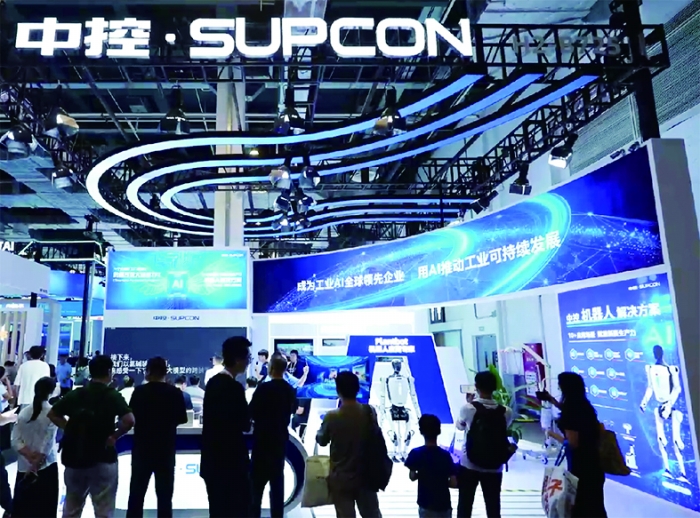
Core Insights - The 2025 World Artificial Intelligence Conference held in Shanghai attracted over 800 tech companies, showcasing more than 100 global or China debuts of innovative products [5][10] - The event highlighted the innovation vitality and industrial advantages of companies listed on the Sci-Tech Innovation Board, particularly in AI and related fields [5][9] Group 1: Company Innovations - Kingsoft Office launched its native AI office assistant "WPS Lingxi," which automates tasks like generating presentations through natural language processing [6] - Cambrian and Jiyue Xingchen collaborated on a new generation of foundational large models, enhancing domestic computing power and model adaptability [5] - The exhibition featured high-precision joint drive products from Hechuan Technology and the Plantbot robot solution from Zhongkong Technology, aimed at high-risk scenario replacements [5][9] Group 2: AI Product Developments - The conference showcased over 150 humanoid robots, demonstrating capabilities in logistics, healthcare, and dining services, indicating a shift from mere concepts to practical applications [8] - Companies like Zhiyuan Robotics and Dematech presented the world's first data-driven humanoid robot in a real logistics environment, showcasing its commercial viability [8] - Zhongkong Technology's TPT model acts as a "smart brain" for factories, optimizing industrial processes for companies like Wanhua Chemical [9] Group 3: Industry Trends - The Sci-Tech Innovation Board has over 40 core companies in the AI industry chain, covering computing power, algorithms, data, and application scenarios [9] - The recent "1+6" reform policy by the China Securities Regulatory Commission aims to support AI companies in listing on the Sci-Tech Innovation Board, enhancing opportunities for innovation and ecosystem development [10] - The conference is expected to position the Sci-Tech Innovation Board as a primary capital market for China's AI industry cluster, contributing to global AI development [10]


金十图示:2025年07月28日(周一)富时中国A50指数成分股午盘收盘行情一览:银行股走势分化,石油、煤炭、电力股走低
news flash· 2025-07-28 03:38
Market Overview - The FTSE China A50 Index showed mixed performance among bank stocks, while oil, coal, and electric power stocks declined [1][6] Banking Sector - Everbright Bank had a market capitalization of 242.84 billion with a trading volume of 0.38 billion, closing at 4.11, up by 0.03 (0.74%) [3] Insurance Sector - China Life Insurance had a market capitalization of 382.10 billion, with a trading volume of 1.46 billion, closing at 59.62, up by 1.12 (2.99%) [3] - China Pacific Insurance had a market capitalization of 371.44 billion, with a trading volume of 1.02 billion, closing at 38.61, up by 1.54 (2.65%) [3] - Ping An Insurance had a market capitalization of 1,085.69 billion, with a trading volume of 5.02 billion, closing at 8.64, up by 0.17 (2.01%) [3] Alcohol Industry - Kweichow Moutai had a market capitalization of 1,806.43 billion, with a trading volume of 3.41 billion, closing at 122.78, down by 16.99 (-1.17%) [3] - Shanxi Fenjiu had a market capitalization of 221.85 billion, with a trading volume of 1.14 billion, closing at 1438.01, down by 3.73 (-2.01%) [3] - Wuliangye had a market capitalization of 476.58 billion, with a trading volume of 1.31 billion, closing at 181.85, down by 0.76 (-0.62%) [3] Technology Sector - Haiguang Information had a market capitalization of 246.59 billion, with a trading volume of 1.20 billion, closing at 341.73, down by 0.23 (-0.07%) [3] - Northern Huachuang had a market capitalization of 282.22 billion, with a trading volume of 4.45 billion, closing at 674.60, up by 1.30 (0.19%) [3] - Cambricon Technologies had a market capitalization of 32.38 billion, with a trading volume of 1.79 billion, closing at 139.31, down by 2.18 (-1.54%) [3] Energy Sector - Sinopec had a market capitalization of 269.58 billion, with a trading volume of 5.34 billion, closing at 5.88, down by 0.11 (-1.27%) [3] - PetroChina had a market capitalization of 1,566.66 billion, with a trading volume of 8.05 billion, closing at 8.56, down by 0.06 (-1.08%) [3] Automotive Sector - BYD had a market capitalization of 1,846.26 billion, with a trading volume of 5.87 billion, closing at 37.78, down by 0.47 (-2.26%) [3] Securities Sector - CITIC Securities had a market capitalization of 363.53 billion, with a trading volume of 32.66 billion, closing at 29.86, up by 0.41 (2.03%) [4] Consumer Electronics - Luxshare Precision had a market capitalization of 272.89 billion, with a trading volume of 23.13 billion, closing at 28.83, up by 0.17 (0.59%) [4] Home Appliances - Gree Electric had a market capitalization of 228.16 billion, with a trading volume of 10.44 billion, closing at 25.72, down by 0.09 (-0.19%) [4] Pharmaceutical Sector - Heng Rui Medicine had a market capitalization of 404.93 billion, with a trading volume of 4.53 billion, closing at 48.52, up by 4.61 (8.17%) [4]







金十图示:2025年07月25日(周五)富时中国A50指数成分股今日收盘行情一览:盘面整体跌多涨少,银行、石油、煤炭等板块表现低迷
news flash· 2025-07-25 07:07
Market Overview - The FTSE China A50 Index showed a predominantly declining trend with more stocks falling than rising, particularly in the banking, oil, and coal sectors [1][6]. Banking Sector - Everbright Bank had a market capitalization of 241.07 billion with a trading volume of 716 million, closing at 4.08, down by 1.21% [3]. - Major banks like China Ping An, China Pacific Insurance, and China Life Insurance had market capitalizations of 374.58 billion, 360.67 billion, and 1,057.65 billion respectively, with trading volumes of 1.962 billion, 789 million, and 2.959 billion [3]. Oil Sector - China Petroleum and China Sinopec had market capitalizations of 1,586.79 billion and 722.62 billion respectively, with trading volumes of 1.598 billion and 996 million, both showing slight declines [3]. Coal Sector - China Shenhua and Shaanxi Coal had market capitalizations of 763.55 billion and 201.27 billion respectively, with trading volumes of 1.049 billion and 905 million, both experiencing declines [3]. Semiconductor Sector - Northern Huachuang, Cambrian, and Haiguang Information had market capitalizations of 246.76 billion, 281.68 billion, and 328.87 billion respectively, with trading volumes of 5 billion, 2.105 billion, and 8.133 billion, showing positive trends for Cambrian and Haiguang [3]. Alcohol Industry - Kweichow Moutai, Shanxi Fenjiu, and Wuliangye had market capitalizations of 1,827.77 billion, 226.40 billion, and 479.53 billion respectively, with trading volumes of 6.140 billion, 1.609 billion, and 2.285 billion, all showing declines [3]. Electric Power Sector - Changjiang Electric Power had a market capitalization of 191.69 billion with a trading volume of 2.910 billion, showing a slight increase [4]. Securities Sector - CITIC Securities, Ningde Times, and Guotai Junan had market capitalizations of 440.17 billion, 361.23 billion, and 1,289.37 billion respectively, with trading volumes of 3.625 billion, 2.769 billion, and 3.803 billion, with CITIC Securities showing a decline [4]. Consumer Electronics - Industrial Fulian, Luxshare Precision, and Dongfang Fortune had market capitalizations of 569.17 billion, 277.97 billion, and 379.14 billion respectively, with trading volumes of 11.391 billion, 3.082 billion, and 3.138 billion, with mixed performance [4]. Chemical and Pharmaceutical Sector - Heng Rui Pharmaceutical, Muyuan Foods, and SF Holding had market capitalizations of 265.38 billion, 242.76 billion, and 374.34 billion respectively, with trading volumes of 2.874 billion, 1.963 billion, and 1.074 billion, showing varied performance [4].







H20芯片破局,国产算力仍具催化
Bank of China Securities· 2025-07-25 00:04
Core Insights - H20's resumption of sales to China is expected to alleviate supply pressure on computing chips, stimulating the entire computing infrastructure and AI industry chain [2][3] - Since the rebound on April 9, overseas computing has seen a significant increase of 40.9%, while domestic computing, represented by Huawei's chain, has only increased by 21.1% [3][4] - The performance of domestic computing has improved, and H20's impact on domestic computing is limited, indicating that domestic computing still has long-term growth potential [5] Industry Overview - The computing power industry chain has been catalyzed by H20's return to the Chinese market, which is designed to comply with U.S. export restrictions and is specifically tailored for the Chinese market [3][5] - The domestic computing power industry is entering a growth cycle, supported by technological advancements, commercial applications, and increasing demand for AI models [4] - Key companies in the domestic computing power sector, such as Huawei, have demonstrated significant performance improvements, with Huawei's computing cluster outperforming NVIDIA's GB200 NVL72 [4][5] Investment Opportunities - The report suggests focusing on specific segments within the computing infrastructure industry, including servers, liquid cooling, copper connections, PCBs, optical communications, cloud computing, and domestic computing [5] - The IPO acceptance of domestic GPU manufacturers like Muxi Integration and Moore Threads fills the gap in the A-share market for full-function GPUs, further supporting the domestic computing ecosystem [4]


金十图示:2025年07月24日(周四)富时中国A50指数成分股午盘收盘行情一览:银行板块回吐昨日涨势,保险、酿酒、半导体等板块集体飘红
news flash· 2025-07-24 03:36
Core Points - The FTSE China A50 Index saw a mixed performance with the banking sector retreating from previous gains while insurance, liquor, and semiconductor sectors showed positive trends [1][6] Banking Sector - The banking sector experienced a decline, with notable stocks like China Everbright Bank showing a decrease of 0.24% [3] - Major banks such as China Pacific Insurance and China Life Insurance reported market capitalizations of 373.69 billion and 360.67 billion respectively, with slight increases in their stock prices [3] Insurance Sector - The insurance sector performed well, with China Pacific Insurance and China Life Insurance seeing stock price increases of 0.92% and 1.43% respectively [3] Liquor Industry - The liquor industry showed strong performance, with Kweichow Moutai, Shanxi Fenjiu, and Wuliangye reporting market capitalizations of 232.44 billion, 1871.65 billion, and 486.02 billion respectively [3] - Kweichow Moutai's stock price increased by 0.98% [3] Semiconductor Sector - The semiconductor sector also performed positively, with stocks like Northern Huachuang and Cambricon Technologies seeing increases of 1.70% and 1.24% respectively [3] - Market capitalizations for key players in this sector include 243.27 billion for Northern Huachuang and 250.71 billion for Cambricon Technologies [3] Oil Industry - The oil sector showed mixed results, with China Petroleum and China Petrochemical reporting market capitalizations of 1616.08 billion and 729.90 billion respectively [3] - China Petroleum's stock price decreased by 1.23% while China Petrochemical remained unchanged [3] Coal Industry - The coal industry saw positive movement, with stocks like Shenhua Group and Shaanxi Coal and Chemical Industry showing increases of 1.93% and 0.46% respectively [3] Automotive Sector - The automotive sector, represented by BYD, reported a market capitalization of 1893.35 billion with a stock price increase of 0.67% [3] Other Sectors - Various other sectors such as shipping, electricity, and securities also showed varied performances, with notable movements in stock prices and market capitalizations across different companies [4][3]


公募基金科创板配置比例创新高
Shang Hai Zheng Quan Bao· 2025-07-23 18:08
Group 1 - The allocation ratio of actively managed equity funds in the Sci-Tech Innovation Board reached a historical high of 15.36% by the end of Q2, an increase of 0.19 percentage points from the end of Q1 [1] - The overall scale of Sci-Tech Innovation Board thematic funds has surpassed 300 billion yuan, indicating a rapid expansion of the thematic fund sector [1] - The proportion of equity investments in various Sci-Tech Innovation Board funds remains high, with some funds like Bosera's Sci-Tech Board three-year open mixed fund having an equity investment ratio of 97.77% [1] Group 2 - With the U.S. interest rates peaking and the Federal Reserve entering a rate-cutting phase, domestic asset valuations are gradually entering an upward range, leading funds to maintain high positions in hard technology investments [2] - A significant number of Sci-Tech Innovation Board stocks have entered the top 50 holdings of public funds, with 230 funds heavily invested in SMIC, totaling over 8 billion yuan in market value [2] - The thematic fund sector has rapidly expanded since the implementation of the "Eight Articles of Sci-Tech Innovation Board," with a comprehensive range of index tools now available [2] Group 3 - As of July 23, the number of Sci-Tech Innovation Board thematic ETFs has increased to 88, with a total scale of approximately 267.4 billion yuan [3] - More than 50 new Sci-Tech Innovation Board thematic ETFs have been listed in the past year, indicating strong market interest and growth potential [3] - The optimistic outlook for A-share technology growth sectors is driven by multiple favorable factors, including advancements in artificial intelligence and improvements in the innovative drug sector [3]