TRINA(688599)

Search documents
海目星2025年预亏超8.5亿:毛利率陷历史低位,四季度扭亏难消分歧|看财报
Tai Mei Ti A P P· 2026-01-27 11:13
Core Viewpoint - The company, HaiMuxing, is expected to report a net loss of 850 million to 910 million yuan for the fiscal year 2025, indicating a further deterioration in performance compared to the previous year due to multiple factors including declining gross margins and increased impairment provisions [2][3] Group 1: Financial Performance - The gross margin has significantly declined from 34.22% in Q3 2022 to 17.76% in Q3 2025, representing a drop of over 48% [3] - The company reported a gross margin of 30.50% for the entire year of 2022, which decreased to 15.20% in the first half of 2025, with a slight recovery to 17.76% in the first three quarters of 2025 [3] - The company has accumulated over 500 million yuan in impairment losses in the first three quarters of 2025, attributed to inventory write-downs and bad debts [5] Group 2: Operational Challenges - The company faces increased operational challenges, reflected in rising inventory turnover days, which reached 526.73 days in 2025 compared to 335.23 days in 2022, and accounts receivable turnover days, which increased to 186 days from 75.61 days in 2022 [5] - The capital liability ratio has risen to 82.36% by Q3 2025, indicating increased debt pressure due to declining operational efficiency and ongoing investments in R&D and overseas expansion [6] Group 3: Market Conditions and Future Outlook - The company has reported a potential turnaround in Q4 2025, with an expected net profit of 2.518 million to 62.52 million yuan, marking a year-on-year increase of 100.76% to 118.92% [7] - The company has over 10 billion yuan in orders on hand, which may support performance in 2026, but confirmation of a sustainable recovery will depend on Q1 2026 data [7] - The company is exploring new technologies in collaboration with industry leaders, but faces challenges in resource allocation across multiple business segments and the need for effective market positioning [8]




多数光伏企业2025年延续亏损状态,部分企业锚定2026年业绩扭亏
Di Yi Cai Jing· 2026-01-27 10:56
Core Viewpoint - The keyword "pre-loss" has become prominent in the 2025 performance forecasts of various photovoltaic companies, indicating that most firms continue to face losses due to operational challenges and supply-demand imbalances in the industry [1] Group 1: Financial Performance - Leading photovoltaic companies are forecasting significant losses for 2025, with Tongwei Co. expecting a loss of 9 to 10 billion yuan, LONGi Green Energy forecasting a loss of 6 to 6.5 billion yuan, and JinkoSolar projecting a loss of 5.9 to 6.9 billion yuan [1] - The overall photovoltaic industry has experienced nine consecutive quarters of losses since Q4 2023, driven by a decline in component prices due to intense competition and insufficient end-user demand [1][2] Group 2: Industry Challenges - The photovoltaic industry is facing a supply surplus, with core raw material prices rising while product prices continue to decline, leading to significant operational pressure on companies [2] - The ongoing low operating rates and the deepening market reforms in the domestic electricity sector, along with increasing trade barriers abroad, have created a complex and challenging operating environment for photovoltaic companies [2] Group 3: Recovery Efforts - Some companies are beginning to emerge from the loss cycle, with LONGi Green Energy expecting to reduce losses by up to 30.38% and Aiko Solar by up to 77.44% compared to 2024 [2] - The China Photovoltaic Industry Association reported a 16.9% year-on-year decline in revenue for the main industry chain in the first three quarters of 2025, although gross margins improved to 3.64% [2] Group 4: Future Goals - Companies like Trina Solar have set profit targets for 2026, aiming for a net profit of no less than 200 million yuan, with increasing targets for subsequent years [3] - LONGi Green Energy's employee stock ownership plan also includes targets for positive net profit in 2026, with specific profit goals for 2027 and 2028 [3] Group 5: Price Adjustments - Trina Solar has raised its component prices three times this month, with prices now ranging from 0.88 to 0.92 yuan per watt, reflecting a response to industry self-discipline [4] - Major component manufacturers are increasing prices by 0.02 to 0.04 yuan per watt, and there is a growing willingness among intermediate suppliers to support price increases [4]




壹快评丨光伏反内卷攻坚,政企同心方得始终
Di Yi Cai Jing· 2026-01-27 04:26
Core Viewpoint - The photovoltaic industry is undergoing a significant transformation towards high-quality development, driven by both internal corporate self-discipline and external government support, as evidenced by recent regulatory measures and policy adjustments aimed at combating price competition and fostering innovation [1][4][7]. Industry Performance - The photovoltaic sector is currently facing severe financial challenges, with major companies like Tongwei Co. and LONGi Green Energy projected to incur substantial losses in 2025, highlighting the industry's struggle with low-price competition and rising material costs [1][2]. - The average gross margin for the industry has plummeted to just 3.64%, leading many companies into a cycle of "production equals loss" [2]. Competitive Landscape - The industry is experiencing an oversupply of homogeneous production capacity, with silicon material capacity exceeding global demand by more than double, resulting in a fierce price war among companies [2][3]. - Companies that previously relied on scale advantages are now also facing revenue declines and negative profits, indicating a widespread crisis across the sector [2]. Material Costs and Innovation - The price of silver, a critical component in photovoltaic cells, has surged by 231% in 2025, pushing companies to adopt cost-reduction technologies such as "less silver" or "silver-free" approaches [3]. - The focus on price competition has led some companies to neglect technological innovation and quality improvement, which are essential for long-term survival [3]. Government Role and Policy Recommendations - Government intervention is crucial for the success of the anti-involution measures, requiring a unified and clear policy direction to stabilize market expectations and foster industry consensus [4][6]. - There is a need for coordinated regulatory efforts across various government departments to effectively combat unfair competition and ensure sustainable industry practices [5][6]. Future Outlook - The current challenges in the photovoltaic industry present an opportunity for transformation, shifting from a focus on quantity to value creation, which is expected to be a long-term process [7]. - Some companies are beginning to reduce losses, and there is optimism that the industry may see a profitability turning point in early 2026 [7].

股市面面观丨1123家上市公司发布2025年业绩预告 哪些赛道公司“最赚钱”?
Zhong Guo Jin Rong Xin Xi Wang· 2026-01-27 03:49
Group 1 - A total of 1123 A-share listed companies have released their 2025 performance forecasts, with 602 companies expecting profits and 521 companies anticipating losses [1][2] - Among the companies predicting profits, Zijin Mining leads with a forecasted net profit of 52 billion yuan, followed by Luoyang Molybdenum with 20.8 billion yuan [2][3] - The automotive sector, represented by SAIC Motor, is expected to see a significant profit increase of 438%-558%, the highest growth rate among the top ten profit forecast companies [2][3] Group 2 - The real estate sector dominates the list of companies forecasting significant losses, with China Fortune Land Development expected to lose between 16 billion and 24 billion yuan [3][4] - Other sectors facing losses include the photovoltaic industry, with Tongwei Co., TCL Zhonghuan, and Trina Solar among the top ten companies predicting losses [4][5] - JinkoSolar is projected to experience the largest decline in net profit, with a decrease of 6063.96%-7074.8% due to price fluctuations in the global photovoltaic industry [9][10] Group 3 - Companies like *ST Weir and Tonghua Dongbao are expected to see substantial profit growth, with *ST Weir forecasting a net profit increase of 8303.8%-9599.14% [6][8] - Approximately 260 companies are expected to have a net profit growth rate exceeding 100%, accounting for about one-fifth of the companies that have released forecasts [7][8] - The performance of companies in the photovoltaic sector is under pressure due to market conditions, impacting their profitability despite efforts to innovate and upgrade technology [9][10]






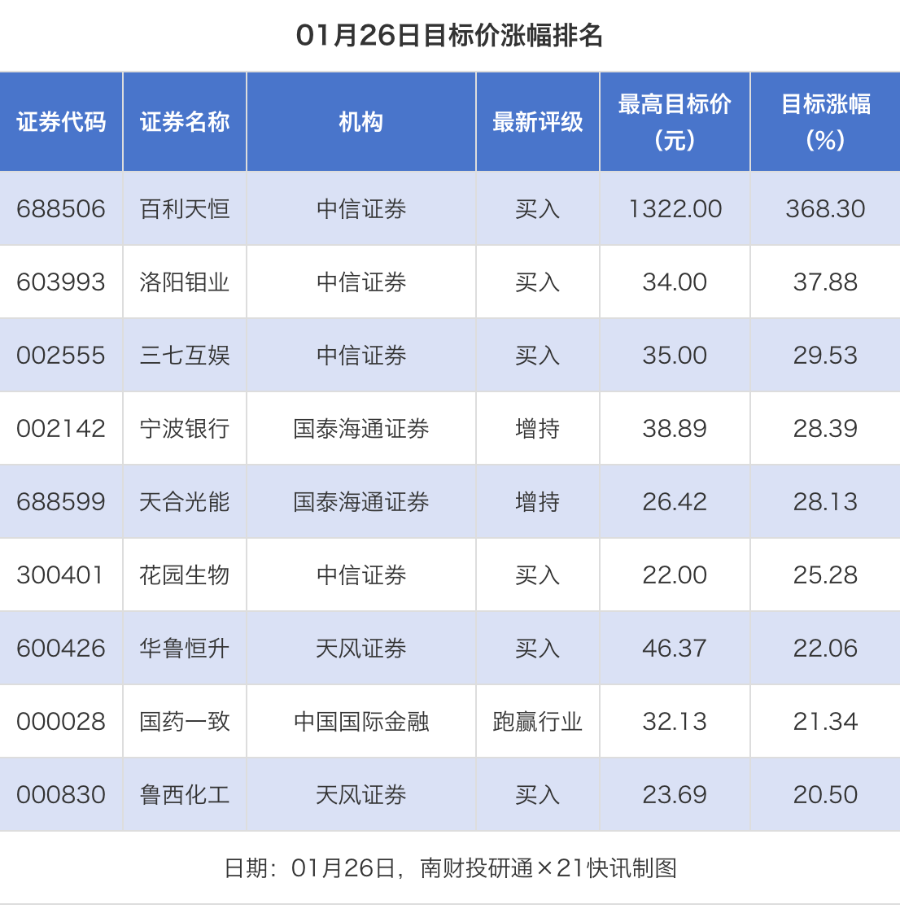
23股获推荐,百利天恒目标价涨幅超300%丨券商评级观察
2 1 Shi Ji Jing Ji Bao Dao· 2026-01-27 01:15
Group 1 - The core viewpoint of the article highlights the target price increases for several listed companies, with significant growth potential identified by brokerage firms [1][3] - The companies with the highest target price increases include Baili Tianheng at 368.30%, Luoyang Molybdenum at 37.88%, and Sanqi Interactive Entertainment at 29.53%, representing the chemical pharmaceutical, industrial metals, and gaming industries respectively [1][3] - A total of 23 listed companies received brokerage recommendations on January 26, with companies like Jianda Co., Shouhua Gas, and Huayuan Bio receiving one recommendation each [3] Group 2 - On January 26, one company had its rating upgraded, specifically Hualu Hengsheng, which was raised from "Hold" to "Buy" by Tianfeng Securities [4][6] - The only company receiving a first-time coverage rating on January 26 was Boshi Jie, which was given a "Strong Buy" rating by China Merchants Securities [6][7]




天合光能:26年目标扭亏为盈,前瞻布局太空光伏-20260126
GUOTAI HAITONG SECURITIES· 2026-01-26 13:25
股票研究 /[Table_Date] 2026.01.26 26 年目标扭亏为盈,前瞻布局太空光伏 天合光能(688599) | [姓名table_Authors] | 电话 | 邮箱 | 登记编号 | | --- | --- | --- | --- | | 徐强(分析师) | 010-83939805 | xuqiang@gtht.com | S0880517040002 | | 吴志鹏(分析师) | 021-23215736 | wuzhipeng@gtht.com | S0880525070004 | 本报告导读: 公司股权激励草案计划的目标 26 年扭亏为盈,在太空光伏领域进行前瞻布局。 投资要点: | [Table_Finance] 财务摘要(百万元) | 2023A | 2024A | 2025E | 2026E | 2027E | | --- | --- | --- | --- | --- | --- | | 营业总收入 | 113,411 | 80,282 | 78,589 | 86,891 | 103,652 | | (+/-)% | 33.3% | -29.2% | -2.1% | 10. ...
天合光能(688599):26年目标扭亏为盈,前瞻布局太空光伏
GUOTAI HAITONG SECURITIES· 2026-01-26 12:52
股票研究 /[Table_Date] 2026.01.26 26 年目标扭亏为盈,前瞻布局太空光伏 天合光能(688599) | [姓名table_Authors] | 电话 | 邮箱 | 登记编号 | | --- | --- | --- | --- | | 徐强(分析师) | 010-83939805 | xuqiang@gtht.com | S0880517040002 | | 吴志鹏(分析师) | 021-23215736 | wuzhipeng@gtht.com | S0880525070004 | 本报告导读: 公司股权激励草案计划的目标 26 年扭亏为盈,在太空光伏领域进行前瞻布局。 投资要点: | [Table_Finance] 财务摘要(百万元) | 2023A | 2024A | 2025E | 2026E | 2027E | | --- | --- | --- | --- | --- | --- | | 营业总收入 | 113,411 | 80,282 | 78,589 | 86,891 | 103,652 | | (+/-)% | 33.3% | -29.2% | -2.1% | 10. ...
商业航天发展提速,太空光伏迎布局良机
GUOTAI HAITONG SECURITIES· 2026-01-26 11:14
Investment Rating - The report assigns an "Accumulate" rating for the industry [1]. Core Insights - The market potential brought by space data centers is enormous, with crystalline silicon and perovskite battery technologies becoming key [2]. - The rapid development of commercial aerospace will benefit space photovoltaics significantly, as solar energy is the only reliable energy source in commercial aerospace, with solar irradiance in space being approximately 5-10 times that of ground photovoltaics [3][7]. Summary by Sections 1. Space Photovoltaics in Commercial Aerospace - Solar energy is a massive energy source, with the sun radiating energy equivalent to 130 trillion tons of coal annually, making it the largest exploitable energy source [7]. - Space photovoltaics are not affected by atmospheric interference, with solar irradiance around 1360 W/m², which is about 1.4 times that of ground photovoltaics [8]. 2. Successful Commercialization of Satellite Internet - Low Earth orbit (LEO) satellites have broad commercial application prospects, characterized by low transmission delays and costs, making them suitable for satellite internet applications [20]. - Companies like SpaceX's Starlink have successfully deployed LEO satellite constellations, enhancing global internet access [22]. 3. Development Opportunities - The mainstream energy solution in space is currently gallium arsenide (GaAs), but crystalline silicon and perovskite technologies are gaining traction due to their cost and efficiency improvements [48]. - The demand for space data centers is expected to grow significantly, with companies exploring the use of crystalline silicon and perovskite layered solutions [5]. 4. Market Outlook - If Elon Musk's goal of deploying 100 GW of AI computing power in space is achieved, it could lead to a demand for 680,000 satellites annually, compared to the current global stock of just over 10,000 satellites [5]. 5. Related Companies - Companies to watch in this sector include Junda Co., JinkoSolar, Trina Solar, Dongfang Risheng, and GCL-Poly Energy [5].
太空光伏火了!马斯克联手贝莱德冲刺100GW,低轨卫星+AI算力刚需爆发!
Xin Lang Cai Jing· 2026-01-26 11:09
Group 1: Industry Overview - The space photovoltaic industry is experiencing significant growth driven by the demand for gallium arsenide batteries and other advanced solar technologies, particularly in high-altitude satellites and deep space exploration [1][2][3] - Musk's 100GW solar power capacity plan is expected to boost the demand for space photovoltaic products, benefiting various companies in the supply chain [1][2][3] Group 2: Key Companies and Their Developments - Qianzhao Optoelectronics (300102) is a leading player in gallium arsenide space batteries with over 60% market share in China, achieving a production efficiency of 35% and an experimental efficiency exceeding 42% [1][12] - Dongfang Risen (300118) has successfully delivered small batches of HJT batteries to SpaceX, with its ultra-thin P-type HJT battery meeting the lightweight requirements for satellites [1][13] - Junda Co., Ltd. (002865) is a global leader in TOPCon batteries, with laboratory conversion efficiency surpassing 33.53%, and is rumored to be a potential supplier for SpaceX's perovskite batteries [1][14] - Yunnan Zhiyuan (002428) is a core supplier of germanium wafers for gallium arsenide space batteries, benefiting from the increasing demand for germanium substrates [1][15] - Sanan Optoelectronics (600703) holds the largest gallium arsenide production capacity globally and is expected to see significant revenue growth from its space photovoltaic applications [1][16] - Maiwei Co., Ltd. (300751) is a leading supplier of HJT production equipment and is well-positioned to benefit from the surge in demand for space photovoltaic manufacturing equipment [1][17] - Saiwu Technology (603212) specializes in photovoltaic packaging materials and is developing radiation-resistant encapsulation films for space applications [1][18][19] - China Satellite (600118) is a key player in satellite platform manufacturing and is expected to benefit from the growth in space photovoltaic systems [1][20] - Aerospace Electronics (600879) provides power systems and communication equipment for satellites, with increasing demand expected due to the growth in space photovoltaic applications [1][21] - Tuojin New Energy (002218) focuses on flexible photovoltaic components suitable for space applications, with expected growth in orders as the market expands [1][22] - Trina Solar (688599) covers multiple technology routes and is positioned to benefit from the expansion of space photovoltaic systems [1][23] - Shanghai Portwan (605598) supplies flexible solar wings and is accelerating the commercialization of perovskite batteries through in-orbit testing services [1][24] - Ruihua Tai (688323) is a leader in CPI film materials, essential for flexible space photovoltaic components, and is expected to see increased demand [1][25] - Jiejia Weichuang (300724) is a leading manufacturer of photovoltaic battery production equipment, poised to benefit from the demand surge in space photovoltaic manufacturing [1][26] - Lens Technology (300433) supplies protective covers for satellite batteries, with expected growth in orders due to the increasing demand for space photovoltaic applications [1][27]



天合光能提示三年累计盈利96亿元目标不构成业绩承诺
Zhong Guo Jing Ying Bao· 2026-01-26 09:12
Core Viewpoint - Trina Solar has issued a risk warning regarding its performance targets outlined in the 2026 restricted stock incentive plan, stating that these targets do not constitute any commitment to future profitability or operational performance [1][2] Group 1: Incentive Plan Details - The incentive plan aims to assess performance over three accounting years from 2026 to 2028, with specific profit targets set: a minimum net profit of 200 million yuan in 2026, 3.2 billion yuan in 2027, or a cumulative total of 3.4 billion yuan for 2026-2027, and 6.2 billion yuan in 2028, or a cumulative total of 9.6 billion yuan for 2026-2028 [1] - The company emphasizes that the incentive plan is based on confidence in its long-term development potential and intrinsic value, aiming to attract and retain talent for sustainable growth [1] Group 2: Industry Context and Performance Outlook - Trina Solar's previous annual performance forecast for 2025 indicated an expected net loss of between 6.5 billion yuan and 7.5 billion yuan, reflecting the broader trend of losses in the photovoltaic industry [1] - The company believes that as the photovoltaic industry gradually recovers and its energy storage and system solutions businesses grow rapidly, it can achieve a performance rebound ahead of the industry [1][2] Group 3: Market Reaction and Stock Performance - As of January 26, Trina Solar's stock price was reported at 20.62 yuan per share, down 1.29%, with a total market capitalization of approximately 48.3 billion yuan [2]