
CHANGAN AUTOMOBILE-B(000625)

Search documents
汽车早餐 | 神龙汽车领导班子调整;长安汽车与京东联合开发新能源无人智能车;马斯克或离开特斯拉
Zhong Guo Qi Che Bao Wang· 2025-10-29 01:29
Group 1: National Policies and Industry Development - The "14th Five-Year Plan" emphasizes the construction of a manufacturing powerhouse, quality powerhouse, aerospace powerhouse, transportation powerhouse, and cyber powerhouse, while maintaining a reasonable proportion of manufacturing [2] - The plan aims to eliminate unreasonable restrictions on consumption in sectors like automobiles and housing, and to establish management methods that adapt to new consumption formats and scenarios [2] - Strategic emerging industries such as new energy, new materials, aerospace, and low-altitude economy will be accelerated [2] Group 2: Automotive Industry Developments - The 8th China International Import Expo will showcase 461 new products, technologies, and services, including new themes in automotive and cultural tourism, aimed at expanding consumption [3] - Over 1.1 million new energy vehicles have been insured through a platform designed to manage high compensation risks in the insurance industry, providing risk coverage exceeding 1.1 trillion yuan [4] - The State Administration for Market Regulation has approved the establishment of 10 measurement talent training centers, including one focused on new energy vehicles, to address technical bottlenecks in modern industry [5] Group 3: International Automotive News - Toyota plans to build multiple automotive factories in the U.S. with an investment exceeding 10 billion dollars [6] - In September, European car sales increased by 11% to 1.24 million units, with Tesla's new car registrations in the EU declining by 19%, while BYD's registrations surged by 272% [7] Group 4: Technological Innovations - Nissan's new solid-state battery has achieved an energy density of 400-500 Wh/kg, potentially increasing the driving range of electric vehicles to 800-1000 kilometers, with plans for mass production by the fiscal year 2028 [8] Group 5: Corporate News - Shenlong Automobile announced leadership changes, appointing new executives to key positions [11] - Changan Automobile is collaborating with JD Group to develop new energy unmanned intelligent vehicles and logistics solutions [12] - Hongmeng Zhixing has delivered its 1 millionth vehicle, achieving this milestone in 43 months with an average transaction price of 390,000 yuan [13] - XPeng Motors reported a 125% year-on-year increase in overseas sales in the first three quarters, with significant market presence in Southeast Asia [14] - Leap Motor established a smart control company in Zhejiang with a registered capital of 200 million yuan [15] - Guoxuan High-Tech founded a power technology company in Wuhu with a registered capital of 1 billion yuan, focusing on battery sales and manufacturing [16]





新央企首季报!转型期的长安汽车遭遇盈利压力
Guo Ji Jin Rong Bao· 2025-10-28 12:41
Core Viewpoint - Changan Automobile, recently established as a new central enterprise, reported a mixed performance in its third-quarter results, highlighting both growth and pressure in its operations. Revenue and Sales Growth - In Q3, Changan achieved operating revenue of 42.236 billion yuan, a year-on-year increase of 23.36%; cumulative revenue for the first three quarters reached 114.927 billion yuan, up 3.58% year-on-year [1][5] - The revenue growth was primarily driven by sales, with total sales of 2.0661 million vehicles in the first three quarters, of which over 30% came from new energy vehicles (NEVs), totaling 724,000 units; September alone saw NEV sales surpassing 100,000 units, marking an 87% year-on-year increase [1][3] - By brand, Avita, as a high-end brand, recorded cumulative sales of 90,700 units in the first nine months, while Deep Blue focused on the mid-range market with sales of 232,300 units; Changan Qiyuan delivered 41,000 units in September, exceeding 200,000 units in total for the first three quarters [1] International Market Expansion - Changan's overseas market also became a significant growth driver, with exports reaching 60,000 units in September and a total of 465,000 units in the first three quarters; Southeast Asia and the Middle East markets saw growth rates exceeding 50% [3] - The new energy factory in Rayong, Thailand, commenced production in Q3, with the first localized model, Deep Blue S05, achieving mass delivery, and an expected annual capacity of 150,000 units to further support overseas sales growth [3] Profitability Challenges - Despite the increase in sales and revenue, Changan's profitability did not improve, with a net profit attributable to shareholders of 764 million yuan in Q3, a slight year-on-year increase of 2.13% but a significant quarter-on-quarter decline of 18.6% [5][6] - For the first three quarters, the net profit attributable to shareholders was 3.055 billion yuan, down 14.66% year-on-year, contrasting with a 20.08% increase in the net profit after excluding non-recurring gains and losses [5][6] - The decline in profitability was attributed to a reduction in non-recurring gains, which fell by 45.39% year-on-year, primarily due to a decrease in government subsidies from 1.564 billion yuan in the same period last year to 508 million yuan, a drop of 67.52% [5][6] Cash Flow and Liquidity Issues - Changan's cash flow situation raised concerns, with a net cash flow from operating activities of only 1.555 billion yuan, a significant year-on-year decline of 64.6%; investment activities showed a net cash flow of -7.859 billion yuan, reversing from a positive figure last year [9] - The cash reserves decreased by 8.863 billion yuan, from 63.27 billion yuan at the end of last year to 54.41 billion yuan, compared to a net increase of 5.122 billion yuan in the same period last year [9] - To alleviate supplier financial pressure and ensure supply chain stability, the company shortened payment terms, resulting in a decrease in accounts payable from 43.836 billion yuan to 27.054 billion yuan, a decline of 38.28% [9] Strategic Transformation and Future Outlook - This quarterly report marks Changan's first as a central enterprise, with accelerated transformation efforts, particularly in core technology development, including the completion of solid-state battery prototype verification with an energy density of 400 Wh/kg, expected to be mass-produced by 2026 [10] - The company launched the "Tianshu Intelligent" brand, introducing an intelligent cockpit system based on the Orin-X chip, and established a European R&D center focusing on local adaptation of new energy vehicles [10] - However, the high costs associated with transformation have led to a dilemma between short-term profitability and long-term strategic positioning, prompting analysts to lower the 2025 net profit forecast for Changan to 4.4 billion yuan from the previous estimate of 4.8 billion yuan [12]
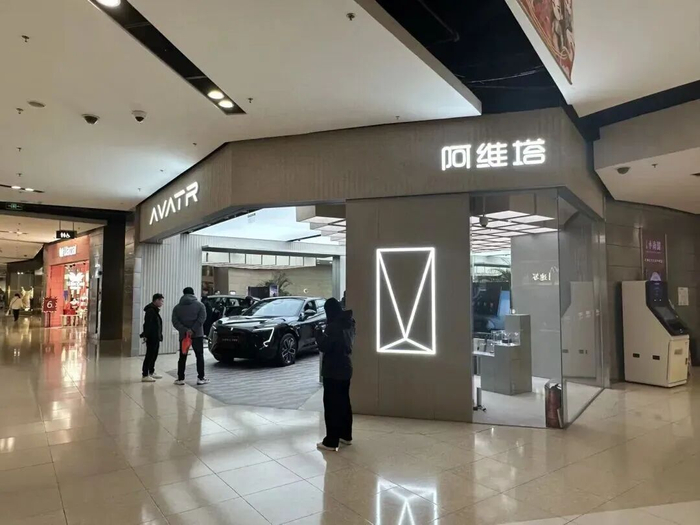
长安汽车(000625) - 2025年10月28日投资者关系活动记录表
2025-10-28 09:58
Group 1: Business Performance - In the first three quarters of 2025, Changan Automobile achieved a total sales volume of 2.066 million vehicles, representing an 8.5% year-on-year increase [1] - New energy vehicle sales reached 724,000 units, showing a significant growth of 59.7% compared to the previous year, outperforming the industry average [1] - Overseas exports totaled 465,000 vehicles, marking a 10.7% increase year-on-year [1] - The company reported a revenue of 42.236 billion CNY in Q3, a year-on-year growth of 23.36%, and a total revenue of 114.927 billion CNY for the first three quarters, reflecting a 3.6% increase [1] - The gross profit margin improved by 0.6 percentage points year-on-year, with a quarterly gross margin increase of 0.49 percentage points [1] Group 2: Future Industry Planning - Changan plans to develop humanoid robots in collaboration with leading partners, focusing on core technologies such as "brain," "energy," and "drive" [2] - The company aims to launch a flying car product by 2030, targeting commercial operation [2] - Exploration of unmanned commercial vehicles, including cleaning robots and agricultural machinery, is underway [2] Group 3: Strategic Plans - Changan is accelerating its transformation into a smart low-carbon mobility technology company, implementing three major strategic plans [2] - The "Shangri-La" plan for new energy aims to create three global smart energy brands: Avita, Deep Blue, and Changan Qiyuan, with a total of 724,000 new energy vehicles sold from January to September 2025 [2] - Significant investments in R&D amounting to 61 billion CNY over the past five years, with a global R&D team of over 24,000 people [3] Group 4: Product Launches - Upcoming products include the Changan Qiyuan A06, featuring advanced driving assistance and a spacious design, set to launch soon [4] - The Deep Blue L06 will be the first to feature a 3nm automotive-grade chip and advanced driving assistance systems [4] - The Avita 12 will be available in both pure electric and range-extended versions, catering to diverse user needs [4] Group 5: Strategic Partnerships - A strategic cooperation agreement was signed with JD Group on October 15, 2025, to explore smart logistics vehicles and intelligent operation systems [4] - The partnership aims to enhance logistics efficiency through customized smart logistics vehicles, leveraging Changan's vehicle capabilities and JD's logistics technology [4] - Future collaborations will include joint marketing efforts and exploring new sales models for commercial vehicles [4]
乘用车板块10月28日跌0.18%,长安汽车领跌,主力资金净流出3.57亿元
Zheng Xing Xing Ye Ri Bao· 2025-10-28 08:33
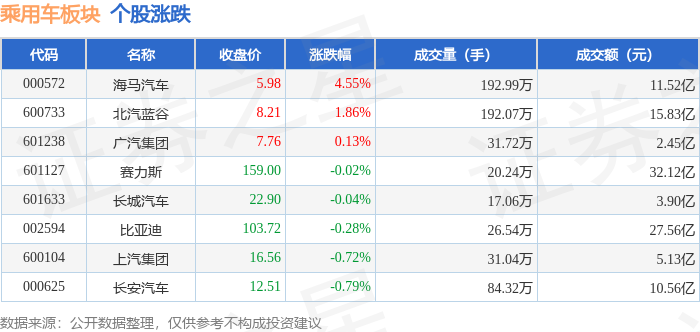
Core Insights - The passenger car sector experienced a decline of 0.18% on October 28, with Changan Automobile leading the drop [1] - The Shanghai Composite Index closed at 3988.22, down 0.22%, while the Shenzhen Component Index closed at 13430.1, down 0.44% [1] Market Performance - The following companies showed notable price movements: - China National Offshore Oil Corporation (CNOOC) closed at 5.98, up 4.55% with a trading volume of 1.93 million shares and a turnover of 1.15 billion [1] - BAIC Blue Valley closed at 8.21, up 1.86% with a trading volume of 1.92 million shares and a turnover of 1.58 billion [1] - GAC Group closed at 7.76, up 0.13% with a trading volume of 317,200 shares and a turnover of 245 million [1] - BYD closed at 103.72, down 0.28% with a trading volume of 265,400 shares and a turnover of 2.76 billion [1] - Changan Automobile closed at 12.51, down 0.79% with a trading volume of 843,200 shares and a turnover of 1.06 billion [1] Capital Flow - The passenger car sector saw a net outflow of 357 million from institutional investors, while retail investors contributed a net inflow of 261 million [1] - The following companies had significant capital flows: - BAIC Blue Valley had a net inflow of 1.85 billion from institutional investors, but a net outflow of 1.12 billion from speculative funds [2] - GAC Group had a net inflow of 21.78 million from institutional investors, with a net outflow of 1.48 million from speculative funds [2] - Changan Automobile experienced a net outflow of 1.06 billion from institutional investors, but a net inflow of 101 million from retail investors [2] - BYD faced a net outflow of 234 million from institutional investors, while speculative funds saw a net inflow of 122 million [2]
泰国,正被中国家电企业“挤爆”
3 6 Ke· 2025-10-28 08:10
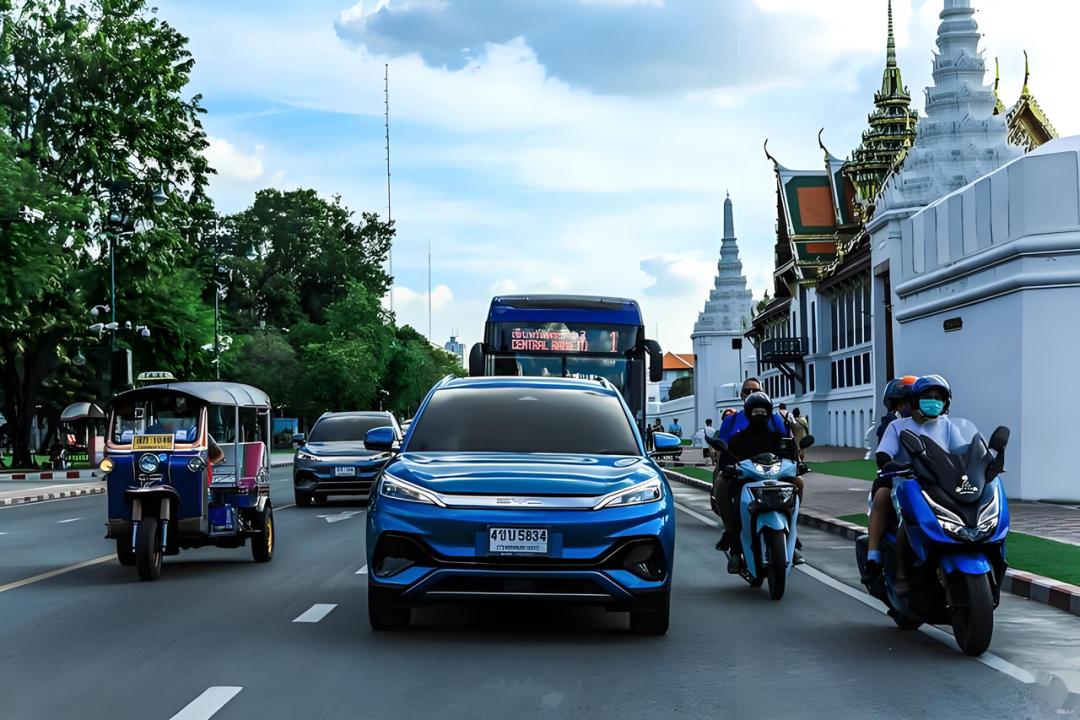
Group 1: Overview of Manufacturing Developments in Thailand - The Haier air conditioning industrial park in Chonburi, Thailand, officially commenced production on September 23, with an annual planned capacity of 6 million units [1] - Hisense's HHA smart manufacturing industrial park is set to be completed by 2030, with an expected annual production capacity of 2.6 million units [1] - The Thai Investment Promotion Committee approved a 3 billion THB investment for Oma's refrigerator production base, aiming for an annual output of 1.7 million units primarily for the European market [1] Group 2: Chinese Automotive Industry Expansion - Chinese automotive brands have significantly increased their presence in Thailand, with companies like BYD, Changan, and Foton embedding deeply into the local automotive supply chain [2] - In 2024, Thailand is projected to be the fourth largest export market for China's new energy vehicles, with exports expected to reach 178,000 units, a 35% increase year-on-year [2] - By the end of 2024, seven Chinese car manufacturers will have established operations in Thailand, achieving a full cycle from planning to production and sales [2] Group 3: Thailand's Strategic Advantages - Thailand's geographical location and political stability make it an attractive manufacturing hub, connecting to major Southeast Asian markets [4] - The rise of Laem Chabang Port as Southeast Asia's second-largest container port enhances Thailand's manufacturing competitiveness by facilitating international trade [4] - Labor costs in Thailand are lower than in China, with the minimum monthly wage in Thailand being approximately 77% of that in China, making it appealing for foreign investment [4] Group 4: Market Dynamics and Consumer Demand - Thailand's automotive production accounts for 45% of ASEAN's total, positioning it as a key player in the Southeast Asian automotive industry [6] - The local production model has allowed Chinese car manufacturers to rapidly capture market share, especially in the electric vehicle segment [6] - The demand for home appliances in Southeast Asia is growing, with a projected annual growth rate of 5%-10% in the region's appliance market [8][9] Group 5: Chinese Home Appliance Industry Trends - The influx of Japanese home appliance companies into Thailand has inspired Chinese firms to follow suit, capitalizing on the growing demand for appliances [8] - Thailand is now the largest white goods manufacturing country in Southeast Asia, benefiting from the restructuring of the global white goods manufacturing industry [9] - Trade agreements like RCEP and favorable local policies have further incentivized Chinese appliance manufacturers to establish production facilities in Thailand [12][14] Group 6: Evolution of Chinese Manufacturing Strategy - The evolution of Chinese manufacturing overseas can be categorized into three phases: product export, brand export, and capability export [15] - Chinese companies are increasingly focusing on localizing their operations, including R&D and marketing, to better meet local consumer needs [16] - The market share of Chinese brands in Thailand's appliance sector has grown significantly, with Chinese brands capturing two spots in the top five air conditioning brands by 2024 [17] Group 7: Long-term Implications of Manufacturing Shifts - The successful "Thailand model" in the automotive sector is likely to influence other industries, including consumer electronics and renewable energy equipment [18] - The ongoing migration of manufacturing capabilities from China to Southeast Asia is part of a broader trend of global supply chain restructuring [19] - Thailand is positioned as a critical hub for Chinese manufacturing expansion, with the potential for continued growth and investment in the region [19]



前长安汽车总裁王俊,上任东风汽车集团副总!释放什么信号?
Nan Fang Du Shi Bao· 2025-10-28 06:31
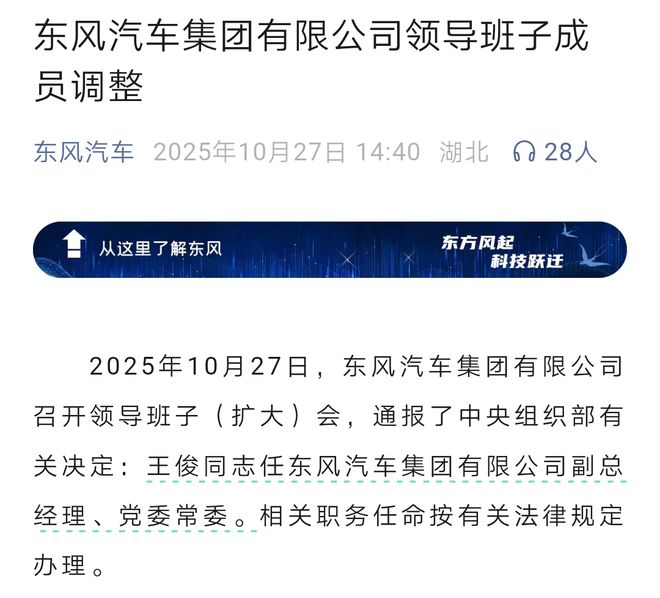
Core Insights - The appointment of Wang Jun as Deputy General Manager and Party Committee Member of Dongfeng Motor Group marks a significant leadership change within the company, reflecting a trend of personnel exchanges among major state-owned enterprises in the automotive sector [2][7][9] - Wang Jun's extensive experience at Changan Automobile, including his role as President, positions him as a key figure to drive Dongfeng's market-oriented reforms and enhance its competitiveness, particularly in the areas of independent brands and new energy vehicles [6][7][8] Group 1 - Wang Jun has been appointed as Deputy General Manager of Dongfeng Motor Group after serving in senior roles at both the Equipment Group and the Armament Group earlier this year [1][2] - His previous leadership at Changan Automobile involved overseeing significant strategic initiatives, including the "Beidou Tianshu" smart plan and the "Shangri-La" new energy plan, which are crucial for Dongfeng's current needs [6][7] - The leadership change is seen as a move to facilitate the exchange of advanced management practices and technical insights between state-owned enterprises, promoting collaboration and innovation [7][8] Group 2 - Wang Jun's arrival at Dongfeng is expected to enhance the integration and optimization of its numerous independent brands, addressing issues of resource dispersion and lack of synergy [8] - The shift in leadership may intensify competition between Dongfeng and Changan, especially in the new energy and intelligent vehicle sectors, as Wang brings valuable insights from his time at Changan [9][10] - This high-level personnel movement signifies a new phase of deep integration and fierce competition within the Chinese automotive industry, highlighting the increasing strategic importance of external talent acquisition [8][9]

长安汽车全品牌推出“购置税补贴方案”,11月底前锁单可享
Feng Huang Wang· 2025-10-28 05:57
Core Viewpoint - Changan Automobile has announced a tax subsidy plan for all brands, aimed at providing cash subsidies for users whose vehicle delivery is delayed due to non-user reasons, based on the difference in vehicle purchase tax from 2025 to 2026 [1] Group 1 - The subsidy plan is applicable to users who complete the order lock on the official online system of each brand before November 30, 2025 [1] - The cash subsidy will be calculated based on the actual purchase tax difference corresponding to the vehicle configuration selected by the user [1] - The plan addresses potential delays in vehicle delivery that may occur in 2026 due to production and transportation issues [1]
开盘:三大指数集体低开 存储芯片板块跌幅居前
Xin Lang Cai Jing· 2025-10-28 02:08
Market Overview - The three major indices opened lower, with the storage chip sector experiencing significant declines. As of the opening, the Shanghai Composite Index was at 3986.89 points, down 0.25%; the Shenzhen Component Index was at 13411.67 points, down 0.58%; and the ChiNext Index was at 3205.44 points, down 0.90% [1] Policy Developments - The Chinese Foreign Minister Wang Yi and U.S. Secretary of State Rubio discussed the importance of U.S.-China relations and the need for high-level interactions to send positive signals to the world [2] - The Chairman of the China Securities Regulatory Commission (CSRC), Wu Qing, announced plans to deepen reforms in the ChiNext board, aiming to establish listing standards that better align with the characteristics of innovative enterprises in emerging sectors [2] - The People's Bank of China (PBOC) Governor Pan Gongsheng indicated that the bond market is operating well and that the central bank will resume open market operations for government bonds [2] - The CSRC released opinions to enhance the protection of small investors in the capital market, including mechanisms to encourage long-term holding of new shares [3] - The CSRC also published a plan to optimize the Qualified Foreign Institutional Investor (QFII) system, aiming to attract more long-term foreign capital [3] Industry Updates - Domestic gasoline and diesel prices were reduced on October 27, with a decrease of 265 yuan per ton for gasoline and 255 yuan per ton for diesel, translating to a reduction of 0.21 yuan per liter for 92-octane gasoline [3] - Lingyi iTech announced that it has received over a hundred orders for complete machine assembly from major clients [4] - Zhenyu Technology plans to invest 2.11 billion yuan in a humanoid robot precision module and components project [5] - China Nuclear Engineering announced that its subsidiary signed a construction contract for the Haiyang Nuclear Power Units 5 and 6 [5] - Chang'an Automobile stated that it is developing a new energy unmanned intelligent vehicle in collaboration with JD.com [5] Financial Performance - EVE Energy announced a preliminary transfer price of 72.2 yuan per share, representing a 6.1% discount from the closing price [6] - Tongfu Microelectronics reported a 95.08% year-on-year increase in net profit for the third quarter [6] - Several companies, including Gaode Infrared and North Rare Earth, reported significant year-on-year profit growth, with increases of 1059% and 280% respectively [6][7] - Beijing Junzheng reported a 19.75% year-on-year decline in net profit for the third quarter [7] International Market Insights - The U.S. stock market saw all three major indices rise, with the Nasdaq up 1.86%, the S&P 500 up 1.23%, and the Dow Jones up 0.71% [8] - Qualcomm launched AI chips to compete with Nvidia in the data center market, with the AI200 and AI250 expected to be commercially available in 2026 and 2027 [8][10] - The S&P 500 companies reported that nearly 70% exceeded quarterly sales expectations, potentially marking the highest number of such companies in four years [10]





倒计时7天 | 机构重仓股·华创证券2025三季度上市公司交流活动




Sou Hu Cai Jing· 2025-10-28 00:31
Core Insights - The upcoming quarterly earnings reports will be crucial for determining the performance of heavily weighted stocks and their potential for valuation restructuring, especially as the market stands at 3900 points [2] - A conference will be held on November 4-5 in Shanghai to discuss the earnings of key stocks and analyze sector performance and growth potential in light of the "14th Five-Year Plan" [2] Company Highlights - A list of companies expected to be discussed includes major players in various sectors such as lithium battery manufacturing, renewable energy, and healthcare, indicating a focus on industries with growth potential [3][5] - Companies mentioned include EVE Energy, LONGi Green Energy, and BYD, showcasing a diverse range of sectors from technology to healthcare [3][5] Industry Focus - The conference aims to provide insights into the economic landscape and investment opportunities across different sectors, particularly in light of the recent policy expectations [2] - The emphasis on sectors like renewable energy and healthcare suggests a strategic focus on industries that align with current market trends and government policies [3][5]

离开长安汽车半年后王俊出任东风汽车副总经理
Xin Lang Cai Jing· 2025-10-27 21:07
Group 1 - Dongfeng Motor Group Co., Ltd. announced the appointment of Wang Jun as the new Deputy General Manager and Party Committee Member [1] - Wang Jun has a 30-year career at Changan Automobile, where he held significant roles in technology research and development, marketing, organizational development, and talent cultivation [2] - The recent personnel changes at Dongfeng Motor began in March 2023, following the retirement of former Chairman Zhu Yanfeng, and have resulted in only one Deputy General Manager position remaining vacant [2][3] Group 2 - Wang Jun's previous role was as President and Non-Independent Director of Changan Automobile, and he has also served as Deputy General Manager of China Ordnance Equipment Group [2] - The current executive team at Dongfeng Motor includes individuals from various backgrounds, with only two executives, Yang Qing and Zhou Feng, having risen through the ranks within the Dongfeng system [3] - The restructuring of leadership at Dongfeng Motor reflects a broader trend of personnel adjustments within state-owned enterprises under the direct management of the State-owned Assets Supervision and Administration Commission [2]
