
FAW Jiefang(000800)

Search documents
一汽奥迪Q6L e-tron家族与A5L联袂上市
Qi Lu Wan Bao· 2025-08-08 01:47
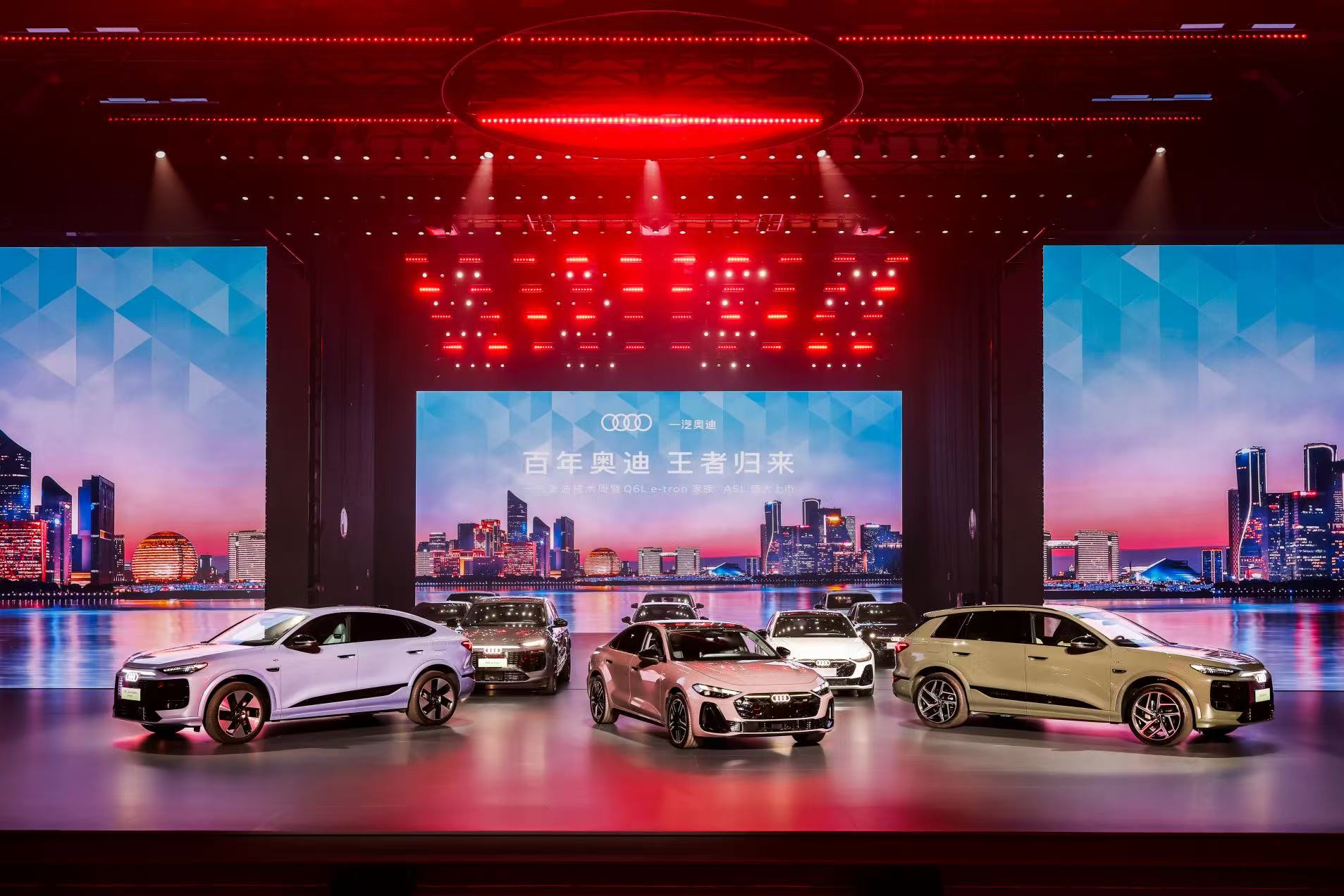
Core Viewpoint - The event marked the launch of the Q6L e-tron family and A5L, showcasing FAW Audi's advancements in smart and electric vehicle technology, in collaboration with leading tech partners like Huawei and CATL [1][4][9]. Group 1: Event Highlights - The event featured an immersive digital technology exhibition, presenting the achievements of Audi's PPE luxury electric platform and PPC luxury fuel intelligent platform [1]. - A stunning light show involving 46 buildings was created, enhancing the brand's connection with users and showcasing its modern image [3]. Group 2: Strategic Developments - FAW Audi's technology week represents a culmination of 37 years of collaboration between FAW and Audi, highlighting milestones in introducing luxury vehicles to the Chinese market [4]. - The company is committed to a dual strategy of "oil and electricity coexistence," focusing on high-quality development in the Chinese automotive industry [5][15]. Group 3: Product Launches - The Q6L e-tron family, priced between 348,800 to 398,800 yuan, is the first product based on the PPE platform, featuring a 107 kWh CATL battery and an 800V high-voltage platform [9]. - The A5L, as the first model on the PPC platform, is priced between 239,800 to 289,800 yuan, incorporating advanced technologies and a new design philosophy [11]. Group 4: Market Commitment - Audi's strategy emphasizes "In China, for China," with a significant product layout aimed at meeting local consumer demands [6]. - FAW Audi aims to achieve a cumulative sales milestone of 10 million vehicles, reinforcing its leadership position in the luxury car market in China [15].


活力中国调研行•走进吉林丨吉林产业跃迁:龙头企业领航 工业集群崛起
Sou Hu Cai Jing· 2025-08-06 16:30
Group 1: Overview of Jilin Province's Economic Development - Jilin Province is experiencing a vibrant economic development, driven by key industries such as advanced manufacturing, automotive, and new materials [2][4][14] - The province's development is characterized by the integration of industry and culture, showcasing a coordinated development model [2][4] Group 2: China FAW Group (China First Automobile Works) - China FAW is the leading player in Jilin's automotive industry, playing a crucial role in the establishment of the "Changchun International Automobile City" concept [4][14] - The company has fostered a complete automotive industry chain, from parts manufacturing to vehicle production, enhancing regional economic collaboration [4][5] - Jilin Shibao Machinery Manufacturing Co., a key supplier to China FAW, exemplifies the growth of automotive component manufacturers in the region [4][5] Group 3: CRRC Changchun Railway Vehicles Co., Ltd. - CRRC Changchun is a prominent player in the rail transportation sector, focusing on the research and manufacturing of rail transit equipment [7][8] - The company has achieved significant technological advancements, particularly in high-speed train technology, contributing to China's rapid rail development [8][9] - CRRC Changchun is leading the digital transformation in the industry by establishing a supply chain management platform that connects nearly sixty enterprises [9][19] Group 4: Jilin Chemical Fiber Group - Jilin Chemical Fiber Group has made breakthroughs in carbon fiber production, which is lightweight yet stronger than steel, marking a significant advancement in new materials [12][13] - The company has invested heavily in R&D, collaborating with universities and research institutions to accelerate the development of high-performance fiber materials [13][20] - The establishment of a complete industrial chain around high-performance fiber materials has positively impacted the local economy and industry structure [13][20] Group 5: Future Directions - Changchun aims to strengthen its industrial economy by focusing on advanced manufacturing and integrating technology with industry [14][21] - Leading enterprises like China FAW, CRRC Changchun, and Jilin Chemical Fiber Group are pivotal in driving economic growth and technological innovation in Jilin Province [14][21]


浅析中国一汽、东风汽车、长安汽车车企布局
Zhong Guo Zhi Liang Xin Wen Wang· 2025-08-06 09:36
Group 1: Overview of Major Automotive State-Owned Enterprises - China Chang'an Automobile Group Co., Ltd. was officially established on July 29, becoming the third automotive state-owned enterprise in China, alongside China FAW and Dongfeng Motor [1] - The three major enterprises—FAW, Dongfeng, and Chang'an—are tasked with driving the development of China's automotive industry [1] Group 2: China FAW Group Co., Ltd. - China FAW Group, established in 1953, is a state-owned automotive enterprise with a registered capital of 35.4 billion yuan and has produced over 62 million vehicles [2] - In 2024, FAW's total vehicle sales are projected to exceed 3.2 million units, with revenue reaching 555.01 billion yuan [2] - FAW has developed a complete manufacturing system for commercial vehicles and has established five major production bases across China [3] Group 3: Dongfeng Motor Group Co., Ltd. - Dongfeng Motor, founded in 1969, has produced nearly 60 million vehicles and aims to sell 2.48 million vehicles in 2024, reflecting a 2.5% year-on-year growth [6][10] - The company has undergone organizational restructuring to optimize its operations into six business groups, enhancing its efficiency [7] - Dongfeng has established a comprehensive layout in the new energy vehicle sector, achieving significant production capabilities in battery and hydrogen fuel cell technologies [9] Group 4: China Chang'an Automobile Group Co., Ltd. - Chang'an Automobile has a registered capital of 20 billion yuan and reported a revenue of 146.9 billion yuan in the first half of the year, with a total sales volume of 1.3553 million vehicles [11] - The company aims to achieve a total vehicle sales target of 3 million units in 2023, with 1 million of those being new energy vehicles [11][12] - Chang'an plans to launch over 50 new energy products globally in the next five years, focusing on advanced technologies such as AI and autonomous driving [14] Group 5: Strategic Goals and Industry Trends - The strategic positioning of the three major automotive state-owned enterprises reflects a shift from following foreign companies to leading the industry, emphasizing technological innovation and high-quality development [15] - Each company is focusing on enhancing their core competencies and developing high-tech products while avoiding "involution" in the industry [15]



商用车板块8月5日涨0.37%,曙光股份领涨,主力资金净流出4.92亿元
Zheng Xing Xing Ye Ri Bao· 2025-08-05 08:37
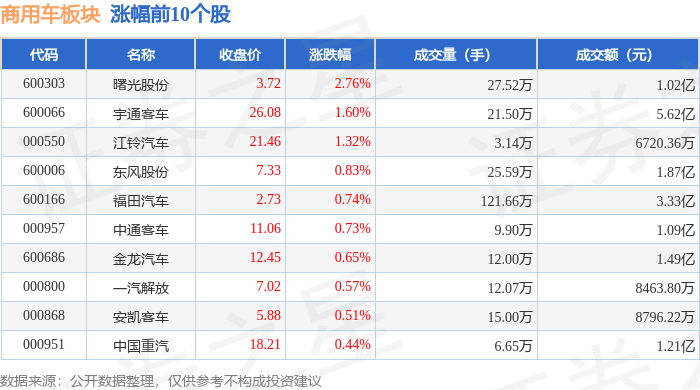
Group 1 - The commercial vehicle sector increased by 0.37% on August 5, with Shuguang Co. leading the gains [1] - The Shanghai Composite Index closed at 3617.6, up 0.96%, while the Shenzhen Component Index closed at 11106.96, up 0.59% [1] - Key stocks in the commercial vehicle sector showed varied performance, with Shuguang Co. closing at 3.72, up 2.76% [1] Group 2 - The commercial vehicle sector experienced a net outflow of 4.92 billion yuan from institutional investors, while retail investors saw a net inflow of 3.58 billion yuan [2] - Among individual stocks, China National Heavy Duty Truck had a net inflow of 972.34 million yuan from institutional investors, but a net outflow of 1499.16 million yuan from retail investors [3] - Foton Motor and Shuguang Co. also showed mixed fund flows, with Foton Motor seeing a net inflow of 731.12 million yuan from institutional investors [3]



人民日报海外版聚焦中国一汽:累计突破关键核心技术1559项
Ren Min Wang· 2025-08-05 01:17
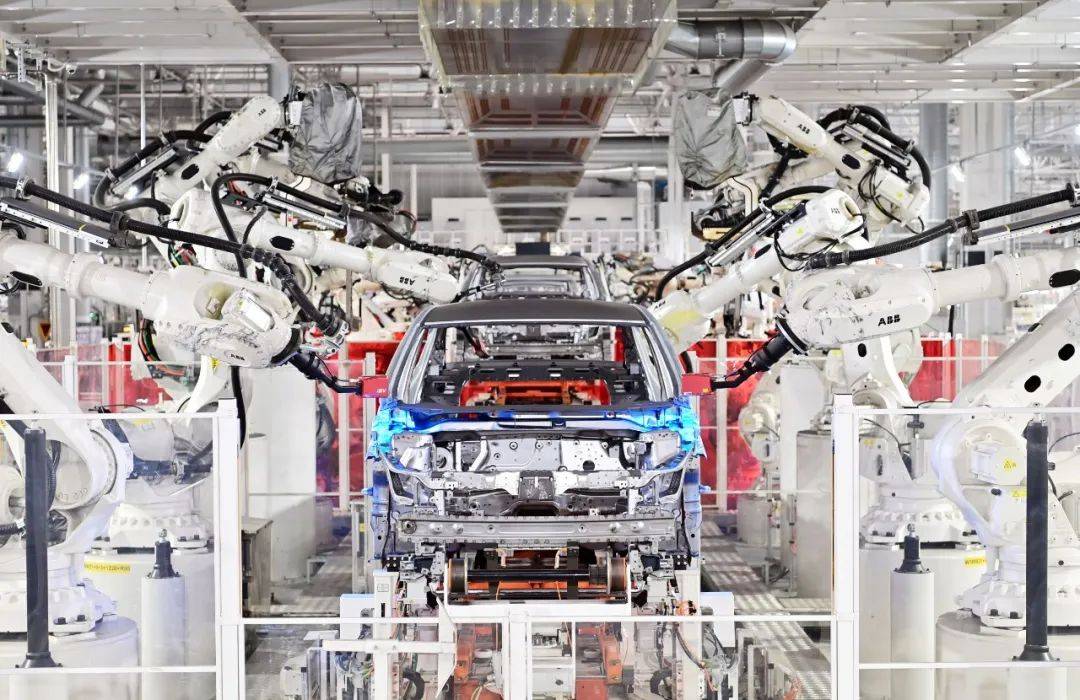
Core Viewpoint - China FAW Group has made significant advancements in automotive technology, achieving breakthroughs in 1559 key core technologies and obtaining 12728 patents over the past five years, emphasizing innovation as the driving force for the company’s growth [15][19]. Group 1: Technological Advancements - The company has developed a fully autonomous intelligent chassis with zero tilt during turns and zero pitching during braking, showcasing its commitment to high-end technology [17]. - China FAW has successfully reduced the cost of air springs from approximately 15,000 yuan to about 2,000 yuan through domestic development, breaking foreign monopolies [17]. - The company has achieved 100% localization of core systems and components in its new energy vehicles, including electric drive systems and shock absorbers [17][19]. Group 2: Production Efficiency - The production line at the Red Flag manufacturing center can assemble a complete vehicle in as little as 54 seconds, with an automation rate of 71.4% in the stamping production line [16]. - The welding workshop utilizes over 739 robots, achieving a 100% automation rate in welding processes, which enhances production efficiency [16]. Group 3: Market Performance - In the first half of the year, China FAW's total vehicle sales reached approximately 1.57 million units, marking a year-on-year increase of 6.2% [19]. - Sales of the company's self-owned brands exceeded 450,000 units, reflecting an 8.5% increase, while new energy vehicle sales surged by 95.5% to over 145,000 units [19].
重汽再破2万 解放/东风超1.4万 福田/徐工翻倍!7月重卡销8.3万辆 | 光耀评车
第一商用车网· 2025-08-04 16:04
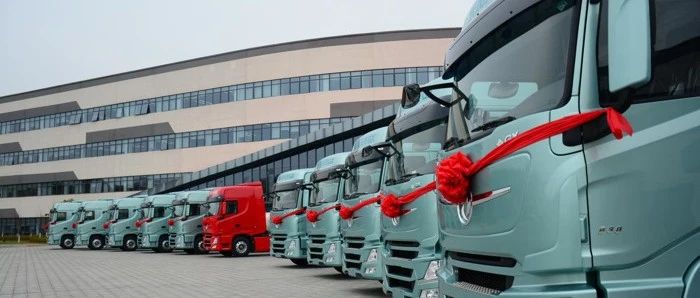
Core Viewpoint - The heavy truck market in China has experienced a significant increase in sales, with July 2025 showing a year-on-year growth of approximately 42%, marking the fourth consecutive month of growth since April 2025 [2][12]. Group 1: Market Performance - In July 2025, approximately 83,000 heavy trucks were sold, a decrease of 15% from June but an increase of about 42% compared to the same month last year [2][3]. - Cumulatively, from January to July 2025, the heavy truck market sales reached approximately 622,000 units, reflecting a year-on-year growth of about 11% [2]. - The sales figures for July 2025 are the second highest in the past eight years, only behind July 2020 [2]. Group 2: Segment Analysis - The sales of electric heavy trucks in July 2025 exceeded 15,000 units, representing a year-on-year increase of over 120% [9]. - The domestic terminal sales of diesel heavy trucks in July 2025 are expected to grow by over 25% year-on-year, despite a significant month-on-month decline [11]. - The gas truck segment saw a recovery in terminal sales, with a domestic penetration rate rising from below 20% in June to approximately 24% in July [7]. Group 3: Company Performance - China National Heavy Duty Truck Group (CNHTC) sold about 22,000 heavy trucks in July 2025, maintaining the highest market share at approximately 27.5% [14]. - FAW Jiefang sold around 15,000 heavy trucks in July 2025, achieving a year-on-year growth of about 42% [16]. - Beiqi Foton reported the highest year-on-year growth among major companies, with sales of approximately 11,500 units in July 2025, reflecting a growth rate of about 134% [20]. Group 4: Future Outlook - The heavy truck market is expected to see significant growth in the third quarter of 2025, driven by the "old-for-new" policy for trucks and the low sales figures from the previous year [24]. - The year-on-year growth rate for September 2025 is anticipated to exceed 50% [24].


三大汽车央企赛跑!长安、一汽2030年销量目标要实现500万辆,谁会先达成?
Mei Ri Jing Ji Xin Wen· 2025-08-04 10:01
Group 1 - The core objective for major Chinese automotive state-owned enterprises is to achieve vehicle sales of 5 million units by 2030, with specific targets set by China FAW and Changan Automobile [1][2][3] - China FAW aims for six key performance indicators to exceed 5 million in total vehicle sales, 3 million in smart connected new energy vehicles, 2 million in self-owned brand sales, 1.5 million in self-owned brand smart connected new energy vehicles, and 700,000 in overseas market sales by 2030 [1][4] - Changan Automobile plans for 5 million total vehicle sales by 2030, with over 60% being new energy vehicles and over 30% from overseas markets [2][4] Group 2 - The total sales target set by the three major automotive state-owned enterprises could reach at least 14 million units by 2030, with new energy vehicle sales projected to be at least 9 million units [4] - Changan and Dongfeng are focusing more on overseas market sales compared to China FAW, with Changan targeting over 1.5 million units in overseas sales, which is double that of China FAW's target [4] - The State-owned Assets Supervision and Administration Commission (SASAC) has initiated a separate assessment for new energy vehicle performance among central enterprises, indicating a push for faster development in this sector [5][7] Group 3 - In the first seven months of the year, Changan's new energy vehicle sales reached 450,000 units, a year-on-year increase of 48.8%, while Dongfeng's sales were 402,000 units, up 6.8%, and China FAW's sales exceeded 145,000 units, marking a 95.5% increase [5] - Both Changan and Dongfeng have set a target of 1 million new energy vehicle sales by 2025, with Dongfeng ensuring 900,000 of those are self-owned brand vehicles [7]
【联合发布】新能源商用车周报(2025年7月第5周)
乘联分会· 2025-08-04 09:20
Core Viewpoint - The article highlights the rapid growth and development of the new energy commercial vehicle market in China, emphasizing significant increases in production, sales, and infrastructure development, particularly in regions like Shanghai and Jiangxi [6][11][20]. Policy and Regulations - Shanghai is implementing a zoned approach to regulate the development of public charging facilities, encouraging construction in "development zones" where demand exceeds supply [8][9]. - Jiangxi aims to achieve an annual production of 250,000 new energy vehicles by 2027, with a target of over 150 billion yuan in revenue for the automotive industry [11][13]. Market Insights - In the first half of 2025, sales of new energy traction vehicles surged by 265.5% year-on-year, with a penetration rate of 30.4% [20][24]. - Major regions driving market growth include Shanghai and Guangdong, with significant sales increases across all six major regions [22][24]. - The top two companies in sales for the first half of 2025 were XCMG and FAW Jiefang, each exceeding 9,000 units sold [25][31]. Company Monitoring - Foton Motor launched several new products, including the Kaven Ledi for multi-scenario freight and the Fengjing T7, which aims to lead the micro truck market with five core advantages [33][38]. - Yutong Bus introduced the Tianjun V6E, a high-value durable pure electric light bus designed for various high-frequency operational scenarios [42][43].


俄罗斯又给中国汽车摆了好几道
投中网· 2025-08-04 07:04
Core Viewpoint - The article discusses the significant challenges faced by Chinese automotive brands in the Russian market, highlighting recent regulatory changes and declining market share as key factors impacting their operations [5][9]. Regulatory Changes - On July 30, 2023, Russia's Federal Technical Regulation and Metrology Agency announced a ban on several Chinese truck brands, citing safety concerns such as inadequate braking performance and noise levels [6][13]. - A new vehicle scrappage tax regulation effective from August 1, 2025, imposes additional taxes based on the price difference between domestic sales and overseas procurement, further complicating the cost structure for Chinese manufacturers [6][14]. - The Russian automotive certification system has undergone a comprehensive reform, requiring all imported vehicles to pass mandatory testing in local laboratories, which increases compliance costs and delays [6][15]. Market Performance - In June 2023, Chinese automotive exports to Russia fell by 75%, and the overall export performance in the first half of the year declined by 62%, leading to a drop in market share from over 60% to 45.3% [8][16]. - The market share of Chinese brands in the Russian truck market was reported at 27.6% in the first half of 2025, but the recent bans have severely impacted sales [13][19]. Historical Context - Chinese automotive brands rapidly filled the market gap left by Western manufacturers after sanctions were imposed, achieving a market share of over 60% within two years [11][21]. - The number of Chinese automotive dealerships in Russia increased significantly, from around 40 to over 600, indicating a strong initial market presence [11]. Challenges and Risks - The increasing scrappage tax and stringent certification requirements have eroded the price competitiveness of Chinese vehicles in Russia, leading to a potential exit of many small and medium-sized manufacturers from the market [15][20]. - Reports indicate that the quality of Chinese vehicles has been criticized for not meeting local climate and usage conditions, which has affected consumer perception and sales [21][22]. Strategic Recommendations - To mitigate risks, Chinese automotive companies are advised to diversify their export markets beyond Russia, focusing on emerging markets in Southeast Asia, the Middle East, Africa, and Latin America [22]. - Long-term strategies should include enhancing technological research and development, improving supply chain resilience, and transitioning from "Made in China" to "Globally Intelligent Manufacturing" to build sustainable competitive advantages [22].


自主攻关 向上向新(创新故事)
Ren Min Ri Bao· 2025-08-03 22:10
Core Insights - China FAW Group is showcasing its innovative achievements at the 2025 Technology Conference, emphasizing the importance of mastering key core technologies and strengthening national automotive brands to drive high-quality development in the automotive manufacturing industry [1][5] - Over the past five years, China FAW has made significant strides in innovation, achieving breakthroughs in 1,559 key core technologies and obtaining 12,728 patent authorizations, positioning innovation as the driving force behind its growth [1][3] Manufacturing Capabilities - The Red Flag manufacturing center features an advanced production line where a complete vehicle can be assembled in as little as 54 seconds, with an automation rate of 71.4% in the stamping production line and 100% in the welding production line [2] - The facility produces approximately 1,000 vehicles daily, utilizing a mixed production line for various vehicle types, including sedans, SUVs, fuel vehicles, electric vehicles, and hybrids [2] Technological Advancements - China FAW has successfully developed domestic air springs, reducing the cost from approximately 15,000 yuan to about 2,000 yuan, breaking the foreign monopoly on this technology [3] - The company has achieved 100% localization of core systems and components in its new energy vehicles, including electric drive systems and air springs, and has developed a fully autonomous intelligent chassis [3][4] New Energy Initiatives - China FAW is addressing the challenges of low-temperature performance in electric vehicle batteries, conducting extreme weather tests to ensure battery efficiency in cold climates [4] - The newly developed low-temperature battery cells maintain vehicle performance in cold conditions and have been implemented in the "Red Flag·Tiangong" series [4] Sales Performance - In the first half of the year, China FAW's total vehicle sales reached approximately 1.57 million units, a year-on-year increase of 6.2%, with self-owned brand sales exceeding 450,000 units, up 8.5%, and new energy vehicle sales soaring by 95.5% [5]