
WLY(000858)

Search documents
食品饮料行业周报:CPI催化预期,底部价值凸显-20251117



Haitong Securities International· 2025-11-17 07:10
Investment Rating - Investment advice indicates a sector recovery catalyzed by recent CPI data, focusing on growth and supply-demand inflection points [5][16]. Core Views - The report emphasizes the importance of consumer goods growth, particularly in beverages, snacks, and food ingredients, while also highlighting structural opportunities in the baijiu sector [5][16]. - CPI data shows a positive trend with October CPI year-on-year at +0.2% and core CPI at +1.2%, indicating a recovery in domestic demand [6][16]. - The baijiu industry is undergoing accelerated clearing, with expectations for improved sales and inventory adjustments leading into 2026 [7][16]. - Consumer goods are expected to benefit from stabilization and recovery, with a focus on low valuation and high dividend stocks [8][16]. Summary by Sections Investment Recommendations - Recommended baijiu stocks include Shanxi Xinghuacun Fen Wine Factory, Gujing Distillery, and stable targets like Kweichow Moutai and Wuliangye [5][16]. - Beverage growth is highlighted with recommendations for Eastroc Beverage and Nongfu Spring, alongside low valuation stocks like China Foods and Tingyi [5][16]. - Snack and food ingredient stocks recommended include Bailong Chuangyuan, Yankershop Food, and Three Squirrels [5][16]. - Beer recommendations include Yanjing Brewery and Tsingtao Brewery, while condiment stocks like Haitian Flavoring & Food are also suggested [5][16]. Baijiu Sector Insights - The baijiu sector is experiencing a significant adjustment, with industry destocking still in progress and a focus on promotional sales for 2026 [7][16]. - Recent sales data from JD.com shows a +18% year-on-year increase in liquor sales during the Double 11 shopping festival, indicating a positive market response [7][16]. Consumer Goods Outlook - Consumer goods are expected to see growth as the mainline, with structural differentiation evident in beverages, snacks, and health products [8][16]. - The report notes that companies with product innovation and channel expansion will have growth advantages, particularly in the context of recent service and non-food price recoveries [8][16].
头部酒企加速出海!食品ETF(515710)盘中下挫!机构:白酒去库存阶段景气回升在望
Xin Lang Ji Jin· 2025-11-17 06:32
Group 1 - The food ETF (515710) showed weak performance with a decline of 0.32% and a trading volume of 54.66 million yuan as of November 17 [1] - Leading stocks in the food sector included Tianwei Food, Lianhua Holdings, and Kweichow Moutai, with increases of 2.06%, 1.37%, and 0.65% respectively [1] - Conversely, Dongpeng Beverage, Yunnan Energy Investment, and Yanghe Distillery experienced declines of 3.02%, 2.34%, and 2.33% respectively [1] Group 2 - The white liquor industry is undergoing a destocking phase, with expectations of recovery in demand and economic revival by Q4 2025 [2] - The trend towards healthier snacks is evident, with categories like konjac continuing to benefit, and leading companies are expected to gain from this trend [2] - The dairy product demand is gradually recovering, with raw milk prices potentially stabilizing [2] Group 3 - The food ETF and its linked funds passively track a segmented food index, with the top ten weighted stocks including Kweichow Moutai, Wuliangye, and Yili [2]



“已经不投老登了”
3 6 Ke· 2025-11-17 05:58
Core Viewpoint - The traditional consumer sectors, referred to as "old industries," are losing their appeal for investment, as evidenced by declining valuations and performance metrics in sectors like liquor, dining, and retail [1][4][8]. Summary by Sections Old Industries Overview - "Old industries" include traditional sectors such as clothing, dining, home appliances, regional supermarkets, and low-value manufacturing, which were once considered stable investments due to demographic dividends and consumption upgrades [1][4]. - These sectors accounted for a significant portion of RMB fund allocations between 2016 and 2021, often viewed as "cash cows" for investment [4][8]. Market Performance - The liquor sector, a representative of high-end consumption, has seen a significant decline, with the total market capitalization of 20 major liquor companies dropping by over 500 billion RMB from previous highs [4][5]. - The white liquor index has experienced a 51% retracement since its peak in February 2021, indicating a severe market correction [5][6]. Financial Metrics - In 2025, the first three quarters showed a 5.83% decline in total revenue and a 6.76% drop in net profit for the liquor sector, with the third quarter witnessing an alarming 18.42% revenue drop [7][8]. - The overall price-to-earnings (PE) ratio for the liquor sector has fallen to approximately 18.7, significantly below the long-term average of 27.6 [5][6]. Shift in Investment Focus - Investment capital is shifting away from "old industries" towards "new productive forces," such as artificial intelligence, semiconductors, and advanced manufacturing, reflecting a broader trend in venture capital [9][10]. - Despite a 32% decline in overall VC financing in 2024, significant funding is still directed towards high-potential sectors, indicating a concentration of capital in fewer, more promising areas [9][10]. Government and Institutional Support - The Chinese government has emphasized the importance of "new productive forces" in its economic policies, encouraging investment in strategic emerging industries [10][11]. - Various funds, including national AI and technology innovation funds, are being established to support these new sectors, further driving the shift in investment focus [11][12]. Evolution of Traditional Industries - Traditional industries are not disappearing; rather, they are evolving. Companies that embrace digital transformation and new technologies are beginning to attract investment again [14][15]. - Examples include traditional clothing brands that have successfully integrated digital supply chains and advanced manufacturing techniques to enhance efficiency and profitability [15][16]. Conclusion - The phrase "no longer investing in old industries" reflects a strategic pivot rather than a complete abandonment of traditional sectors, as new players and innovative approaches emerge within these markets [18][19].
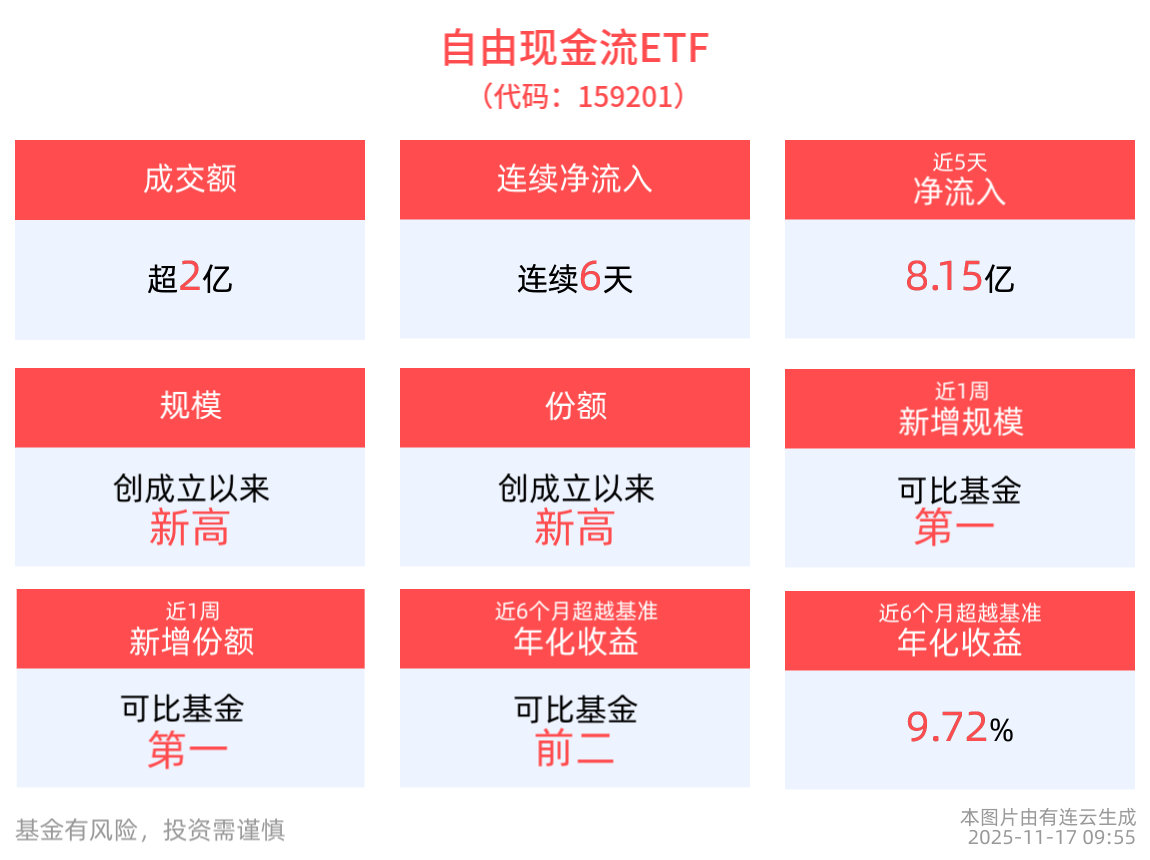
成交额超2亿元,自由现金流ETF(159201)连续6天净流入,合计“吸金”8.88亿元
Sou Hu Cai Jing· 2025-11-17 02:18
Core Insights - The Guozheng Free Cash Flow Index has decreased by 0.86% as of November 17, 2025, with mixed performance among constituent stocks [1] - The Free Cash Flow ETF (159201) has dropped by 1.07%, currently priced at 1.21 yuan, with a trading volume of 2.02 billion yuan [1] - Over the past six days, the Free Cash Flow ETF has seen continuous net inflows, totaling 8.88 billion yuan, with a daily average net inflow of 1.48 billion yuan [1][4] Performance Metrics - The Free Cash Flow ETF has achieved a net value increase of 22.85% over the past six months [4] - Historical performance shows a maximum monthly return of 7%, with the longest consecutive monthly gain of 6 months and a total gain of 22.69% [4] - The ETF has a monthly profit percentage of 87.5% and a historical 100% profit probability for holding over six months [4] Fund Details - The management fee for the Free Cash Flow ETF is 0.15%, and the custody fee is 0.05% [5] - As of October 31, 2025, the top ten weighted stocks in the Guozheng Free Cash Flow Index account for 54.79% of the index, including China National Offshore Oil Corporation and SAIC Motor [5] Stock Performance - The top ten stocks in the index have shown varied performance, with notable declines in stocks like Gree Electric Appliances (-1.08%) and China Aluminum (-2.57%) [7]







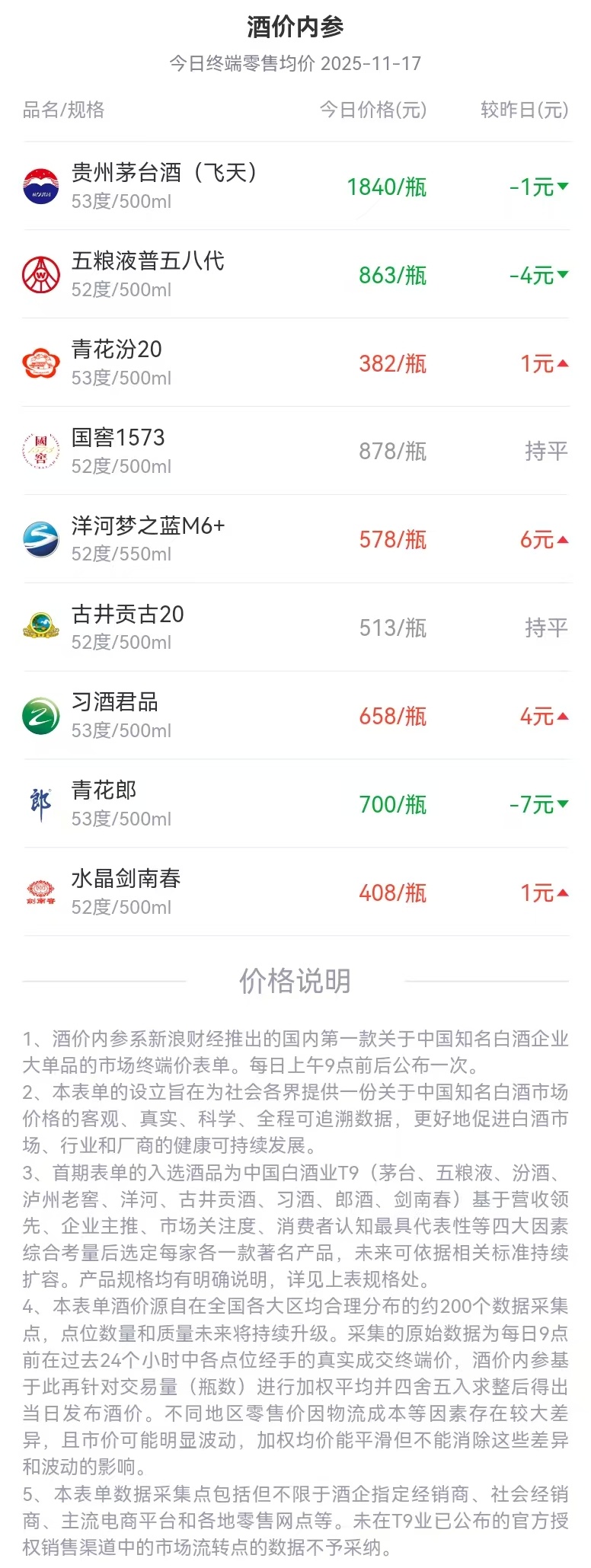
酒价内参11月17日价格发布 整体价格稳定飞天微跌1元
Xin Lang Cai Jing· 2025-11-17 00:31
Core Insights - The overall retail price of major products in the Chinese liquor industry remains stable, with some brands experiencing price increases [1] Price Changes - Yanghe Dream Blue M6+ saw a price increase of 6 yuan per bottle, marking its third consecutive day of price rise [1] - Xijiu Junpin increased by 4 yuan per bottle, continuing its second day of growth [1] - Qinghua Fen 20 and Shuijing Jian'nanchun both experienced a slight increase of 1 yuan per bottle [1] - Guizhou Moutai Feitian's price decreased slightly by 1 yuan per bottle [1] Price Table Summary - Guizhou Moutai Feitian (53°/500ml) priced at 1840 yuan, down by 1 yuan [3] - Wuliangye Pu Wu 8th generation (52°/500ml) priced at 863 yuan, down by 470 yuan [3] - Qinghua Fen 20 (53°/500ml) priced at 382 yuan, up by 1 yuan [3] - Guojiao 1573 (52°/500ml) priced at 878 yuan, unchanged [3] - Yanghe Dream Blue M6+ (52°/550ml) priced at 578 yuan [3] - Xijiu Junpin (52°/500ml) priced at 658 yuan [3]


从三季报看中国经济:新消费潜力迸发
Jing Ji Ri Bao· 2025-11-17 00:03
Core Viewpoint - The third-quarter reports of listed companies reflect the resilience and vitality of China's consumer market, indicating a structural adjustment period in the consumption sector with both challenges and opportunities [1] Overall Recovery - The consumer sector shows a steady recovery overall, but there is uneven performance across different segments. Essential consumption remains stable, while discretionary consumption is experiencing a divide [2] - Essential consumption sectors like food and beverages are performing well due to their necessity, with leading companies showing stable revenue and profit growth [2] - The liquor industry, representing traditional high-end consumption, is under pressure, with major companies like Wuliangye and Luzhou Laojiao reporting significant declines in revenue and profit [2] - In contrast, the new energy vehicle industry is thriving, benefiting from policy support and product upgrades, becoming a key growth driver in the consumer sector [2] Channel Transformation - Traditional retail companies are accelerating their online transformation, integrating online and offline channels to capture market changes, with those embracing digitalization seeing growth [3] Cost Pressures - Global commodity prices remain high, putting pressure on raw material and logistics costs, which challenges the gross margins of mid-to-low-end consumer companies [4] - Companies that optimize product structures and improve supply chain efficiency are demonstrating stronger profitability and market competitiveness [4] Structural Highlights - A number of structural highlights are emerging, driving high-quality development in consumer-related listed companies through innovation in technology, business models, and consumer scenarios [5] - In the smart home sector, companies like Ecovacs and Haier are experiencing significant profit growth, with Ecovacs reporting a 131% increase in net profit [5] - The traditional consumption sector is exploring new business models, with companies like Kweichow Moutai and Mercury Home Textiles achieving double-digit growth through innovative product offerings [6] New Consumption Scenarios - Companies are actively transforming to capture new consumption trends, with firms like Golden Dragon Fish and Miaokelando reporting substantial profit increases due to cost improvements and channel optimization [8] - The consumer market is becoming increasingly segmented, with new brands focusing on specific demographics and scenarios, such as new-style tea drinks and pet economy products [8] - Domestic brands are gaining market share and showing strong performance in sectors like sportswear and beauty products, driven by cultural confidence and supply chain advantages [8] Market Dynamics - The consumer market is undergoing structural upgrades, with recovery being uneven due to factors like income expectations and regional disparities [9] - Companies with strong brand barriers and unique market advantages are favored by capital, while those embracing new trends and product iterations can still find growth opportunities [9] - The competition is shifting from traditional versus new consumption to the operational efficiency and strategic vision of different companies within the same industry [9] High-Quality Development - The recovery trend in China's consumer market is moving from total growth to structural optimization, with companies encouraged to focus on high-quality development through innovation [10]



抢着买到亏本卖,白酒1700亿库存“爆雷”,五粮液茅台跌下神坛?
Sou Hu Cai Jing· 2025-11-16 23:36
Core Insights - The white liquor industry is facing a significant crisis, with inventory piling up and prices plummeting, leading to concerns about its future viability [1][3][11] Group 1: Inventory and Pricing Issues - The average inventory turnover days for white liquor has exceeded 900 days, indicating that it takes over two and a half years for a bottle to be sold after production [1] - High-end liquor is reportedly being stored for over 700 days, leading to severe inventory backlogs [1] - As distributors attempt to recover funds, they are forced to lower prices, which in turn exacerbates the market's decline, creating a vicious cycle [1] Group 2: Changing Consumer Demographics - Younger generations (post-90s and post-00s) show little interest in traditional white liquor, preferring lower-alcohol beverages like fruit wine and beer [3] - The previously dominant middle-aged consumer group is also drinking less due to health concerns and reduced social engagements [3] - The introduction of strict alcohol consumption regulations has led to a near-zero consumption in government settings and a 30% cut in business banquet budgets, further diminishing the demand for white liquor [3] Group 3: Market Dynamics and Speculation - Over the past decade, white liquor has been treated as a financial product, leading to inflated prices; however, economic downturns have caused investors to withdraw, resulting in a complete collapse of price bubbles [6] - The wholesale price of Feitian Moutai has dropped from 2220 yuan to 1640 yuan, marking a historic low [6] Group 4: Future Directions for the Industry - The white liquor industry must adapt to the challenges of overcapacity, changing consumer preferences, and tightening regulations by either targeting new consumer groups, adjusting product offerings, or embracing health-conscious trends [11]

食品饮料月月谈电话会
2025-11-16 15:36
Summary of Conference Call on Dairy and Beverage Industry Industry Overview - The dairy industry is experiencing a continuous capacity reduction, with expectations for supply-demand balance improvement by mid to late 2026, leading to potential stabilization in milk prices. As of October, milk prices remained stable at 2.94 yuan per kilogram, with a production loss of approximately 0.2 yuan per kilogram and a loss rate of about 5% [2][2][2]. Key Points on Dairy Companies New Dairy Industry - New Dairy reported a strong performance in October, continuing the trend from Q3, with double-digit growth in low-temperature fresh milk and yogurt. The company is expanding into new channels, achieving significant revenue from collaborations, and is expected to meet its profit margin targets ahead of schedule by 2026 [4][4][4]. Mengniu Dairy - Mengniu's Q3 results met expectations, with stable market share following price reductions on its flagship product. The company anticipates stable revenue and profit margin growth through 2026, with a relatively low valuation providing investment flexibility [5][5][5]. Yili Group - Despite weak overall demand, Yili's low-temperature milk and other segments showed positive growth, with low-temperature white milk exceeding 20% growth. The company is expected to stabilize its liquid milk business by 2026, benefiting from diversified product offerings and channels [6][7][6][7]. Miao Ke Lan Duo and Youran Dairy - Miao Ke Lan Duo is experiencing rapid growth in the B-end market, with significant C-end product launches. The company is expanding its deep processing of dairy products, which is expected to improve profitability. Youran Dairy is increasing fresh milk supply with stable prices, supporting profits, and is projected to enhance profitability further with a reduction in livestock numbers [8][8][8]. Beverage Industry Insights Master Kong - Master Kong's beverage business saw a slight decline in Q3, but the drop has narrowed in October. The company expects to stabilize its beverage business next year, with a focus on promotional activities and potential price adjustments for its one-liter products [9][10][9][10]. Nongfu Spring - Nongfu Spring's water business experienced double-digit growth in October, with its sugar-free tea brand capturing nearly 80% market share. The company is expected to maintain steady revenue and profit growth, making it a strong long-term investment choice [10][10][10]. Dongpeng Beverage - Dongpeng Beverage reported a nearly 30% growth rate, with ambitious annual targets. The company shows significant growth potential from a valuation perspective [10][10][10]. Investment Recommendations - The dairy sector is recommended for investment due to expected improvements in profitability and market conditions by 2026. Companies like Mengniu, Yili, and New Dairy are highlighted for their growth potential and stable valuations [5][7][4][4]. - In the beverage sector, Master Kong and Nongfu Spring are noted for their resilience and growth prospects, making them attractive investment options [9][10][10].




量化市场追踪周报:市场表现分化,主动资金呈现“高低切”-20251116
Xinda Securities· 2025-11-16 10:31
- The report does not contain any specific quantitative models or factors for analysis or construction[1][2][3][4] - The report primarily focuses on market trends, fund flows, and industry performance without detailing quantitative models or factors[5][6][7] - No formulas, construction processes, or evaluations of quantitative models or factors are provided in the report[8][9][10]



食品饮料行业周报:10月餐饮受益双节效应,板块情绪回暖-20251116
Huaxin Securities· 2025-11-16 10:03
Investment Rating - The report maintains a "Recommended" investment rating for the food and beverage & commercial sectors [10][61]. Core Insights - The October data indicates a recovery in the restaurant sector, benefiting from the dual holiday effect, leading to improved sentiment in the sector [6][60]. - The liquor sector is experiencing a positive market sentiment, with companies showing resilience despite ongoing performance adjustments [6][59]. - The overall consumer sector is showing signs of improvement, with October retail sales reaching 46,291 billion yuan, a year-on-year increase of 2.9% [7][60]. Summary by Sections Industry News - In October, liquor consumption prices decreased by 2% year-on-year, while retail sales of tobacco and alcohol increased by 4.1% [5][19]. - JD Supermarket reported an 18% year-on-year growth in liquor sales during the Double Eleven shopping festival [5][19]. Investment Views - The liquor sector is benefiting from positive consumer sentiment, with a shift towards recovery in valuations after a prolonged period of suppression [6][59]. - Recommendations include high-dividend leaders such as Kweichow Moutai, Wuliangye, and Luzhou Laojiao, as well as flexible stocks like Jiu Gui Jiu and She De Jiu Ye [6][59]. Key Company Feedback - The report highlights the performance of key companies, with notable increases in stock prices for She De Jiu Ye and Jiu Gui Jiu, reflecting positive market trends [30][31]. - The liquor industry's revenue for 2024 is projected to be 796.4 billion yuan, showing a year-on-year growth of 5.3% [34]. Core Data Trends - The cumulative production of liquor in 2024 is expected to be 4.145 million tons, a decrease of 7.72% year-on-year [34]. - The report emphasizes the importance of product innovation and strategic adjustments among leading companies to navigate the competitive landscape [60].


