WLY(000858)

Search documents
五粮液:公司独特优势包括独有的产区、古窖池群、品质、品牌、消费群体
Zheng Quan Ri Bao· 2026-01-14 12:36
Group 1 - The core viewpoint of the article highlights the unique advantages of Wuliangye, which include its exclusive production area, ancient cellar group, quality, brand, and consumer base, forming an irreplaceable core competitiveness for the company [2] Group 2 - The company emphasizes that its unique production area is a significant factor contributing to its competitive edge [2] - The ancient cellar group is mentioned as a critical element that enhances the quality of Wuliangye's products [2] - The brand reputation and the specific consumer demographic are also identified as key components of the company's competitive strength [2]


16只白酒股下跌 贵州茅台微跌0.92%
Bei Jing Shang Bao· 2026-01-14 11:00
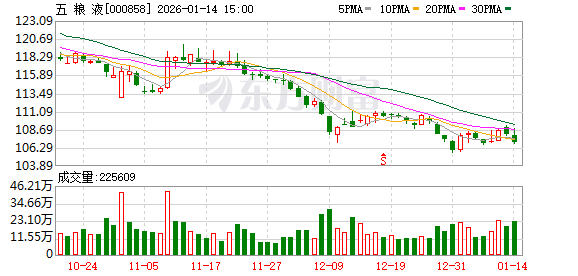
Core Viewpoint - The liquor sector, particularly the baijiu market, is currently experiencing a slight downturn, but there are signs of potential recovery as leading brands show an upward trend in sales ahead of the Spring Festival [1] Group 1: Market Performance - The Shanghai Composite Index closed at 4126.09 points, down 0.31% [1] - The baijiu sector index closed at 2237.49 points, with a minor decline of 0.03% [1] - Among individual stocks, Kweichow Moutai closed at 1398.01 yuan per share, down 0.92% [1] - Wuliangye closed at 107.04 yuan per share, down 0.89% [1] - Shanxi Fenjiu closed at 175.48 yuan per share, down 0.85% [1] - Luzhou Laojiao closed at 116.86 yuan per share, down 0.97% [1] - Yanghe Brewery closed at 63.30 yuan per share, down 0.39% [1] Group 2: Analyst Insights - Zheshang Securities noted that the baijiu sector is currently at a bottom range [1] - The report indicates that leading liquor companies are beginning to see an upward inflection point in sales [1] - There is an optimistic outlook for core products from brand liquor companies, with expectations for sales to exceed forecasts during the Spring Festival [1]




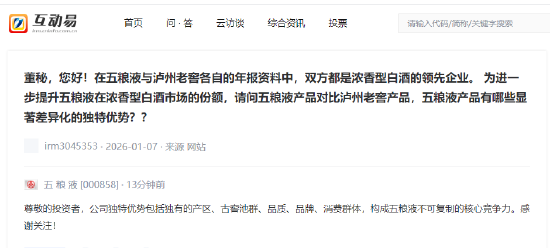
五粮液:产区、古窖池群、品牌、消费群体等构成五粮液不可复制的核心竞争力
Xin Lang Cai Jing· 2026-01-14 08:05
Core Viewpoint - The article discusses the competitive advantages of Wuliangye in the Chinese liquor market, particularly in comparison to Luzhou Laojiao, highlighting its unique strengths that contribute to its market position [1][2][3]. Group 1: Company Advantages - Wuliangye's unique advantages include its exclusive production area, ancient cellar group, product quality, brand reputation, and consumer demographics, which together form its irreplaceable core competitiveness [1][2][3].
当政策红利遇上消费刚需 中证主要消费指数如何成为行业压舱石?
Sou Hu Cai Jing· 2026-01-14 06:27
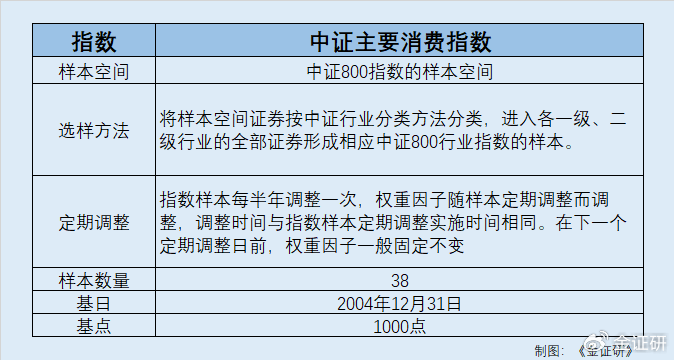
Group 1 - The core viewpoint of the article emphasizes the importance of policies aimed at boosting consumption, highlighting the collaboration between business and financial sectors to enhance consumer spending [1][2] - The China Securities Major Consumption Index, which focuses on the consumption sector, has an average free float market capitalization exceeding 600 billion yuan, reflecting the overall performance of major consumption stocks in the A-share market [2][3] - The index includes 38 sample stocks, with a free float market capitalization ranging from 36.47 billion yuan to 8,885.48 billion yuan, indicating significant growth potential in the consumption sector [2][4] Group 2 - The index is heavily concentrated in the food and beverage sector, with a weight of 67.62%, and agriculture, forestry, animal husbandry, and fishery at 28.42%, together covering over 96% of the index's weight [4][5] - The top ten stocks in the index are supported by leading companies such as Kweichow Moutai, Yili, and Wuliangye, which have strong brand recognition and stable cash flows [5][6] - The ongoing policy support for consumption is expected to enhance the long-term value and growth potential of the consumption sector, making the China Securities Major Consumption Index a quality benchmark for investing in core consumption assets [7]



90%的名酒在跌价,2026年酒企怎么活?
首席商业评论· 2026-01-14 04:34
Core Viewpoint - The article discusses the significant changes in the Chinese liquor industry, particularly the white wine sector, highlighting a shift from a focus on brand prestige and social status to a more value-driven approach based on product quality and consumer experience [3][5][21]. Group 1: Industry Overview - As of early 2026, the white wine industry is undergoing a deep adjustment, with a notable decline in both revenue and profit across major companies, marking the first time in a decade that the industry has experienced consecutive quarters of double-digit declines [14][21]. - The average inventory turnover days for 20 listed liquor companies reached 1,424 days by the end of Q3 2025, indicating that some inventory may take nearly four years to deplete [10]. - The overall revenue for 20 A-share listed liquor companies in the first three quarters of 2025 was 3,177.79 billion yuan, a year-on-year decrease of 5.90% [14]. Group 2: Market Dynamics - The price system in the white wine market has collapsed, with the market price of premium brands like Moutai dropping below 1,600 yuan, a decline of over 15% for other high-end products [12][14]. - Over 99% of famous liquor prices have fallen, with average retail prices decreasing by more than 30% [12]. - The industry is witnessing a "devaluation of value," where consumers are no longer willing to pay for brands that do not deliver tangible quality or experience [16][18]. Group 3: Future Trends - The future of the liquor industry will be characterized by a "polarization" where companies must either provide "extreme experiences" or "precise value" to survive [8][21]. - High-end products will focus on exceptional craftsmanship and unique experiences, while lower-end products will cater to specific daily needs with high cost-effectiveness [25][29]. - The younger demographic is increasingly important, with 95 post-90s consumers making up only 18% of the white wine market, prompting a need for products that resonate with their lifestyle [25]. Group 4: Strategic Shifts - Companies are exploring new distribution models, such as direct-to-consumer sales, and are innovating product lines to meet changing consumer preferences [18][20]. - Regulatory changes are pushing for clearer labeling of production processes and ingredients, moving away from vague marketing strategies [18]. - The industry is transitioning from a focus on speculative investment to a more grounded approach centered on genuine consumer value and experience [21][31].


五粮液曾从钦带队调研,要求全体营销人员要下沉一线,保障旺季动销效率
Xin Lang Cai Jing· 2026-01-14 03:29
Core Insights - The current Chinese liquor industry is undergoing a deep adjustment period, with accelerated changes in consumer trends [3][6] - The company emphasizes the need to adapt to new challenges by focusing on customer and market insights, enhancing consumer demand understanding, and promoting a harmonious lifestyle [3][6] Group 1: Market Research and Strategy - The chairman of Wuliangye Group, Zeng Congqin, led a team to conduct in-depth market research in cities including Guangzhou, Shenzhen, Nanjing, Hangzhou, Jiaxing, and Sanya from January 7 to 12 [1][4] - The research focused on optimizing marketing strategies, upgrading channel systems, and improving consumer services [1][4] Group 2: Marketing and Sales Initiatives - The company plans to implement a comprehensive strategy called "Five New Expansions," targeting new demographics, channels, scenarios, markets, and mechanisms to deepen consumer engagement [3][6] - With the upcoming Spring Festival, the company aims to prepare and deploy effective sales strategies to ensure high efficiency during peak sales periods [3][6] Group 3: Future Goals and Marketing Philosophy - The year 2026 marks the beginning of the "15th Five-Year Plan" and is designated as the "Year of Marketing Innovation" for Wuliangye [3][6] - The company will adhere to a marketing approach defined by "one core, three reinforcements, and dual goals," focusing on marketing transformation, market response strategies, and execution capabilities [3][6]

i茅台越火,五粮液越惨
Sou Hu Cai Jing· 2026-01-14 01:48
Core Viewpoint - The article highlights the contrasting fortunes of Kweichow Moutai and Wuliangye in the Chinese liquor industry, emphasizing Moutai's successful pricing strategy through the iMoutai app, while Wuliangye struggles with pricing chaos and declining performance [2][3][7]. Group 1: Moutai's Strategy - Moutai's use of the iMoutai app has effectively stabilized prices and increased direct sales, benefiting its financial performance while undermining competitors like Wuliangye [3][6]. - The app serves as a "price stabilizer" and "profit harvester," allowing Moutai to control pricing and combat scalpers, making the product more accessible to genuine consumers [2][3]. Group 2: Wuliangye's Challenges - Wuliangye is facing unprecedented difficulties, including price discrepancies, a significant drop in performance, and a chaotic distribution channel [2][7]. - The launch of Wuliangye's new retail platform in 2022 has not resolved its issues; instead, it has led to confusion among consumers due to inconsistent pricing across different sales channels [4][5]. - In Q3 2025, Wuliangye reported a revenue of 8.174 billion yuan, a year-on-year decline of 52.66%, marking its first revenue drop since 2015 [7]. - Wuliangye's reliance on its flagship product, the "Pu Wu," which accounts for over 50% of its revenue, has become a liability as it faces intense competition from brands like Moutai and others in the market [8][9]. Group 3: Competitive Landscape - Moutai's growth contrasts sharply with Wuliangye's decline, as Moutai's revenue and net profit showed slight increases, while competitors like Shanxi Fenjiu have surpassed Wuliangye in both revenue and profit [7][9]. - Wuliangye's struggle to maintain its "second place" status is compounded by the aggressive strategies of competitors, leading to a potential loss of market position if it fails to address its pricing and distribution issues [9].
酒价内参1月14日价格发布 洋河梦之蓝M6+下跌4元
Xin Lang Cai Jing· 2026-01-14 01:32
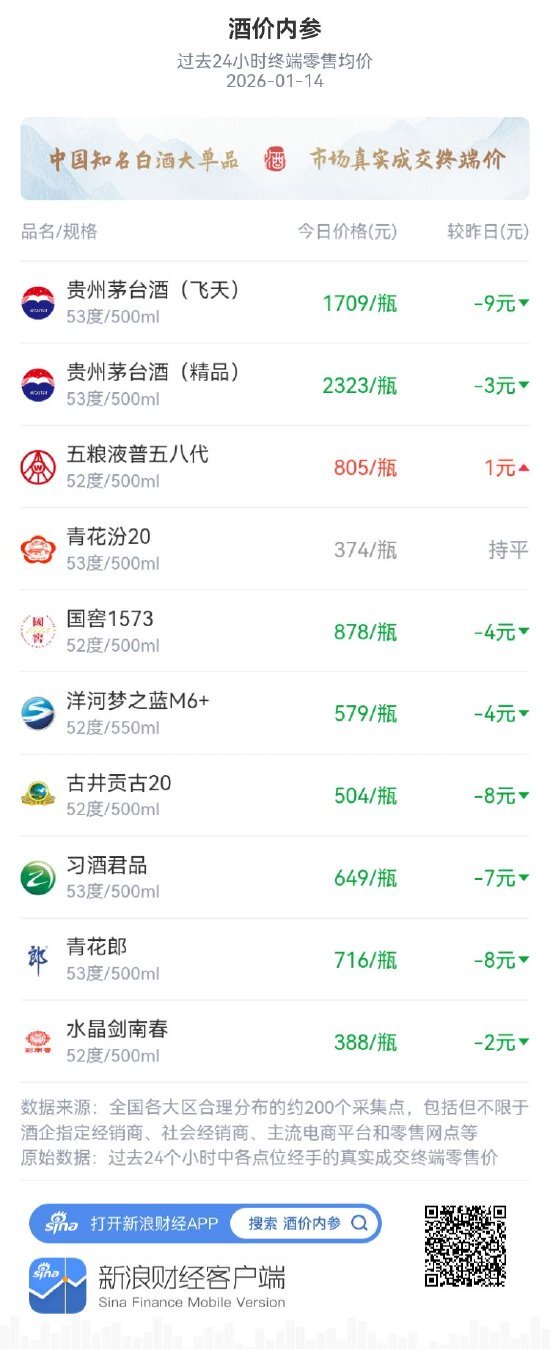
Core Viewpoint - The Chinese liquor market is experiencing a price adjustment, with the average retail price of the top ten liquor products declining, indicating cautious market sentiment [1]. Group 1: Market Price Trends - On January 14, the average retail price of the top ten liquor products decreased by 44 yuan, bringing the total price to 8925 yuan [1]. - Eight out of the ten products saw price declines, with Feitian Moutai leading the drop at 9 yuan per bottle [1]. - Other notable declines include Gujing Gonggu 20 and Qinghua Lang, both down 8 yuan per bottle, while Guojiao 1573 and Yanghe Dream Blue M6+ fell by 4 yuan each [1]. Group 2: Market Dynamics - The market is characterized by a general downward trend, with a narrowing trading volume and a clear differentiation among products [1]. - Only Wuliangye Pu 58th generation saw a slight increase of 1 yuan per bottle, while Qinghua Fen 20 remained unchanged [1]. Group 3: Pricing Mechanism Changes - On January 13, Kweichow Moutai announced a new market-oriented pricing strategy, moving away from fixed factory prices to a dynamic pricing mechanism based on market conditions [3]. - This new pricing system aims to enhance the company's control over retail prices and stabilize the market, allowing for flexible pricing based on product, channel, and operational model differences [3]. - The company is piloting a consignment model for new products, allowing consumers to order online and pick up in-store, aiming for a win-win situation between manufacturers and channels [3].

酒价内参1月14日价格发布 青花郎下跌8元
Xin Lang Cai Jing· 2026-01-14 01:20
Core Insights - The article highlights a recent decline in the retail prices of major Chinese liquor brands, indicating a cautious market sentiment and a general downward trend in prices [1][6]. Price Trends - The average retail price of the top ten Chinese liquor products decreased to 8,925 yuan on January 14, down by 44 yuan from the previous day [1][6]. - Eight out of the ten major products experienced price drops, with Feitian Moutai leading the decline at 9 yuan per bottle [1][6]. - Other notable price decreases include Gujing Gong and Qinghua Lang, both down by 8 yuan per bottle, while Guojiao 1573 and Yanghe Dream Blue M6+ fell by 4 yuan per bottle [1][6]. Market Dynamics - The market is currently characterized by a broad decline in prices, with a notable contraction in trading volume [1][6]. - Only Wuliangye's Pu Wuhai Dai saw a slight increase of 1 yuan per bottle, while Qinghua Fen 20 remained unchanged [1][6]. Data Collection Methodology - The "Wine Price Reference" collects data from approximately 200 sampling points across various regions, including designated distributors, social distributors, e-commerce platforms, and retail outlets [2][7]. - The data aims to provide an objective and traceable representation of the market prices for well-known liquor brands [2][7]. Strategic Changes in Pricing - On January 13, 2026, Kweichow Moutai announced a new market-oriented operational plan, which includes a dynamic pricing mechanism that deviates from the traditional fixed pricing model [3][8]. - This new pricing strategy allows for flexible pricing based on market conditions, enhancing the company's ability to control retail prices and stabilize the market [3][8]. - The company is testing a consignment model where consumers can order online and pick up in-store, aiming for a win-win situation between manufacturers and distributors [3][8].

2026年,白酒行业将进入“降价潮”?
Sou Hu Cai Jing· 2026-01-13 14:06
Group 1 - The core viewpoint is that the recent price adjustments by major liquor companies like Moutai and Wuliangye indicate a significant turning point in the liquor industry, which is currently undergoing deep adjustments [4] - Moutai has reduced the prices of several products, including Moutai 1935 from 798 yuan to 668 yuan and aged Guizhou Moutai (15) from 5399 yuan to 3409 yuan, reflecting a broader trend of price reductions in the industry [3] - Wuliangye plans to adjust its pricing strategy starting in 2026, maintaining a factory price of 1019 yuan while offering a discount of 119 yuan, effectively lowering the invoice price to 900 yuan [3] Group 2 - The liquor industry is facing a "price inversion" crisis, with 60% of liquor companies experiencing this issue, particularly in the 800-1500 yuan price range, leading to a cycle of losses for distributors [4] - The current market conditions, including high inventory and sluggish sales, necessitate proactive price adjustments by liquor companies to reshape the pricing structure and stimulate market activity [4][7] - The anticipated "price reduction wave" is not limited to the liquor industry but is expected to affect various sectors, including automotive and real estate, indicating a broader economic trend [5] Group 3 - Historical precedents show that proactive price adjustments in the liquor industry can lead to increased market activity and expanded market share, as seen during the adjustments from 2013 to 2015 [7] - The current challenges in the liquor industry, such as supply-demand imbalances and inventory pressures, are more complex than in previous years, making it essential for companies to embrace price reductions to rebuild the pricing system [7] - The price adjustments by Moutai and Wuliangye are likely to trigger a broader industry-wide price restructuring, potentially leading to the elimination of smaller, less distinctive liquor brands [7]