WLY(000858)

Search documents
1月13日深证国企ESG(970055)指数跌1.7%,成份股中核科技(000777)领跌
Sou Hu Cai Jing· 2026-01-13 10:53
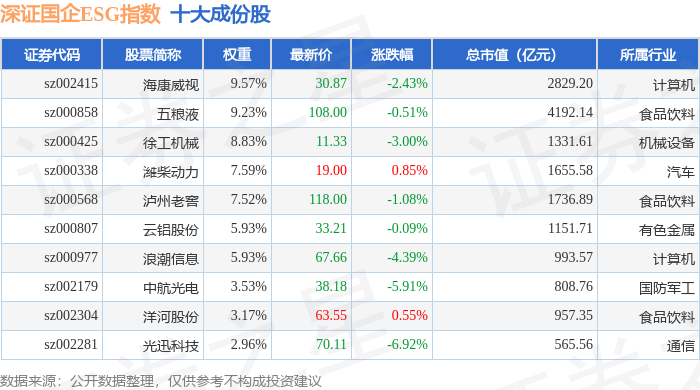
Group 1 - The Shenzhen State-owned Enterprise ESG Index (970055) closed at 1462.82 points, down 1.7%, with a trading volume of 56.526 billion yuan and a turnover rate of 2.08% [1] - Among the index constituents, 9 stocks rose while 40 stocks fell, with Dengkang Dental leading the gainers at a 6.17% increase and China Nuclear Technology leading the decliners at a 9.27% decrease [1] - The top ten constituents of the Shenzhen State-owned Enterprise ESG Index include Hikvision, Wuliangye, and Xugong Machinery, with respective weights of 9.57%, 9.23%, and 8.83% [1] Group 2 - The net outflow of main funds from the index constituents totaled 2.961 billion yuan, while retail investors saw a net inflow of 2.199 billion yuan [1] - Detailed fund flow data indicates that Yunnan Energy Investment and Yanghe Brewery experienced net inflows from retail investors, while major funds showed outflows for several stocks including Yun Aluminum and Wuliangye [2] - The fund flow analysis highlights the varying investor sentiment, with significant retail interest in certain stocks despite overall net outflows from institutional investors [2]






白酒板块1月13日跌0.9%,*ST岩石领跌,主力资金净流出8.17亿元
Zheng Xing Xing Ye Ri Bao· 2026-01-13 09:00
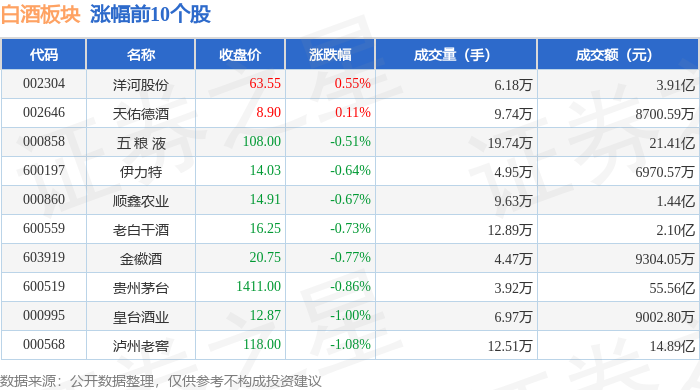
Group 1 - The liquor sector experienced a decline of 0.9% on January 13, with *ST Rock leading the drop [1] - The Shanghai Composite Index closed at 4138.76, down 0.64%, while the Shenzhen Component Index closed at 14169.4, down 1.37% [1] - Major liquor stocks showed mixed performance, with Wuliangye down 0.51% to 108.00 and Moutai down 0.86% to 1411.00 [1] Group 2 - The liquor sector saw a net outflow of 8.17 billion yuan from institutional investors, while retail investors contributed a net inflow of 3.19 billion yuan [2] - The top stocks by net inflow included Wuliangye with a net inflow of 46.20 million yuan from institutional investors, while *ST Rock had a net outflow of 38.73 million yuan [3] - Retail investors showed a preference for stocks like Moutai and Gujing Gongjiu, with net inflows of 15.08 million yuan and 15.08 million yuan respectively [3]




五粮液入选“2025中国企业ESG百强”榜单
Xin Lang Cai Jing· 2026-01-13 05:38
Group 1 - The core viewpoint of the article emphasizes the growing importance of ESG (Environmental, Social, and Governance) as a key metric for high-quality corporate development and a vital link between corporate value and social value [1][2] - The "2025 China ESG Top 100" list was released by Sina Finance, evaluating over 5,000 A-share listed companies and mainland companies listed in Hong Kong using 18 industry-specific ESG evaluation models and over 150 ESG indicators [1][9] - The list serves as a benchmark for industry development and provides valuable decision-making references for investors [1][2] Group 2 - Wuliangye, recognized for its outstanding ESG performance, ranked 53rd on the "2025 China ESG Top 100" list, highlighting its commitment to sustainable development practices [2][6] - The publication of the list not only acknowledges the sustainable practices of the listed companies but also conveys the core values of ESG to the entire industry [2] - Companies are encouraged to integrate ESG principles deeply into their strategic planning, operations, and supply chain collaboration to achieve a win-win situation between commercial and social value [2] Group 3 - The ESG rating system by Sina Finance is based on over 140 indicators for quantitative evaluation of corporate ESG performance, forming a comprehensive ESG ranking [9] - The Sina Finance ESG Rating Center aims to promote sustainable development and responsible investment, establishing a platform for ESG practices and standards in China [10]

酒价内参1月13日价格发布,飞天茅台
Xin Lang Cai Jing· 2026-01-13 01:33
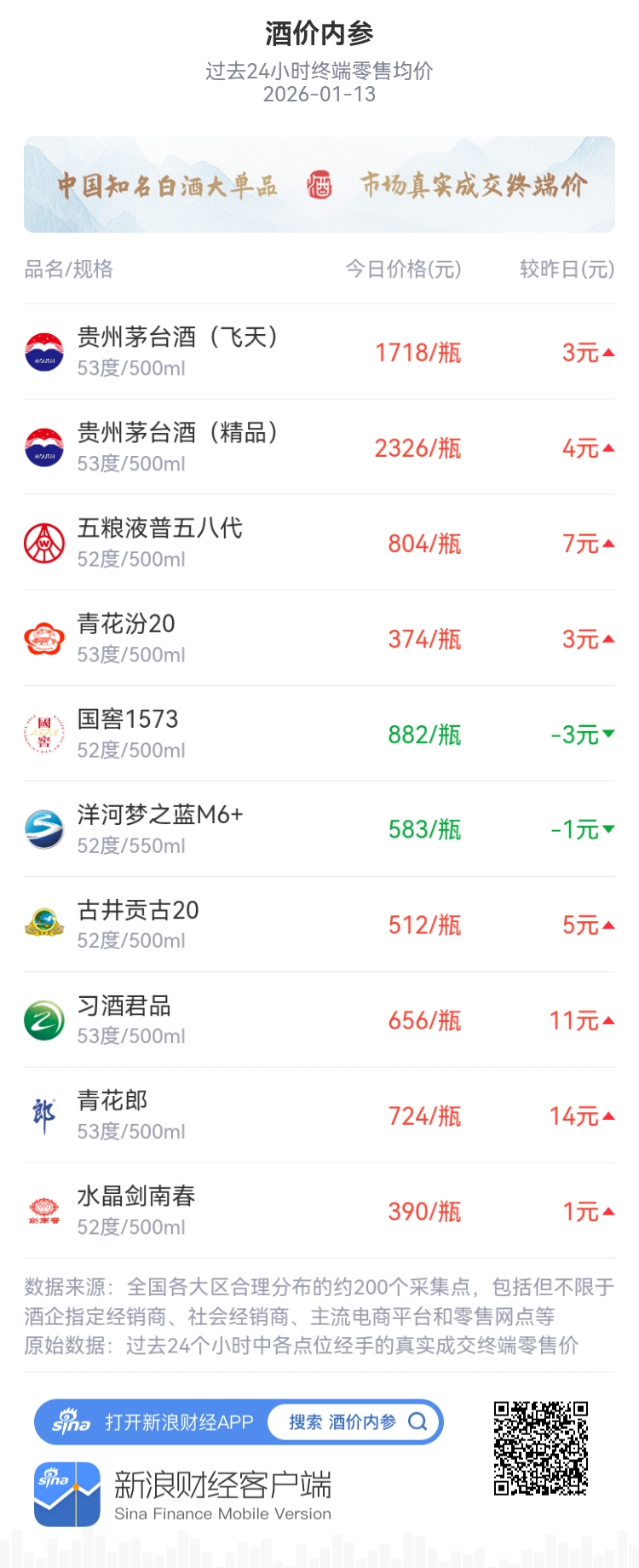
新浪财经"酒价内参"过去24小时中收集的数据显示,中国白酒市场十大单品的终端零售均价在1月13日 迎来普遍反弹,整体价格显著回升。如果十大单品各取一瓶整体打包售卖,今日总售价为8969元,较昨 日上涨44元。市场在连续探底后情绪明显回暖,价格中枢获得放量支撑。 来源:酒业内参 | 五粮液普五八代 | 804/瓶 | 7元 | | --- | --- | --- | | 52度/500ml | | | | 青花汾20 | 374/瓶 | 3元 | | 53度/500ml | | | | 国窖1573 52度/500ml | 882/瓶 | -3元 | | +27梦之蓝M6+ | 583/瓶 | -1元▼ | | 52度/550ml | | | | 古井贡古20 52度/500ml | 512/瓶 | 5元- | | 习潜着词 53度/500ml | 656/瓶 | 11元- | | 青花郎 53度/500ml | 724/瓶 | 14元- | | 水晶剑南春 | | | | 52度/500ml | 390/瓶 | 1元 | 数据来源:全国各大区合理分布的约200个采集点,包括但不限于 酒企指定经销商、社会经销商 ...
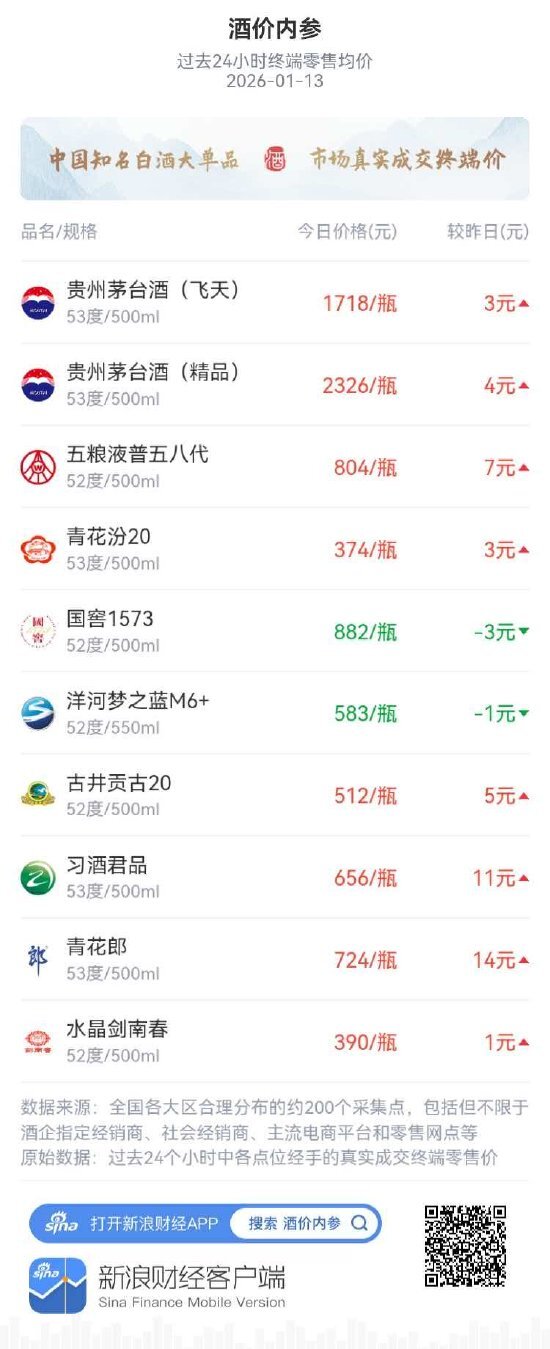
酒价内参1月13日价格发布 市场普涨反弹整体价格显著回升
Xin Lang Cai Jing· 2026-01-13 01:09
Core Viewpoint - The Chinese liquor market has experienced a significant rebound in retail prices for the top ten products, indicating a recovery in market sentiment after a period of decline [1]. Price Trends - The overall retail price for the top ten liquor products reached 8969 yuan, an increase of 44 yuan from the previous day [1]. - The market showed a broad upward trend, with most core products experiencing price increases, reflecting restored market confidence [1]. Individual Product Performance - Qinghua Lang saw the most substantial increase, rising by 14 yuan per bottle [1]. - Xijiu Junpin increased by 11 yuan per bottle, showing a strong rebound [1]. - Wuliangye Pu 58th generation ended its decline with a price increase of 7 yuan per bottle [1]. - Gujing Gonggu 20 rose by 5 yuan per bottle, while Jingpin Moutai increased by 4 yuan per bottle [1]. - Feitian Moutai and Qinghua Fen 20 both saw a rise of 3 yuan per bottle [1]. - The only products that experienced price declines were Guojiao 1573, which fell by 3 yuan, and Yanghe Dream Blue M6+, which decreased by 1 yuan [1][4]. Market Data Sources - The data was collected from approximately 200 points across major regions, including designated distributors, social distributors, mainstream e-commerce platforms, and retail outlets [4].

酱酒品牌剩者为王,大众品重视春节催化:食品饮料行业周报(20260105-20260111)-20260112
Huachuang Securities· 2026-01-12 11:12
Investment Rating - The report maintains a "Recommendation" rating for the food and beverage industry, indicating an expected increase in the industry index exceeding the benchmark index by more than 5% in the next 3-6 months [26]. Core Insights - The report emphasizes that the remaining brands in the sauce liquor sector will thrive, while mass-market products are expected to benefit from the upcoming Spring Festival [2][8]. - The dairy sector is showing signs of improvement, with a potential rebound in raw milk prices and a narrowing supply-demand gap, which could lead to increased demand for processed dairy products [6]. - The beverage and snack categories are experiencing sustained growth, with specific segments like energy drinks and konjac snacks showing remarkable sales increases despite overall declines in the snack market [6]. - The report highlights a significant shift in the sauce liquor industry, where pricing strategies are becoming more pragmatic, with a new growth level emerging around the 200 yuan price point as lower-tier brands face market exit pressures [6][8]. - The report suggests that leading liquor companies should maintain operational stability during this industry downturn, focusing on balanced investments in base liquor to prepare for future market recovery [8]. Summary by Sections Industry Overview - The food and beverage sector consists of 126 listed companies with a total market capitalization of 44,935.30 billion yuan, representing 3.54% of the market [3]. - The circulating market value stands at 43,859.19 billion yuan, accounting for 4.28% of the total market [3]. Performance Metrics - The absolute performance of the industry over the past month is 1.3%, with a relative performance decline of 2.2% compared to the benchmark [4]. - Over the past 12 months, the industry has seen a relative performance decline of 25.2% [4]. Sector-Specific Insights - Dairy products are expected to benefit from a favorable pricing environment and improved supply dynamics, with major companies actively preparing for the Spring Festival [6]. - The beverage sector is witnessing growth in specific categories, with leading brands launching targeted marketing campaigns for the holiday season [6]. - The sauce liquor market is undergoing a consolidation phase, with a focus on brand strength and market share recovery among leading companies [6][8].



白酒板块1月12日涨0.79%,*ST岩石领涨,主力资金净流入4.03亿元
Zheng Xing Xing Ye Ri Bao· 2026-01-12 09:04
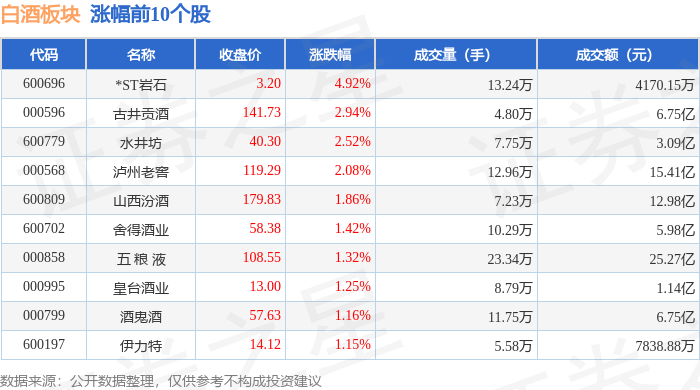
Core Viewpoint - The liquor sector experienced a rise of 0.79% on January 12, with *ST Rock leading the gains, while the Shanghai Composite Index rose by 1.09% and the Shenzhen Component Index increased by 1.75% [1] Group 1: Market Performance - The closing price of *ST Rock was 3.20, with a gain of 4.92% and a trading volume of 132,400 shares, amounting to 41.70 million yuan [1] - Gujing Gongjiu closed at 141.73, up 2.94%, with a trading volume of 48,000 shares and a transaction value of 675 million yuan [1] - Luzhou Laojiao closed at 119.29, increasing by 2.08%, with a trading volume of 129,600 shares and a transaction value of 1.54 billion yuan [1] Group 2: Capital Flow - The liquor sector saw a net inflow of 403 million yuan from main funds, while retail investors experienced a net outflow of 29.32 million yuan [1] - Wuliangye had a main fund net inflow of 267 million yuan, but retail funds saw a net outflow of 87.06 million yuan [2] - Luzhou Laojiao recorded a main fund net inflow of 85.62 million yuan, with retail funds experiencing a net outflow of 34.07 million yuan [2]


翻倍牛股股票遭法拍!知名白酒经销商成被执行人
证券时报· 2026-01-12 07:27
Core Viewpoint - The article discusses the upcoming judicial auction of shares held by Yibin Zhiyi Liquor Co., Ltd. in A-share company Mengsheng Electronics, highlighting potential arbitrage opportunities due to the difference between the auction starting price and the market value of the shares [3][5]. Group 1: Company Overview - Yibin Zhiyi Liquor Co., Ltd. was established in 2001 with a registered capital of 50 million yuan, and its shareholders include Li Songtao, Liu Nan, and Zhang Chunyi [6]. - The company was once a well-known liquor distributor and has made significant donations to educational institutions, including over 1,000 boxes of liquor to universities [6]. Group 2: Financial Situation - Zhiyi Liquor has faced severe operational crises in recent years, with numerous lawsuits and a total amount involved in execution reaching nearly 200 million yuan [3][12]. - The company was listed as an executed person by the Chengdu Intermediate People's Court in May 2022, with an execution amount of 367 million yuan [12][14]. Group 3: Shareholding and Investment - Zhiyi Liquor's investment in Mengsheng Electronics began in 2019, with a cumulative investment of approximately 50 million yuan, and it held 2.9656 million shares at the time of the company's IPO [9]. - Following a stock split in 2022, Zhiyi Liquor's holdings increased to 4.1518 million shares, with a current market value exceeding 240 million yuan [9]. Group 4: Auction Details - The judicial auction for the shares is set to take place from January 23 to January 24, with a starting price of 87.4369 million yuan and a market valuation of 105 million yuan [5]. - As of now, there have been no registrations for the auction [5]. Group 5: Market Performance - Mengsheng Electronics has been performing well in the market, with its stock price increasing by over 90% since late November of the previous year [7].


翻倍牛股股票遭法拍,知名白酒经销商成被执行人
Zheng Quan Shi Bao· 2026-01-12 04:57
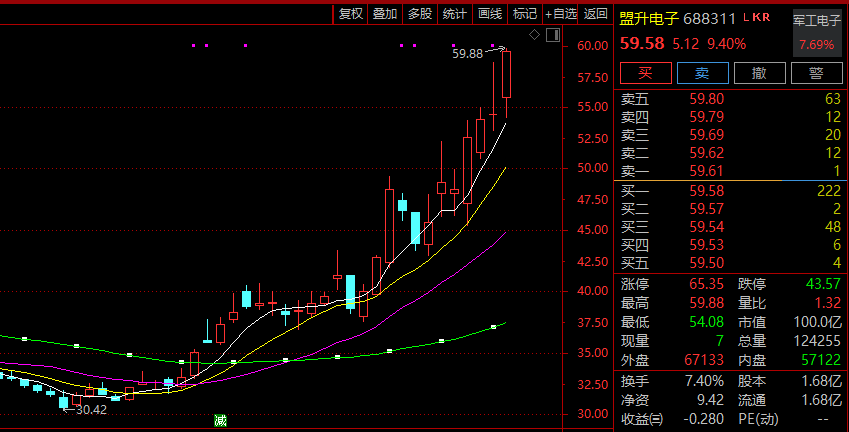
Core Viewpoint - The judicial auction of 2,965,600 shares of Alliance Electronics (688311) held by Yibin Zhiyi Liquor Co., Ltd. is set to begin, with a starting price of 87.4369 million yuan and a market valuation of 105 million yuan, indicating potential arbitrage opportunities due to the current market value exceeding 174 million yuan [1][3]. Group 1: Company Background - Yibin Zhiyi Liquor Co., Ltd. was established in 2001 with a registered capital of 50 million yuan, primarily engaged in the sales and services of products like Wuliangchun liquor [4]. - The company has a history of significant charitable contributions, including donations of over 1,000 boxes of liquor to universities and a total of more than 400,000 yuan in scholarships since 2007 [4]. Group 2: Financial Situation - Yibin Zhiyi Liquor has faced severe operational crises in recent years, accumulating debts and becoming a defendant in multiple lawsuits, with total amounts involved nearing 200 million yuan [1][12]. - The company was listed as a defendant by the Chengdu Intermediate People's Court in May 2022, with an execution amount of 367 million yuan, and was later included in the tax non-compliance list due to tax arrears [11][12]. Group 3: Investment History - The company initially invested approximately 50 million yuan in Alliance Electronics starting in 2019, holding 2,965,600 shares at the time of the IPO, which had a market value of about 123 million yuan based on the initial offering price [7]. - Following a stock split in 2022, the company's holdings increased to 4,151,800 shares, with a current market value exceeding 240 million yuan, although all shares have been frozen [7]. Group 4: Market Performance - Alliance Electronics has been performing well in the market, with its stock price increasing by over 90% since late November of the previous year [5].
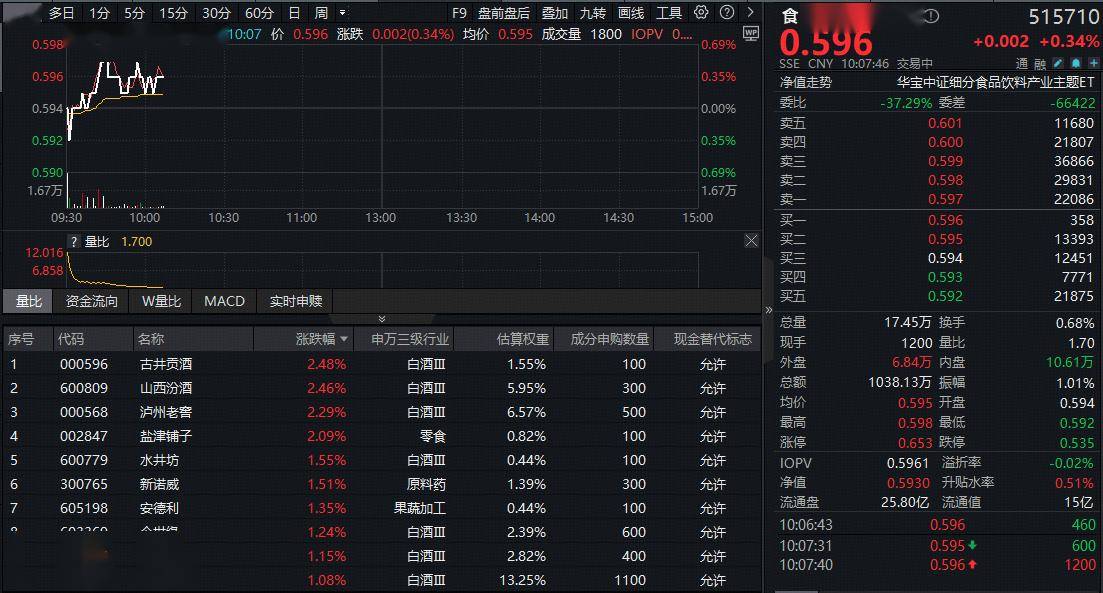
ETF盘中资讯|“i茅台”成交用户超40万!“茅五泸汾洋”集体上攻,机构喊话白酒配置机会!
Sou Hu Cai Jing· 2026-01-12 02:33
Group 1 - The food and beverage sector is experiencing an upward trend, with the Huabao Food and Beverage ETF (515710) showing a price increase of 0.34% as of the report time [1] - Major liquor stocks such as Shanxi Fenjiu, Luzhou Laojiao, and Gujing Gongjiu have surged over 2%, while Wuliangye and Yanghe have increased by more than 1% [1] - Kweichow Moutai has implemented a strategy to stabilize the market by directly reaching consumers through its iMoutai platform, which has gained over 2.7 million new users [1] Group 2 - Guizhou Moutai's recent dealer communication emphasized three principles: preventing speculation, adapting supply and demand, and stabilizing the market [2] - The current valuation of the food and beverage sector is at a historical low, with the PE ratio of the Huabao ETF at 20.16, indicating a favorable entry point for investors [2] - The white liquor industry is expected to reach a turning point as major companies like Moutai and Wuliangye implement market strategies ahead of the Spring Festival [3] Group 3 - The iMoutai platform's launch of the full range of Moutai products is expected to stabilize prices and improve market management [3] - The Huabao Food and Beverage ETF primarily invests in leading high-end and mid-range liquor stocks, with significant allocations to brands like Moutai, Wuliangye, and Luzhou Laojiao [3] - Investors can also consider the Huabao Food and Beverage ETF linked fund for exposure to core assets in the food and beverage sector [3]